

The brands that win on price comparison platforms are rarely the cheapest. They are the ones with the most complete product data, the most verified reviews, and the clearest specifications. Price is just the starting point.
Online shopping has changed dramatically over the last decade. With thousands of stores and millions of products available online, comparing prices manually has become almost impossible. This is where E‑Catalog comes in — a powerful price aggregation platform designed to help shoppers quickly find the best deals, compare products, and make informed purchasing decisions.
Unlike traditional comparison websites that simply list prices, E-Catalog goes much further. The platform combines structured product data, real-time store listings, expert reviews, and user feedback. This allows consumers to see not only which store offers the lowest price, but also which product best fits their needs.
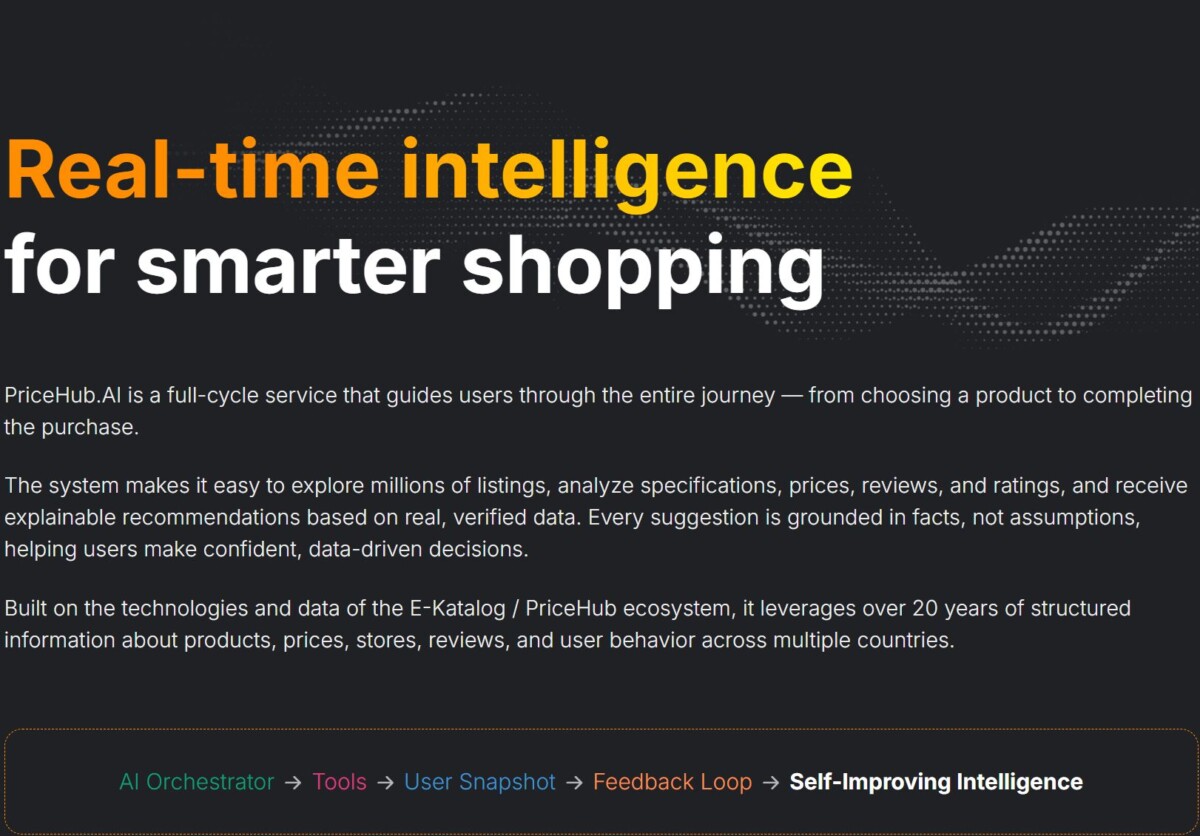
A key innovation inside E-Catalog is the integration of intelligent recommendation technology developed by PriceHub.AI. Instead of forcing users to manually analyze hundreds of models, the system can help narrow down the best options automatically.
The AI engine evaluates multiple data points simultaneously:
The result is a smart product shortlist tailored to the shopper. According to the platform, recommendations are grounded in verified product databases and real market prices rather than generic internet information.
One of the biggest challenges for online shoppers is information overload. A single search for a smartphone, laptop, or camera may generate hundreds of models with similar features. E-Catalog solves this by organizing products into detailed comparison tables where users can filter by price, brand, performance, battery life, display type, and many other parameters.
The smart system inside PriceHub.AI continuously analyzes structured product information collected over more than two decades of market monitoring. The technology connects specifications, prices, reviews, and compatibility data to generate transparent recommendations that are easy to understand.
Another advantage of E-Catalog is its ability to track price changes across multiple online stores. Because listings are updated regularly, users can compare offers and identify the most competitive deals available at that moment.
This real-time synchronization ensures that shoppers see current prices rather than outdated listings. As a result, consumers save both time and money while retailers benefit from increased visibility.
Price comparison platforms are evolving from simple search tools into intelligent shopping assistants. With the integration of PriceHub.AI, E-Catalog represents the next step in this evolution.
Instead of opening dozens of tabs and reading countless reviews, users can rely on AI-powered insights that transform complex data into clear purchasing guidance. The result is a faster, smarter, and more transparent shopping experience.
For anyone looking to compare products, discover the best deals, and choose the right model with confidence, E-Catalog offers one of the most advanced solutions in modern online retail.
E-Katalog is an independent price aggregation platform founded in 2001 that serves millions of users monthly across Ukraine, Poland, the US, and the UK. Unlike Google Shopping, which integrates with Google Ads and gives preferential placement to paid listings, E-Katalog presents all retailer offers equally based on price competitiveness and product relevance. Its integration with PriceHub.AI adds an intelligent recommendation layer that evaluates specifications, reviews, and compatibility data to help shoppers narrow down options, rather than simply sorting by price. For merchants, the distinction matters because visibility on E-Katalog is earned through data quality and price competitiveness, not advertising spend.
PriceHub.AI draws on a structured product database built across more than 20 years of catalog development, covering specifications, model generations, compatibility relationships, and historical price data. The AI engine evaluates this structured data alongside real-time store listings, expert reviews, user feedback, and browsing context to generate a shortlist of genuinely relevant products. Recommendations are directly linked to live listings at current prices, not to theoretical or outdated product information. The system is designed to produce logical conclusions rather than random suggestions because it is reasoning from structured knowledge rather than unstructured web content.
Yes, particularly if you sell in categories where consumers research before buying, such as electronics, home appliances, sporting goods, or tools. These platforms influence purchase decisions before shoppers ever reach your store. Merchants with complete product data, competitive pricing, and verified reviews are surfaced more favorably by AI recommendation engines. Merchants with incomplete listings or above-market pricing are filtered out before the shopper even considers clicking through. Auditing your presence on major comparison platforms every 90 days is a basic competitive hygiene practice that most merchants at the $100K to $1M range have not yet built into their workflow.
An independent comparison platform presents retailer offers without distorting results based on advertising relationships or affiliate commission rates. E-Katalog explicitly positions itself this way, meaning a merchant with a genuinely competitive price and complete product data can surface alongside or above larger retailers without paying for placement. This is structurally different from platforms where sponsored listings dominate the top positions. For smaller Shopify merchants competing against larger brands with bigger ad budgets, independent comparison platforms represent one of the few contexts where product quality and price competitiveness can win on a level playing field.
Four things move the needle most: complete and accurate product specifications, real-time pricing that reflects your actual current price, verified customer reviews from genuine purchasers, and consistent stock availability. AI recommendation engines deprioritize listings with incomplete data because they cannot generate confident recommendations from partial information. Start by auditing your product data completeness on the platforms where your category is most active. Then build a systematic review generation process into your post-purchase flow. Finally, ensure your pricing feeds are updated in real time rather than on a manual or daily batch schedule. Merchants who treat product data as a competitive asset rather than an operational chore see meaningfully better placement over a 60 to 90 day period.





