





Quick Decision Framework
- Who This Is For: Shopify sellers doing $5K to $200K per year in custom or branded apparel, accessories, or merchandise who currently rely on third-party print-on-demand services and want to reclaim margin and production speed.
- Skip If: You sell non-printable products, you consistently move 500-plus units per design and screen printing is already more cost-effective for your volume, or you have zero space for a small production setup.
- Key Benefit: Bring your cost per print down to $1.05 to $1.95, capture 74 to 80% gross margins per unit, and fulfill same-day instead of waiting 5 to 10 business days for a third-party fulfillment partner.
- What You’ll Need: A Windows PC with at least 8GB RAM and 50GB free storage, a small dedicated workspace (the K13 Lite printer footprint is 29 by 13 inches), and blank garments or substrates to print on.
- Time to Complete: 15 minutes to read this article. Setup and first print: 2 to 4 hours. Break-even on equipment: 1 to 3 months with consistent daily volume.
The merchants I see stuck at $150K per year almost always have the same problem: they are paying someone else to manufacture their product, one unit at a time, at a margin that leaves nothing for growth. The ones breaking through to $500K have usually figured out how to own at least one part of their production stack.
What You’ll Learn
- Why the DTF printing market is growing at nearly 29% annually and what that means for your competitive window right now.
- How to calculate the real ROI of owning your own DTF printer, including break-even timelines and per-unit margin at different daily volumes.
- Which use cases generate the highest returns across Shopify, Amazon, Etsy, and local markets.
- What the complete DTF workflow actually looks like, including what the oven does and why it matters for print quality.
- How in-house DTF production changes your speed to market, design testing capability, and long-term positioning as a brand.
Third-party print-on-demand services like Printful, Printify, and Gelato built their businesses on one simple premise: most sellers would rather pay a premium per unit than deal with production. For a long time, that was the right trade. Low volume, uncertain demand, no space, no time. Outsourcing made sense.
But something has shifted. The custom apparel market has matured. Shopify sellers who started with zero-inventory POD models are now running real brands with predictable monthly demand. And they are starting to notice something uncomfortable: the fulfillment partner that got them started is now the ceiling on their margins. Every shirt that goes out the door at $25 cost $8 to $12 to produce through a third party. The math works until it doesn’t.
Direct-to-film printing has changed the calculus. DTF technology lets you print full-color, photo-quality transfers onto virtually any fabric or substrate, then heat-press them onto finished goods in minutes. The process is faster than direct-to-garment, works on cotton and polyester blends without pre-treatment, and produces prints that are wash-durable and vibrant. More importantly for Shopify operators, it is now accessible at a price point that makes in-house production genuinely viable for stores doing as few as 10 to 15 units per day.
The Market Opportunity Is Real and the Window Is Open Now
The global DTF printing market was valued at $2.72 billion in 2024, according to Grand View Research’s industry report on direct-to-film printing, and is projected to reach $3.92 billion by 2030. That is a 6% compound annual growth rate for the hardware segment alone. Inside the broader print-on-demand market, which Mordor Intelligence estimates at $15.19 billion in 2026 and $46.43 billion by 2031, DTF is the fastest-growing production method with a segment CAGR of 28 to 29%. Direct-to-garment, the older technology most third-party services still rely on, is growing at 4.4%.
More than 7.2 billion DTF prints were produced globally in 2024, a 30% increase from the prior year. North America accounts for 40% of the print-on-demand market, and Shopify powers an estimated 62 to 63% of all POD stores. Marketplaces including Amazon, Etsy, and eBay drive 59.7% of POD revenue, which means the channels where DTF-produced goods sell best are the same channels your store is likely already using.
The window that matters here is not just market size. It is competitive timing. Most of your direct competitors in the custom apparel space are still outsourcing production. They are constrained by 5 to 10 business day fulfillment windows, minimum order requirements, and per-unit costs that prevent them from competing aggressively on price. Sellers who bring production in-house now, while the equipment is still affordable and the skill gap is still meaningful, will have a structural cost advantage that compounds over time. Understanding how print on demand compares to dropshipping as a business model helps clarify why owning production is the next logical step once you have validated demand.
The ROI Math That Changes the Decision
The core financial case for in-house DTF production is straightforward, and the numbers hold up under scrutiny. A standard 8.5 by 11 inch full-color DTF print costs $1.05 to $1.95 in materials, including film, ink, adhesive powder, and electricity. That cost is consistent whether you print one shirt or one hundred. There are no setup fees, no color separations, no minimum runs.
At a retail price of $25 per shirt and a blank cost of $5, your per-unit gross profit is $18.50 at 74% margin. That margin holds at 10 units per day and at 500 units per day. Compare that to the economics of outsourcing: a comparable shirt through a major POD service costs $12 to $16 landed before shipping, leaving you $4 to $8 per unit at a 16 to 32% margin. The difference is not incremental. It is structural.
Break-even on an entry-level DTF setup depends on daily volume. At 10 shirts per day with a $5 profit per unit after materials (a conservative estimate), you generate $1,500 per month in gross profit from the printer. At 50 shirts per day, that number reaches $7,500 per month. A complete entry-level setup including printer, oven, and consumables runs $2,826 to $3,957 USD depending on the bundle. At 10 shirts per day, you break even in 2 to 3 months. At 30 shirts per day, you break even in 3 to 4 weeks.
The ROI calculation changes further when you factor in what in-house production enables beyond margin: same-day fulfillment for premium pricing, design testing without minimum order risk, and the ability to offer genuine customization at scale. Those are capabilities that third-party services cannot replicate regardless of price. Using a margin calculator to stress-test your pricing before you commit is worth doing, because the real question is not whether the margin is better. It is whether your current volume justifies the capital outlay and how quickly you can grow into it.
What the DTF Workflow Actually Looks Like
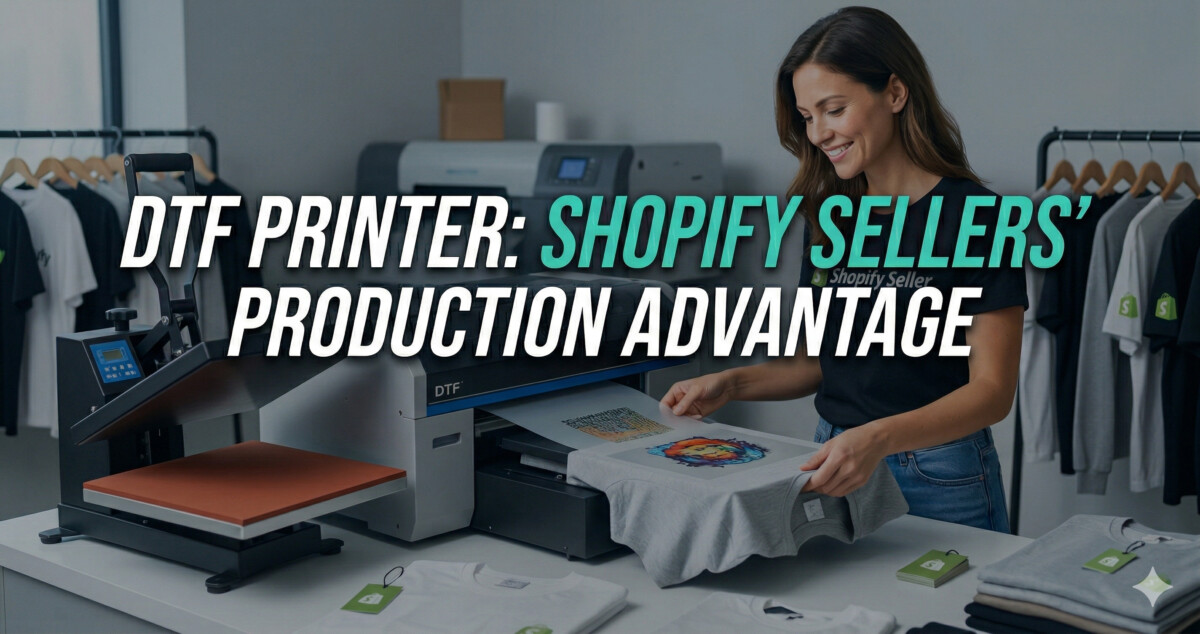
Understanding the production process matters because it directly affects how you evaluate equipment and what the setup actually requires. DTF printing is a three-stage process: print, cure, transfer.
In the print stage, your design is sent from design software to the DTF printer, which prints the image onto a special PET film using CMYK inks plus white ink. The white ink layer is critical because it provides the base that makes colors vibrant on dark fabrics. Without it, the print would be transparent on anything other than white material. The K13 Lite uses a white ink circulation system that runs every 30 minutes to prevent sedimentation, which is one of the most common failure points on cheaper DTF setups.
In the cure stage, adhesive hot-melt powder is applied to the wet ink on the film, then the film passes through an oven that melts the powder into the ink layer. This creates the bonding layer that will adhere to the fabric during heat transfer. The oven is not optional. It is a required part of the workflow, which is why bundle configurations that include the oven are the practical choice for anyone setting up a production operation rather than just experimenting. The smokeless oven variant matters specifically for home-based and small-office setups, where fumes from a standard DTF oven would be a real problem.
In the transfer stage, the cured film is placed on the garment or substrate and pressed with a heat press at the appropriate temperature and pressure for 15 to 20 seconds. The film peels away and the design is permanently bonded to the fabric. The entire process from print to finished shirt takes 15 to 25 minutes at entry-level speeds, and the output is wash-durable, stretch-resistant, and works on cotton, polyester, canvas, denim, and most fabric blends.
For Shopify operators specifically, the workflow integrates directly with your existing design assets. If you already have product mockups and design files, you can be printing production-ready transfers on day one. The learning curve is real but manageable, and it is significantly shorter than screen printing or sublimation.
The Procolored K13 Lite: What Makes It the Entry Point Worth Discussing
Procolored is not a generic white-label brand. The company was founded in 2018 in Shenzhen, holds 100-plus patents in product technology and design, operates a US support presence in Pico Rivera, California, and reported monthly sales exceeding $1 million by the end of 2023. They have helped more than 30,000 startups get into the DTF business, and their product lineup covers the full range from beginner to industrial production.
The Procolored K13 Lite DTF Printer bundle is their most popular configuration for a reason. The bundle includes the 13-inch A3 printer with LiteHead technology, the Smokeless Oven for curing, a full ink set (CMYK plus white), adhesive powder, 100 meters of PET roll film, and Procolored Studio Lite software. Everything you need to print on day one ships in one order.
Several features distinguish this setup from cheaper alternatives. The Infrared Printhead SafeGuard System detects film warping and debris as small as 2mm in real time, reducing the most common printhead failures by 90%. The automated cleaning cycle runs every 10 hours to prevent white ink clogging, which is the maintenance problem that kills most entry-level DTF setups within the first few months. G7 certified color accuracy means what you see on screen is what you get on fabric, which matters enormously when you are fulfilling orders for customers who have approved a specific design. The printer handles a maximum print width of 13 inches and a maximum print length of 118 inches, which covers the full range of standard apparel and accessory applications.
At a print speed of 5 A4 sheets per hour, the K13 Lite is positioned for small-batch to medium-volume production. It is not an industrial press. It is a serious entry-level setup designed for sellers doing 10 to 50 units per day who want professional output without industrial infrastructure. The 6-month printhead warranty with one free replacement gives meaningful protection on the most expensive consumable component.
Use Cases Where In-House DTF Production Wins
The strongest use cases for in-house DTF production share a common characteristic: they involve either short runs, frequent design changes, or premium customization that third-party services handle poorly or expensively.
For Shopify stores, the highest-value application is design testing. When you outsource production, testing a new design means committing to a minimum order or paying premium per-unit prices on small batches. With in-house DTF, you can print one shirt to validate a design before adding it to your store. This changes how you manage your product catalog. You can run 20 design tests in a month for the same cost that outsourcing a 10-unit test run would require. The stores I have seen scale fastest in the custom apparel space are relentless design testers. In-house production is what makes that economically viable.
For marketplace sellers on Amazon, Etsy, and eBay, DTF opens up genuine made-to-order customization at a margin that makes the business model work. Personalized products consistently command 20 to 40% price premiums on Etsy and Amazon Handmade. With outsourced production, that premium gets consumed by per-unit costs. With in-house production, it goes directly to gross margin. The combination of marketplace traffic and in-house fulfillment is where serious custom apparel businesses are being built right now.
For local and B2B revenue streams, DTF is particularly strong. Sports teams, schools, corporate apparel orders, and event merchandise are all repeat-purchase categories with 65 to 75% margins and customers who are not price-sensitive in the same way consumer ecommerce shoppers are. A single corporate apparel account doing $2,000 per month can pay for the equipment in two months. These revenue streams do not require a Shopify store at all, which means they can run in parallel with your existing ecommerce operation and diversify your revenue base. Understanding how to structure your selling channels from the start makes it easier to capture multiple revenue streams from the same production setup.
Pinterest and TikTok deserve specific mention because both platforms have become meaningful discovery channels for custom apparel. DTF-produced goods photograph well, the production process itself is compelling short-form content, and the ability to offer genuinely unique designs gives you something to show that mass-market competitors cannot replicate. Sellers building audiences on these platforms and converting them through Shopify are among the fastest-growing custom merchandise brands right now.
The Production Advantage That Compounds Over Time
The financial case for in-house DTF production is compelling on its own. But the more durable advantage is operational. When you control your production, you control your fulfillment speed, your quality consistency, and your ability to respond to demand signals in real time.
Third-party POD services have gotten better, but they still operate on their timeline, not yours. A spike in demand during a product launch or a seasonal moment means waiting for their capacity to free up. With in-house production, a demand spike is an opportunity to fulfill faster than any competitor who is still waiting on a fulfillment partner. Same-day and next-day fulfillment on custom products is a genuine competitive differentiator that customers notice and pay for.
Quality control is the other compounding advantage. When you print in-house, you see every transfer before it goes on a garment. You catch color drift, film warping, and adhesion issues before they become customer complaints and returns. Most POD sellers have experienced the frustration of a fulfillment partner shipping a bad batch and having no visibility into the problem until the reviews start coming in. In-house production eliminates that dependency entirely.
The Shopify profit and loss framework I use with operators consistently shows that the brands with the healthiest long-term margins are the ones who have identified at least one part of their cost stack where they can own the economics rather than rent them. For custom apparel sellers, DTF production is that opportunity. The equipment is accessible, the workflow is learnable, and the margin improvement is immediate and permanent.
The question is not whether in-house DTF production makes financial sense. For sellers doing consistent custom apparel volume, it clearly does. The question is whether the timing is right for your business, and whether the capital outlay fits your current cash position and growth trajectory. If you are doing 10 or more custom apparel orders per day and relying on a third-party service, the answer is almost certainly yes.
Frequently Asked Questions
What is DTF printing and how is it different from regular print on demand?
DTF stands for Direct-to-Film. Instead of printing a design directly onto a garment like direct-to-garment (DTG) does, DTF prints the design onto a special PET film, applies adhesive powder, cures it through an oven, then heat-presses the finished transfer onto the fabric. The key differences are that DTF works on nearly any fabric type including polyester blends without pre-treatment, produces more vibrant colors on dark garments, and is significantly cheaper per print than DTG at comparable quality levels. Standard third-party POD services typically use DTG or screen printing. In-house DTF gives you the same or better output quality at 60 to 80% lower per-unit cost.
How much does it actually cost to print a shirt with a DTF setup?
For a standard full-color 8.5 by 11 inch design, your material cost runs $1.05 to $1.95 per print, covering film, ink, adhesive powder, and electricity. Add a $4 to $6 blank shirt and your total cost of goods is $5 to $8 per finished unit. At a typical retail price of $22 to $28 for a custom tee, your gross margin is 70 to 78%. That compares to 16 to 32% gross margin when outsourcing the same shirt through a major POD service. The material cost stays consistent regardless of order size, which means DTF is equally profitable on a single unit and a 100-unit order.
What do I need to set up a DTF printing operation at home or in a small office?
You need the DTF printer itself, a curing oven (sold separately or as a bundle), a heat press, blank garments or substrates, and design software. A Windows PC with at least 8GB RAM and 50GB of free storage is required for the RIP software that most DTF printers use. For space, the printer footprint is roughly 29 by 13 inches and the oven adds a comparable footprint. A dedicated table or workbench in a spare room or garage is sufficient. The smokeless oven variant is important for enclosed spaces because standard DTF ovens produce fumes during the curing process. Total startup cost for a complete entry-level setup runs $2,800 to $4,500 depending on bundle configuration and heat press quality.
How long does it take to break even on a DTF printer investment?
Break-even depends entirely on your daily production volume and the margin differential between in-house and outsourced production. At 10 shirts per day with a $5 net profit per unit improvement over outsourcing, you generate approximately $1,500 per month in additional gross profit. On a $3,000 equipment investment, that is a 2-month break-even. At 30 shirts per day, break-even comes in 3 to 4 weeks. Most operators with consistent demand report breaking even within 1 to 3 months. The variable that matters most is not the equipment cost but how quickly you can ramp daily production volume to a level that justifies the investment.
Can I use a DTF printer to sell on Shopify, Amazon, Etsy, and eBay at the same time?
Yes, and this is one of the strongest arguments for in-house production. When you control your own DTF setup, you can fulfill orders from any channel without depending on a third-party service’s integration or capacity. Marketplaces including Amazon Handmade, Etsy, and eBay collectively drive nearly 60% of print-on-demand revenue, and personalized products on these platforms command 20 to 40% price premiums. In-house DTF lets you capture that premium without the per-unit cost eating the margin. You manage one production operation and route orders from any channel through it. The only practical limit is your daily print capacity, which scales as your volume grows.
