





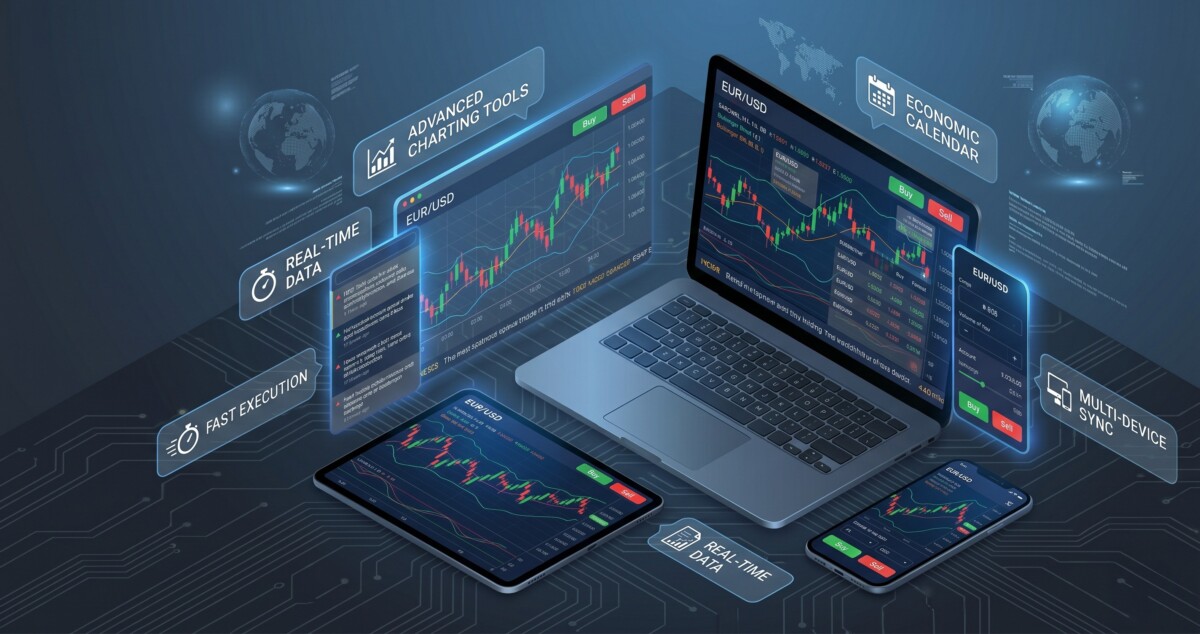
Quick Decision Framework
- Who This Is For: Retail traders and aspiring day traders evaluating forex platforms for the first time, or reconsidering their current broker after experiencing slippage, high fees, or platform instability.
- Skip If: You are an institutional trader or already have a multi-year relationship with a regulated broker whose performance you have verified through real trading data.
- Key Benefit: A clear framework for evaluating the five platform features that most directly affect daily trading outcomes, so you can make a decision based on what actually matters rather than marketing claims.
- What You’ll Need: A list of currency pairs you plan to trade, your approximate daily trade volume, and 20 minutes to compare platform specs against the criteria in this article.
- Time to Complete: 8-minute read. Platform comparison and account setup: 30 to 60 minutes depending on broker verification requirements.
What You’ll Learn
- Why order execution speed is the single highest-leverage platform feature for day traders, and what latency benchmarks actually matter in live market conditions.
- How to calculate the true cost of a trade beyond the advertised spread, including commissions, swap rates, and the hidden cost of spread widening during volatile sessions.
- What charting and indicator capabilities separate platforms built for active traders from those designed for occasional investors.
- How to evaluate a platform’s security architecture so you can assess real fund protection, not just marketing language about encryption.
- Why real-time data quality and integrated news feeds directly affect entry and exit timing, and what to look for when comparing data feeds across brokers.
Most traders who lose money in their first year of daily forex trading do not lose it because they picked the wrong pairs or misread a chart. They lose it because their platform worked against them. Delayed execution on a fast-moving EUR/USD position. Spreads that doubled during a news event nobody warned them about. A charting interface that required three clicks to place a trade that needed to happen in two seconds.
A good forex platform for daily trading delivers fast order execution, transparent costs, flexible charting tools, strong security, and real-time data in a single integrated environment. Each of these five features affects trading outcomes directly. None of them are optional if you are placing multiple trades per session and managing risk in real time.
Whether you are placing your first live trades or reassessing a platform after a rough stretch, the criteria below give you a practical checklist grounded in what daily trading actually demands.
Fast and Reliable Order Execution to Capitalize on Market Movements
Fast, consistent order execution is the most important platform feature for day traders because it determines whether you enter and exit positions at the price you intended. In active markets, a delay of even 100 to 200 milliseconds can mean the difference between a fill at your target price and slippage that eats directly into your margin. Platforms with execution speeds below 50ms on major pairs give day traders a meaningful structural advantage over those operating at 200ms or more.
The practical test is straightforward: does the platform confirm your order at the quoted price, consistently, under normal market conditions and during high-volatility events like NFP releases or central bank decisions? Slippage and order rejections spike during exactly those moments when fast execution matters most, so a platform that performs well in quiet sessions but degrades under pressure is not reliable for daily trading.
A trader who wants to monitor forex pairs at Taurex or any other platform needs clear, real-time quotes and fast order confirmation within the same interface. This setup removes the friction of switching between screens during fast price moves and allows traders to act on short-term opportunities without second-guessing their execution environment.
Stable, low-latency order processing also reduces the compounding cost of slippage across a full trading session. A day trader placing 10 to 20 trades per day at 1 to 2 pip slippage per trade can lose more to execution friction than to losing trades. That is a solvable problem, but only if you choose a platform built for speed from the infrastructure level up.
Low Spreads and Transparent Fees to Minimize Trading Costs
The true cost of trading is almost always higher than the advertised spread, and understanding the full fee structure before you commit to a platform is one of the most important decisions a day trader makes. For traders placing 10 or more trades per session, a difference of 0.5 pips per trade on EUR/USD translates to meaningful capital erosion over weeks and months, even when individual trades are profitable.
The spread-versus-commission trade-off is the first thing to evaluate. Raw spread accounts often advertise 0.0 pip spreads on major pairs but charge a fixed commission of $3 to $7 per lot per side. Standard accounts bundle the broker’s markup into a wider spread with no separate commission. Neither structure is inherently better. The right choice depends on your average position size and trade frequency. A high-volume scalper typically benefits from raw spreads plus commission. A swing-oriented day trader holding positions for hours may find a spread-only account more cost-efficient.
Beyond spreads and commissions, look closely at swap rates for positions held overnight, deposit and withdrawal fees, and whether the platform widens spreads during off-hours or major news events. A broker that shows tight spreads during your demo account testing but widens to 3 to 5 pips during live NFP releases is not offering the pricing you evaluated. Stable spreads during active market sessions, transparent fee schedules, and clear account statements that break down costs per trade are the markers of a platform you can trust with real capital.
Advanced Charting Tools, Including Customizable Indicators
The quality of a platform’s charting environment directly affects the quality of your analysis, and for day traders who rely on technical setups to time entries and exits, a limited or inflexible charting interface is a genuine competitive disadvantage. The baseline requirement is support for multiple timeframes from one minute to daily, with fast chart updates that reflect tick-by-tick price movement without lag.
Built-in indicators matter, but customization matters more. A platform that includes RSI, MACD, Bollinger Bands, and moving averages is table stakes. What separates a serious trading platform from a basic one is the ability to adjust indicator parameters, layer multiple studies on a single chart, and save custom layouts that reload instantly when you open the platform each morning. Day traders who develop systematic approaches need their tools to behave consistently, not reset with each session.
Support for custom scripts and automated indicators is worth evaluating if you plan to develop or use third-party tools. Platforms built on MetaTrader 4 or MetaTrader 5 give traders access to a large library of community-built indicators and expert advisors, which can accelerate strategy development significantly. MT5 in particular adds depth-of-market data and more advanced order types that active traders find useful as they develop more sophisticated approaches.
Drawing tools round out the charting requirement. Trend lines, horizontal support and resistance levels, Fibonacci retracements, and channel tools are the core set. The test is not whether they exist on the platform but whether they are fast to apply, easy to adjust, and visually clear enough to read at a glance during a live trade.
Robust Security Features Protecting User Data and Funds
Platform security for forex trading operates on two levels: protecting your personal and financial data in transit, and protecting your deposited capital from misuse or insolvency risk. Both matter, and a platform that performs well on one but not the other is not fully secure.
At the data level, the standard is TLS encryption for all communication between your device and the broker’s servers, combined with two-factor authentication for account access. Two-factor authentication in particular closes the most common attack vector, which is credential theft through phishing or data breaches at unrelated services. A trader who reuses passwords across platforms is one breach away from losing account access, and 2FA prevents that outcome even when login credentials are compromised.
At the capital level, the key question is whether client funds are held in segregated accounts, separate from the broker’s operating capital. Segregation means that if the broker faces financial difficulty, your deposited funds are not part of the company’s assets available to creditors. This is a regulatory requirement under most serious jurisdictions and should be verifiable on the broker’s regulatory disclosure page, not just their marketing copy.
Regulatory oversight is the structural layer that enforces both of these protections. A broker regulated by a recognized financial authority is subject to regular audits, capital adequacy requirements, and client fund protection rules. The specific jurisdiction matters: regulation in the UK (FCA), Australia (ASIC), Cyprus (CySEC), or the Seychelles (FSA) each carries different levels of oversight and investor protection. Understanding which regulatory body governs your broker, and what protections that jurisdiction provides, is a basic due diligence step before depositing capital.
Real-Time Market Data and News Integration
Real-time price data is not a feature, it is a prerequisite. A forex platform that introduces latency into its data feed, even by a few seconds, gives you a distorted picture of the market and undermines every technical analysis decision you make. For day traders, the data feed is the foundation everything else is built on, and it deserves the same scrutiny as execution speed and fees.
The practical markers of a quality data feed are tick-by-tick bid and ask updates on major pairs, accurate volume data, and spread information that reflects live market conditions rather than indicative pricing. During high-impact news events, the data feed should update continuously without freezing or showing stale prices. A platform that goes dark for even 10 to 15 seconds during an NFP release leaves traders blind at the moment volatility is highest.
Integrated news feeds and economic calendars add a layer of context that pure price data cannot provide. Knowing that a rate decision is scheduled for 2:00 PM is useful. Seeing the headline and market reaction appear in the same interface where you manage positions is significantly more useful, because it eliminates the delay of switching between a trading platform and a news terminal. Some platforms go further and connect news events directly to chart annotations, so price reactions are visible in context rather than requiring the trader to reconstruct the timeline manually.
For traders who follow fundamental catalysts alongside technical setups, the quality of news integration can be the deciding factor between platforms that are otherwise comparable on execution and fees. An economic calendar that shows consensus forecasts, previous readings, and actual results in real time gives day traders the information they need to decide whether to hold through a data release or close positions before the announcement.
Frequently Asked Questions
What is the most important feature of a forex trading platform for day traders?
Order execution speed is the single most critical feature for day traders. Fast, consistent execution determines whether you enter and exit positions at your intended price. Even a 100 to 200 millisecond delay can result in slippage that erodes profitability across a full trading session. Platforms that execute trades in under 50ms on major pairs give active traders a structural advantage. After execution, transparent pricing and stable spreads during volatile sessions are the next most important factors, because trading costs compound quickly at high trade frequency.
How do I calculate the true cost of trading on a forex platform?
The true cost of a forex trade includes the spread, any per-lot commission, overnight swap rates for positions held past the daily rollover, and any platform or withdrawal fees. For a day trader placing 10 trades per session on EUR/USD, a 1 pip spread difference amounts to roughly $100 per lot per day. To compare platforms accurately, request a full fee schedule, check whether spreads widen during news events, and calculate your expected monthly cost based on your actual trade volume and average position size rather than the advertised minimum spread.
What charting features should I look for in a forex trading platform?
A forex platform built for active trading should support multiple timeframes from one minute to daily, include standard indicators like RSI, MACD, and moving averages with adjustable parameters, and allow you to save custom chart layouts. Drawing tools including trend lines, horizontal levels, and Fibonacci retracements are essential for technical traders. Platforms built on MetaTrader 4 or MetaTrader 5 offer access to a large library of community-built indicators and automated trading tools, which is a significant advantage for traders who want to develop systematic approaches.
How do I know if a forex broker is keeping my funds safe?
Check three things: whether the broker holds client funds in segregated accounts separate from company capital, which regulatory authority governs the broker and what protections that jurisdiction provides, and whether the platform uses two-factor authentication for account access. Segregated accounts protect your capital if the broker faces financial difficulty. Regulatory oversight enforces capital adequacy requirements and audit obligations. Two-factor authentication protects against credential theft. All three should be verifiable through the broker’s regulatory disclosure pages, not just their marketing materials.
Why does real-time data quality matter for daily forex trading?
Real-time data quality directly affects every technical analysis decision you make. A data feed that introduces latency, even a few seconds, shows you a distorted picture of current market conditions and can cause you to enter or exit positions based on prices that no longer exist. During high-impact news releases, a platform that freezes or shows stale data leaves you unable to manage positions at the moment volatility is highest. Look for platforms that provide tick-by-tick bid and ask updates, accurate spread information during live market conditions, and integrated economic calendars that show real-time results alongside price charts.
