

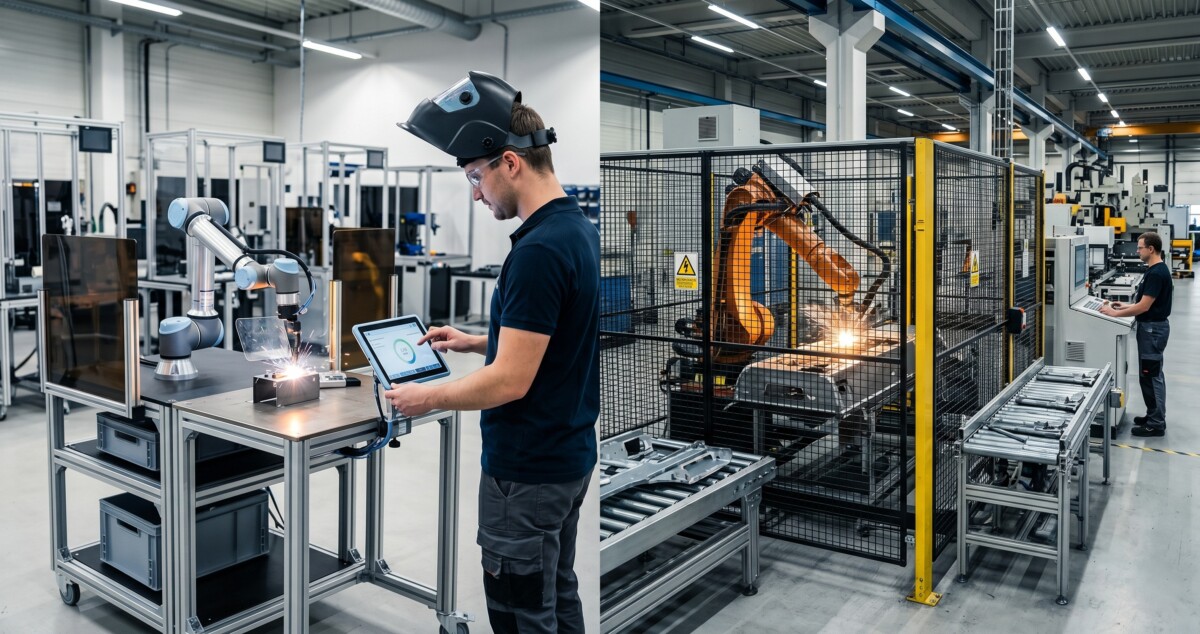
The American Welding Society projects a shortage of 320,500 skilled welders by 2029. For eCommerce manufacturers, that is not a future problem. It is a present one that cobot welding is already solving.
The American Welding Society estimates a shortage of 320,500 skilled welders in the US by 2029. If you’re running a manufacturing operation behind an eCommerce storefront, you’re already feeling the early pressure of that gap. Lead times stretch. Quality gets inconsistent. You post a job and wait. Meanwhile, your competitors are shipping.
The answer most operators land on is automation. But “automation” covers a wide range, from a $25,000 collaborative robot welder your team can be running in a week to a $500,000 traditional industrial system that takes months to integrate and requires a dedicated engineer to reprogram whenever your product line shifts. The right choice depends almost entirely on how your production actually works, not how you wish it worked.
This guide breaks down cobot welding versus traditional automation across the dimensions that matter to eCommerce manufacturers specifically: flexibility, cost, speed, safety, and workforce fit. By the end, you’ll have a clear picture of which path fits your operation at your current stage.
Cobot welding and traditional automation solve the same core problem through fundamentally different design philosophies, and understanding that difference is what makes the rest of this comparison useful.
A cobot welder is a collaborative robotic system built to work alongside human operators in a shared workspace. The design priority is flexibility and ease of use. Most cobot welding systems allow operators to program tasks through intuitive graphical interfaces, or to physically guide the robot arm through a motion to “teach” it a welding path. No advanced coding required. No dedicated robotics engineer on staff. The system is designed so that a trained operator can reconfigure it for a different product in a matter of minutes to a few hours, not days.
Traditional industrial welding automation takes a different approach. These systems are built for maximum throughput on stable, repetitive production runs. They operate inside safety cages or behind physical barriers, separated from human workers. They are programmed by specialists, optimized for a specific task, and designed to run that task at high speed, continuously, for years. Reprogramming them for a different product is a significant undertaking. That is a feature, not a bug, when your production never changes. It becomes a serious liability when it does.
The welding cobot segment is currently the fastest-growing category in robotic welding, projected to reach a 21.6% CAGR through 2034 according to Fortune Business Insights, driven specifically by small and mid-sized manufacturers who need automation without the rigidity of traditional systems. That growth is not happening in spite of eCommerce demand variability. It is happening because of it.
For eCommerce manufacturers, the comparison between cobot welding and traditional automation comes down to five dimensions. Here is how they stack up across each one.
Cobot welding wins decisively on flexibility, which is the single most important dimension for most eCommerce manufacturing operations. A cobot system can switch between different products, adjust welding paths, and accommodate custom order variations with minimal downtime. In practice, this means your team can run a standard product line Monday through Thursday and pivot to a custom batch on Friday without a reprogramming sprint or production halt.
Traditional automation is built for the opposite environment. Once a traditional system is programmed and optimized for a specific task, changing it requires engineering time, production downtime, and often a service call. If your product catalog is stable and your SKU count is low, that is fine. If you sell across multiple product variants, take custom orders, or introduce new designs seasonally, traditional automation will become a bottleneck rather than a solution.
Cobot welding systems are designed for fast deployment. Most manufacturers can have a cobot system operational within days to a few weeks of delivery, compared to the months-long integration timelines that traditional industrial automation typically requires. The programming interfaces are built for operators, not engineers. Your existing team can learn to operate and reconfigure a cobot system without specialized robotics training.
Traditional automation requires skilled engineers for initial programming, system integration with your existing production infrastructure, and any subsequent changes. If you don’t have that expertise in-house, you’re paying for it every time something needs to change. For businesses in a growth phase where the product line is still evolving, that ongoing cost adds up quickly.
A collaborative robot system typically costs between $20,000 and $40,000 and can pay back its investment within 12 to 30 months, depending on your production volume and labor cost baseline. That payback window is achievable for most eCommerce manufacturers doing meaningful production volume. Traditional industrial automation systems carry significantly higher upfront capital costs, plus additional expenses for safety infrastructure, integration engineering, and ongoing maintenance by specialized technicians.
The comparison below reflects typical investment ranges for each approach. These are illustrative benchmarks. Your actual numbers will vary based on system complexity, integration requirements, and vendor.
The cost picture also connects directly to your manufacturing inventory management strategy. If you’re running lean production with tight cash cycles, a cobot system’s lower capital requirement and faster payback period preserves the working capital you need to stay flexible on materials and staffing.
Traditional automation holds a genuine advantage in raw throughput. Industrial welding robots are engineered to operate continuously at high speed, producing consistent results across large production runs with minimal variation. If your business model depends on producing thousands of identical units per shift, traditional automation delivers a level of output that cobot systems cannot match.
Cobot welding is optimized for moderate production volumes and mixed product lines, which describes the reality of most eCommerce manufacturing operations. The typical eCommerce manufacturer is not running a single product at automotive scale. They are managing a catalog of variants, handling custom orders, and responding to demand signals that shift week to week. For that environment, the throughput ceiling of a cobot system is rarely the binding constraint. Flexibility is.
Cobot welding systems are built with integrated safety as a design requirement, not an add-on. Built-in contact detection sensors, automatic stop features, and force-limiting technology allow cobots to operate in shared spaces with human workers without the safety cages and physical barriers that traditional industrial robots require. This matters for space-constrained operations. A cobot can be integrated into an existing workstation layout without a major floor plan redesign.
Traditional automation requires dedicated floor space, physical safety enclosures, and strict access protocols. This is not a minor consideration. For a growing eCommerce manufacturer operating out of a mid-sized facility, dedicating a significant portion of your floor to a caged automation cell is a real cost, both in square footage and in operational inflexibility. You can follow your existing essential warehouse storage safety guidelines alongside a cobot setup without major protocol overhauls. Traditional automation requires building a parallel safety system around it.
A cobot welder is the right choice when your production environment values adaptability over raw throughput, which describes the majority of eCommerce manufacturing operations at the $500K to $5M revenue stage.
The clearest signal that a cobot welder fits your operation is product variability. If you manage multiple SKUs, offer customization, or introduce new designs on a regular cadence, a cobot’s reprogrammability is not a nice-to-have. It is the core functional requirement. A traditional system that takes days to reprogram for a new product is incompatible with an eCommerce model where customer expectations and catalog evolution move faster than industrial engineering cycles.
The second signal is team composition. If you do not have a robotics engineer on staff and do not plan to hire one, a cobot system designed for operator-level programming is the practical choice. The intuitive interfaces and teach-by-demonstration programming approaches that leading cobot systems offer mean your existing production team can own the system without outside dependency. That matters operationally and financially.
The third signal is capital stage. If you are in a growth phase where capital efficiency matters more than maximum throughput, the $20,000 to $40,000 entry point for a cobot system and the 12 to 30 month payback window allows you to automate without tying up the working capital you need for inventory, marketing, and fulfillment. Integrating supply chain automation at the production layer fits naturally into this kind of staged investment approach.
Traditional automation is not the wrong answer. It is the right answer for a specific production profile that many eCommerce manufacturers will eventually grow into, even if they are not there yet.
The case for traditional automation is strongest when your production is high-volume, stable, and dominated by a small number of identical SKUs. If you are producing thousands of the same welded component per shift with no meaningful variation, the throughput ceiling and cycle time consistency of a traditional industrial system will outperform a cobot at that scale. The higher upfront investment becomes defensible when the volume justifies it.
Traditional automation also makes sense when you have the engineering infrastructure to support it. If you have robotics specialists on staff, a facility designed to accommodate safety enclosures, and a product line that is mature and unlikely to change significantly, the operational overhead of traditional automation is manageable. The system will do exactly what it was built to do, consistently, for years.
The honest assessment: most eCommerce manufacturers at the $500K to $5M stage are not in this situation. They are managing variable demand, evolving product lines, and lean teams. Traditional automation is a future consideration for many of them, not the right first step.
Choosing between cobot welding and traditional automation comes down to three questions, answered honestly against your actual production data rather than your aspirational production targets.
Start with what your production actually looks like, not what you want it to look like in three years. How often do your products change? What percentage of your orders involve customization or variation? What is your average batch size? If the honest answers point toward variability and mixed runs, that is a cobot environment. If they point toward long, stable, high-volume runs of identical products, that is a traditional automation environment.
The mistake most manufacturers make at this stage is planning for the production environment they expect to have rather than the one they currently operate. Automation should serve your present workflow first. You can scale and upgrade as your production stabilizes and volumes grow.
The upfront hardware cost is the most visible number in any automation decision, but it is rarely the most important one over a three to five year horizon. Total cost of ownership includes maintenance, operator training, downtime costs when the system needs reprogramming or repair, the cost of specialist labor if you need it, and the opportunity cost of capital tied up in a system that may not fit your production needs in two years.
For most eCommerce manufacturers, a cobot system’s lower capital requirement, faster payback period, and lower ongoing maintenance burden produce a better total cost of ownership outcome than traditional automation, even if the traditional system’s per-unit throughput is higher. Run the numbers against your actual production volume and labor cost baseline. The math usually confirms what the intuition suggests. Connecting this analysis to your broader digital supply chain strategy will also surface where welding automation fits in the larger picture of your operational efficiency investment.
If you are new to welding automation, starting with a single cobot system is almost always the right move, regardless of your long-term automation vision. A single cobot deployment lets you test automation in your actual production environment, train your team on real workflows, identify the integration points and edge cases that no vendor demo will show you, and build the internal competency to scale intelligently.
Welding cobots can reduce operational costs by up to 30% while improving production efficiency by 50% compared to manual welding processes, according to market research on the welding collaborative robots segment. Those numbers are achievable, but they require real integration and operator adoption, not just hardware installation. Starting with one system and doing it right produces better outcomes than deploying three systems simultaneously and managing the chaos of a rushed rollout. This step-by-step approach works well for growing eCommerce businesses at every stage.
If you’re exploring modern welding solutions, it’s worth looking at systems designed for flexibility and ease of use. Denaliweld is focused on helping manufacturers adopt automation without unnecessary complexity. These types of solutions are built to support businesses that need both efficiency and adaptability, without the integration overhead and capital commitment that traditional industrial systems demand.
The most sustainable automation strategy treats your team as a core asset rather than a cost to be replaced. This is where cobot welding has a structural advantage that goes beyond the technical specs.
Cobot systems are designed for human-robot collaboration, not human replacement. Your existing operators can be trained to program, operate, and maintain a cobot system without becoming robotics engineers. That upskilling creates a more capable workforce, reduces your dependency on specialized external labor, and builds institutional knowledge that compounds over time. An operator who understands your cobot system is also an operator who understands your production process more deeply, which has value well beyond the welding cell.
Traditional automation, by contrast, creates a dependency on specialized expertise that most small to mid-sized manufacturers cannot sustain internally. When the system needs reprogramming or repair, you’re calling in a specialist. That dependency is manageable at scale. It is a vulnerability for a growing operation where agility matters more than optimization.
The practical approach: invest in training your operators on the cobot system from day one. Build internal documentation for your most common welding programs. Create a clear escalation path for issues that exceed your team’s capability. The goal is a team that owns the automation, not one that tolerates it.
A cobot welder is a collaborative robotic system designed to work safely alongside human operators in a shared workspace, while a traditional welding robot is an industrial system built for high-speed, high-volume production in a separated, caged environment. The core difference is flexibility versus throughput. Cobots can be reprogrammed quickly by operators using intuitive interfaces, making them well-suited for variable product lines and mixed production runs. Traditional welding robots require specialist programming and are optimized for stable, repetitive tasks at maximum speed. For eCommerce manufacturers managing multiple SKUs or frequent product updates, the cobot’s adaptability is typically more valuable than the traditional system’s peak throughput.
A cobot welding system typically costs between $20,000 and $40,000 for the hardware, with additional costs for integration, fixturing, and operator training that vary by application. The payback period is typically 12 to 30 months, depending on your production volume, labor cost baseline, and how efficiently the system is integrated into your workflow. Traditional industrial welding automation starts significantly higher, often $150,000 to $500,000 or more when safety infrastructure and integration engineering are included, with payback periods of three to seven or more years. For most eCommerce manufacturers at the $500K to $5M revenue stage, the cobot’s lower capital requirement and faster payback produce a better return on investment at their current scale.
Yes, cobot welding systems are specifically designed for operator-level programming and use. Most systems offer intuitive graphical programming interfaces and teach-by-demonstration functionality, where an operator physically guides the robot arm through a motion to program a welding path. This means your existing production team can learn to operate and reconfigure the system without a robotics engineering background. The training curve is measured in days to weeks for basic operation, not months. This is one of the primary advantages cobots hold over traditional automation for small to mid-sized manufacturers, where hiring dedicated robotics specialists is not practical.
Traditional welding automation is the better choice when your production is high-volume, stable, and dominated by a small number of identical products with minimal variation. If you are producing thousands of the same welded component per shift on a consistent, long-term basis, the throughput ceiling and cycle time consistency of a traditional industrial system will outperform a cobot at that scale. Traditional automation also makes more sense when you have the engineering infrastructure to support it: robotics specialists on staff, a facility designed for safety enclosures, and a mature product line unlikely to change significantly. Most eCommerce manufacturers at an early to mid-growth stage do not meet these criteria, making cobots the more practical starting point.
Total cost of ownership for welding automation includes hardware, safety infrastructure, integration engineering, operator training, ongoing maintenance, downtime costs when reprogramming or repairs are needed, and the opportunity cost of capital tied up in the system. For cobots, the lower upfront hardware cost ($20,000 to $40,000), minimal safety infrastructure requirements, operator-level programming, and lower maintenance burden typically produce a favorable total cost of ownership over a three to five year horizon, even compared to traditional systems with higher peak throughput. Run the calculation against your actual production volume and labor cost baseline. Factor in how often your product line changes, since every reprogramming event on a traditional system carries a real cost that compounds over time.





