
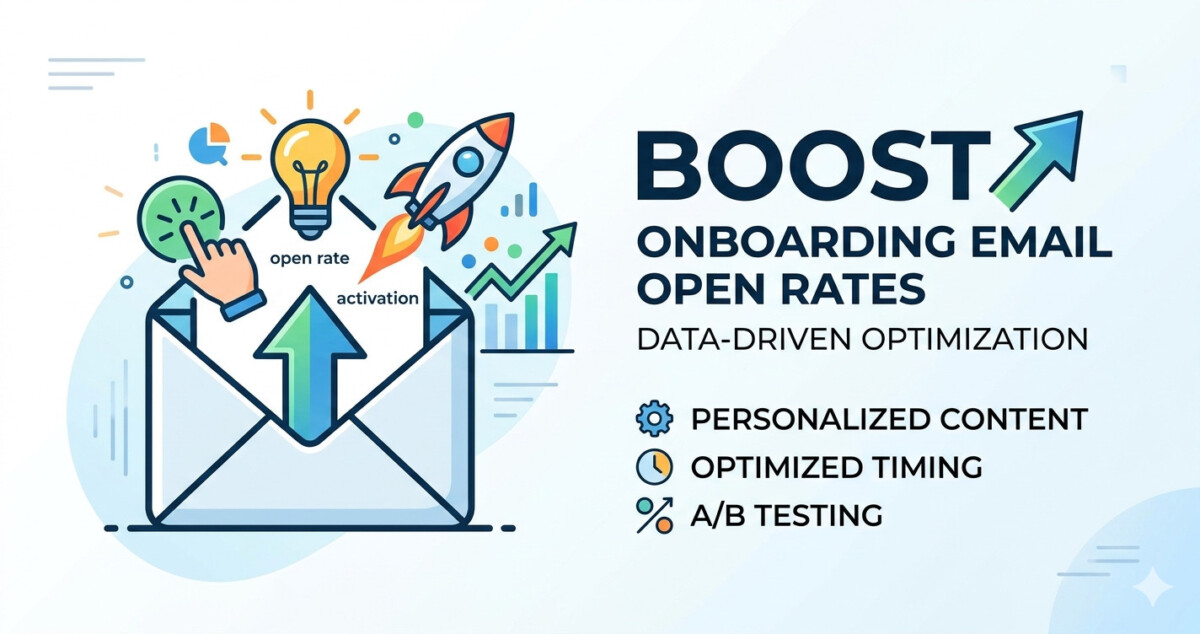
Onboarding emails in SaaS are the first real conversation you have with a user after they sign up.
This is where curiosity turns into activation, or fades into churn. Most teams focus on subject lines, timing, and sequencing. Those things do matter but they are not the foundation. Higher open rates in onboarding emails prominently come from brand authentication. If your emails are not trusted at the inbox level, they will not be opened, no matter how well they are written.
In SaaS, onboarding is crucial. By registering, a person has shown purpose, yet that intent may be fragile. The next few emails determine whether they activate or quietly disappear.
Most SaaS onboarding flows rely on four core emails:
Even though each of these has a separate purpose, they are all dependent on one thing and that is, they must be seen. Even highly relevant onboarding communications are disregarded if they seem unreliable or generic.
Your email creates friction at the worst possible time if it has an odd appearance, incorrect domain, an unknown sender name, or inconsistent branding. Before you optimize copy or timing, you need to solve inbox placement and sender recognition problems.
Inbox providers do not evaluate your emails the way marketers do. They are not judging your copy but rather judging your credibility.
Every email you send is checked against a set of signals,
Your onboarding emails can end up in spam, get filtered into low-visibility tabs, or not be delivered at all if these signals are weak.
Providers like Google and Yahoo now enforce stricter requirements for senders at scale, including properly configured SPF, DKIM, and DMARC.
Before anything else, trust is established through technical signals.
Authentication is the first layer of trust. SPF guarantees your sending servers are authorized. DKIM assures that your email has not been altered. DMARC enforces alignment and tells inbox providers how to handle failures.
When these are correctly configured, your emails are treated as legitimate by default. That improves inbox placement, which directly increases visibility, which in turn lifts open rates.
There is also a second layer emerging here. In some inboxes, BIMI can further reinforce this trust layer by displaying a verified brand logo next to your email, making the sender instantly recognizable at the moment of opening. To activate it, you have to buy verified mark certificate. That small visual cue reduces hesitation significantly.
Authentication gets you into the inbox but consistency will make users recognize you. You can start with the sender identity. A combination of a real name and your brand works well, something like “John-from-yourorganization” instead of a generic “no-reply”.
Then look at your domain. It should clearly match your product. If your onboarding email comes from a different or obscure domain, it creates doubt.
Finally, maintain consistency in design and tone. The same layout, color palette, and CTA style across emails builds familiarity. Users do not re-evaluate every email from scratch. They rely on recognition patterns. Trust compounds when everything looks and feels consistent every time.
Open rates are often treated as a copywriting problem. In onboarding, they are more of a trust problem. When a user sees your email in their inbox, they make a quick decision. Do I recognize this sender? Does this look safe? Is this relevant to what I just signed up for?
Recognition reduces this hesitation and increases the likelihood of repeated opens across the onboarding sequence. This is especially critical in the first 24 to 72 hours after signup. That is when user intent is highest and attention is easiest to lose.
Strong onboarding campaigns often report open rates in the 40 to 55 percent range. That level of performance is not driven by clever subject lines alone. It is driven by consistent trust signals across every email. Users open emails they recognize and trust. Everything else is secondary.
Once authentication is in place, the next step is making your brand consistently recognizable.
Don’t alternate between generic addresses or various sender names. During the onboarding process, choose a distinct identity and adhere to it. A human plus brand structure is effective because it seems personal while maintaining a connection to your product.
Instead of seeming like a growth hack, your subject lines should sound like your product. Keep yourself clear of unnecessarily combative or deceptive language. Users begin to doubt your credibility if the tone of your onboarding emails is inconsistent. Here, consistency and clarity will always outperform cleverness.
Each onboarding email needs to feel integrated into the whole system. Make use of the same CTA patterns, colors, typography, and layout structure. When user’s cognitive load is reduced, your emails become readily recognized even in a packed inbox. Consistency is not just a design choice here but a trust mechanism.
A typical flow looks like,
If everything passes, the email is delivered to the inbox, often with recognizable branding and, in some cases, your verified logo.
From the user’s perspective, it just feels seamless. The email looks familiar, expected, and safe to open.
Now consider where things break,
Although these gaps are small, their influence is significant. Your onboarding emails may become spam or appear unreliable due to a single mistake.
SaaS onboarding email performance is often treated as a messaging problem, but it starts much earlier. Authentication determines whether your emails are trusted, delivered, and recognized. Once that foundation is in place, improvements in copy and timing begin to matter. The practical path is to fix authentication, align your brand identity, monitor deliverability, and then optimize the experience on top of a system users already trust.





