

There they were on a stranger across from me on the subway, the perfect sneakers.
Retro silhouette. Suede. A warm navy with a cream logo. Understated, but impossible to ignore.
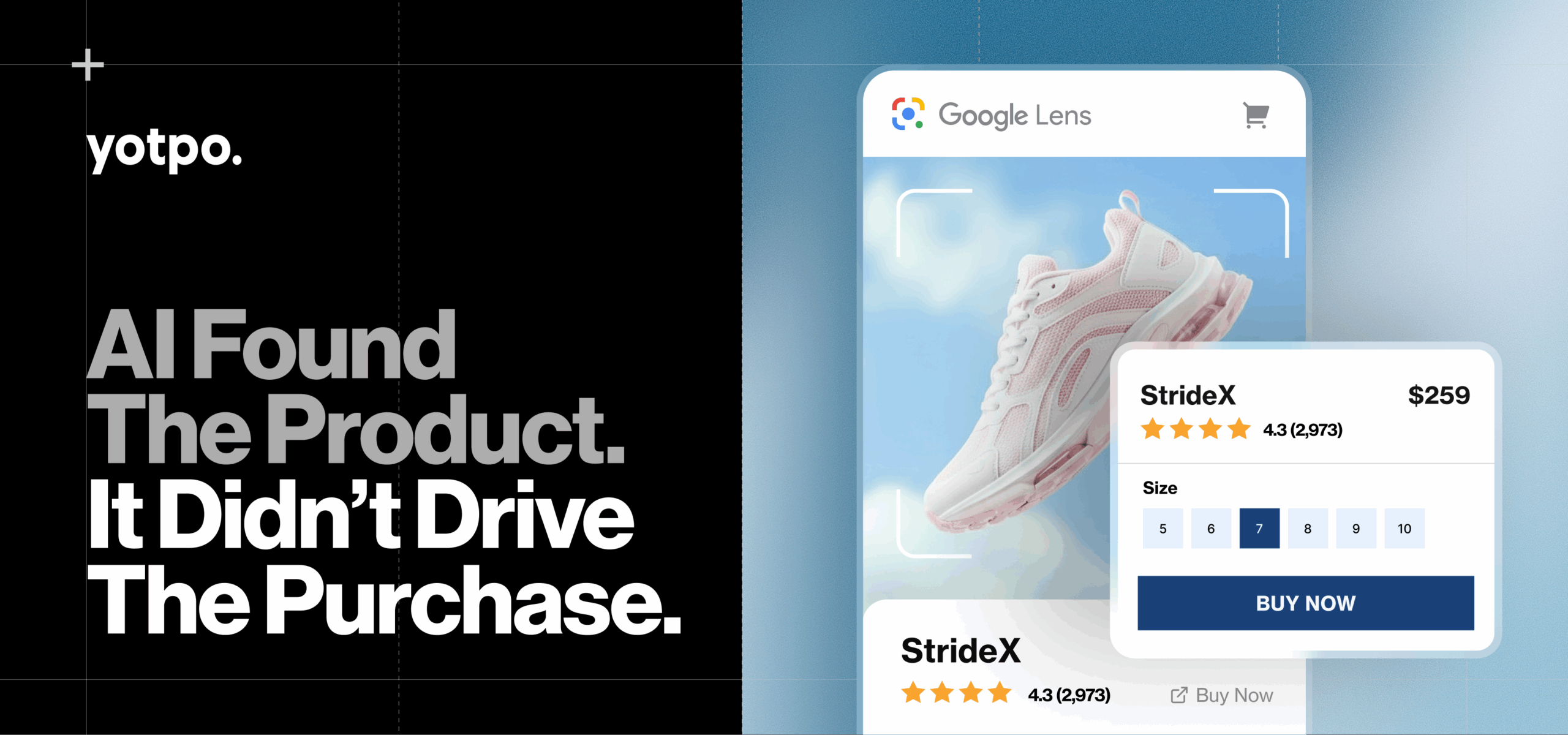
I didn’t ask where she got them. Instead, I did what modern shoppers do: snapped a photo, opened Google Lens, and within seconds had a brand name and a grid of lookalikes.
That moment, seeing something on a real person in real life, is still one of the most powerful purchase triggers that exists.
No algorithm served it, no brand paid for me to see it. It was just one human noticing another and thinking, I need those.
And that’s exactly where most brands lose the plot.
They obsess over what they can control, ad spend, product pages, email flows, while the moments that actually shape decisions happen elsewhere: on subways, in TikTok feeds, inside AI conversations, buried in 3-star reviews.
Discovery and consideration have fragmented across dozens of surfaces, and most brands have lost visibility into nearly all of them.
I’ve spent six years in ecommerce, with earlier stints in CPG and advertising. I’m also a wife and mom of two. I live on both sides of this equation: the marketer watching the data and the consumer living the behavior.
And what I keep seeing, in both the numbers and my own shopping cart, is a shift toward intentional, strategic shopping.
People don’t just buy anymore. They investigate.
95% of consumers who discover products through influencers don’t buy immediately, they research further.
71% read reviews before purchasing.
48% abandon the cart entirely if reviews aren’t available.
This isn’t niche behavior. It’s the default.
What’s driving it is simple: pressure and access. When every purchase matters more, people think harder. And with AI, social platforms, and real-world inspiration all in play, research has become both more layered and more human.
What happened after that subway moment wasn’t linear. It was a loop, messy, multi-channel, and incredibly efficient.
After spotting the sneakers, I did something intentional – I liked a few Instagram posts about retro sneakers and I searched “suede sneakers” on TikTok.
Within 24 hours, all my social feeds had transformed. Suddenly I was seeing brands I’d never engaged with before: Autry, Pane, ALOHAS, Daze. Styling videos, sponsored posts, organic content. Even email newsletters started reflecting what I’d been browsing.
All with zero additional effort required.

This confirmed something I had been thinking about for awhile now, the fact that we’re not just consumers anymore. We’re actually training systems in real time. One signal, and your entire discovery environment reshapes itself around your intent.
29% of people now discover products through social media, and for Gen Z that number is even higher.
By now I knew what I was looking for. So I typed into ChatGPT: “What are the best retro suede sneakers under $250 that are comfortable for walking?”
In seconds, I had a clean, synthesized comparison, something that would’ve taken an hour across tabs.
72% of consumers plan to use AI-enabled search for shopping, and many of us already are.
AI compresses time. But it doesn’t create trust.
For that, I went to TikTok. I wanted to see real people wearing the shoes. Not models, not studio shots. Real women styling them with jeans, walking in them, reviewing the comfort. One video stuck with me: someone saying “Well, if Bella loves them…” about the exact pair I was considering. That single moment of social proof did more than any product description ever could.
YouTube gave me the deep dive. A woman lacing up her new pair, walking around her apartment, comparing them to her old sneakers.
68% of consumers trust YouTube reviews, and I understand why. It felt like getting advice from a friend.
Here’s the important part: none of this happened on the brand’s website. The brand I eventually bought from had zero visibility into the two weeks I spent forming an opinion about them across five different platforms.
Consideration is no longer a stage you own. It’s a conversation happening without you.

When it came time to decide, I didn’t look for perfection. I looked for truth.
Specifically: 3-star reviews. The ones that say, “They run a half size small, but I walked 10,000 steps in them on vacation.”
I sought out verified reviews with photos. Real feet, real lighting, real context. Each small signal stacked into certainty.
Products with 50+ reviews see conversion rates increase by up to 270%. I’m part of that statistic.
I set up a price alert. It hit and I purchased without a second thought.
Afterward, I left a detailed review with photos. Not because I had to, but because it felt like closing the loop. Someone out there is about to start the same journey I just finished, and she deserves real input from a real person.
Total research time: 3-4 hours over three weeks, half of it passively thanks to algorithmic feeds.
Confidence level: 100%. Buyer’s remorse: zero.

AI is transforming how we shop, but not why we buy.
It’s exceptional at synthesizing, comparing, and surfacing what’s relevant. It eliminates friction from discovery. But it doesn’t replace the human layer. It amplifies the need for it.
What actually made me buy? A stranger on the subway. A candid TikTok. A nuanced 3-star review.
As AI makes discovery instant, differentiation shifts. When every brand can be surfaced in seconds, the question becomes: who has the most believable human proof?
The uncomfortable truth: almost nothing in my journey was controlled by a brand. And that’s exactly the point.
Show up where you can’t control. Your product information, reviews, and content need to be structured so AI engines can find you, understand you, and recommend you. The brands that show up in AI answers win the consideration set before a shopper ever visits their site. But it’s not just AI. It’s TikTok, YouTube, review pages, conversations you’ll never see. You need to exist credibly in all of them.
Invest in people, not just production. Polished campaigns don’t train algorithms, real content does. The offhand “if Bella loves them” moment on TikTok did more for that brand than a six-figure shoot could. When someone is training their algorithm to find your category, you need enough authentic content in the ecosystem that you actually appear.
Make reviews your connective tissue. Reviews validate what algorithms surface, confirm what TikTok showed, and answer the questions AI couldn’t. Products with strong review profiles don’t just convert better on your site, they show up in AI recommendations, get cited in YouTube comparisons, and build the human trust layer that no technology can manufacture.
Design for the loop, not the funnel. The journey is human, then digital, then human again. Inspiration starts with a real-world moment. Research goes digital. The purchase decision comes back to human trust. Your strategy needs to support all three phases.
That purchase didn’t end at checkout. It ended when I left a review. That’s the loop: one person’s experience becoming another person’s starting point.
The real question for brands isn’t whether your marketing is good enough. It’s whether you show up at all in the places where people are actually forming opinions, and if you do, whether there’s enough real human proof to make someone hit buy.
See how Yotpo Reviews and Discover work together to help your brand get found and chosen.





