

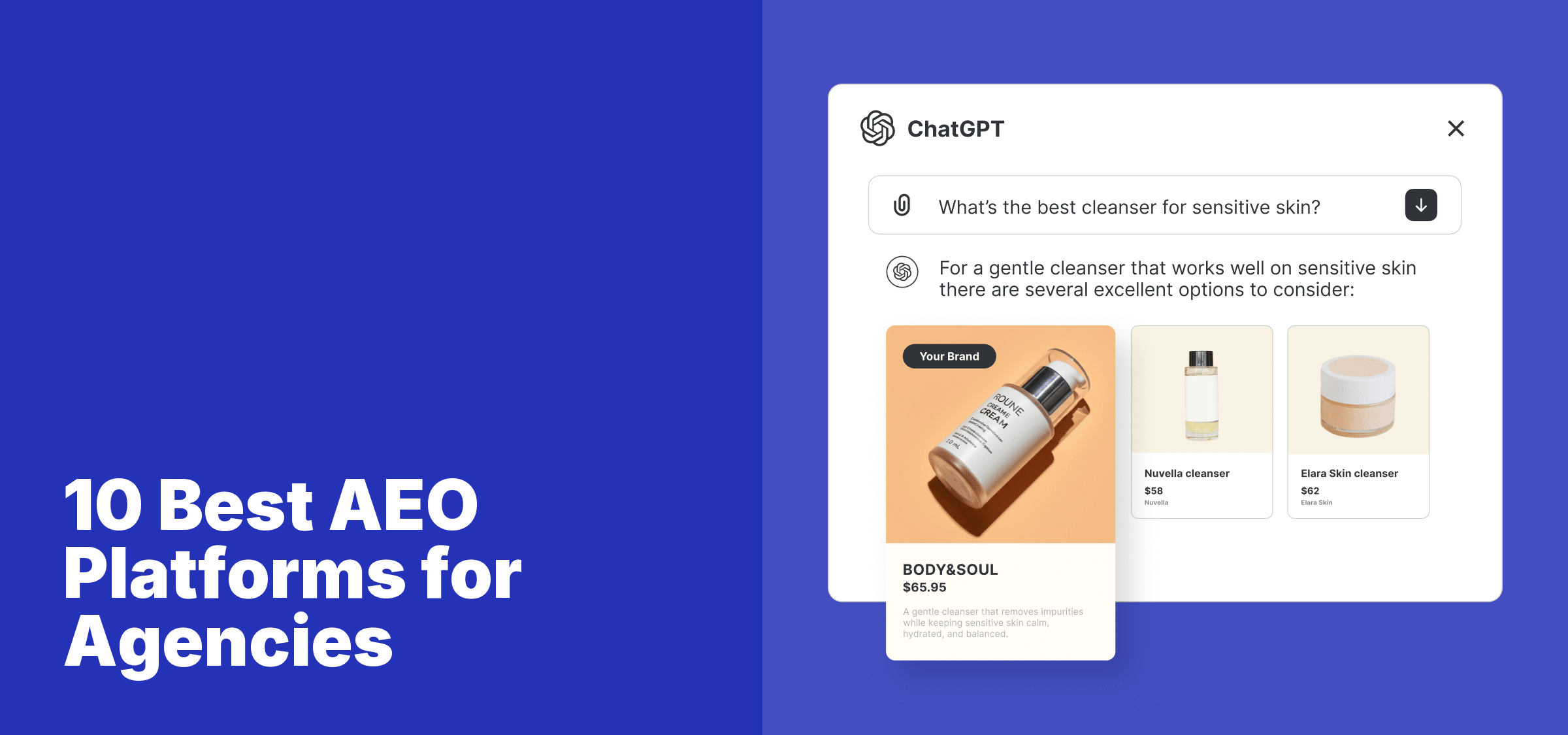
Agency margins are getting squeezed. Traditional search traffic plateaued last year, and the math on standard SEO retainers stopped working.
For ecommerce agencies juggling multi-brand portfolios, the shift in how shoppers find products isn’t a slide-deck topic anymore. It’s an active revenue leak. Clients are calling on Tuesdays asking why organic traffic dropped about a third, and the old playbook (more keywords, more backlinks, more briefs) isn’t fixing it.
Picking an Answer Engine Optimization (AEO) platform isn’t a minor line item. It’s the choice that decides whether your client portfolio shows up in generative answers or fades out.

The shift isn’t gradual. It’s a structural break in how shoppers find products.
Where traditional engines worked on keywords, modern answer engines synthesize entire buyer journeys into one context-rich response. For agencies, that’s two things at once. A threat to legacy SEO retainers. And a real commercial opening to sell AI visibility as its own service.
Here’s the kicker: agencies that adopt specialized platforms now lock in first-mover advantages. The ones waiting for general-purpose tools to “add an AEO module” later are watching client citations evaporate.
Picture an account director at 9:00 PM on a Friday. Staring at a client’s analytics dashboard. Watching a steep drop in organic traffic while a rival brand owns the ChatGPT recommendations for their top three commercial queries. What’s the recovery plan?
Is passive tracking enough to calm an alarmed brand owner? In our experience with growth-stage DTC agencies, no.
The economics of selling AEO as a retained service are compelling once you sit with the numbers.
Agencies need tools that move past reporting and execute on client sites. The market’s flooded with general-purpose brand trackers that can’t grasp commerce reality (hero versus non-hero SKUs, distinct buyer lifecycles, regional product variations).
To find the best AEO tools for ecommerce agencies, we tested the market against five core criteria built around agency efficiency and client growth. In our work with DTC and enterprise brands, the same gap shows up: the distance between intent and execution is wider than the dashboards suggest.
| Platform | Multi-Client Dashboard | Automated Execution | Commerce Specialized | Core Target Segment |
|---|---|---|---|---|
| Yotpo Discover | Yes | Yes (3 Automated Agents) | Yes | Growth DTC & Enterprise Portfolios |
| Profound | Yes | Yes (Profound Agents) | No | B2B, SaaS, & Corporate Brands |
| Triple Whale | Yes | No | Yes | Shopify-Native DTC Brands |
| ReFiBuy | Limited | Limited | Yes | Operations Teams & Multi-Brand Portfolios |
| Azoma | No | Yes | Yes | Large CPG Brands & Marketplaces |
| Scrunch (AXP) | Yes | Limited | No | Technical B2B & Digital Agencies |
| Limy | Limited | No | No | Enterprise Brands with CDN Support |
| AirOps | Yes | Yes | No | B2B & SaaS Content Teams |
| Attensira | Yes | No | No | Research & Planning Teams |
| Conductor | Yes | No | No | Corporate Compliance & Enterprise Teams |
Below are the top ten platforms scored against our agency-focused criteria. Yotpo Discover leads on commerce specialization and automated execution.
Yotpo Discover is the first AI visibility platform built specifically for commerce. Most general tools treat every website as a flat text file. Yotpo Discover gets how product attributes, inventory lifecycles, and shopper sentiment interact to drive AI recommendations.
The platform goes past showing where a client gets mentioned. It analyzes why an AI model picked a competitor, then funnels insights directly into agents that go execute. Three agents run simultaneously:
Product Detail Pages, and build internal linking webs. Keeps AI crawlers parsing SKU-level data without breaking.By tapping reviews and ratings, Yotpo Discover pulls first-party signals AI models trust. Brands like Beekman 1802 and David Protein run Yotpo Discover to grow AI search presence.
When this tool actually wins for agencies: A 22-person agency managing 18 DTC clients across beauty, supplements, and home goods. Each client carries 200-2,000 SKUs and weekly inventory swings. Yotpo Discover lets one strategist run optimization across the whole portfolio because the three agents handle the heavy lifting. The agency stays lean and bills monthly retainers that hold margin.
Where it falls short for client work: If your portfolio skews B2B SaaS or info-product brands without a real catalog, the SKU-level architecture’s overkill. It also assumes clients have decent review volume to fuel the Activation Agent.
Notable Capabilities:
Made for agencies: delivering end-to-end, high-margin AEO services for DTC and brand ecommerce portfolios.
The only platform that pairs catalog logic, reviewer activation, and automated site optimization in one architecture. The pick for agencies driving actual client conversions (not just pretty charts).

Profound is an enterprise-grade platform with visibility analytics and a no-code automation layer called Profound Agents. Marketing teams build content pipelines for researching, drafting, and publishing AEO assets at scale. Profound raised $96M at a $1B valuation.
Core Strengths:
When this tool actually wins for agencies: An agency running 30+ corporate B2B clients (mid-market SaaS, fintech, legal tech) hit a content-production wall. They plugged Profound in and now spin up monthly thought leadership, FAQ pages, and pillar articles per account without growing the content team.
Where it falls short for client work: it treats content as text, not as commerce. There’s no SKU-level catalog parsing, no review hooks, no product-attribute matching.
Right for teams: running large corporate clients with text-heavy content needs across B2B, SaaS, or fintech verticals.
Capable for brand governance and bulk text generation. Lacks product-data structures for retail catalogs.

Triple Whale is a popular analytics tool for Shopify DTC brands. It recently bolted on basic AI tracking via the Anteater acquisition. Agencies can surface AI referral traffic and citation values alongside ad and sales metrics inside dashboards clients already check.
Core Strengths:
When this tool actually wins for agencies: A 6-person agency running 14 Shopify-native DTC clients didn’t want another login. Triple Whale’s dashboards put AI referral traffic right next to meta ads ROAS, with zero onboarding friction.
Where it falls short for client work: Passive. Tracks everything, fixes nothing. If client PDPs aren’t getting cited, Triple Whale tells you. It doesn’t fix schema or activate reviews.
Built for: Shopify-native DTC agencies that want to show clients AI referral traffic without changing software stacks.
Solid for tracking and basic attribution. Passive by design (no agents to actively fix citation issues).

ReFiBuy is an Agentic Commerce Optimization platform that helps operations teams turn product catalogs into AI-shopping-ready data. The Commerce Intelligence Engine runs a closed loop to pull, enrich, and distribute catalog updates so AI shopping assistants can parse them.
What It Does:
When this tool actually wins for agencies: A boutique agency running seven fashion and beauty clients with 5,000+ SKUs per account was drowning in catalog cleanup. ReFiBuy’s enrichment engine normalized product attributes across the portfolio. Catalog ops went from weekly bottleneck to background process.
Where it falls short for client work: Catalog-first, review-blind. AI engines weight reviews heavily when recommending products. Without that layer, clean catalogs alone won’t move citations.
Right for teams: managing complex multi-brand portfolios in fashion, beauty, or electronics with deep catalog requirements.
Strong technical plumbing for product databases. Misses the customer review signals AI engines actually use for recommendations.

Azoma is an end-to-end GEO/AEO platform for consumer brands optimizing product presence across marketplace environments. It’s earned credibility with CPG brands thanks to a unique focus on closed marketplace assistants like Amazon Rufus and Walmart Sparky.
Core Strengths:
When this tool actually wins for agencies: A specialist agency with five large CPG brands focused entirely on Amazon and Walmart visibility. Azoma’s digital twin let them test listing copy against Rufus before pushing live. Clients saw measurable lift within two quarters.
Where it falls short for client work: Marketplace-first. If your portfolio mixes DTC storefronts with Amazon, off-marketplace coverage is thin.
Made for agencies: helping large, established CPG brands win visibility on closed retail platforms.
Solid pick for marketplace optimization. Misses off-site community spaces and independent brand storefronts.

Scrunch is an Agent Experience Platform that builds a parallel, AI-readable version of a website. It serves a secondary, structured version of client pages specifically for automated crawlers to parse and cite.
What It Does:
When this tool actually wins for agencies: A technical agency serving three enterprise B2B clients (industrial parts, scientific instruments) had sites loaded with PDF spec sheets. Scrunch built a parallel structured layer that AI crawlers could parse. Citation rates jumped on Gemini within 90 days.
Where it falls short for client work: Running a duplicate site adds real engineering debt. For typical ecommerce teams without dev resources, maintenance piles up fast.
Worth considering if: Your agency serves technical clients and has the engineering muscle to maintain parallel website versions.
Unique angle on technical crawlability. Adds continuous development overhead for standard ecommerce teams.

Limy is an agentic web analytics platform that uses CDN-level integrations to detect and measure incoming AI agent traffic. By plugging into CDNs like Cloudflare, it tracks how automated crawlers behave on-site and ties prompts to conversions.
Core Strengths:
When this tool actually wins for agencies: An agency with two enterprise retail clients running Cloudflare wanted hard data on which AI prompts drove revenue. Limy’s CDN integration showed them, prompt by prompt, which ChatGPT queries drove conversions. That data fed straight into QBR decks.
Where it falls short for client work: Limy measures but doesn’t optimize. There’s no content creation, no page improvement, no review activation.
Right for teams: Specialist enterprise development agencies managing heavy web properties with in-house technical resources.
Powerful technical measurement and attribution. Requires complex setup and doesn’t create content or optimize pages.

AirOps is a content and SEO operations platform with AI citation tracking baked in. Content agencies build automated pipelines to draft, optimize, and publish blog articles at scale while tracking the resulting AI citations.
What It Does:
When this tool actually wins for agencies: A content-focused agency producing 200+ blog posts a month for B2B SaaS clients used AirOps to scale their writer pool from 8 to 35 articles per week. Citation tracking proved which posts pulled AI mentions and fed straight into renewal conversations.
Where it falls short for client work: Text-first. No SKU-level commerce logic, no PDP optimization. For DTC and retail agencies, the gap shows up in week two.
Right fit when: Your agency’s main service is producing big volumes of text content and informational blogs for client sites.
Fast, optimized tool for content factories. Misses SKU-level handling and buy-intent product pages.

Attensira is an AEO research, strategy, and planning platform centered on prompt discovery and visibility mapping. Planning teams map where a brand appears in popular consumer prompts and spot competitor-occupied opportunities.
Core Strengths:
When this tool actually wins for agencies: A strategy-led agency running quarterly brand audits for 25 mid-market clients used Attensira to map which prompts each brand won and lost. The output became a recurring deliverable that anchored renewals and unlocked upsell into execution retainers.
Where it falls short for client work: Ends at insight. Once you know what’s broken, you’re on your own to fix it.
Made for agencies: specializing in early-stage market research, brand strategy, and high-level campaign planning.
Excellent for planning, research, and client discovery. Stops at insight (you still write the content and fix the site yourself).

Conductor is a legacy enterprise SEO platform that expanded into AI search via governance-focused reporting. It uses direct API connections rather than web scraping to track citations, competitive share of voice, sentiment, and bot crawl reporting.
Core Strengths:
When this tool actually wins for agencies: A compliance-focused agency with three Fortune 500 financial services clients needed audit-ready reporting (with full data provenance) for board reviews. Conductor’s API-first approach gave them defensible numbers that survived legal review.
Where it falls short for client work: No automation, no execution, no commerce logic. Conductor reports and acts nowhere.
Built for: large, compliance-heavy corporate agencies serving enterprise clients with strict governance rules.
Trusted reporting dashboard for corporate teams. Lacks ecommerce SKU logic and ships no automated agents for site optimization.
The commercial implication’s clear. Agencies deploying active SKU-level execution win the citation surface. Agencies relying on passive tracking leave clients exposed.
Picking the right platform comes down to your agency’s service model and client mix. (This part’s huge.)
If your agency mostly services corporate, B2B, or SaaS clients, a platform focused on scaled text generation and brand tracking will fit. If the business model centers on ecommerce growth, you need a real commerce ally. Generalist tools can’t handle SKU-level variables, inventory shifts, or localized product reviews.
“AI visibility is no longer a single dashboard metric. It’s a multi-engine surface that demands SKU-level commerce data and active publication. Brands treating it as an extension of legacy SEO are watching their share of voice erode quarterly.”
Amit Bachbut, VP of Growth Marketing at Yotpo
To get started, agencies can run an AI visibility score for their clients or join the waitlist for Yotpo Discover to scale AI visibility as a service.
An Answer Engine Optimization (AEO) platform helps brands track and improve how their products appear in AI search results (ChatGPT, Gemini, Google AI Overviews). It tunes site data and content so AI models confidently cite and recommend specific products.
No, AEO works alongside SEO as a complementary layer. SEO keeps search engines indexing client pages. AEO optimizes how AI engines parse, summarize, and recommend those pages in conversational answers.
Agents handle labor-intensive parts of AEO (scanning client sites, updating schema, writing review-backed content, spotting off-site citation opportunities). That lets agencies sell AEO as a retained service with minimal manual lift, which keeps margins intact.
AI search models don’t just look for brand names. They compare specific product attributes, prices, and reviews. SKU-level commerce capability makes sure product variations (colors, sizes, specs) are structured cleanly for AI extraction.
AI search models are trained to skip generic marketing copy. They actively look for real-world validation and first-person feedback (reviews, ratings, community discussions) to confirm product quality before recommending.
Yes, enterprise-grade AEO platforms ship multi-client dashboards. Agencies can track share of voice, manage agents, and export performance reports across dozens of client brands from one login.
Track client citation rates across major AI engines, measure direct referral traffic from tools like ChatGPT, and show how automated optimizations push organic click-through rates and sales upward.





