

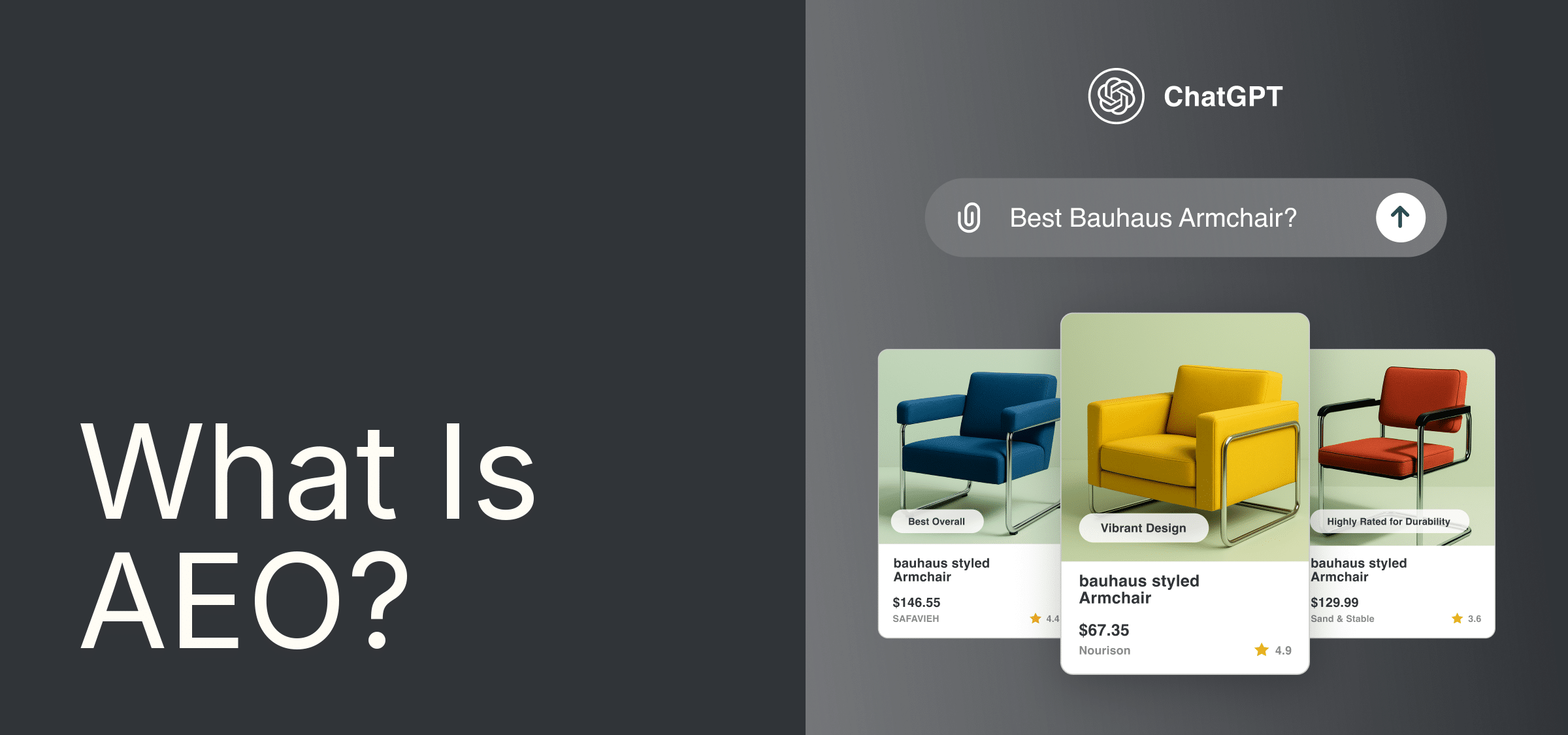
Search has moved a long way from keyword indexing toward Answer Engine Optimization (AEO), and for any serious e-commerce brand, that shift changes how you think about discovery. Shoppers don’t just click links anymore; they ask conversational questions and expect a quick, summarized recommendation in return. What follows shows how AEO works, why it sits on top of your existing SEO rather than replacing it, and how to build lasting AI visibility.

The change in AI visibility isn’t a slow drift. It’s more of a structural shift in how people find products. SEO ran on intent expressed through keywords, while AEO runs on intent expressed through chat-based context, so the surface area you can influence has grown. Brands that built visibility on keyword density now face a category-redefining question: how do you optimize for an engine that paraphrases instead of retrieves? The honest answer is that the old playbook doesn’t transfer cleanly, and that’s the part most teams miss.
Picture a director of organic growth at a fast-growing DTC brand staring at her dashboard at 11pm. She notices Google AI Overviews have quietly stopped citing her top thirty product pages. Her rankings look stable, yet organic referral traffic keeps sliding.
That mismatch happens because answer engines reach high-intent buyers before they ever land on a standard results page. If your brand isn’t cited inside that chat summary, you simply don’t exist to that shopper.
Our data suggests this transition is picking up speed across every retail sector. ChatGPT alone has reached 900 million weekly active users, turning chat into a primary starting point for commercial discovery.
Perplexity is growing fast too, reaching over 100 million monthly active users. These searchers aren’t hunting for a list of links.
They want direct, verified recommendations, comparing products side by side against specific needs.
So what changes when the search interface itself becomes a conversational partner? Organic visibility moves from passive page indexing toward active information extraction.
To win citations, e-commerce brands have to serve up structured, verified data that AI engines can read, interpret, and trust. Skip that bridge, and your catalog stays invisible to the fastest-growing pool of buyers on the web.
It helps to set the core mechanics of AEO against the search model you already know, which crawls pages to build a static index from keywords and link authority. Answer engines read, synthesize, and paraphrase complex web data to respond to a specific question. AEO doesn’t replace your foundation; it builds a specific execution layer on top of it.
| Dimension | Traditional SEO | Answer Engine Optimization (AEO) |
|---|---|---|
| Primary Interface | Search Engine Results Pages (SERPs) containing list of links | Chat-based chat boxes and synthesized summary passages |
| Search Intent Style | Short-tail keywords and structured search phrases | Chat-based questions, complex scenarios, and comparative queries |
| Technical Core | HTML structure, page speed, mobile responsiveness, XML sitemaps | JSON-LD schema, API accessibility, machine-readable product tables |
| Content Focus | Keyword density, topical authority, complete text guides | Structured Q&As, review summaries, comparative analysis, factual tables |
| Authority Signals | Domain authority, backlink volume, internal link architecture | user feedback, third-party forum mentions, verified buy data |
| Primary Success Metric | Keyword rankings, organic impressions, organic click-through rate | AI visibility share, citation frequency, referral traffic share |
Traditional SEO still handles the structural health of your site, making sure search engines can find your pages. AEO focuses on something different: whether those engines actually choose to cite your brand inside the answers they generate.
Say a shopper asks for the best running shoe for flat feet. Traditional SEO helps your category page rank in the blue links. AEO is what gets the model to name your specific shoe in its written answer, pulling in positive sentiment from real customer reviews to back up the choice.
To optimize for answer engines, you first need to understand how they build their knowledge. Platforms like ChatGPT, Perplexity, Gemini, and Claude don’t lean on static training data.
They use a hybrid approach instead, mixing real-time web retrieval, API data pull-in, and close reading of offsite consumer discussions. They actively search the web the moment a user asks, looking for the most accurate, verified information they can find.
These systems lean hard on third-party validation, cross-referencing your onsite product details against independent publications, social threads, and customer review databases.
User-generated content, the real voices of your shoppers, has grown into a vital database that AI models query for the contextual proof they need before recommending a product.
When an engine pulls an answer together, it looks for patterns of agreement across these sources so its recommendation stays safe and accurate.
That’s why brands like Beekman 1802 and David Protein keep their SKU-level commerce data readable and chat-friendly, so these engines can crawl and cite them. AI engines favor sites that lay out their data clearly, since it makes pulling exact attributes like material, price, and dimensions far easier. Hide those details behind heavy JavaScript or complex tables, and the engine skips your catalog, choosing a competitor whose data reads clean and machine-friendly instead.
A working AEO program needs a clear, repeatable process. It runs from first measurement into technical restructuring, then content, offsite community work, and continuous automation. The five stages below lay out the path to build and scale your brand’s AI visibility.
You can’t optimize what you don’t measure. The first stage of any serious AEO program is a detailed baseline of your current visibility across the major chat-based engines. That baseline shows where your products already get cited, which competitors own your top commercial terms, and how answer engines read your brand’s authority.
Start by compiling your top fifty high-priority SKUs and their primary transactional search phrases. Type those queries into ChatGPT, Gemini, and Perplexity by hand, noting when your brand gets cited and what sentiment shows up. Then compare those manual crawls against your SEO rankings to spot the gaps, the places where your site ranks well organically but never shows up in the AI summary.
We see this all the time: a product page ranks in the top three on Google, yet the AI Overview cites a competitor with better-structured reviews. Track and act on these gaps weekly so you know which engines skip your pages and why. The aim is an AI Visibility Score that reflects your true share of voice across these interfaces.
The most common mistake is treating the audit as a one-time project. AI model indexes shift quickly, so a baseline from last month is already stale. Set up recurring, automated tracking that captures shifts in citation patterns as models update.
AI engines don’t browse a website the way a human shopper does. They parse, extract, and index code. This stage is about updating your site’s technical structure so AI crawlers can instantly read and trust your product catalog.
Confirm that your technical team has nested JSON-LD schema on every product page. It should carry the basics like price and availability, plus deeper SKU-level details: dimensions, ingredients, materials, and warranty terms. Trim your taxonomy by cutting code bloat and the heavy JavaScript wrappers that block crawlers.
Your internal linking needs to work for machine navigation too. Build logical, well-organized paths between complementary product categories and their matching editorial guides. When a crawler lands on a product page, it should easily find links to verified reviews, comparison charts, and usage guides, so it can map your product’s full authority.

A lot of brands assume their standard SEO schema is enough for AEO. But that schema often lacks the deeper attributes and chat-friendly structure these models want. Don’t leave out detailed specs, since those precise attributes are exactly what chat-based engines reach for when answering an complex question.
Answer engines favor content that’s direct, credible, and grounded in real customer experience. This stage reshapes your editorial strategy to produce buying guides, comparison hubs, and FAQ pages that answer chat-based questions head-on.
Read through your customer review database to find the exact language, questions, and worries real buyers bring up. Use those insights to build complete buying guides on your blog. Rather than generic marketing copy, write content that answers conversational questions, like “Is this waterproof jacket breathable enough for running in summer?”
Structure that content with clear H2 and H3 headings phrased as questions. Right beneath each one, write a concise one-to-two sentence answer.
That format makes it easy for answer engines to lift your text and use it as a direct citation. Back every informational claim with real data and verified customer sentiment, since that’s the kind of proof AI search engines weight most.
Steer clear of pumping out generic AI-written content with no real-world proof. These models are trained to spot and deprioritize shallow, repetitive text. If your articles read like generic summaries, engines will pass them over for content with original research, expert quotes, and authentic customer feedback.
Answer engines don’t form their opinions from your website alone. They actively crawl outside platforms, forums, and communities to see what real people say about your brand. This stage is about cultivating genuine offsite discussion and third-party mentions that build external validation for your products.
Find the communities, Reddit subreddits, and niche forums where buyers talk about your product category. Encourage your loyal customers and brand advocates to share honest, detailed experiences there. Give them prompts that nudge them toward specific features and use cases, since those detailed discussions get crawled heavily.
Partner with independent publishers and industry experts to earn authentic editorial coverage. When those sites publish buying guides or comparisons, make sure they include clear, direct links to your specific SKUs. This web of offsite mentions proves your brand’s authority to AI retrieval systems.

Don’t try to game these platforms with fake accounts or spammy posts. AI engines keep getting better at filtering out manufactured sentiment. Focus on mobilizing your real customer base instead, using loyalty points and rewards to encourage genuine, high-quality participation.
AEO isn’t a static project. It’s a continuous, circular process of tracking, analysis, and refinement. The final stage sets up a closed-loop system where real-time visibility data feeds straight into your content production and technical updates.
Set up automated tracking that monitors your share of voice and citation frequency daily. When the data shows a drop for a key SKU, look right away at which competitor took your spot and what sources the engine cited. Use those insights to update onsite content, adjust your technical schemas, or launch targeted offsite prompts.
This kind of systematic approach keeps your brand adapting as AI model behavior and competitor strategies shift. In our work with growing brands, the teams that build these closed loops hold notably higher visibility over time, and that gap compounds quietly in their favor. The goal is to move from passive tracking toward active, automated work across your footprint.
Many teams keep data tracking and content execution completely separate. If your SEO analysts find a citation gap but have no clear way to hand it off, those gaps just sit there. Build cross-functional workflows so tracking data turns into immediate improvement.
Judging your AEO program means tracking metrics beyond organic traffic and rankings. Since AI engines often summarize information right inside their interfaces, success shows up as your brand’s presence within those summaries. Focus on these four KPIs to measure the commercial impact of your work, since they tell you far more than rankings alone.
Track these weekly to see which efforts drive the highest return. If citation frequency rises but referral traffic stays flat, look at how the engine presents your links, since you may need to restructure content for more direct clicks. Read these KPIs together, and you can keep refining your approach.
Understanding AEO theory is one thing. Executing it by hand across thousands of SKUs is close to impossible. The space is crowded with generic visibility trackers that miss the complex realities of commerce, like hero versus non-hero SKUs, different buyer lifecycles, and cross-channel regions. Brands need an automated execution engine built for e-commerce, not another dashboard that hands them homework.
That’s where Yotpo Discover comes in. It’s the first AI visibility platform built for the complex reality of commerce, moving past passive tracking to act on your brand’s behalf. Discover looks at why a model chose a competitor over you, then funnels those insights into purpose-built agents that close the gaps.
To scale this work, Yotpo Discover runs three automated agents that handle your full AEO workflow:
Run these three agents together, and you can automate the complex work of technical, onsite, and offsite improvement. This closed-loop system keeps your catalog visible, well cited, and strongly recommended across every major chat-based search platform.
“Answer Engine Optimization isn’t about trying to trick an algorithm with keyword density. It’s about restructuring your technical data and authentic proof points so that modern models can easily extract, verify, and recommend your products with real confidence.”
Amit Bachbut, VP of Growth Marketing at Yotpo
Traditional SEO focuses on optimizing web pages to rank in a list of blue links on search engines. AEO focuses on structuring your content and technical data so chat-based AI engines cite your brand directly within synthesized, chat-based answers.
AEO doesn’t replace SEO. Instead, it works as a complementary planned layer that builds on top of a healthy technical SEO foundation, focusing specifically on chat-based query structures and machine-readable data feeds.
Your strategy should target the most widely used chat-based platforms. These include ChatGPT, Perplexity, Gemini, Claude, and Google AI Overviews, which together handle most chat-based search queries.
AI engines actively crawl third-party review platforms to verify product claims and gauge public sentiment. Authentic shopper voices provide the real-world validation models use to justify their recommendations.
AI engines source information through a combination of static training indexes, real-time web crawlers, API integrations, and structured onsite schema like JSON-LD, which they parse to extract SKU-level details.
Technical updates, such as fixing JSON-LD schema errors, can improve AI crawling within days. But building meaningful offsite citations and share of voice usually takes three to six months of consistent work.
An AI Visibility Score is a metric that represents how frequently and prominently your brand appears in generated AI search answers. It is your primary benchmark for tracking the success of your ongoing improvement efforts.
Yes, modern answer engines include clickable citations and source links in their responses, so users can click through to your website to make a buy once they feel confident in the recommendation.
Yes. Make sure your website is crawlable, your product schemas are correct, your content directly answers user questions, and your brand has strong, positive offsite signals on platforms like Reddit.
To see where your brand stands in chat-based search, you can get a free, immediate AI visibility score and readiness report. It pinpoints exactly which technical and content gaps are holding your products back from being cited. To start automating your AI search visibility across all major engines, visit the waitlist page to secure early access to Yotpo Discover.





