

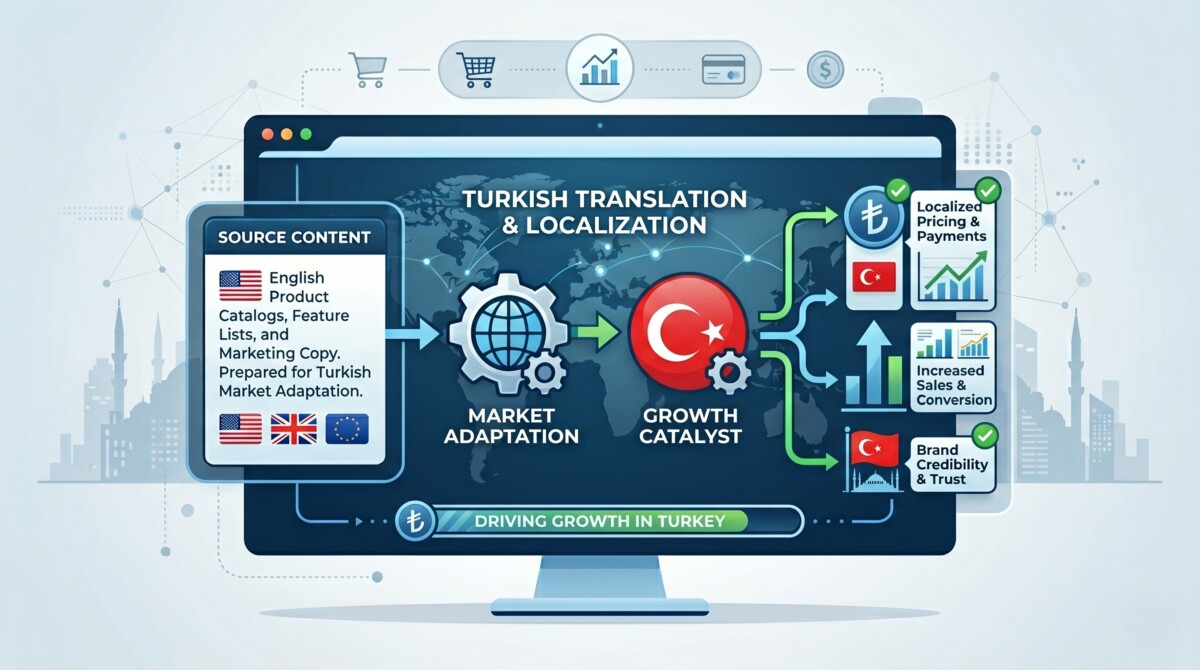
Fintech brands entering Turkey succeed or fail on localization, not translation. Turkey’s regulators require legally precise Turkish documentation, its payment rails are domestic only, and consumer trust depends on financial language that reads as native. Localization is the precondition for growth in this market, not the reward for it.
In financial services, a translation error is not a typo. It is a reason for a customer to decide you cannot be trusted with their money.
Turkey’s fintech sector has quietly become one of the most closely watched growth stories in emerging market finance. A young, digitally native population, a sophisticated banking infrastructure, and an assertive regulatory framework have combined to produce a market drawing serious international capital and equally serious competitive attention.
For global fintech brands looking to enter, and for Turkish fintechs expanding outward, the opportunity is real. So is the complexity. Turkey operates in Turkish, linguistically, commercially, and legally, and the distance between entering this market and earning credibility within it runs directly through language. A Turkish translation strategy that integrates financial software localization is not peripheral to fintech growth in Turkey. For the brands that get it right, it is the foundation.
Turkey’s fintech market runs on Turkish at every layer that matters: regulatory, commercial, and legal. A foreign brand that treats Turkish as a marketing translation problem rather than an operating requirement cannot legally launch, and it will not earn consumer trust even if it does.
The regulatory environment is Turkish by design. The sector operates under a multi-layered framework governed by the Central Bank of the Republic of Turkey, the Banking Regulation and Supervision Agency known as the BDDK, and the Capital Markets Board. Every compliance obligation inside that framework, from licensing applications to AML and KYC documentation to consumer disclosures and data protection notices under Turkey’s KVKK law, must be produced in precise, legally defensible Turkish. There is no English shortcut. A brand that cannot produce accurate Turkish compliance documentation cannot operate legally, regardless of how good its product is. This is where specialist Turkish translation services with legal and financial expertise stop being a line item to optimize on price and start being a condition of entry.
Consumer trust compounds the point. When you ask someone to share banking credentials or authorize a payment, the language you use carries an outsized trust signal. Stiff machine-translated copy, or terminology that does not match the register Turkish consumers expect from their banks, creates doubt at the exact moment a product needs to inspire confidence. That doubt shows up as abandoned onboarding and churn.
The payment infrastructure makes localization unavoidable. International wallets do not operate in Turkey. PayPal exited in 2016 after the BDDK declined to license it under local data residency rules, affecting tens of thousands of businesses, and Apple Pay and Google Pay still are not available as of early 2026, even after 2024 amendments eased cross-border data rules. Domestic alternatives such as Paycell and BKM Express fill that space inside the national banking system. Every payment-facing touchpoint has to be rebuilt around domestic rails and explained through Turkish flows that match how those systems actually work. This is the same discipline behind adapting to local payment methods and customer expectations in any new market.
Turkish translation changes fintech outcomes at four points in the user relationship: acquisition, onboarding, in-product experience, and support. Each one is a place where unclear Turkish quietly converts marketing spend into churn.
Acquisition and onboarding set the first impression, and it is almost always linguistic. App store listings, landing pages, and acquisition copy establish tone before anyone downloads anything. If that copy reads as translated rather than written, it signals to a Turkish consumer that the brand does not know them. Onboarding raises the stakes. KYC instructions have to be precise enough that a first-time digital banking user can finish identity verification without confusion. A mistranslation here does not produce a deferred decision. It produces an abandoned flow and a lost user the brand already paid to acquire.
Compliance communication operates under a different standard than any other content. A slightly off product description loses some conversion. A mistranslated regulatory disclosure creates legal exposure that no conversion rate offsets. Loan agreements, payment authorization forms, KVKK consent mechanisms, and AML disclosures all have to be both legally exact and plainly readable, two requirements that pull in opposite directions and need specialist linguists to reconcile.
Product microcopy is the operational language of the app. Transaction confirmations, error messages, balance notifications, and payment prompts have to be authoritative enough to signal institutional credibility yet clear enough that an error message is immediately actionable. That balance is hard to reach through direct translation, especially given how Turkish’s agglutinative structure interacts with UI character limits. Done well, it lowers in-app confusion and cuts support tickets generated by unclear states. Support and retention close the loop. Financial anxiety is the default state of a user who cannot complete a transaction, and the Turkish they meet in FAQs, chatbot flows, and escalation scripts decides whether they leave resolved or churned.
In financial services, a localization error does not just cost conversion. It creates legal exposure, regulatory action, and a trust collapse that no acquisition budget recovers. Every sector benefits from accurate localization. Financial services is the one where inaccurate localization causes the most damage, fastest, across the most dimensions at once.
The specific exposures are concrete. A single ambiguous term in a Turkish loan agreement can constitute a consumer protection violation. A misrendered interest rate disclosure, where the phrasing implies different terms than the product actually offers, invites formal action from the BDDK. A KVKK consent notice that fails to describe accurately how user data is processed is not a UX issue; it is a data protection breach. KVKK violations carry administrative fines that are revised upward each year for inflation and reach well into the millions of lira, figures that dwarf any saving from low-quality translation output.
Then there is trust. Turkish consumers who hit a translation error in a payment confirmation, a loan offer, or an account statement do not extend the benefit of the doubt. They reason, correctly, that a brand that cannot communicate clearly in Turkish cannot be trusted to manage their money carefully. That is why choosing a provider for this work is not a procurement decision made on price and turnaround alone. It calls for demonstrable fintech domain expertise, native Turkish linguists fluent in regulatory terminology, certified quality assurance, and the capacity to handle both high-volume product localization and precision-critical compliance documentation within one quality framework.
Treat Turkish localization as a continuous function sequenced before acquisition spend, not a one-time launch translation. The brands that do this convert the traffic they pay for. The ones that do not pay full acquisition cost and recover little of the revenue it was meant to generate.
Start with a Turkish-language audit before a single line of copy is written. A market-entry audit run by native Turkish fintech linguists identifies which content categories need full cultural rewriting versus light adaptation, which terminology choices signal institutional credibility, and where Turkish regulatory documentation diverges from what the brand already produces for other markets. That audit prevents the expensive rework that follows a launch built on translated rather than localized foundations.
From there, match the quality level to the risk. Not all fintech content carries the same exposure, and treating an error message and a loan agreement with the same process is how localization budgets get spent on output that creates liability instead of value.
Two sequencing rules follow. First, treat localization as a continuous function, not a project, because a brand that localizes once at launch will be running compliance documentation that no longer matches current regulation within 18 months. Second, invest in localization before acquisition spend, not after. The most common entry mistake is funding paid acquisition before the product experience is fully localized, which produces strong click-through from well-targeted Turkish ads, then onboarding drop-off from rough KYC flows, then support load from unclear copy, then churn. The same principle that governs ecommerce localization, not just translation applies here: a fully localized experience is the precondition for converting the traffic marketing generates.
The Turkey lesson applies directly to any Shopify merchant expanding into a non-English market: localization, not translation, is what earns trust and conversion abroad. The same gap that sinks a fintech in Istanbul sinks a DTC brand entering Germany, Japan, or Brazil.
Shopify Markets has made the storefront mechanics of cross-border selling genuinely easy. You can run multi-country storefronts, currencies, and localized experiences from one admin, and local payment methods activate automatically across most regions. What merchants underestimate is the part Shopify cannot do for you: the language and cultural fit that decides whether a shopper in a new market trusts the checkout enough to complete it. Only about 28 percent of Shopify stores sell internationally, and transparent local pricing has been shown to lift conversions by roughly 23 percent, while unclear pricing pushes up to 14 percent of shoppers to abandon their carts. Those numbers are illustrative of a consistent pattern: clarity in the customer’s own language is where cross-border conversion is won or lost.
The stage-aware move is the same one disciplined fintech entrants make. Establish excellence in one market before adding complexity. Localize the highest-trust touchpoints first, checkout, payment, returns, and support, in the local language, not just your product titles. Then expand market by market. For the full playbook, see the guide on selling internationally on Shopify with a structured, one-market-at-a-time approach. Whether you are a fintech entering Istanbul or a brand doing $1M months considering your first non-English market, the discipline is identical: outcome first, trust first, localized before you spend to acquire.
In Turkish fintech, language is not the packaging around the product. It is the product. Turkey’s market is maturing fast, and the competitive field is filling with domestic players built for Turkish consumers and international brands arriving with serious capital. The brands that establish themselves will not necessarily own the most sophisticated technology. They will own the deepest trust.
That trust is built in a thousand small places: every onboarding instruction, every transaction confirmation, every regulatory disclosure, all of it in Turkish that reads as if it were written there rather than converted from somewhere else. A reader who never notices the language is the goal. A reader who notices a seam in it is a reader deciding whether to leave.
Financial translation and financial software localization are not the supporting layer beneath a fintech brand’s Turkey strategy. For the brands that read this market correctly, they are the strategy. The same is true, in milder form, for any merchant crossing a language border: get the localization right before you scale the spend, and the market opens. Get it wrong, and you pay for traffic that was never going to convert.
Yes. Turkish regulators require legally precise Turkish-language compliance documentation as a condition of operating, not as an optional optimization. Licensing applications, AML and KYC documentation, consumer disclosures, and KVKK data protection notices all fall under a framework governed by the Central Bank of the Republic of Turkey, the BDDK, and the Capital Markets Board. There is no English-only path through it. A brand that cannot produce accurate, legally defensible Turkish documentation cannot launch legally, regardless of product quality. Because these documents have to be both legally exact and plainly readable, they call for certified human translation by linguists fluent in Turkish financial and regulatory terminology, with independent review before anything is filed or published.
Machine translation with light human post-editing is acceptable for low-risk content such as marketing pages and app store descriptions, but it is the wrong tool for regulatory and compliance material. The right approach matches quality level to risk. App store listings and landing pages carry reputational risk and tolerate machine translation plus editing. Onboarding and KYC flows carry conversion risk and need native fintech linguist review. Regulatory disclosures, legal terms, and compliance documentation carry legal and financial risk and require certified human legal-financial translation with independent review before publication. Treating an error message and a loan agreement with the same process is how localization budgets get spent on output that creates liability instead of value.
They are unavailable largely because of data localization and licensing rules that these companies have not met. PayPal stopped operating in Turkey in 2016 after the BDDK declined to renew its license under rules requiring payment providers to keep IT infrastructure inside the country. Apple Pay and Google Pay still are not available as of early 2026, with Apple’s absence also tied to fee disputes with Turkish banks, even after 2024 amendments eased some cross-border data restrictions. Turkish consumers use domestic alternatives such as Paycell and BKM Express instead. For a foreign fintech, this means every payment-facing flow has to be rebuilt around domestic rails and explained in Turkish that matches how those systems actually work.
A mistranslation in regulated fintech content costs far more than lost conversion; it creates legal exposure, regulatory action, and trust collapse. An ambiguous term in a Turkish loan agreement can constitute a consumer protection violation. A misrendered interest rate disclosure can invite formal action from the BDDK. A KVKK consent notice that misdescribes data processing is a data protection breach, and KVKK fines are revised upward each year for inflation and reach well into the millions of lira. Beyond the fines, Turkish consumers who spot a translation error in a payment confirmation or account statement tend to conclude that a brand which cannot communicate clearly in Turkish cannot be trusted with their money, which accelerates churn no acquisition budget recovers.
Yes. The localization-versus-translation distinction applies to any merchant entering a non-English market, not just fintechs in Turkey. Shopify Markets handles the storefront mechanics of cross-border selling, multi-currency, localized storefronts, and local payment activation, but it cannot supply the language and cultural fit that decides whether a shopper in a new market trusts your checkout. Only about 28 percent of Shopify stores sell internationally, and clear local-language pricing and copy measurably improve conversion. The disciplined move is the same one good fintech entrants make: localize your highest-trust touchpoints first, checkout, payment, returns, and support, establish excellence in one market, then expand. Localize before you scale acquisition spend, not after.





