
Email remains the highest margin retention channel for Shopify stores, returning an average of $36 for every $1 spent. Build the welcome, abandoned cart, and post purchase flows first, match your platform to your revenue stage, and add advanced segmentation only after those foundations produce revenue.
Most brands stuck at $300K do not have a traffic problem. They have a follow up problem they keep trying to fix with more traffic.
Roughly seven out of ten shoppers who start a checkout on a Shopify store leave without buying. That number has barely moved in a decade, and most merchants respond to it the same way: spend more on ads to replace the people who left. It works just well enough to feel like progress, and it gets more expensive every quarter.
The brands that break through the early revenue plateaus tend to do something quieter first. Before scaling spend, they build a system that follows up automatically with the people they already paid to attract: the new subscriber, the cart abandoner, the first time buyer. I watched this pattern repeat across hundreds of merchant conversations during my six years inside Shopify, and it holds whether you are doing $10K months or $1M months.
This guide covers the retention system in its simplest durable form: three automated flows, a platform decision matched to your stage, and a clear line on when complexity is earned and when it is premature. If you run paid traffic without this foundation, this is the highest leverage week of work available to you right now.
Email is still the highest margin marketing channel available to Shopify brands, generating an average return of $36 for every $1 spent according to Litmus research, with retail and ecommerce programs reporting returns at the top of that distribution. No paid channel comes close to that math, and the gap widens as acquisition costs climb.
The structural reason is ownership. Your email list is the only major channel where you control both the audience and the cost of reaching it. Meta and Google rent you access to your own customers and reprice that access whenever their auctions tighten. Your list does not reprice. A subscriber acquired in 2024 costs you nothing to email in 2026, which is why email economics compound while paid economics decay.
There is also a margin effect that founders feel before they can name it. Revenue from a paid ad carries the full acquisition cost against it. Revenue from an automated email carries almost none, so a dollar of email revenue contributes several times more profit than a dollar of cold traffic revenue. For a brand doing $50K a month at typical DTC margins, shifting even 10% of revenue from paid to owned channels can change whether the business funds its own growth or keeps borrowing against next quarter’s ad budget.
Whether you are pre-launch or running an eight figure operation, the principle holds: email is not a side channel to set up eventually. It is the margin engine that makes every other channel affordable.
An email retention system is a set of automated flows triggered by customer behavior, not a weekly newsletter sent on a calendar schedule. The distinction matters more than any tool choice you will make. A campaign goes to everyone at a time you picked. A flow goes to one person at the moment their behavior signals intent: they subscribed, they abandoned a checkout, they received their first order.
The revenue gap between the two approaches is not subtle. Klaviyo’s benchmark data across hundreds of billions of sends shows behavior triggered flows generating dramatically more revenue per recipient than broadcast campaigns, and I broke down exactly how that architecture fits together in my guide to Klaviyo lifecycle marketing flow architecture. The short version: flows reach people at high intent moments, campaigns reach people at convenient moments, and intent wins.
The other defining property of a system is that it runs without you. A newsletter requires you to show up every week with something to say. Flows are built once, then improved quarterly. For a founder wearing six hats at the $0 to $500K stage, that difference decides whether email actually happens or lives permanently on the someday list.
This is also why I push back when early stage merchants tell me they “do email” because they send a monthly promo blast. A promo calendar is fine. It is not a retention system. The system is the automation layer underneath, and it is worth building before you write a single campaign.
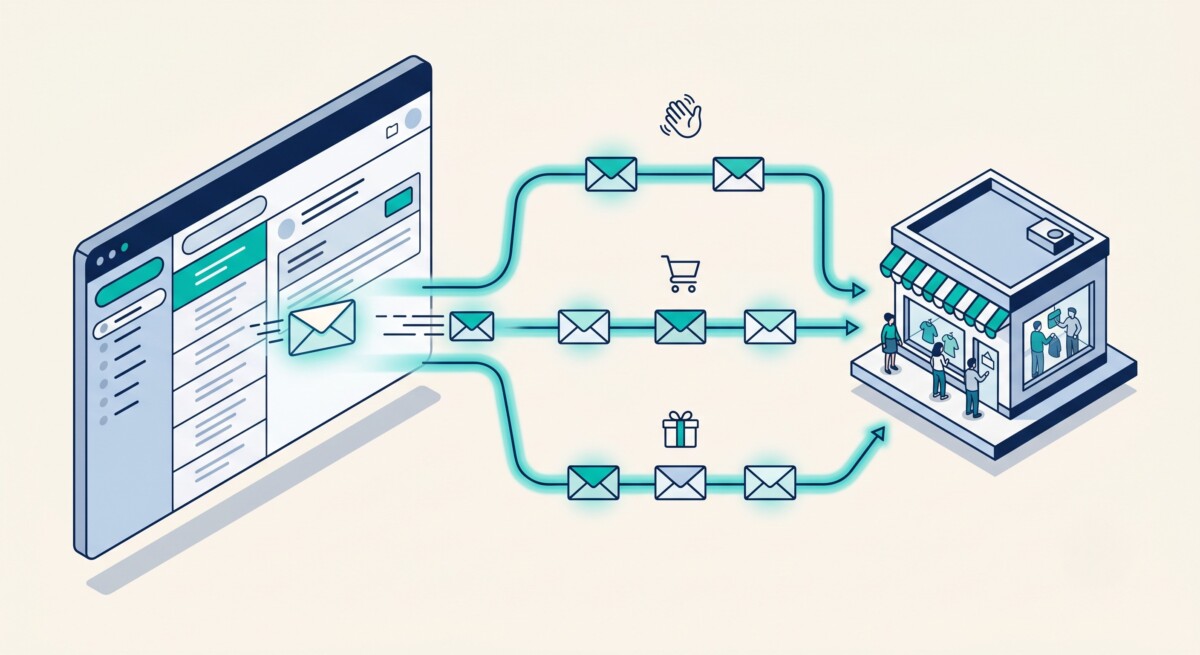
Build your welcome series first, your abandoned cart flow second, and your post purchase sequence third. These three cover the highest intent moments in the customer journey, and together they typically account for the large majority of automation revenue a store generates.
The welcome series converts the subscribers your popups and lead magnets capture. Three emails over five to seven days is enough: introduce the brand and founder, address the most common pre-purchase objection, then make a clear first offer. Subscribers in their first week are the warmest non-buyers you will ever have, and most stores let that window close in silence.
The abandoned cart flow is the most directly measurable money in email. Klaviyo benchmarks put abandoned cart open rates above 40%, and a well built three email sequence over 48 to 72 hours routinely converts around 10% of recipients. I covered the structure in detail in these abandoned cart recovery strategies, but the core is simple: a reminder within the first hour, an objection handler at 24 hours, and a final nudge (with an incentive only if your margins allow it) at 48 to 72 hours.
The post purchase sequence is the one most stores skip and the one that compounds longest. A thank you with delivery expectations, a usage or care email once the product arrives, and a review or replenishment ask two to three weeks later. This is where one time buyers become repeat customers, and repeat rate is the metric that separates brands that scale from brands that churn through audiences.
Choose your email platform based on your revenue stage and the behavioral data you need, not on the feature list of the biggest name in the category. The most common platform mistake I see is not picking a bad tool. It is paying for a $50K a month tool while running a $5K a month store, or the reverse: outgrowing a starter tool and losing a year of behavioral data you can never recover.
If you are pre-launch through roughly $10K to $20K a month, almost any reputable tool with Shopify integration and solid automation will do the job, and price matters more than depth. Independent roundups of email marketing platforms built for small businesses are a useful starting point at this stage, because they compare the free tiers, sending limits, and automation features that actually constrain a small store, rather than enterprise capabilities you will not touch for years.
From roughly $20K a month upward, the calculus changes because behavioral data starts paying for itself. This is where Shopify native depth matters: viewed product, added to cart, and predictive analytics events that generic small business tools track loosely or not at all. Klaviyo is the category leader here, and I published a full Klaviyo review for Shopify brands at every stage covering exactly when its pricing is justified and when it is a cost center.
Klaviyo is not the only credible answer, and treating it as the default is its own form of premature complexity. Omnisend offers stronger unit economics for stores under $200K annually, Mailchimp remains serviceable for content led brands, and several challengers compete hard on price. I compared the field in my breakdown of Klaviyo competitors and alternatives. The honest guidance: match the tool to your current stage, confirm it can export your data cleanly, and plan to revisit the decision when email becomes a top two revenue channel.
Add segmentation, SMS, and advanced lifecycle flows only after your three foundation flows have run for at least 60 days and produce measurable revenue. Not before. The single most consistent failure pattern I have watched at the $500K to $2M stage is premature complexity: eight flows half built, twelve segments nobody maintains, an SMS program launched before the welcome series converts.
The 18 month filter applies here the same way it applies to every tool decision. Before adding a capability, ask whether it will still matter to your business in 18 months. Foundation flows pass that test at every stage. A sunset segment strategy or a predictive churn model passes it at $2M and fails it at $200K, because at $200K your constraint is list size and offer clarity, not segmentation sophistication.
A reasonable maturity path looks like this. From $0 to $20K a month: the three flows plus one campaign a week, nothing else. From $20K to $80K: add browse abandonment, a win back flow, and basic engagement segmentation. Beyond that: SMS, predictive analytics, and the deeper lifecycle architecture, ideally with a dedicated owner, because at that stage email is a part time job at minimum.
The discipline is harder than it sounds, because every platform’s marketing pushes you toward its most advanced features. Resist it. A store with three excellent flows will outearn a store with twelve mediocre ones, and the team running three flows actually understands why their numbers move. Build the foundation, let it bank revenue for two months, and let the data tell you what to add next.
Yes, email marketing is still worth it for small Shopify stores in 2026, and it is arguably more valuable now than five years ago because paid acquisition costs keep rising. Email returns an average of $36 for every $1 spent across industries, and ecommerce programs report returns at the top of that range. For a small store, the practical advantage is that automated flows run without daily effort: a welcome series, abandoned cart flow, and post purchase sequence built once will recover revenue every week while you focus on product and fulfillment. Free tiers on most platforms mean the starting cost is effectively zero.
Set up your welcome series first, your abandoned cart flow second, and your post purchase sequence third. The welcome series converts new subscribers during their warmest window, the first five to seven days after signup. The abandoned cart flow recovers checkouts that were started but not completed, and a three email version over 48 to 72 hours typically converts around 10% of recipients. The post purchase sequence turns first time buyers into repeat customers through delivery updates, usage guidance, and a review or replenishment ask. Together these three flows cover the highest intent moments in the customer journey and generate the majority of automation revenue for most stores.
Choose an email marketing platform by matching it to your current revenue stage rather than buying for a stage you have not reached. Under roughly $20K a month, prioritize price, a native Shopify integration, and solid automation; most reputable small business platforms clear that bar. Above $20K a month, behavioral data depth starts paying for itself, which is where Shopify native platforms like Klaviyo and Omnisend justify their cost through viewed product tracking, predictive analytics, and revenue attribution. Whatever you choose, confirm the platform exports your data cleanly so a future migration does not cost you your subscriber history.
Switch to Klaviyo when email becomes a top two revenue channel for your store and you need behavioral data to keep growing it, which for most Shopify brands happens somewhere between $20K and $50K in monthly revenue. The clearest signals: you want flows triggered by viewed product or added to cart events your current tool cannot see, you are spending more than a few hours weekly working around platform limitations, or your segmentation needs have outgrown basic list tags. Switching earlier means paying premium pricing for capabilities you cannot use yet. Switching much later means losing months of behavioral data that Klaviyo cannot capture retroactively.
Most Shopify stores should send one to two campaign emails per week on top of their automated flows. Flows do not count against this cadence because they reach individuals based on behavior rather than blasting the full list. One weekly campaign is enough to stay present in the inbox without exhausting your list, and two works well for brands with strong content or frequent product drops. The more important discipline is consistency: a store that sends one good email every week for a year will outperform a store that sends four emails one month and none the next. Watch unsubscribe and spam complaint rates, and pull back if they climb past your platform’s benchmarks.





