


If you were to ask a marketer a decade ago if they could predict the future of eCommerce, you’d be hard pressed to get an answer that resembles today’s landscape. No longer does the customer journey start and stop on your website — it is a web of various touch-points along the way. The evolution of the customer journey has become more complex from its linear beginnings. . From discovery to purchase (and for the continuous cycle), merchants typically have numerous channels to track and nurture.
Generally speaking, advertisers utilize many different marketing channels to enhance customer acquisition and retention.
Acquiring new customers has always been challenging (and expensive, especially during peak times) — but having a strong customer acquisition strategy is key.
In this bog, we’ll explore why if you’re not taking advantage of performance marketing within your customer acquisition strategy, you should be. There are three main factors that contribute to the attractive nature of performance marketing and why it works: cost, risk, and transparency.
If we want to get technical, the Performance Marketing Association defines performance marketing as “online marketing and advertising programs in which advertisers pay marketing companies when a specific action is completed, such as a sale, lead, or click.”
Simply, this means, as a merchant, you do not pay unless there is a specific action. This can be very favorable as a brand.
These benefits and more come together to form a viable option with far less risk, typically resulting in a lower cost for customer acquisition.
 Source: Klickly.com
It’s no secret, the cost of customer acquisition is rising.
The goal of any digital advertiser is to maximize revenues and protect the ROI. They’re tasked with acquiring new customers and retaining existing ones — but you don’t need me to tell you that. We’ll focus on the former: acquiring new customers.
While the customer acquisition cost (CAC) will vary by brand, platform, and even product, the price has risen over 50%. Because of these variables, brands are always looking for different ways to improve their CAC.
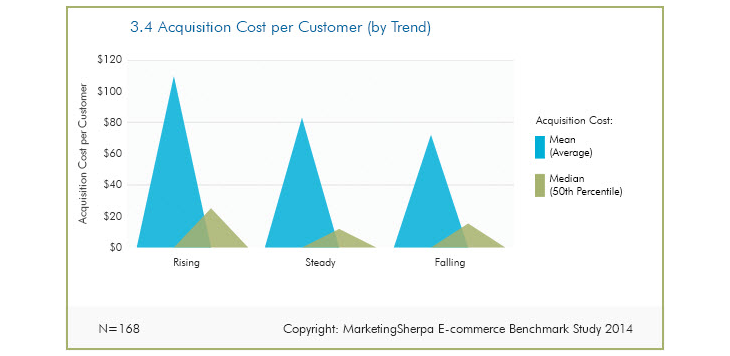 Performance marketing is often much cheaper.
There is no question that traditional digital advertising works. I’d be shocked to find a marketer who doesn’t use a combination of display, social, email, content, search, etc. According to eMarketer, marketers spent $129.34 billion dollars on digital advertising in 2018 alone. But there is one issue: the majority of those channels don’t have a way to guarantee performance in the same way performance marketing does.
Brands and advertisers spend a lot of money on advertising in the form of a budget, paid upfront. This upfront spend is put toward advertising your products, which in turn results in clicks and — hopefully — sales. However, that last action isn’t always guaranteed.
With performance marketing, the risk doesn’t fall on the merchant but goes to the advertising company itself. They assume the liability because you (this part might ring a bell) only pay when there is a successful outcome. This is great news for brands that can then redistribute the extra money they would have spent on an upfront budget to other channels — or put it towards their beach house if that’s more your style. This added flexibility allows you to scale and compete.
It’s easier to plan your budget.
As mentioned, our goal to maximize our ROI — which can be challenging when you’re looking across the sea of marketing channels you’re likely using. While the majority of marketing platforms allow you to set a budget, performance marketing platforms have an advantage.
Performance marketing campaigns are easy to budget for. Marketers typically have to identify their goals and provide an ideal CPA (cost-per-acquisition) when planning.
From there, the clarity in tracking allows brands to make modifications when needed. If one strategy isn’t working, it’s relatively easy to explore a different angle. Eventually, the results will either support your approach or convince you to pivot.
One other benefit is that outcomes are a priority throughout performance marketing campaigns, meaning your ads will be optimized for your goals — be it impressions, clicks, leads, sales or whatever else your goal may be.
The majority of revenue comes from existing customers.
So, you’re now using a combination of traditional digital and performance-based marketing to get new customers. Fantastic! Now, you want to make sure you’re giving an equal amount of love to your retention efforts.
Retention comes in many different forms: email, social media, display, video, loyalty programs, and more — the list goes on and on. Whether you’re using email automation or push notifications, you want to make sure you’re nurturing your existing customers — especially when existing customers are nearly 65% more likely to purchase products, and spend nearly 31% more so than first time purchasers.
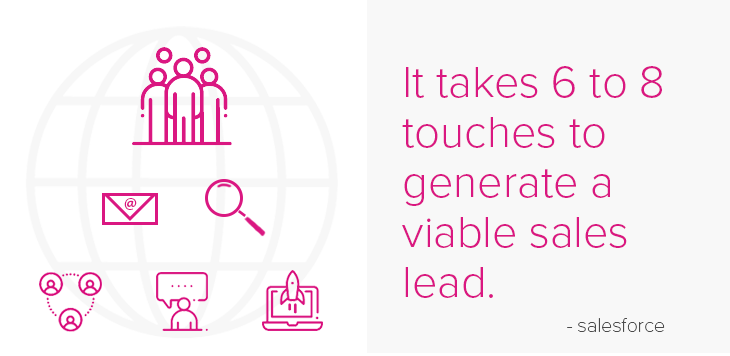
With an average of 6-8 touch-points required across many channels before a conversion happens, you want to ensure you’re using the right platforms and tools to extend your marketing budget.
 New customers help fuel your retention strategies
Without customers, there is no retention. Without new customers you’re limited to how much you can squeeze out of your current client base. Hopefully, by now, you understand why performance marketing strategies are a good option when it comes to customer acquisition. Typically, it costs five times as much to attract a brand new customer than it does to keep an existing one, but performance marketing can help ease some of that burden on your ROI.
Opting to add performance marketing to your marketing stack can help drive additional customers at a reduced cost — and having a great life-time value (LTV), can have a significant
If you’re ready to take the dive and see if your business is ready for performance marketing, I have some parting thoughts and tips when thinking about your strategy.
This article originally appeared in the FirePush blog and has been published here with permission.





