


Whitney Blankenship
Content Marketing Manager
Reading Time: 6 minutes
Customer Lifetime Value (CLV) is one of the most important metrics you can track for ecommerce. Not only does it help you pinpoint which of your customers are your best customers, but it helps you learn how to transform shoppers into customers that spend more, buy more often, and stay with your brand longer.
In this piece, we’ll dive deeper into the CLV formula, how to calculate CLV for ecommerce, and some strategies for improving your CLV.
Customer lifetime value is the amount of total value (in terms of revenue) that you can expect from a customer throughout their lifetime as your shopper.
Want a fool-proof email marketing strategy that keeps customers coming back for more? Try Omnisend free for 14 days!
It costs more to acquire new customers than it does to retain existing ones. Customer lifetime value goes beyond shot-in-the-dark customer retention strategies and allows you to identify exactly where you can get more value out of your existing customer relationships.
What CLV helps you understand:
Information is power, and the more information you have on your customers, the better you’re able to increase the value they bring to your store.
When calculating customer lifetime value, you need to do a few calculations first. What you need to know is:
The average order value is simple enough to figure out. Take your total amount of revenue, and divide it by your total number of purchases.
Average purchase frequency, or repeat purchase rate, is also an easy calculation: average the number of purchases each customer makes in a single year.
From here, you simply multiply your average order value by your average purchase frequency and then multiply that by the average number of years in your customer’s lifetime.
The simplest way to calculate CLV looks like this:
CLV = AOV x Purchase Frequency x Customer Lifetime
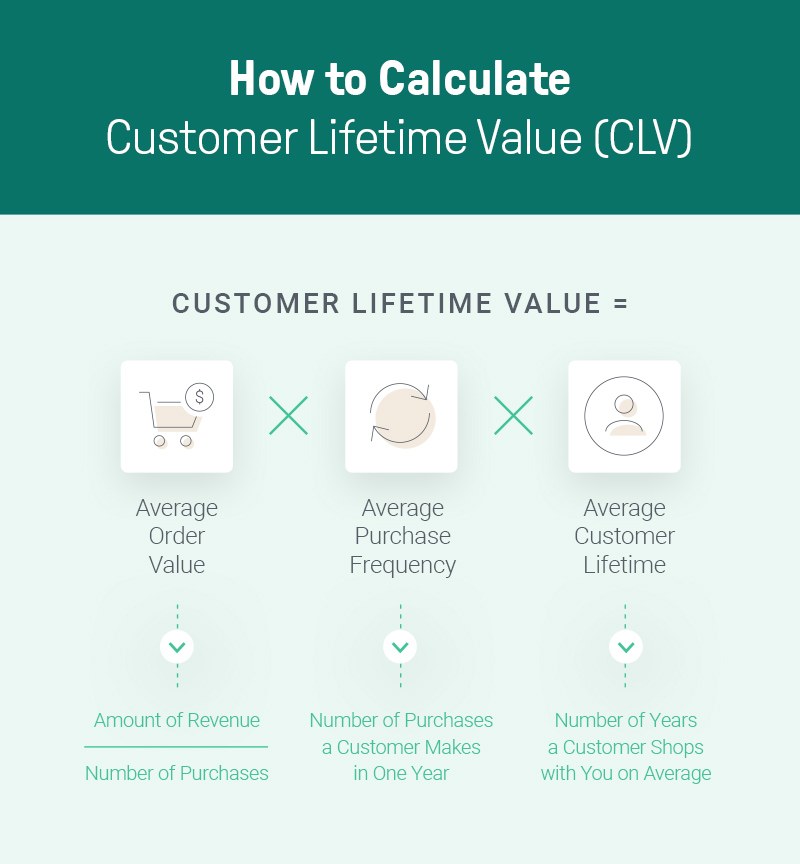
Okay, so let’s take this formula and break it down practically. Say you have an average order value of $50, and your average customer purchases six times a year and shops with you for around five years or so in their lifetimes.
To figure out your CLV, you’d formulate it this way:
CLV = 5 x 50 x 6
CLV = $1500
This helps put your CAC in perspective. If you’re paying $15 to acquire a new customer, this is great news. However, if you’re paying $2000 in customer acquisition, then you’ve got work to do.
What’s significant about this formula is that you can determine exactly where you need optimization. For example, if you’ve got the same AOV and repeat purchase rate, but your customers only stick around for one year, then you need to work on retaining customers after that first year.
If your retention rate is great, and your repeat purchase rate isn’t the issue, then you need to work on your average order value.
CLV helps you make actionable decisions about how to treat your customers moving forward and what concrete actions to take to increase your revenue.
Improving customer lifetime value is centered around retention strategies, which are unique for ecommerce stores. Once you’ve calculated your CLV, you know where your biggest opportunities for growth lie.
Use the CLV formula to spot these opportunities and adjust your strategy accordingly.
Create automation workflows that keep your customers hooked—try Omnisend free for 14 days!
Customer retention, regardless of your current retention rate, should always be a priority for online sellers. Your existing customers are far too valuable to give up. If you need to improve your retention, or simply maintain a healthy retention rate, these strategies will help you do so.
Check out our Cart Insiders Episode on Post-Holiday Customer Retention and Loyalty!
For more excellent ways to keep your customers coming back for more, check out our piece on 9 customer retention strategies that actually work.
Increasing your average order value is a great way to simultaneously amplify your customer lifetime value, and the best part is that these strategies increase your revenue exponentially.
Increasing AOV is such a simple way to earn more revenue and make calculating CLV work for you.
We know that the more frequent a customer purchases from you, the more likely they are to make a future purchase. Increase the number of purchases your customers make over their lifetime with these strategies.
These various strategies for customer retention, AOV, and repeat purchase rate are relatively simple to implement, and they all work together to increase your CLV. Even if you have a solid customer lifetime value, neglecting these strategies means you’re leaving money on the table.
Increasing your CLV is the most sustainable way to increase your revenue. Unlike quick tricks and tips, improving CLV is an investment in the health of your ecommerce store. By investing in your customers first, not only will they be more loyal to your brand, but they’ll reward you by spending more and purchasing more often.
What are your best tips for improving your CLV? Tell us below!
Get marketing automation that keeps you closer to your customers. Try Omnisend free for 14 days!






