

Time is money. You’ve probably heard the adage repeated ad nauseam, but it’s not just a clever turn of phrase.
In the business world, time and money are nearly interchangeable; a lot of time can be spent making money, and with a lot of money, you can pay others for their time.
But what do you do if you’re low on both?
First-time entrepreneurs might be brimming with passion and enthusiasm, but lacking experience can make it harder to secure financing. Without the money to hire employees, they’ll need to commit much of their own time.
Thankfully, there’s a solution for first-time entrepreneurs: starting a dropshipping business.
Dropshipping is a retail business model wherein products sold by an online retailer are manufactured, warehoused, and shipped by a third-party dropshipping company.
Under a dropshipping business model, rather than purchasing large quantities of stock from a supplier, an online store will buy a single item directly from the manufacturer only after the payment is transferred from the customer’s credit card.
Dropshipping has many advantages for first-time business owners. In the initial stages of your business, you won’t have many employees, if you have any. Delegating the fulfillment of your order to a third party helps free up time that can be spent focusing on marketing, customer support, and growing your brand.

Since dropshipping delegates much of the grunt-work of starting a business to a third party, it has a lot of advantages for merchants looking to grow their business:
Let’s take a closer look at how dropshipping works, and go over some of the options for automating your online business.
All dropshipping companies perform the same function, but they can differ greatly when it comes to their costs, products, policies, and ease of use. All dropshipping success stories are unique, so the “right” dropshipper for one brand could be completely wrong for another.
When looking over options for your dropshipping store, it’s important to pay attention to the types of products the company sells, whether their service charges and shipping fees fit into your budget, and whether their shipping times are reasonable for the location of your customers.
To make it easy, we’ve compiled a list of the best dropshipping companies that we’ve come across. We’ll talk about each dropshipping service and tell you what kinds of merchants we recommend them for.
Let’s get started:
Spocket is an order fulfillment service that connects you with a vast network of wholesale merchants, primarily based in the United States and Europe, making it a top choice for dropshipping suppliers in the USA. Additionally, it features merchants from Canada, Asia, Australia, Brazil, and other countries, ensuring a global reach for your dropshipping business.
With the Spocket plug-in, you can browse merchants’ products and add them to your Shopify store in one click. Spocket also automates the entire order process, with products shipped to your customers at the point of purchase.

One of the biggest highlights of Spocket is its branded invoice feature, which allows you to create a custom invoice for your brand that’s shipped alongside your products. Branded packaging can go a long way in building brand awareness and acquiring repeat customers.
AliDrop is a dropshipping platform that connects you with suppliers offering a wide range of products from AliExpress, Alibaba, or Temu and helps in AliExpress Dropshipping, Alibaba Dropshipping, and Temu Dropshipping. It provides an automated solution for sourcing and fulfilling orders, particularly focusing on fast shipping from US and EU suppliers. Ideal for merchants looking to scale their business efficiently, AliDrop integrates seamlessly with Shopify, making it easier to manage your store and fulfill orders without hassle.
With AliDrop, you can browse products, import them directly to your Shopify store, and automate the entire fulfillment process. One of its standout features is the VIP chat support, which ensures you can resolve any issues quickly and keep your operations running smoothly.
Price: Plans start at $39/month for up to 50 products, with a free 7-day trial available for first-time users.
Advantages:
Disadvantages:
Recommended for: Entrepreneurs seeking a reliable dropshipping solution with access to fast shipping and winning products from US and EU suppliers, and who want to automate their order fulfillment process.
When it comes to variety of products, few dropshipping companies can compete with AliExpress. The online retail service, which launched in 2010, features more than 100 million products, meaning it’s likely that no matter what business you’re in, you’ll find something to sell.

If you plan on dropshipping with AliExpress, the best option to use in your Shopify store is the DSers app. Under its free plan, the DSers-AliExpress Dropshipping plug-in allows you to explore AliExpress’s enormous collection of products and add them to your store in just a few clicks.
Under its Advanced plan—which is still less costly than the alternatives—you’ll get access to automation features that pull new orders from your store, ship products to your customers, and mark orders as fulfilled—all without you having to lift a finger.
SaleHoo is a research tool and supplier directory for dropshippers, wholesalers, and ecommerce stores. The SaleHoo database includes over 8,000 wholesale distributors and dropship suppliers, with over 1.6 million wholesale products.
With SaleHoo, merchants gain access to the SaleHoo Market Research Lab, which provides in-depth data and sales insights on each product available. This means that merchants can see how well products have done in other stores, and on online marketplaces like eBay and Amazon, before adding them to their own.

SaleHoo even lets you see how many other retailers are selling each product, meaning you can factor in its availability when building your brand. This is perfect for merchants looking to add their brand’s own spin on a product they know is in high-demand, or to take their chance at offering exclusivity of a product that’s harder to find.
Blanka is a platform designed for entrepreneurs looking to start or scale a dropshipping business in the beauty, skincare, or hair care sectors. With Blanka, merchants can access a wide range of North American-made products that are ready to be branded with their own logo.
Blanka eliminates the common challenges of dropshipping by offering zero minimum order quantity (MOQ), zero risk, and zero commitment. This makes it an ideal choice for those new to the business or looking to expand their product line without the usual upfront costs.

Through its integrations with Shopify, Wix, and WooCommerce, Blanka provides a seamless experience for adding products to your online store. This allows merchants to easily manage their inventory, branding, and fulfillment, ensuring smooth operations from start to finish.
SourcinBox is a dropshipping agent and sourcing supplier that works directly with manufacturers and factories in China. It has a strong connection with dropshippers from the United States, Germany, Brazil, and many other countries and regions. It has integrated with major ecommerce platforms and is actively engaged in upgrading and broadening services.
SourcinBox helps handle everything you need for carrying out your business including product sourcing, quality control, customizing products or packaging, warehousing, and shipping products to your end customers, whether you are doing dropshipping or private label business.

Once you’ve connected your store with SourcinBox, the store orders will sync to SourcinBox automatically. And you can place hundreds of orders in bulk on the app. Once the orders are shipped, the real-time tracking numbers will be updated in your store and your customers’ mailboxes.
Shopify App: Yes
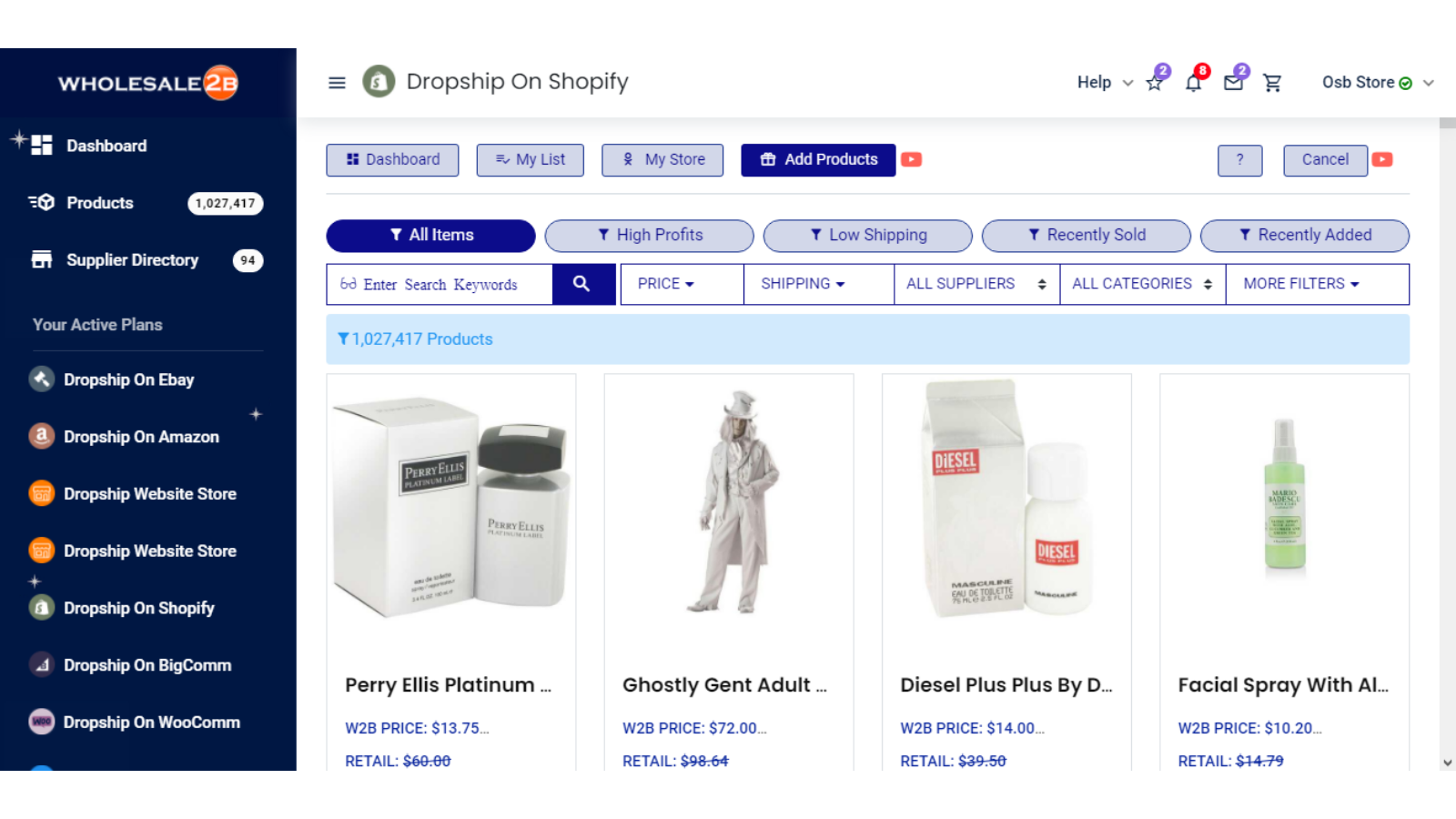
Wholesale2b offers over a million products from wholesale suppliers based primarily in the United States and Canada, meaning if you’re selling to customers in North America, Wholesale2b will be able to connect you with local suppliers to keep your shipping costs low.
Wholesale2b’s Shopify app pulls orders from your store, sends them to your selected dropshipper to be fulfilled, and even adds tracking information once the package is shipped—all automatically. It also has built-in integrations with Amazon and eBay.
Modalysts is an automated dropshipping app known for carrying big name luxury brands like Dolce & Gabbana, DSquare, Calvin Klein, and a lot more. Selling products from companies your customers already love can give a big boost to your own brand’s reputation in their minds.
For US-based merchants, Modalyst offers a marketplace of US suppliers that can ship domestic orders in six to eight days. Even if you’re not based in the US, Modalyst’s group of wholesale suppliers ship to more than 80 countries worldwide. The app also has an API partnership with AliExpress, meaning that by using the Modalyst chrome extension, you’ll get access to the millions of dropshippers on that marketplace.

Modalyst even curates collections of products made from sustainable materials from eco-friendly suppliers, for merchants looking to reduce their carbon footprint. Plus, you can add your own branding to your products, through the Modalyst Private Label Dropshipping Program.
Doba is a dropshipping platform that offers suppliers based mostly in the United States and China. For merchants in either location, Doba offers an easy way to sell local products with fast shipping times.
Doba’s most unique feature is its automated pricing rules. Rather than price products manually, merchants can create “rules” to price their products at a fixed markup on the wholesale price. When suppliers change their prices, the automated price changes too.

Inventory Source is a dropshipping platform and order management tool that facilitates relationships between dropshippers and retailers, allowing them to sync products and inventory, and automatically transfer fulfillment information.
The app directly connects stores to suppliers without charging any additional fees for the products, allowing merchants to build a more personal relationship with their suppliers and offer products at a much lower cost.

But its most unique features is this: since Inventory Source is primarily a stock management tool, it’s the only option on this list that actually allows you to add your own dropshippers—though custom integrations do come with an added cost.
Unlike the other entries on this list, Wholesale Central is not an app, tool, or platform, but rather a directory of dropshippers, suppliers, and wholesalers. For both buyers and suppliers, Wholesale Central offers an easy way to find tons of potential business partners.
On Wholesale Central, store owners can browse products and suppliers, or search for products and suppliers by name. When they find a product or supplier they’re interested in working with, they’re provided with contact information to reach out to that supplier.

Although Wholesale Central doesn’t offer any inventory management tools, it’s a free and vast resource that includes tons of dropshippers and suppliers that can provide your store with products.
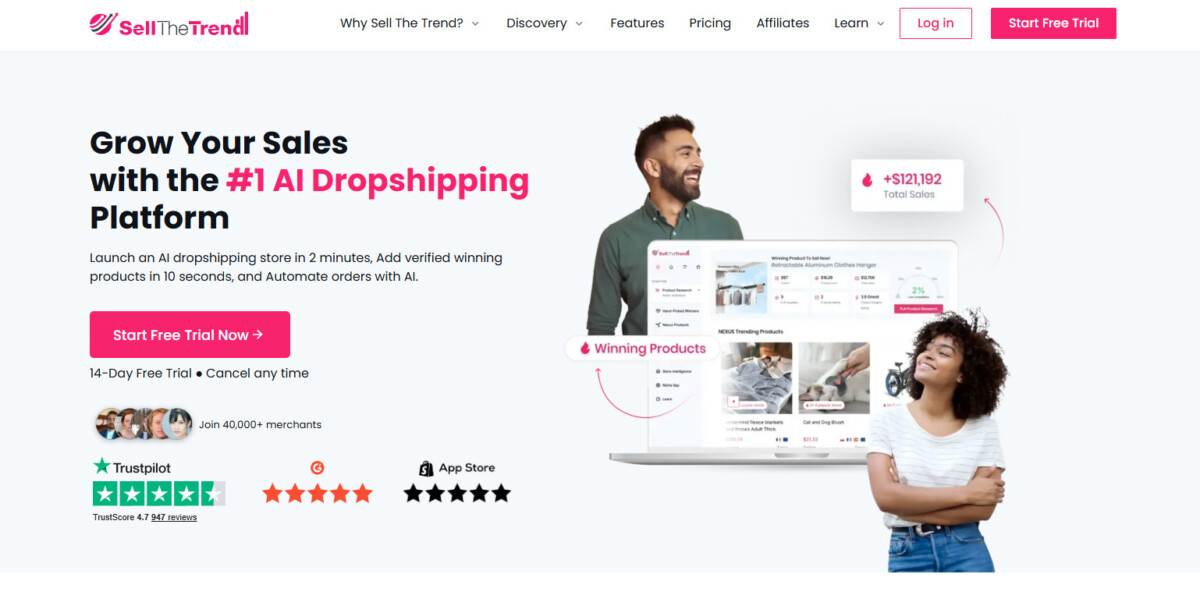
Sell The Trend is an all-in-one dropshipping platform designed to help entrepreneurs start and grow their online stores without handling inventory. It simplifies the entire dropshipping process from finding trending products to adding them to your store and automating order fulfillment.
Established in 1999, Worldwide Brands is one of the oldest and most trusted supplier directories among veteran retailers. Dropshippers on Worldwide Brands must meet a set of criteria and established guidelines that helps ensure high-quality wholesalers.
Like Wholesale Central, Worldwide Brands is a directory of suppliers and dropshippers open to working with new retailers. While it might not offer much automation, it does include more than 16 million certified wholesalers, a wide range of wholesale products, and a dedicated list of certified dropshippers, if you’re looking for dropshippers specifically.
Learn more: Amazon Dropshipping Guide: How To Dropship on Amazon

If you’re an artist, designer, writer, or just an especially creative entrepreneur, you might find that dropshipping companies limit your ability to create a unique aesthetic for your brand. If that’s the case, you should consider using print-on-demand companies to dropship your own custom products.
Print-on-demand dropshipping is a business model where you work with a supplier to customize and design your own products, usually easily printed things like t-shirts, mugs, tote bags, posters, blankets, pillowcases, tapestries, and more!
Neither business model is “better” for every merchant, but both methods have advantages and disadvantages that could make them the better choice for your business idea:
| Print-on-Demand | Dropshipping |
|
|
|
|
|
|
|
|
|
|
|
|
If you’re a more design-oriented merchant with artistic sensibilities, you’ll find it very rewarding to build your own brand through custom-designed products. If you’re not, you might find it difficult and time consuming.
If your strength is in marketing, then you’re likely to have success in dropshipping, which doesn’t require you to design your own products, but curate them. Either way, you should have a good eye for branding.
And keep in mind that you don’t need to limit yourself to just one model of order fulfillment. You could, for example, build a fashion brand that includes your own custom-designed shirts and bags alongside dropshipped accessories like jewelry, hats, and gloves.
Learn more: Print on Demand: A Low-Risk Way to Sell Custom T-Shirts, Books, and More

If a dropshipping business is starting to look like the perfect option for your next business, you’re probably wondering where to get started. Let’s take a look at the steps to building a dropshipping store:
The first step to starting your business is coming up with a product idea. Remember that with dropshipping, you’re curating products around a brand, so your primary focus should be on the visual aspects of your brand.
It’s important to choose a brand and product that interests you. Not even the best business idea will take off without being fueled by the passion of its founder. Find something you like. Don’t choose an idea that’s uninteresting to you just because you think it will sell well.
Sometimes the dropshipper themselves can serve as inspiration. You could try browsing some of their products and seeing if there are ones that “fit” together and might serve a commonly under-served niche.
Once you have an idea, you’ll be able to identify your primary competitors and perform a competitive analysis. A competitive analysis is an in-depth exploration of your competitors’ business strategies: their target markets, branding, key features, price points, and ecommerce websites.
Doing this will help you to evaluate their strengths and weaknesses, and highlight opportunities to outperform them when developing your own brand. Understanding your competitors will help you to identify what makes your own brand unique.
With your market research out of the way, your next step will be finding a dropshipping supplier that carries the goods you need to build your brand. There are a ton of suppliers that can be found via the websites listed here, but keep in mind that you don’t just have to use one supplier.
Supplier directories like Wholesale Central and Worldwide Brands are great for finding a retailer that carries a specific product. They can also be really great for brainstorming ideas and spotting under-served niches.
Many dropshipping companies connect directly to products in your Shopify store, so you could also sell products from different dropshippers alongside your own products, if you wanted.
With your dropshipper(s) selected, you’re ready to start your online store. Remember that maintaining your store will be an ongoing process, so you can always add new products and adjust your branding based on what’s working and what isn’t.
What’s most important is that you’ve made sure everything on your website functions as it should and that customers don’t hit any snags in the process of making a purchase. Check out our Shopify store launch checklist to make sure you’ve got everything ready for your launch.
With your store live, it’s time to start bringing in traffic. If you’ve built up a following on social media or within an online community, you may have customers at-the-ready who you can direct to your store right away. In most cases though, you’ll need to start identifying your target audience.
Find online communities dedicated to your product. Attend in-person trade shows and pass out business cards. Develop a social media marketing strategy to build your following online. And don’t forget to stay tuned to the news in communities that connect with your product, so you can stay on top of the latest trending products in your industry.
Learn more: How to start a dropshipping business

When you start a Shopify store, you’ll be able to integrate product sourcing apps that help automate the process of shipping and dropshipping fulfillment in your online business. With dropshipping, a third-party company directly sends orders from your store and then sends the orders out to your customers, all without you having to lift a finger.
Dropshipping products frees up a lot of time for you to focus on other important aspects of starting a business, like SEO marketing, branding, and customer service. It also means you don’t have to pay for stock until it’s sold, making it nearly impossible to incur losses on products.
For new merchants, the amount of time and money saved through dropshipping is unparalleled. With no costs on stock and no need to employ others to ship products, dropshipping is a low-risk business venture that’s perfect for first-time entrepreneurs.
The cheapest dropshipping site is Wholesale Central, which is free. However, Wholesale Central is only a directory of dropshippers who carry specific products, so the dropshippers themselves may still charge fees.
The cheapest dropshipping app is DSers‑AliExpress Dropshipping, which has a free plan that lets you add up to 3,000 products. Its Advanced plan—which allows up to 20,000 products and additional automation options—is the second-cheapest option, at $19.90/month.
If you’re looking for the best dropshipping products, most dropshippers will list their bestsellers on their website. Keep in mind, though, that how well your products sell depends a lot on outside factors, like your marketing and business plan.
No, not all website-building platforms include features that let you easily integrate dropshipping platforms. However, any website built on Shopify will let you integrate dropshipping features from a number of different dropshippers.
Dropshipping tends to be very profitable, because overhead costs can be kept low, since you don’t need to store or purchase stock before selling it.
No, not all website-building platforms include features that let you easily integrate dropshipping platforms. However, any website built on Shopify will let you integrate dropshipping features from a number of different dropshippers.
Dropshipping has very low overhead costs because stock doesn’t need to be purchased before it’s sold. Dropshipping also offers more location flexibility, frees up more time, and makes it easier to test new products, in comparison to other types of businesses.





