


A recovery time objective (RTO) is one of the main parameters within a disaster recovery strategy. It defines the maximum length of time your systems can be down before there are negative impacts on your business.
Determining an appropriate RTO for each of your services lets you gauge whether you’re meeting your service level agreements (SLAs) with customers. It also informs whether you’re able to restore service within an acceptable time frame. Regularly breaching your RTOs after incidents is a sign that your disaster preparedness needs more attention.
In this article, you’ll learn why RTOs matter, how they contribute to disaster recovery, and the techniques you can use to progressively improve your objectives.
The recovery time objective is the amount of downtime a system is allowed to suffer before it must be successfully restored. When services go offline, you need to recover them quickly to avoid lost sales, reputational damage, and excess support requests from customers. RTOs define how much time you’ve got before negative effects are unavoidable.
Recovery point objectives (RPOs) are an adjacent concept tied to RTOs. Whereas RTO defines the amount of permissible downtime, RPO establishes the extent of permitted data loss that incidents can incur. This is important because not all incidents are necessarily recoverable—what happens if an administrator accidentally deletes your production database?
An RPO of one hour means a catastrophic incident shouldn’t destroy any data that was an hour old when the event started. RPOs are met by implementing a backup regime that replicates critical data on an appropriate cadence. RTOs are achieved by integrating tools and processes that allow incidents to be rapidly detected, investigated, and recovered from, which includes efficient restoration of previously backed up data.
RTOs measure how long data recovery teams have to restore service after a disaster. They focus resolution efforts by providing a consistent objective that everyone works toward. RTOs benefit the organization by allowing all teams to identify when incidents start to materially harm the business.
RTOs are often a component of Service Level Agreements (SLAs). This customer-facing contract sets out the reliability characteristics your service will exhibit over a particular period.
Overall uptime is often the key constituent of an SLA, but it may also cover other metrics, including RTOs. An SLA that states data will be inaccessible for no longer than an hour contains an implicit RTO of one hour or less, for example.
RTOs guide you toward maintaining a balance between disaster preparation and cost efficiency. A low RTO means you’ve committed to rapidly resolving incidents. This means you must be highly prepared for disaster, which usually carries higher ongoing costs. You’re more likely to need a comprehensive tool suite, dedicated teams, and regular rehearsals of possible incidents for the RTO to remain attainable.
Conversely, higher RTOs give you much more leeway when an incident begins, which can represent a lesser state of preparedness. It’s usually less expensive to maintain high RTO values but this needs to be considered alongside the potential costs of incidents.
A high RTO could be more likely to get breached if your disaster preparedness is low and you’re infrequently rehearsing your recoveries. That longer time window will soon be consumed if you’ve not practiced how you’ll utilize it.
IT incidents are unavoidable. However proactive you are in fixing bugs and scanning for security threats, sometimes a service will go down and take your data with it. RTOs demonstrate you’re being pragmatic in acknowledging this inevitability.
Estimating how long it’ll take you to recover, making a commitment that service will restore at a given time, and regularly rehearsing your strategy prepares you for when the event occurs. Once you’ve practiced recovering your service within the RTO, you and your customers can be more confident that any unforeseen events won’t have lasting consequences for your business.
Determining an RTO requires careful analysis of all your systems. RTOs must be realistic to be effective. You can’t simply choose a number, write it into your SLA, and hope for the best when an outage occurs.
The process of determining an RTO can be summarized as follows:
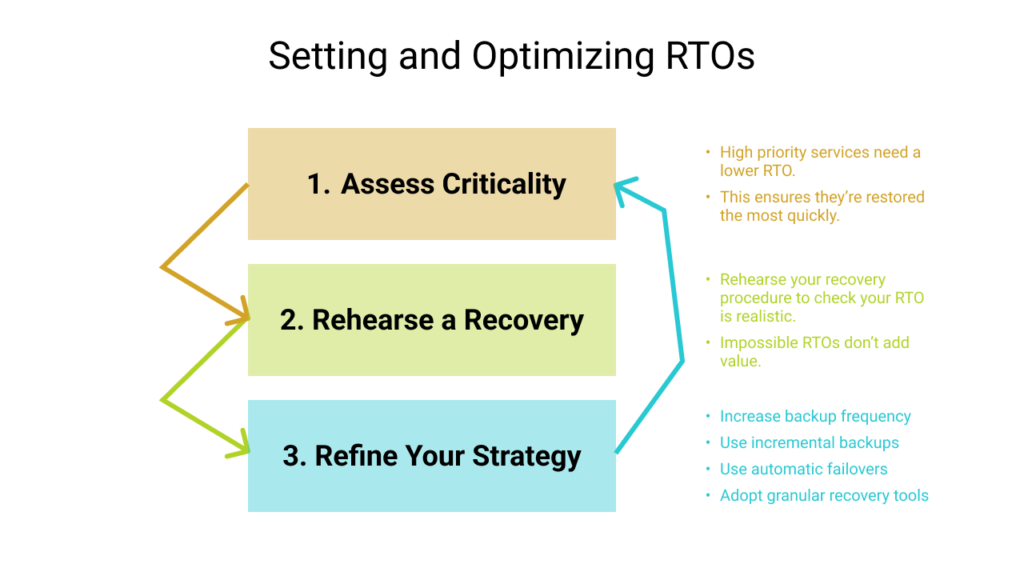
To start deciding your RTOs, look at the required quality level for each of your services. Ask yourself how long your business or product could function in their absence. Individual services can be allocated their own RTOs to reflect their level of criticality. A payment system might be given a lower RTO (shorter recovery window) than a photo upload service, for example, because failed payments will immediately affect your bottom line.
Next, you need to calculate whether the RTO you’ve arrived at is actually achievable. The assessment should be based on data such as the time it took you to restore after the last incident. Refine this value by rehearsing your disaster recovery strategy.
Often there are technical limitations that prevent you from using a lower RTO. Data backups can take significant time to restore, depending on how large they are, where they’re stored, and whether you’re starting a full or partial recovery. There’s no use in setting an RTO of one hour when you know you need two hours to utilize your backups. Analyze your backup regime, test how quickly you can access critical data, and check your RTO is compatible with your findings.
RTOs are vital during disasters because they provide an unambiguous notification when events begin to unacceptably
Successfully responding within the RTO relies on a cohesive disaster recovery plan for getting services back online. Good strategies are formed from multiple elements that your whole team is familiar with:
Once you’ve established your recovery process, you can define your RTOs and look for ways to improve them.
Very low RTOs in the region of a few seconds or minutes are usually unrealistic for large-scale services with significant volumes of data. You have to recognize the time that will be required to recover that data during an incident.
Nonetheless, there are methods that can improve your RTOs while keeping them attainable.
These techniques will accelerate your disaster response, allowing you to set lower RTOs.
Recovery time objectives define how much downtime you can tolerate before an incident must be resolved. Exceeding the RTO means that your business operations have been interrupted. This will be noticed by customers and could have negative repercussions for your organization, whether financial, regulatory, or reputational.
Setting a low RTO doesn’t guarantee you’ll achieve it unless it’s part of a comprehensive disaster recovery plan that’s carefully supported by tools and procedures. Try using Rewind’s data protection platform to backup your applications and accelerate their restoration. Rewind gives you immediate access to your critical data and lets you restore it in just a few clicks. This efficiency can help you reduce your RTOs and make bigger promises to customers.





