

Effort—what MacArthur Genius Grant winner Angela Duckworth famously dubbed “grit”—is essential to success.
However, what unlocks potential is not so much brute force, but a wide-eyed recognition of (1) where we are, and (2) a vision for where we want to be.
In business, this process for unlocking potential and creating an action plan is known as gap analysis.
This article walks through a simplified process for conducting just such an analysis, along with a gap analysis template to guide your future research.
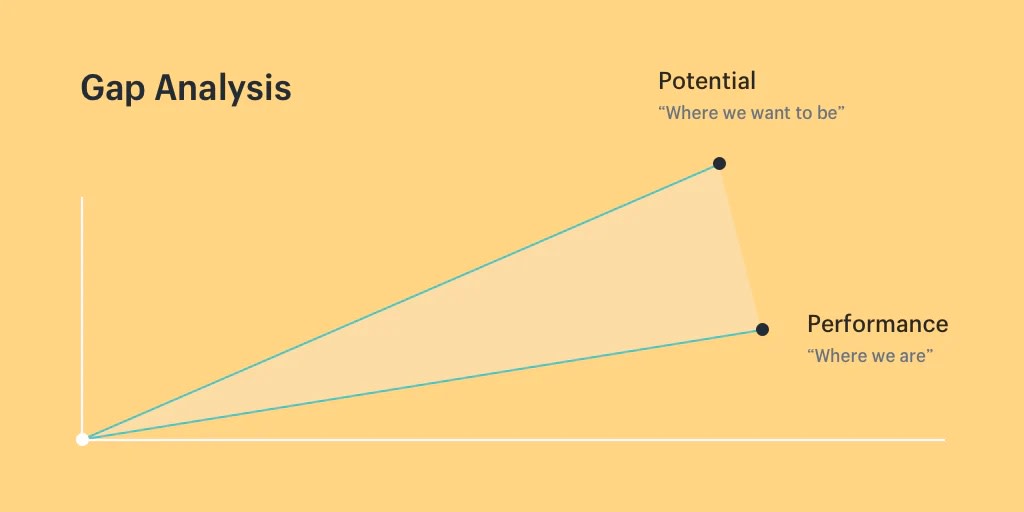
Gap analysis is the quantitative and qualitative comparison of a company or individual’s current performance (i.e., current state) with potential performance (i.e., future or target state).
The gap analysis methodology goes by many names: need assessment, need analysis, or need-gap analysis. Whatever you call it, the core principle remains the same: to identify and then find solutions to the problems holding your business back.
Gap analysis addresses two questions:
While the process starts with an inward look at current versus potential performance, it doesn’t stop there. Gap analysis should also include outside sources like industry benchmarks and your market’s competitive landscape to determine your desired state.
This type of 360-degree analysis can be performed at both strategic or operational levels. You can analyze your overall business goals or go granular into various processes or departments.
After going through the first phase of analysis—performance versus potential—you may find that your results exceed expectations. The same can also be true if your entire business is currently experiencing fast-paced growth.
In those cases, the aim changes from finding problems to identifying success factors that can be repeated, applied to other areas of your business, and ultimately scaled.
Regardless of what you’re evaluating—be it problems or successes, human resources or logistical functions—the actual process of doing the analysis is the same.
In research, gaps can emerge in various forms, such as:
The temptation with the gap analysis process is to start by going big. Unfortunately, when you try to tackle too much at once—to make everything better, all at the same time—resources get stretched thin.
Instead, prioritize the areas where either (1) the biggest positive
This could be any one of a host of factors:
Once you’ve isolated an area big enough to make an
Once you have chosen your areas of focus, your first step is to identify both where you currently are—performance—and where you want to be in the future—potential.
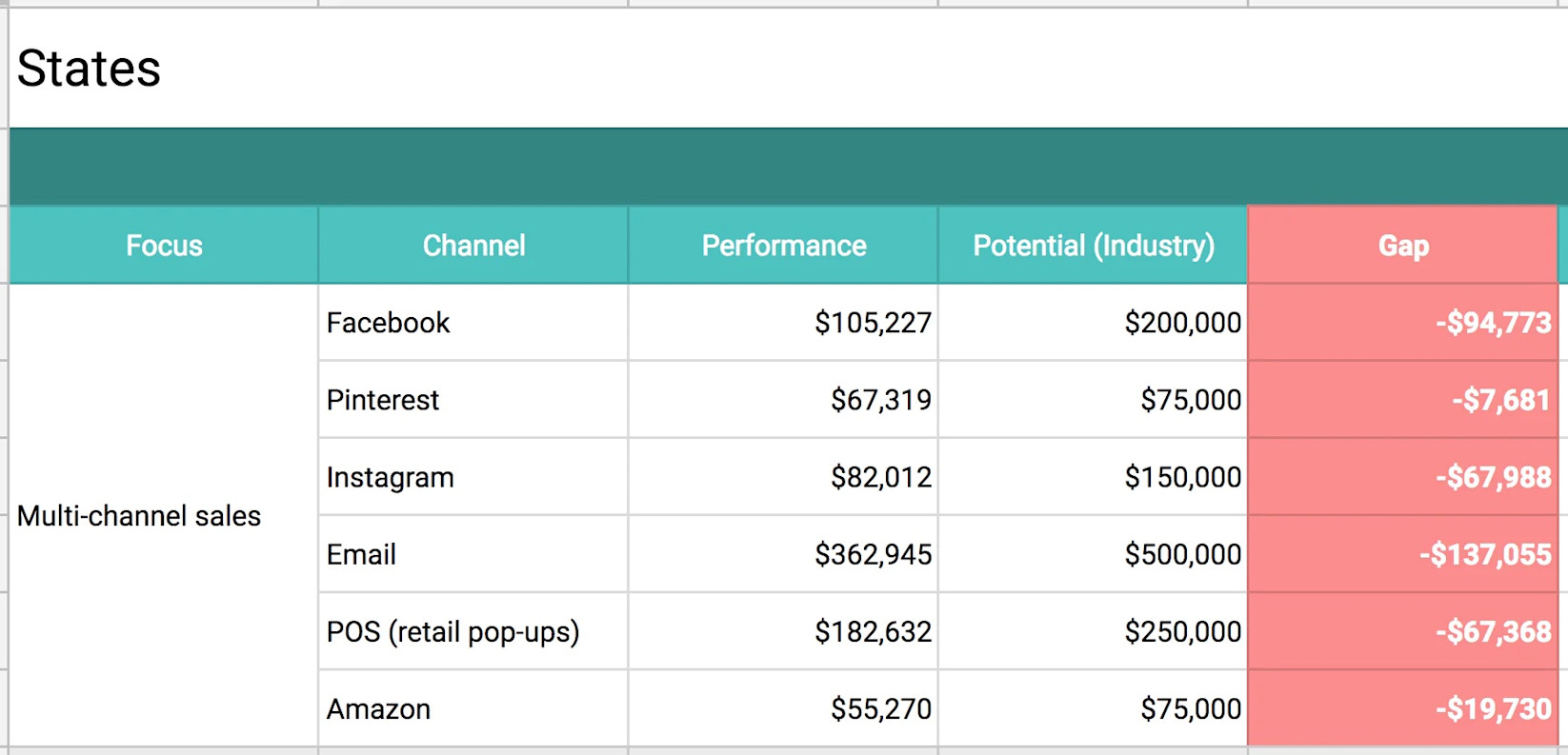
For illustrative purposes, let’s select:
Every gap analysis starts with introspection. Where are you currently within the key performance indicator (KPI) that you’re analyzing? The idea is to list all the attributes—in this case, channels—that play a role in success or failure.
The attributes (and thus the analysis) can be quantitative or qualitative. The key is to be specific and factual when identifying possible weaknesses. The required data can be collected from a variety of sources, depending on what gap is being analyzed, including:
The future state represents the ideal condition in which you want your business to be. For quantitative analysis, like tracking sales metrics, you would include either data from the industry or projected sales (i.e., goals).
When planning for the future, you want to be highly specific by choosing goals within a specific time period (e.g., increase sales by 40% overall by the end of Q3).
Defined quantitatively, gaps are straightforward. What are the numerical differences between where you are and where you want to be?
Qualitatively, this will take a bit more introspection and collaboration.
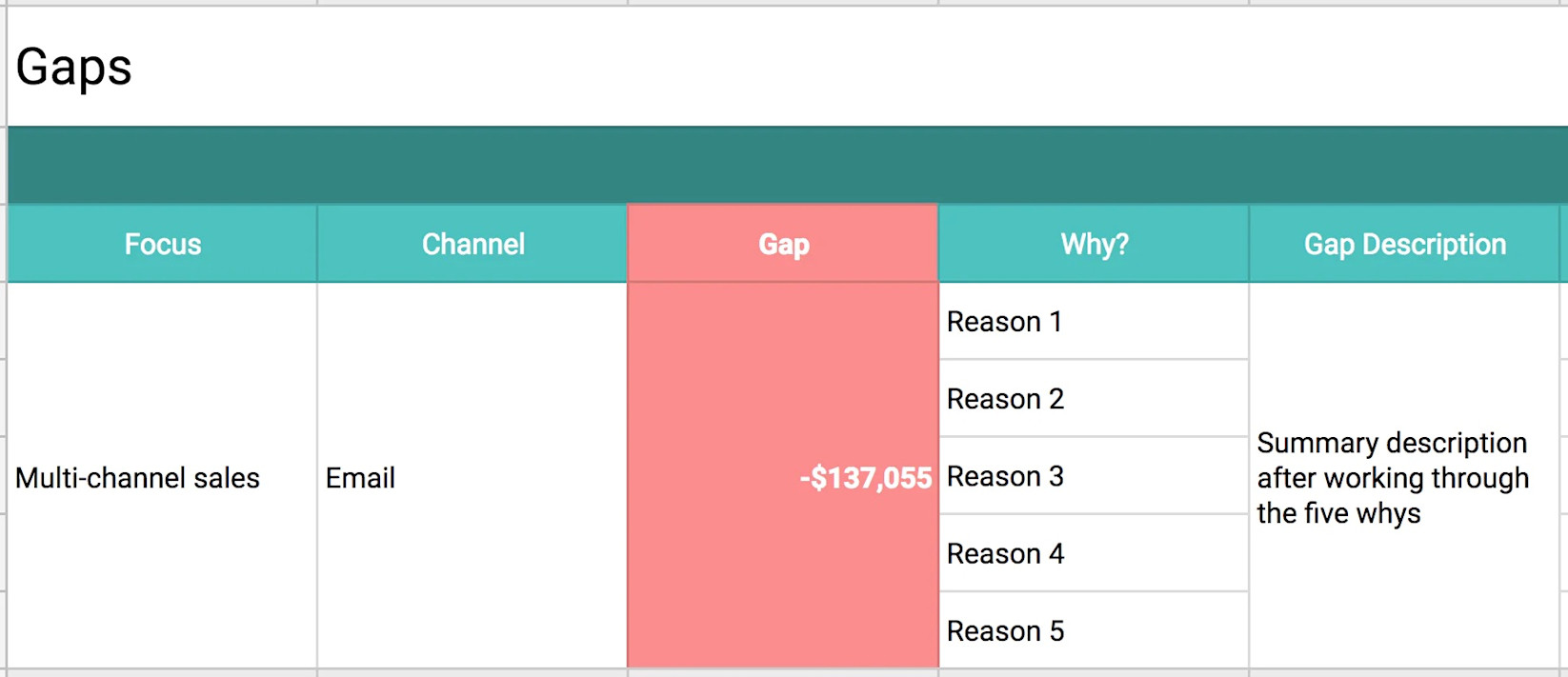
Having identified the gaps, the next step is to describe each gap to better understand the reasons behind their existence.
If you’re currently ahead of your targets, then it’s a great time to analyze what exactly made the results possible and if there are ways to use the same principles in other areas of your company.
Even a well-performing system can always be optimized, so going through this step is crucial.
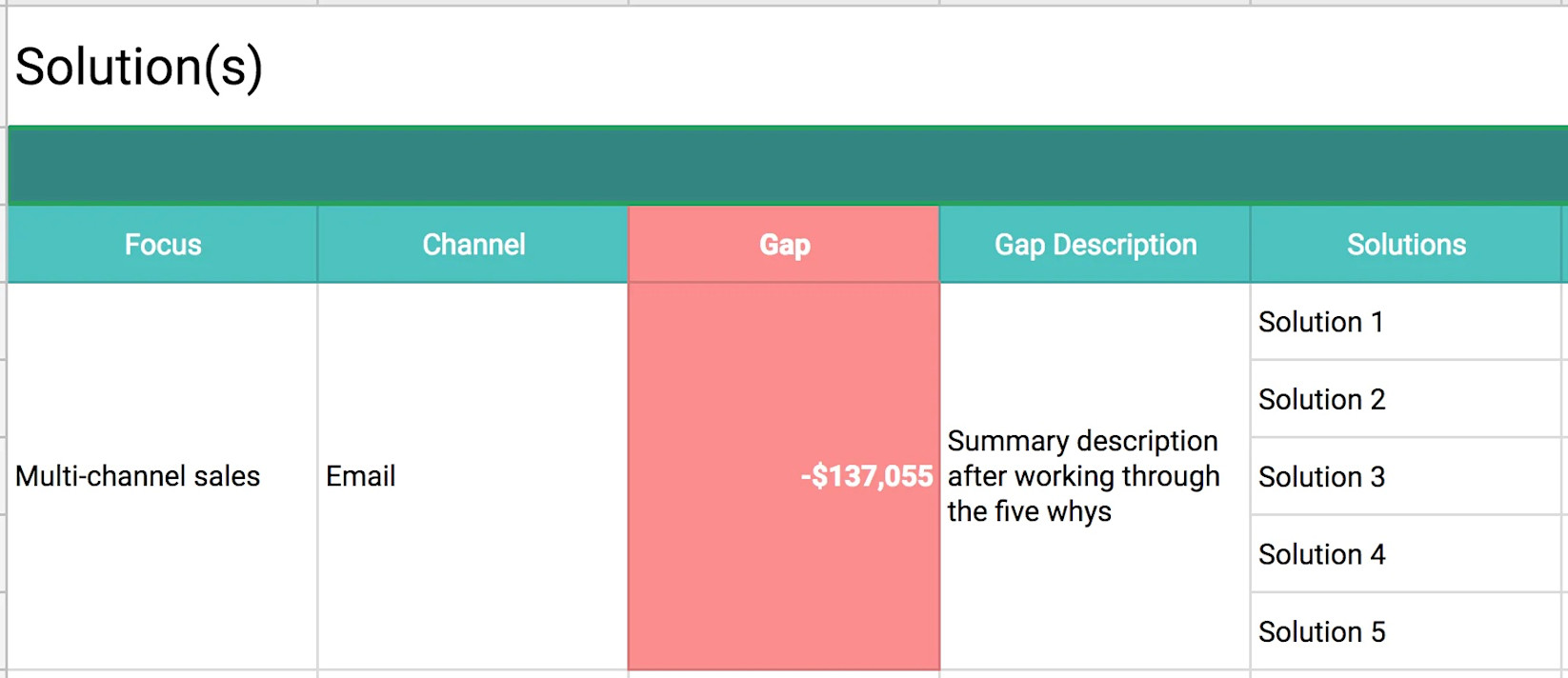
The third and final step in your gap analysis report is to brainstorm all the possible solutions to the gaps and the reasons behind them. These solutions must be specific and directly
To do that, let’s return to the multichannel focus from before:
By creating an exhaustive list of solutions to the gap-description summary, you enable yourself to think wide and yet position yourself for practical implementation.
When formulating possible solutions, it’s important to keep in mind that there may be implementation costs involved. Those costs can include time, money, and human resources.
The “five whys” is an iterative technique used to explore the cause-and-effect relationships underlying a particular problem. Its primary goal is to determine the root cause of a problem by repeating the question “Why?” with each question forming the basis for the next question.
Although this technique is called the five whys, it doesn’t mean you have to ask “Why?” five times. The idea is to repeat the process for as long as it takes to identify the root cause(s). It can take fewer or more than five whys before you arrive at the underlying issue.
Rather than go the multichannel ecommerce route, let’s look at a situation where customers are unhappy because they’re being shipped products that don’t meet their expectations. 1. Why are customers being shipped bad products?
Because manufacturing built the products with materials different from what the customer expected, based on advertising.
2. Why did manufacturing build the products with different materials than advertised?
Because the supply-chain manager expedites work on the shop floor by calling the head of manufacturing directly to begin production. An error occurred when the specifications were being communicated.
3. Why does the supply-chain manager call the head of manufacturing directly to start work instead of using written communication?
Because the “start work” form requires the supply-chain manager’s direct approval before work can begin.
4. Why does the form require approval from the supply-chain manager?
Because the manufacturer does not offer a digital integration with your company’s current ecommerce platform.
In this case, only four whys were required to find out that a non-value-added signature—driven by a lack of integration—caused the gap.
In industry-focused research, gap analysis often involves analyzing market trends, customer needs, and competitor offerings.
By understanding the unmet needs and opportunities within the industry, researchers can develop innovative solutions and strategies to bridge these gaps and create a competitive advantage.
Ecommerce brands can use profit gap analysis to identify areas where they are underperforming financially.
A target profit is determined based on historical performance or industry benchmarks. Profits are then compared to targets, and areas for improvement are identified in revenue generation or cost cutting. Ecommerce brands use this analysis to make strategic decisions and improve their profitability.
Several tools and techniques can be employed to facilitate gap analysis in research, such as:
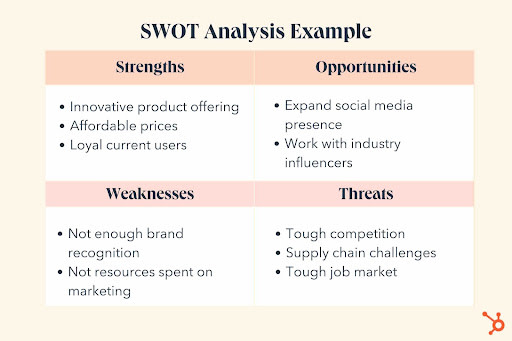
Source: Hubspot
SWOT analysis is a strategic planning tool that helps identify an organization’s strengths, weaknesses, opportunities, and threats.
By categorizing internal and external factors, it helps decision-makers plan and strategize better. The tool is used for setting goals, analyzing markets, and assessing competition.
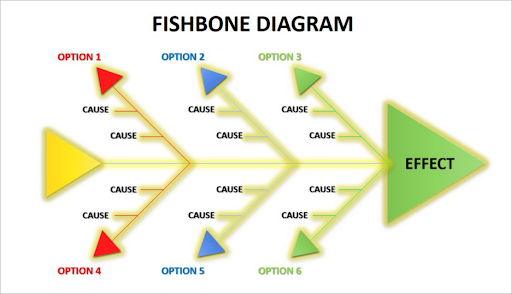
Source: Unichrone
A fish bone diagram, also known as an Ishikawa diagram or cause-and-effect diagram, is a visual tool for identifying and analyzing root causes.
It helps teams systematically explore contributing factors by categorizing potential causes into categories and displaying them as a “fish bone” structure. A lot of companies use this kind of diagram for quality management, process improvement, and problem-solving.
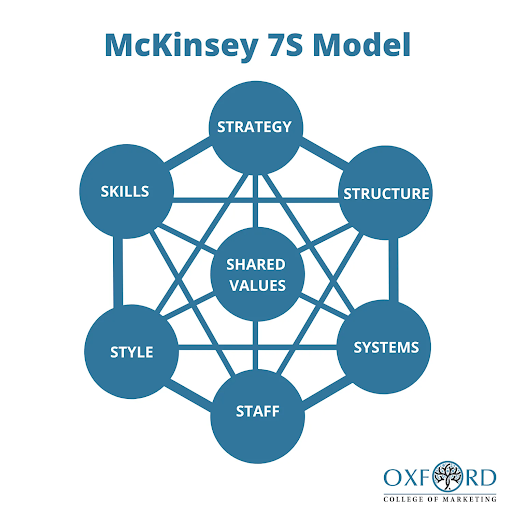
Source: Oxford College of Marketing
The McKinsey 7S framework measures how well an organization’s strategy, structure, systems, shared values, skills, and style align.
These seven elements are interconnected to identify areas for improvement or change. This framework is used for organizational changes, mergers and acquisitions, or diagnosing and fixing performance problems.
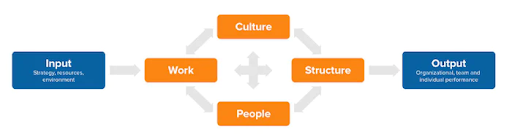
Source: Mind Tools
Also known as the Congruence model, the Nadler-Tushman model evaluates the fit between an organization’s work, people, structure, and culture.
The tool analyzes the congruence between each of the four components to identify gaps, misalignments, and areas for improvement. The model is used to analyze organizational performance, guide change initiatives, and design new structures and processes.
Gap analysis in research offers several benefits, including:
Despite its benefits, gap analysis in research also presents some challenges and limitations:
To conduct effective gap analysis in research, consider these best practices:
In the end, gap analysis yields a detailed examination of:
Instead of brute force—or “shooting from the hip”—you’ll have hard data on which to base your new products and initiatives, along with a roadmap to guide you.
The three fundamental components of a gap analysis are the current state, the desired future state, and the gap. The gap represents the difference between the desired and actual outcomes, highlighting areas for improvement.
A SWOT analysis is not a gap analysis. While gap analysis focuses on identifying differences between current and desired states, SWOT analysis deals with identifying strengths, weaknesses, opportunities, and threats.
Types of gap analysis include performance gap analysis, needs gap analysis, market gap analysis, skills gap analysis, and software gap analysis. These different types focus on various aspects of an organization, such as processes, actual and budgeted sales, employee skills, and market opportunities.
Additional research by Michael Keenan