





Dotdigital blog
Puzzled by these marketing terms? Let’s talk about cross-channel, omnichannel, and multichannel marketing. Learn what they mean and how they can boost your customer experience.
Being present across all channels is no longer the only aspect of marketing. It’s about creating experiences that are meaningful and seamless for your customers. But with terms like multichannel, cross-channel, and omnichannel often used interchangeably, it’s easy to get confused.
This guide breaks them down, shows how they differ, and helps you choose the right approach for your business.
What is cross-channel marketing?
Cross-channel marketing is all about coordination. You still use multiple channels, but now they work together. The goal is to guide customers along a journey, with messaging and campaigns aligned across touchpoints.
- Channels share some data and insights
- Messaging is coordinated across platforms
- You can track how different touchpoints influence behavior
When cross-channel works best:
- You want more cohesive experiences without full omnichannel complexity
- Your audience interacts across a few key channels regularly
- You want to use engagement data to optimize campaigns and personalize interactions
Here’s an example:
A customer sees an abandoned cart email, then receives a push notification reminding them about the items, with messaging consistent across both.
What is multichannel marketing?
Multichannel marketing means using multiple channels to reach your audience, such as email, social media, your website, mobile apps, and in-store touchpoints.
- Each channel usually operates independently
- Messaging can differ from one channel to another
- The focus is on broad reach rather than a fully seamless experience
When multichannel works best:
- You want to increase visibility across multiple platforms
- Resources or technology are limited for deeper integration
- Your audience interacts on some channels but a completely unified journey isn’t essential
Here’s an example:
Sending promotional emails, posting on social media, and running paid search campaigns independently, without linking customer data across them.
What is omnichannel marketing?
Omnichannel marketing is the gold standard for seamless, fully integrated customer experiences. All channels, online and offline, are connected so your customers can engage with your brand smoothly across touchpoints.
- Channels share a unified customer profile and real-time data
- Messaging, content, and offers are consistent across every interaction
- The focus is customer-centric: anticipating needs and guiding the journey
When omnichannel works best:
- Your business can integrate multiple systems (CRM, ecommerce, POS, analytics)
- You want premium, personalized customer experiences
- You want to understand behavior across the full journey and optimize in real-time
The benefits:
There’s growing consensus that omnichannel, or a well-structured cross-channel strategy, can significantly boost customer satisfaction, retention, engagement, and lifetime value, especially when data and personalization are used.
Here’s an example:
A customer starts browsing on a mobile app, receives a personalized email with recommendations, purchases online, and picks up in-store, all with a consistent, seamless experience.
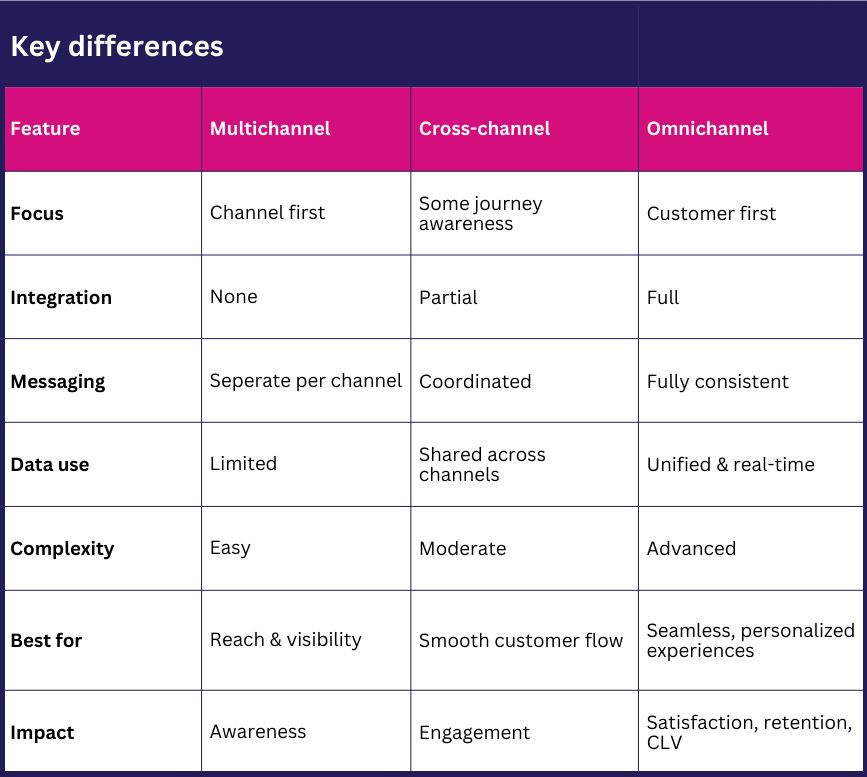
Recap of multichannel vs cross-channel vs omnichannel
How to choose the right approach
Picking the right strategy is about what fits your audience, your team, and technology. So, think of these approaches as a spectrum, where each step builds on the previous one:
1. Start with multichannel
- Focus on the channels where your audience is most active
- Keep campaigns simple and separate to avoid stretching resources
- Gather baseline performance data like open rates, clicks, and conversions
2. Move to cross-channel
- Coordinate messaging and timing across key channels
- Use shared data to track customer movement between touchpoints
- Align campaigns to guide audiences along a journey rather than broadcasting messages
- Begin personalizing interactions based on behavior and engagement patterns
3. Evolve to omnichannel
- Integrate systems to create a unified customer view
- Deliver consistent messaging, content, and offers across all touchpoints
- Use insights from the full journey to anticipate needs, automate follow-ups, and optimize campaigns in real time
- Map your audience’s most common journeys first. This highlights where coordination or integration has the biggest impact
- Consider your resources and tech stack. Moving straight to omnichannel without the right systems or team can create complexity instead of results
- Treat it as an evolution. Even small steps toward coordination or integration can improve the customer experience
Measuring success
Tracking performance is essential to know if your approach is working and where to improve. Metrics should match your strategy stage. Here’s what that looks like:
1. Multichannel metrics
- Individual channel performance: open rates, clicks, website visits, social engagement
- Conversion tracking: did a message lead to a purchase, sign-up, or other goal?
- Use this to identify which channels are most effective
2. Cross-channel metrics
- Customer movement between channels: are emails driving traffic to your website or app?
- Attribution insights: which touchpoints contribute most to conversions?
- Engagement patterns: see how customers respond when messaging is coordinated across channels
- Use this to refine content, timing, and channel strategy
3. Omnichannel metrics
- Full customer journey tracking: first touch to purchase and beyond
- Retention and lifetime value: see how seamless experiences improve long-term engagement
- Cross-device and offline-online integration: measure impact across all touchpoints
- Customer satisfaction: surveys, net promoter score, and feedback loops
- Use these insights to personalize, automate, and anticipate customer needs

- Always start with clear goals. Metrics are only useful if they’re tied to your objectives
- Use combined dashboards to spot patterns and opportunities across channels
- Don’t ignore qualitative feedback. Things like surveys and reviews reveal gaps that numbers alone won’t show
How Dotdigital helps your cross-channel marketing strategy
Here at Dotdigital, we know the importance of implementing comprehensive marketing tools tailored to your business goals and target audience. That’s why we’ve developed an innovative cross-channel platform as an all-in-one solution to help manage your channels.
With the Dotdigital platform, you can:
Connect with your customers on all their favorite channels
Your customers move across channels, so your marketing should too. With Dotdigital, you can reach them seamlessly across email, SMS, social, and more, making every interaction count.
Create seamless customer journeys
Dotdigital’s marketing tools help you send personalized messages to customers through email, text messages, and social media. By enhancing their experience at every stage of their journey, you’ll be able to build stronger relationships and drive engagement.
Supercharge your email marketing
Email is a powerful way to stay in touch with customers who want to hear from your business. Dotdigital’s email builder makes designing eye-catching emails a breeze so that you can grab your customers’ attention and inspire them to take action.
Turn texts into sales
Have you considered using SMS marketing to reach your customers? It’s a quick and effective way to connect with them in real time. With Dotdigital, you can integrate your text messages with other channels like email and social media to increase your chances of making a sale.
Grow, convert, and retain with social media retargeting
Looking to expand your customer base? Dotdigital has got you covered. With Facebook Lead Ads, you can easily acquire new leads and grow your marketing lists. Plus, keep your current customers engaged by showing them targeted ads after they visit your website.
Reduce barriers to purchase with live chat
Forrester says using live chat on your website can increase conversion rates by up to 40%. With Dotdigital’s live chat feature, you can make it easy for customers to get the help they need while also increasing their happiness and likelihood of buying from you.
Reach customers anywhere with push notifications
Dotdigital helps you stay connected with customers by sending them timely push notifications on their smartphones. These messages remind customers of your business and encourage them to take action, like making a purchase.
Final thoughts
Choosing the right marketing approach is about delivering experiences that your customers actually want:
- Cross-channel keeps your message consistent
- Multichannel gets you seen
- Omnichannel makes every interaction seamless and personal, boosting engagement, loyalty, and lifetime value
Start where you are, learn from your data, and evolve your strategy. Even small improvements in how your channels work together can make a big difference, turning one-off interactions into lasting relationships.
