

Ecommerce search engine optimization is all about adjusting your ecommerce website or store as per the search engine guidelines and best practices.
The ultimate motto of ecommerce SEO is to bring your website, its pages, or your products as high on the search engine result pages (SERP) as possible. When your site ranks at the top, it gets increased visitors, sales, and brand awareness.
The process revolves around finding the right keywords, optimizing on-page elements, resolving technical issues, building links, etc. Read on for more!
Keywords are phrases or words users search for on search engines (and on ecommerce platforms) to find what they are looking for.
Every ecommerce search engine optimization strategy starts with thorough keyword research and finding the right keywords people are searching for in your niche. These keywords are then used to create relevant content around them.
During the keyword researching process, you have to find out:
a. Informational keywords – Terms starting with “how to”, “what is”, “why”, “tips for”, etc.
b. Commercial keywords – Often start with “top” or “best” and typically include terms like “buy”, “purchase”, “review”, etc.
Techniques and tools to find ecommerce keywords are
When selecting the keywords, consider the following factors:
TIP: Good keywords should be relevant to your niche. For example, if you sell Sneakers, relevant keywords can be “sneaker prices in 2024,” “sneakers for women,” etc. Plus, choose one with the maximum volume but less competition.
Once keywords are found, create content on both types. Write answers, explanations, and guides on information keywords. Plus, use commercial keywords to rank your products and create categories and subcategories.
After finding keywords, the next step is optimizing the content on individual web pages, mainly product and category pages. You should tackle the following factors individually, so search engines find your content good to rank.
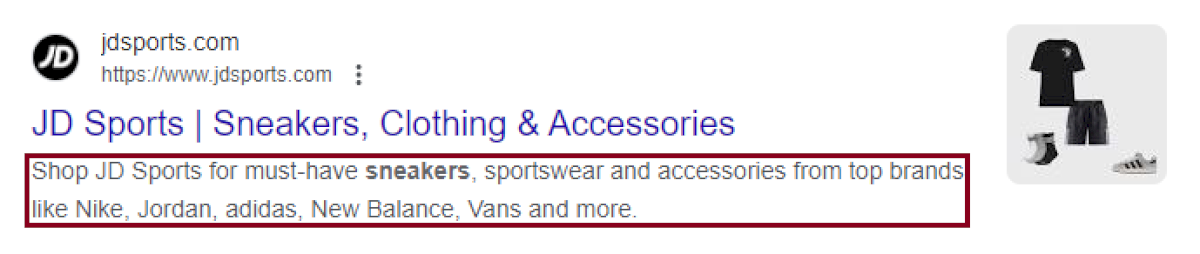
The title tag is primarily an HTML code to specify the title of a web page and appears in the search results as a clickable link. For example, “JD Sports | Sneakers, Clothing & Accessories” is a title tag.
Here are the tips for writing compelling title tags:
NOTE: You can also mention advantageous terms in the title as well. For example, “25% off”, “[Free Shipping]”, etc. This technique increases the CTR.
A short summary of the page’s content that appears under the title tag is called a meta description. It is also an HTML tag that tells search engines about web pages, collection pages, product pages, and blog posts.

Here are some tips for writing a good meta description:
A URL (Uniform Resource Locator) is displayed under the domain name, which tells us about the page or article linked to it. If we talk about an ecommerce site, a URL consists of various components, such as:
Here is an example of a slug:

Best practices to create URLs on your ecommerce site:
As the name suggests, product images are simply photographs of the products a business sells. Like product descriptions, FAQs, pricing, and specifications, they are an important part of a product page.
Follow these tips to optimize your product images:
Many elements make up a product page. Each element is unique and uses content to tell search engines and readers about different product aspects.
Here are the different content-demanding elements:
Do you know? It is very easy to make product descriptions from already-written longer descriptions. How? With the help of an AI text summarizing tool, such as Summarizer.org. Provide it with a longer summary and click on the summarize button.
This AI-based tool uses advanced NLP algorithms to read, understand, and pinpoint the main sentences in the text. It cuts out all the unnecessary details and writes a summary that explains only the important aspects.
Here is how this tool summarizes product descriptions:

Internal linking on an eCommerce site is when a hyperlink on one page of a website directs the reader to another page on the same website. For example, linking a category page to the homepage.
Internal links help the search engine crawlers navigate through an ecommerce website, its categories, product pages, and blog articles. This way, search engines can easily find all pages, products, and uploaded data on your site.
These are a few tips to build internal links on an ecommerce website:
Technical SEO is all about making a website meet the technical requirements of search engines. If you follow all the guidelines, you can make your ecommerce website easily crawlable, indexable, and user-friendly for search engines.
Ultimately, technical SEO aims to improve a website’s rankings, increase organic traffic, and make the website easy to crawl by search engines.
Here are the things to do under the hood of technical SEO:
In 2014, Google announced that they wanted to see “HTTPS everywhere” and that secure HTTPS websites would be given preference over non-secure ones.
Since then, it has become necessary to use HTTPS, a secure version of HTTP, on ecommerce sites to keep user data, passwords, and credit card information safe.
All you have to do is switch to HTTPS to encrypt data exchanged between your website and visitors’ browsers. Get and install an SSL certificate from your hosting provider to make a secure connection.
To structure an ecommerce website, use clear navigation menus and categories to organize it logically. Design it in a way that buyers can easily find products from the homepage within a few clicks.
In addition, use descriptive category names and incorporate relevant keywords. It helps both users and search engines better understand the content of your website.
Next, use Google’s Mobile-Friendly Test or Chrome DevTools to evaluate mobile compatibility. If there are some issues, make your website responsive and functional for various mobile devices. Optimize font sizes and button spacing.
A sitemap is a file that is uploaded on an ecommerce website. It lists pages, images, videos, and other files. When search engine crawlers go through the site, a sitemap helps them do it efficiently.
So, create a comprehensive sitemap that lists all pages, including product pages and categories. Submit the sitemap to Google Search Console to make everything easy to index and improve search engine visibility.
TIP: Update and resubmit the sitemap regularly whenever your site’s structure or content changes significantly.
Search engines prioritize those website pages to come on top of the SERPs that have low page-loading speeds. These pages take less time to showcase all the data.
When you create your ecommerce site, check its page-loading speeds using tools like Google Page Speed Insights. Identify any areas for improvement.
Implement the following changes to improve it:
Content marketing is a type of digital marketing. It involves creating, publishing, and promoting content to increase ecommerce website traffic and generate leads and sales.
These are the types of content that are used for content marketing:
However, for an ecommerce website, the best content marketing tactic is blogging. It involves writing engaging and informative content on specific topics or keywords related to your niche. People will come, read, and engage with your site.
Blogging can help you :
TIP: When writing blogs, there are times when you take data from other sources and write it in your own words to use it in your content. However, manually writing each piece takes a lot of effort and time.
An alternative way is to use an AI paraphrasing tool, such as Paragraphrewriter.net. This free-to-use AI-powered tool is built to rewrite any form of content thoroughly while maintaining the same meaning. Try it now!
This is how this tool rewrites the provided content:

Linking building is acquiring links from another website; it involves getting other websites to link to your website. This process boosts your website’s authority for search engines and makes your website rank higher.
If you somehow manage to acquire some high-quality backlinks from trusted sources, search engines start trusting your ecommerce site. Ultimately, they will rank your blogs, products, and other content higher than before.
These are some strategies we use for link-building:

EcomBalance is a monthly bookkeeping service specialized for eCommerce companies selling on Amazon, Shopify, Ebay, Etsy, WooCommerce, & other eCommerce channels.
We take monthly bookkeeping off your plate and deliver you your financial statements by the 15th or 20th of each month.
You’ll have your Profit and Loss Statement, Balance Sheet, and Cash Flow Statement ready for analysis each month so you and your business partners can make better business decisions.
Interested in learning more? Schedule a call with our CEO, Nathan Hirsch.
And here’s some free resources:
SEO for ecommerce means making your online store easy for search engines to find, understand, and show in search results. The goal is to get more people to visit your site, buy things, and know about your brand.
First of all, find keywords people use to search for products like yours. Use these words in your website content. Make sure each page has a clear title, description, and web address. Use good-quality images and describe them well.
Make your website optimized for phones. Submit a sitemap so the search engines can easily crawl pages on your site. Make sure your website loads fast and is secure. Write helpful blogs and ask other websites to link to yours.
The post A Quick Guide to SEO for Ecommerce Website appeared first on EcomBalance.





