
Imagine a commerce environment where cyclical platform upgrades are a thing of the past. That is the core promise drawing merchants toward Adobe’s newly versionless commerce ecosystem. But moving from a legacy, high-maintenance setup to a fully managed SaaS architecture requires more than a simple switch.
We analyzed public feedback, timelines, and budgets from businesses that have already made the leap. While the long-term payoff includes eliminating cyclic upgrade costs and unlocking decoupled infrastructure, the upfront transition requires careful planning to avoid workflow disruptions.
Let’s explore what actual users are saying about the real-world costs, deployment speeds, and operational realities of migrating to Adobe Commerce.
For years, enterprise retailers have prepared for the costly, time-consuming cycles of major platform upgrades. The recent pivot toward a fully managed, multitenant SaaS architecture fundamentally changes how businesses approach their commerce backend.
At the heart of this architectural shift is Adobe’s “locked core” philosophy. Historically, businesses built custom functionality directly inside the primary commerce engine. While this offered deep customization, it also meant that every platform update carried the risk of breaking custom features.
The new versionless model changes this dynamic by prioritizing out-of-process extensibility. By leveraging tools like the Adobe Developer App Builder and API Mesh, development teams can build custom business logic as independent, serverless applications. This means the core engine remains untouched, allowing for continuous, small deployments without the fear of system-wide disruptions.
Legacy Platform-as-a-Service (PaaS) models often burdened internal IT teams with extensive server maintenance, security patching, and infrastructure monitoring. The technical debt associated with these “in-process” customizations slowed down time-to-market for new features and campaigns.
Transitioning to a SaaS model offloads the heavy lifting of infrastructure management to the provider. This allows your internal teams to pivot from constant maintenance to actively designing better customer experiences.
The financial impact of shedding legacy tech debt is substantial. Current industry data indicates that high-growth retailers spend approximately 46% of their budgets on simply maintaining their existing infrastructure. This leaves very little room for aggressive customer acquisition or experimentation.
“By externalizing custom code from the core engine, engineering teams can finally step away from constant maintenance and start focusing on frontend experiences that directly impact revenue,” notes Davis Belcher, Content Marketing Manager.
Reallocating those funds enables businesses to invest heavily in the next wave of commerce technology, specifically generative AI integration and advanced agentic orchestration.
When planning a migration of this scale, analyzing the real-world experiences of other businesses is invaluable. Based on aggregated feedback from major software review platforms, a clear picture emerges regarding the strengths and operational realities of the upgraded ecosystem.
The most consistent praise directed at Adobe Commerce centers on its native ability to handle immense complexity. Reviewers frequently highlight the platform’s robust B2B capabilities, which are often cited as a primary driver for migration.
Businesses managing extensive product catalogs find tremendous value in the platform’s ability to natively support company account hierarchies, shared catalogs, and complex, customer-specific pricing logic. The capacity to build sophisticated approval workflows and handle multi-store, multi-currency operations without relying on a web of third-party plugins is a significant advantage for global enterprises.
However, the transition is not without its hurdles. The most common critiques point toward a steep initial learning curve. While the backend capabilities are powerful, navigating the extensive administration panels requires dedicated training.
Furthermore, reviewers frequently cite a high dependency on specialized developers. Even with the shift to App Builder and out-of-process extensions, setting up and maintaining microservices and API integrations requires a highly technical team. Moving to a SaaS model simplifies infrastructure, but you still need experienced engineering talent to maximize the platform’s decoupled architecture.
Ultimately, the public consensus reveals a distinct trade-off. If your operation requires a simple, plug-and-play storefront with basic inventory needs, the advanced architecture of Adobe Commerce might introduce unnecessary overhead.
However, for enterprise and mid-market brands running complex, omnichannel operations, the trade-off is widely considered worthwhile. The initial investment in technical orchestration pays off by providing a highly scalable, flexible foundation that is completely insulated from the disruptive upgrade cycles of the past.
Understanding the financial commitment required for a platform shift means looking beyond the initial implementation quote. For commerce leaders, budgeting correctly requires balancing upfront licensing fees against the reduction in long-term technical debt.
Moving to a fully managed cloud service shifts your budget from capital expenditures to operational expenditures. While the baseline licensing for an enterprise-grade SaaS architecture carries a higher initial price tag than self-hosted environments, the Total Cost of Ownership (TCO) tells a different story.
By eliminating the need for internal server capacity planning and constant security patch management, companies reduce their infrastructure overhead. Data reveals that businesses migrating away from legacy, open-source setups save roughly $45,000 for every 10,000 post-migration transactions due to minimized downtime and simplified daily operations.
Self-hosted platforms often hide their true costs in developer hours. Every time a legacy system requires a version upgrade, engineering teams must manually test, fix, and redeploy dozens of custom extensions. These in-process modifications create a fragile ecosystem where one update can interrupt checkout flows or product routing.
A multitenant SaaS model removes this cyclical financial drain. Because the core code is locked and managed by the provider, businesses bypass the multi-month upgrade projects that typically occur every few years.
Upgrading your backend is not just a defensive move for stability; it is a strategic investment in future capabilities. A modern architecture provides the necessary foundation for advanced generative AI and machine learning tools, such as Adobe Sensei, to operate smoothly.
Thanks to upgraded frontend performance and AI-driven personalization, merchants often reach their break-even point on the migration investment within 9 to 15 months. Upgraded stores powered by cloud-native infrastructure are currently achieving impressive 3.7% mobile conversion rates compared to the standard industry benchmark of 2.9%.
As previously established, reducing legacy maintenance frees up massive portions of the IT budget. Leading e-commerce brands are reallocating these newly available funds into agentic orchestration—intelligent automation that manages complex workflows dynamically.
“When you externalize your complex logic and let the platform handle infrastructure, your technical teams are no longer just maintaining servers,” explains Eli Weiss, VP Retention Advocacy. “You unlock the bandwidth to build proactive, AI-driven experiences that actually guide shoppers toward purchasing decisions rather than just reacting to them.“
Speed to market is a major concern when shifting platforms. Rushing the process can result in lost data and broken SEO, while dragging it out consumes valuable resources. Establishing a realistic timeline is critical to a smooth launch.
Before any code is moved, a rigorous discovery phase is mandatory. The success of the entire project hinges on accurately mapping current data and evaluating existing customizations.
During this phase, teams must audit every third-party extension and custom PHP module. The goal is to separate core commerce functions from unique business logic. Identifying which bespoke features should be rewritten as independent microservices is the most crucial step in establishing the new locked-core architecture.
To minimize operational disruption, modern migration strategies heavily favor phased rollouts over massive, simultaneous launches.
Instead of replacing the entire system overnight, businesses can utilize tools like the API Mesh to run legacy systems alongside the new architecture. By migrating specific services incrementally—such as moving the product catalog first, followed by the checkout experience—brands ensure their existing storefront remains fully functional and revenue-generating during the transition.
Refactoring legacy code to fit a serverless environment used to be a massive bottleneck. Today, development timelines are significantly compressed thanks to intelligent developer tooling.
Modern SDKs and AI coding assistants help engineering teams convert old, deeply integrated customizations into modern, API-first applications. By automating the boilerplate code generation required for App Builder deployments, technical teams can focus entirely on optimizing complex logic rather than writing basic framework structures.
While AI tooling and phased rollouts speed up the process, enterprise merchants must still set grounded expectations. Depending on catalog size, technical debt, and integration complexity, a standard migration typically spans nine to eighteen weeks from initial discovery to stable production.
A significant portion of this timeline must be dedicated to data mapping and QA testing. Allocating sufficient weeks to securely transfer customer profiles, order histories, and SEO metadata ensures that you launch the new platform without sacrificing organic visibility or customer trust.
Replatforming should not cause disruptions to your storefront’s visibility. Marketing teams rely on continuous traffic and consistent conversion tracking to hit revenue targets. By utilizing modern deployment strategies, merchants can virtually eliminate front-facing downtime during their Adobe Commerce migration.
A primary concern during migration is maintaining site speed when connecting to a new backend. Implementing Adobe Edge Delivery Services (EDS) pushes rendering directly to a global CDN, completely removing the traditional backend server from the live delivery process.
This decoupled approach ensures that performance remains flawless regardless of backend data transitions. Utilizing EDS optimizations can drastically compress heavy page load times to roughly 1 second. This speed buffer keeps shoppers engaged and prevents bounce rates from spiking during the transition period.
One of the largest risks during go-live is losing customer orders placed in the middle of the switch. To prevent this, merchants employ data delta synchronization.
Instead of freezing the live site for a massive, single data dump, the primary catalog and historical data are moved beforehand. The migration tools then run in Delta Mode, specifically transferring only the incremental changes—such as new account creations or active carts—that occurred since the initial sync. This enables two environments to run in parallel until the exact moment of cutover, preventing the need for a weekend maintenance window.
Marketing downtime isn’t just about the storefront loading; it’s also about organic discoverability. Modern search engines and AI assistants prioritize fast-loading, structured websites.
Because LLMs prioritize well-structured sites when synthesizing responses, upgrading your infrastructure directly protects your search footprint. Implementing server-side rendering and edge caching during migration ensures that AI crawlers can easily access and parse your updated catalog, keeping your brand visible in crucial product recommendation queries.
Generative Engine Optimization (GEO) has shifted the focus from ranking for specific keywords to being cited directly within AI-generated answers. To protect your GEO during migration, ensure your new product data architecture heavily utilizes schema markup.
Data indicates that content structured with clear data points, statistics, and verifiable facts achieves higher AI visibility and organic traction in AI Overviews and modern search assistants. By ensuring your newly migrated product pages provide immediate, machine-readable answers regarding pricing, stock, and specifications, you help position your brand as the recommended choice across discovery tools.
A successful migration is built on meticulous preparation. Before any data is transferred, your internal teams should consider adopting these five technical strategies to ensure a smooth transition to the cloud environment.
Begin by mapping your current PaaS environment. Catalog every third-party extension and custom modification directly tied to the core code. Evaluate which of these features are strictly necessary for the new storefront. Cleaning house by removing outdated modules before migration reduces the complexity and timeline of the final data transfer.
Adopt the out-of-process mindset early. For the core business logic that you must retain, consider refactoring traditional PHP modules into independent microservices. Utilizing the Adobe Developer App Builder allows your team to deploy these custom functions as serverless applications. This effectively isolates your unique workflows from the main commerce engine, simplifying future updates.
AI services, including native Adobe tools like Live Search and Product Recommendations, rely on continuous data feeds. During your pre-migration phase, standardize your product attributes, pricing rules, and category hierarchies. A clean, highly structured catalog ensures that SaaS data export modules can sync changes flawlessly, powering your front-end experiences with accurate, real-time inventory metrics.
“When transitioning platforms, your primary goal is continuity,” advises Mira Talisman, Growth CRO Team Lead. “By establishing a composable frontend first, you ensure that complex backend data swaps never disrupt the shopper’s purchasing journey.“
By migrating your frontend presentation layer to a headless structure before moving the database, you create a stable environment. The visual experience remains consistent for the customer while the engineering team works quietly on the backend plumbing.
Once your core infrastructure is simplified through SaaS hosting, train your team to utilize built-in AI capabilities. Prepare your merchandising and marketing departments to adopt agentic automation for tasks like dynamic pricing and category sorting. Integrating these tools early allows your staff to transition smoothly from manual maintenance to strategic campaign management.
Ultimately, replatforming is not just an IT initiative; it is an upgrade to the customer journey. When you resolve backend bottlenecks, the direct beneficiary is the everyday shopper navigating your catalog.
Site speed is a direct revenue driver. Every micro-second of delay limits conversion potential, and an estimated 53% of mobile users abandon a site entirely if it takes longer than 3 seconds to load.
“Every 100 milliseconds of latency you shave off during checkout translates directly to higher completed orders,” explains Ben Salomon, Growth Marketing Manager. “When your infrastructure is out of the way, your conversion funnel finally works as intended.” By leveraging a decoupled frontend and global CDN distribution, the new architecture can confidently deliver lightning-fast load times regardless of catalog size.
Modern e-commerce is rapidly shifting toward intelligent, conversational discovery. Driven by tools like Adobe Sensei, traffic to retail websites from generative AI sources has surged radically across the digital landscape.
A modernized backend allows AI agents to process natural language and understand the specific context of a shopper’s life in real time. Rather than returning rigid search results, these agents dynamically curate personalized product assortments. This level of guided discovery acts like a highly trained in-store associate, reducing shopper frustration and product return rates.
As your upgraded architecture delivers faster pages and AI agents surface relevant products, you still need social proof to confidently close the sale.
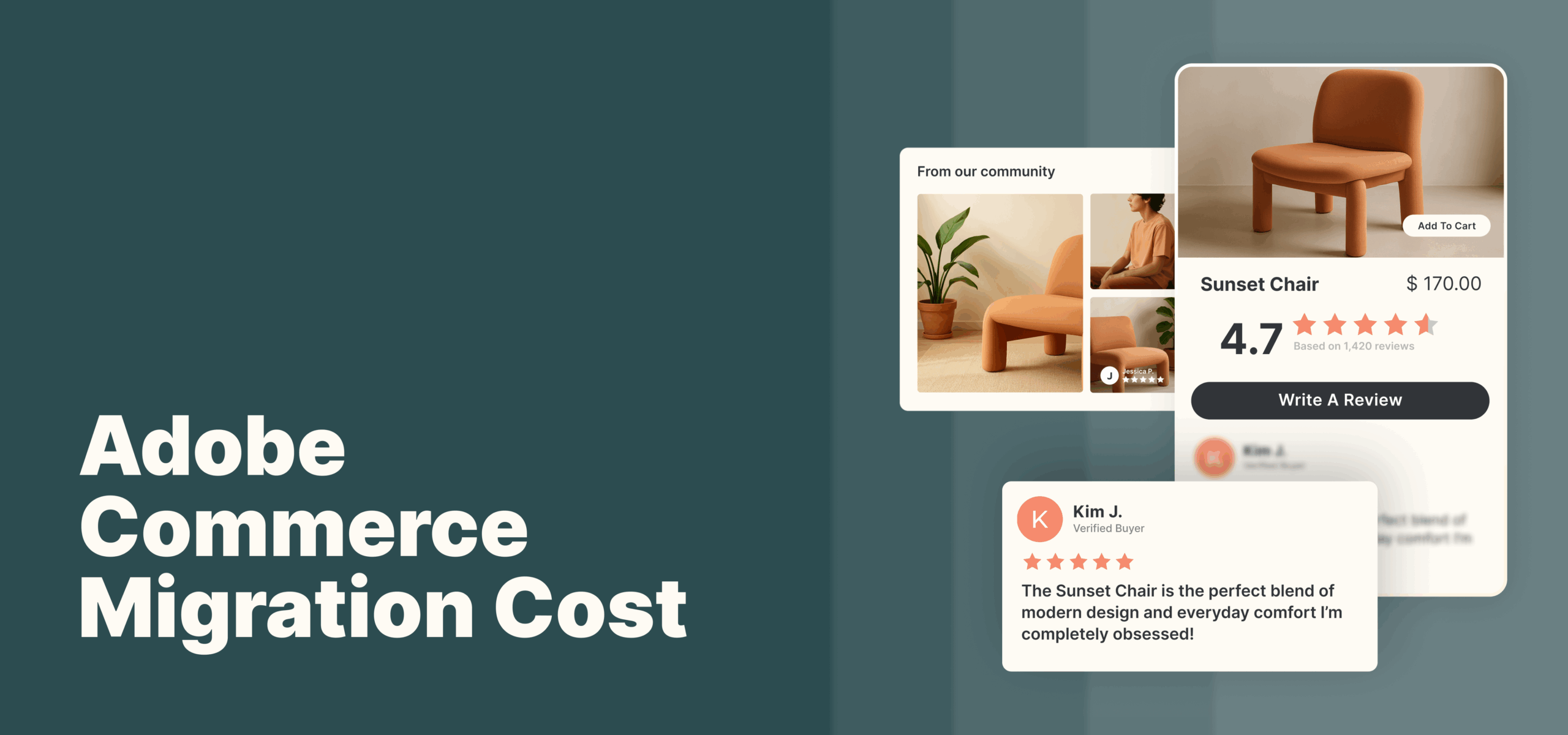
Consider utilizing Yotpo Reviews and Yotpo Loyalty to maximize the ROI of this newly optimized infrastructure. When shoppers encounter verified reviews and user-generated content during their journey, they convert 161% higher than those who don’t. Furthermore, prominently displaying customer photos creates a 137% purchase likelihood lift. By feeding this fresh, machine-readable review content into your fast-loading pages and engaging returning buyers through personalized, tier-based loyalty structures, you build a high-converting digital ecosystem that modern search engines love to crawl.
Migrating to Adobe Commerce’s versionless cloud architecture requires a rigorous codebase audit, strategic phased rollouts, and a skilled technical team. However, the long-term operational payoff—reducing cyclic upgrade costs, eliminating technical debt, and preparing your store for agentic AI discovery—is significant.
By treating this transition as a vital evolution rather than just an IT chore, brands can unlock faster storefronts, smarter automated operations, and ultimately, a more engaging omnichannel experience. Taking the time to audit your customizations today ensures a smoother leap into the future of commerce.
Depending on the complexity of your custom extensions and the size of your product catalog, a standard enterprise migration typically spans 10 to 24 weeks from initial discovery to stable production.
The biggest hidden cost is the dedicated developer hours required to manually audit, untangle, and rewrite legacy “in-process” PHP customizations into independent microservices before the platform shift can occur.
Extensions that are deeply tied to the core code must be refactored. The new versionless architecture mandates that custom business logic be built as separate, serverless applications using the Adobe Developer App Builder.
By reducing the need for major manual version upgrades and constant server maintenance, retailers can reallocate large portions of their IT budgets toward revenue-generating initiatives like AI integration and advanced personalization.
Not if correctly managed. By utilizing Edge Delivery Services (EDS) alongside data delta synchronizations, merchants can ensure their storefront remains fully operational and fast during the cutover process.
The platform natively handles immense B2B complexity out-of-the-box, supporting features like intricate company account hierarchies, shared catalogs, and customer-specific pricing logic without needing a massive web of third-party plugins.
App Builder allows engineering teams to easily deploy and manage custom functionality outside of the main commerce engine. This ensures that routine platform updates never break your unique store customizations.
Structure your newly migrated catalog data with clear, descriptive schema markup and guarantee fast page load times. AI engines and Overviews heavily prioritize fast, cleanly structured sites when synthesizing product recommendations.
Yes. A phased rollout—migrating specific services incrementally while utilizing tools like an API Mesh—significantly mitigates deployment risk and prevents costly sales disruptions.
While baseline server maintenance and security are handled by Adobe, you still require specialized, highly technical engineering talent to manage ongoing API integrations, serverless microservices, and AI orchestration tools.






