Writing a blank check for a new e-commerce platform is a luxury most growing brands simply don’t have. While enterprise giants freely absorb millions into complex architecture, your budget demands a rigorous, dollar-for-dollar return on investment. Looking past the flashy developer tools, what is the actual financial impact of an upgrade?
This guide unpacks genuine Adobe Commerce reviews, revealing the hidden maintenance costs and revenue-driving AI capabilities that actually matter. We’ll help you evaluate whether the platform’s price tag translates into scalable, sustainable value for your bottom line.
Evaluating a massive platform migration requires looking past the surface-level marketing to understand the real-world impact on your budget and resources. These core takeaways distill the most critical financial and operational insights from verified users who have already navigated this technical transition. Keep these essential points in mind as you weigh the platform’s long-term value against the initial sticker shock.
Transitioning to a premium architecture is rarely a one-time expense, making it crucial to understand the ongoing financial obligations you are assuming. Beyond the initial licensing fees, growing brands must carefully budget for continuous developer maintenance and complex custom integrations. Uncovering these hidden operational costs early will help you determine if your team is truly prepared for the long-term financial commitment.
When exploring authentic Adobe Commerce reviews, the platform maintains a solid 4.4-star rating across 349 verified enterprise and mid-market users. However, reading between the lines of this impressive aggregated score reveals a clear duality in user sentiment. On one hand, merchants offer massive praise for the software’s nearly limitless scalability and complex integration capabilities. On the other hand, there is a consistent, underlying warning regarding the sheer financial investment required to keep the system running optimally. For growing brands, it becomes clear that the initial software licensing fee is only the beginning of the financial conversation.
One of the most pressing concerns highlighted in user feedback is the risk of the architecture consuming a disproportionate amount of internal resources. Unlike simple, plug-and-play alternatives, highly customized commerce environments demand continuous attention.
For businesses operating without a large, dedicated internal technical team, the costs of ongoing maintenance, custom development retainers, and complex version upgrades can escalate rapidly. If not managed strategically, these operational overhead costs can sometimes overshadow the immediate revenue benefits of the platform’s advanced features.
This reality encourages brands to scrutinize every development hour and carefully weigh the need for custom features against their budget.
To mitigate these technical hurdles, it helps to thoroughly understand the difference between deployment models. Historically, many brands utilized the Platform-as-a-Service (PaaS) model, which offers ultimate code-level customization but comes with significant developer overhead for manual patching, server maintenance, and infrastructure monitoring.
In contrast, transitioning to the newer Software-as-a-Service (SaaS) architecture fundamentally changes the financial equation for budget-conscious SMBs. This cloud-native model offers self-service provisioning that allows technical teams to launch production and sandbox instances in mere minutes.
Crucially, this SaaS approach handles zero-patch maintenance, meaning new features, security updates, and performance enhancements are delivered automatically. By eliminating the need for manual version upgrades, growing teams can drastically reduce their reliance on expensive agency retainers, reallocating that critical budget toward active growth marketing and customer acquisition.
Despite the significant operational costs, this enterprise architecture offers profound financial benefits for brands experiencing rapid, complex growth. The ability to handle massive product catalogs and unify diverse sales channels translates directly into measurable operational efficiency and higher profit margins. By strategically leveraging these advanced built-in capabilities, growing businesses can completely eliminate the need for future, highly disruptive replatforming projects.
The true financial value of a robust architecture emerges when a brand begins to experience hyper-growth or expands internationally. While the initial deployment costs are undeniably significant, the platform justifies its price tag by preventing the need for future, highly disruptive replatforming projects.
The system is engineered to seamlessly manage over 250 million SKUs within a single catalog instance without sacrificing site speed. Furthermore, the ability to apply up to 30,000 unique price points per SKU empowers brands to deploy highly complex pricing rules, geographic currency variations, and tiered customer group discounts dynamically, avoiding the need for expensive custom database development.
For SMBs looking to diversify their revenue channels, expanding into wholesale and B2B operations is often the most lucrative next step. Running entirely separate platforms for B2C and B2B storefronts duplicates licensing fees, complicates inventory management, and doubles operational labor.
Adobe Commerce allows growing brands to consolidate both channels onto a single, unified instance, driving immediate and noticeable cost savings. By leveraging out-of-the-box feature efficiencies—such as customizable Quote Templates, shared B2B catalogs, and detailed company purchasing hierarchies—sales teams can significantly reduce manual order entry and close large, complex wholesale deals faster.
If a full backend migration is entirely out of the current budget, consider an innovative and cost-effective middle ground. The Adobe Commerce Optimizer acts as a high-performance experience overlay, allowing brands to strategically decouple their frontend presentation layer from their existing backend logic.
By layering Adobe’s high-converting, lightning-fast Edge Delivery Services onto a legacy or less sophisticated backend, merchants can improve Core Web Vitals, organic search rankings, and overall conversion rates. This headless approach delivers measurable revenue lifts by upgrading the shopper experience without requiring the massive capital expense and timeline of a full, ground-up platform migration.
The way consumers search for and discover products is fundamentally changing, shifting rapidly toward AI Overviews and intelligent discovery tools. Adapting your commerce architecture to meet these new technological standards is a critical, long-term revenue strategy. Ensuring your catalog is perfectly optimized for these advanced systems will position your brand to capture the most profitable, high-intent traffic available today.
Search behavior is fundamentally shifting away from traditional keyword queries and toward conversational interactions with LLMs and AI Overviews. Rather than browsing category pages, shoppers are increasingly relying on AI agents to compare options, evaluate constraints, and curate highly specific product shortlists.
Businesses that configure their commerce architecture to participate in this agent-led discovery process are seeing remarkable financial returns. In fact, current industry data shows that AI-driven referrals to storefronts generate 254% more revenue per visit and convert 31% higher than traditional search traffic. These systems bring highly qualified, high-intent buyers straight to the checkout line, making compatibility with AI agents a primary ROI driver for any modern platform investment.
To capitalize on this new wave of traffic, consider transitioning your marketing budgets from legacy SEO tactics to Generative Engine Optimization (GEO). The recent $1.9 billion dollar acquisition of Semrush signals exactly where the industry is heading: deep integration between commerce catalogs and search intelligence. GEO focuses on structuring your product data, attributes, and metadata so that they are inherently machine-readable.
If an AI agent cannot seamlessly access and interpret your inventory levels, pricing rules, and product specifications, your brand might simply be omitted from the AI’s curated recommendations. Prioritizing structured data ensures you remain visible to the highest-converting traffic available.
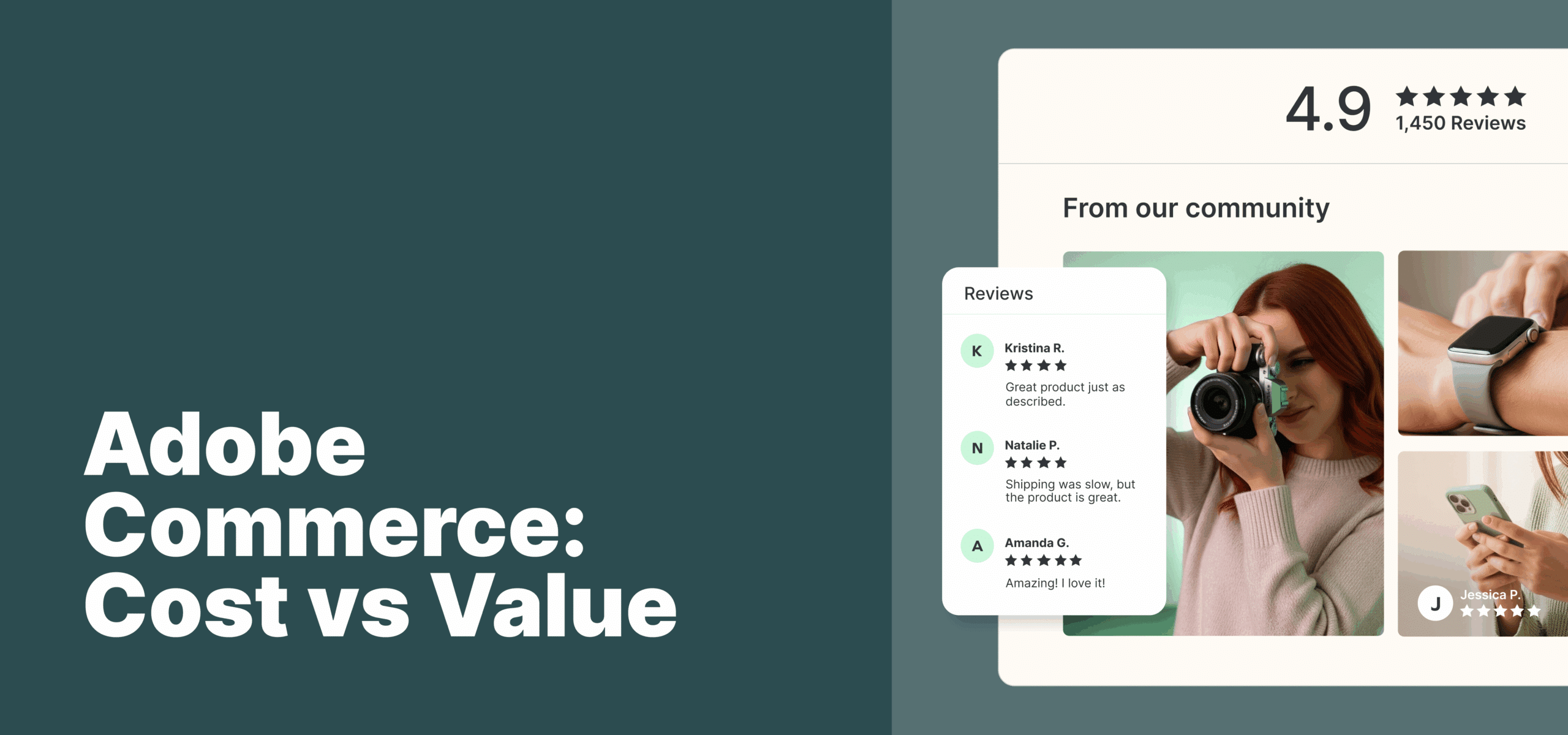
A powerful backend infrastructure provides the necessary speed and scalability, but authentic social proof is what actually convinces hesitant shoppers to complete their purchase. Integrating genuine customer feedback directly into your newly upgraded storefront is one of the most effective ways to accelerate your return on investment. By prioritizing this transparent content, you not only build immediate buyer trust but also continuously feed valuable, dynamic data into AI Overviews and search engines.
Migrating to a robust, enterprise-grade backend provides exceptional speed and operational scalability, but the infrastructure alone does not close the sale. A premium storefront is only half the battle; the on-page content is what ultimately persuades a shopper to convert. To truly maximize the return on a major platform upgrade, growing brands should intentionally prioritize authentic social proof.
Ben Salomon, Growth Marketing Manager, emphasizes this strategic priority: “Building trust through authentic customer feedback is one of the fastest ways to accelerate the ROI of any new commerce platform. A fast, scalable website successfully gets a shopper to the product page, but it is the relatable, transparent social proof that confidently guides them through the checkout.“
The financial value of social proof is measurable and highly impactful for budget-conscious SMBs. Incorporating user-generated content (UGC) directly addresses shopper hesitation and drives immediate revenue lifts. Verified data reveals that shoppers who interact with reviews and UGC convert 161% higher than those who do not.
The barrier to entry for these gains is also surprisingly low; establishing a baseline of just 10 reviews on a single product yields a 53% uplift in conversion rates. Furthermore, visual commerce is a dominant factor, with the addition of customer photos driving a massive 137% purchase likelihood lift.
Acquiring new customers—especially through advanced AI engines and premium search channels—is a costly endeavor. To ensure your platform investment remains profitable, you should aim to retain these shoppers over the long haul.
Consider utilizing tier-based loyalty structures to transition one-time retail or B2B wholesale buyers into a source of predictable, recurring revenue. By rewarding high-value actions, such as writing detailed reviews or reaching specific spend thresholds, you foster deep brand affinity while offsetting the initial customer acquisition cost.
To extract the maximum value from your sophisticated commerce architecture, consider seamlessly integrating Yotpo Reviews and Yotpo Loyalty. A unified approach allows you to capture high-quality feedback efficiently; for example, utilizing Smart Prompts makes you 4x more likely to capture high-value, descriptive review topics.
Additionally, by orchestrating SMS Review Requests through powerful integrations like Klaviyo or Attentive, you can achieve a 66% higher conversion rate compared to standard email requests. This constant stream of fresh, highly relevant user-generated content acts as continuous, dynamic data that feeds directly into LLMs, increasing the likelihood of your brand appearing in AI Overviews and driving sustained, profitable growth.
Making the final call on an enterprise-grade migration requires an honest assessment of your current growth limitations and available technical resources. While the total cost of ownership can initially seem intimidating, remaining on a restrictive platform that stifles your expansion carries its own financial considerations.
Ultimately, the significant investment often becomes justified when your immediate need for unified B2B channels, AI readiness, and global scalability outweighs the upfront expense.
To decide if this architecture is the right choice, you should look far beyond the base licensing fee and calculate your Total Cost of Ownership (TCO). While Adobe Commerce license fees scale based on your Gross Merchandise Value (GMV)—typically starting around $22,000 to $40,000 per year for SMBs and scaling to $125,000+ for massive enterprises—that initial sticker price is just the beginning. Industry data from 2026 reveals that the license alone generally represents only 20% to 40% of your actual annual spend.
A comprehensive TCO analysis must account for ongoing server hosting (if not utilizing the bundled SaaS Cloud edition), specialized third-party extensions, and critical developer retainers. Development agencies often charge between $100 and $180 per hour, meaning a robust mid-market store can incur an estimated TCO of $122,000 to over $450,000 per year when factoring in custom integrations, security patches, and platform maintenance. Lower-tier platforms might appear more affordable upfront, but if your catalog scales rapidly, relying heavily on manual workarounds on a basic platform can drain resources just as quickly.
The right moment to consider an enterprise-grade upgrade is when your current infrastructure actively restricts your revenue growth. This tipping point typically occurs when you need to unify disjointed B2B and B2C channels, when your product catalog variations become too complex for a lightweight platform to render efficiently, or when your legal department requires strict data sovereignty and compliance that only a private cloud or on-premise setup can offer.
Furthermore, if you are actively looking to capture your share of the projected $385 billion agentic commerce market, adopting an architecture built for machine-readability becomes a core strategic consideration. If your business requires these advanced capabilities to scale, the TCO transitions from a daunting operational expense into a justifiable long-term investment.
Upgrading to a sophisticated commerce architecture is a major financial commitment where hidden costs can multiply quickly. However, for brands hitting a ceiling with basic platforms, it can be an investment in unparalleled global scale.
By leveraging unified B2B features, exploring the zero-patch SaaS model, and optimizing your catalog for AI agents, growing SMBs can justify the TCO through sustained revenue acceleration. Pairing this powerful backend with the trust-building momentum of authentic user-generated content ensures you convert the high-value traffic you work so hard to acquire.
Navigating the complexities of a major platform upgrade naturally brings up a multitude of strategic, financial, and highly technical questions. We have compiled the most common inquiries from growing brands evaluating this specific architecture and its broader impact on the e-commerce market. Review these detailed answers to gain further clarity on pricing models, AI integration standards, and the overall value proposition for your specific business needs.
It can be cost-prohibitive for very small teams operating without dedicated technical resources. While base license fees start around $22,000 per year for lower GMV tiers, the Total Cost of Ownership (TCO) usually ranges between $122,000 and $450,000+ annually when factoring in agency development ($100–$180/hr), custom hosting, and ongoing maintenance. However, for rapidly growing SMBs consolidating complex B2B and B2C channels, the long-term operational savings often justify the initial expense.
The Platform-as-a-Service (PaaS) model gives your developers ultimate code-level control over the environment but requires your team to manage complex server infrastructure, security compliance, and manual application patching. In contrast, the Software-as-a-Service (SaaS) model provides rapid provisioning and handles zero-patch maintenance, meaning security updates and performance enhancements are applied automatically, significantly reducing developer overhead for budget-conscious brands.
Agentic commerce—where AI shopping assistants autonomously find, compare, and recommend products on behalf of consumers—drastically improves traffic quality. By adopting standards like the Universal Commerce Protocol (UCP), stores become accessible to LLMs. Data shows this AI-referred traffic carries immense purchase intent, generating 254% more revenue per visit and converting 31% higher than traditional search methods.
Historically, because the platform allows for infinite customization, merchants often built deeply bespoke features and intricate third-party integrations. When it came time for major version updates or security patches, these customizations had to be meticulously rebuilt and tested to prevent the site from breaking, requiring expensive developer retainers. The newer SaaS models aim to alleviate this by automating core updates.
Yes. One of the platform’s greatest cost-saving advantages is the ability to run multiple localized storefronts—including unified B2B wholesale and direct-to-consumer catalogs—from a single backend environment. Features like Quote Templates, shared catalogs, and company credit hierarchies are built-in, eliminating the need to pay licensing and maintenance fees for two separate platforms.
Adobe’s $1.9 billion acquisition of Semrush signals a massive pivot toward Generative Engine Optimization (GEO). Brands are now encouraged to align their content strategy to focus less on traditional “blue link” rankings and more on how they are cited within AI Overviews and LLMs. The integration seamlessly connects visibility intelligence with commerce data, emphasizing that catalogs must be semantically rich to capture LLM-driven traffic.
GEO is the strategic practice of formatting your product data, metadata, and on-page attributes so that they are inherently machine-readable. Since modern shoppers use LLMs to curate shortlists, GEO ensures that an AI agent can instantly access and interpret your inventory, pricing, and specific product specs, ensuring you aren’t excluded from conversational search recommendations and AI Overviews.
Customer reviews act as a continuous stream of fresh, semantic, natural-language content. AI engines actively scan for this type of authentic social proof to validate a product’s quality, context, and specific use cases. Because user-generated content naturally includes long-tail keywords and conversational phrasing, it dramatically increases the likelihood that an AI shopping assistant will confidently cite your brand. Furthermore, shoppers interacting with this content convert 161% higher.
The Optimizer is a headless, high-performance experience overlay launched to help brands modernize without full replatforming. It allows merchants to deploy Adobe’s lightning-fast frontend presentation layer (Edge Delivery Services) directly on top of their existing legacy backend logic, significantly improving Core Web Vitals and organic search metrics without the capital expense of a total backend migration.
The modern SaaS deployment architecture is designed for rapid agility. It features self-service provisioning that allows technical teams to spin up complete production environments and sandbox instances in under two minutes. This drastically accelerates development and testing timelines compared to traditional, manual on-premise infrastructure setups.