

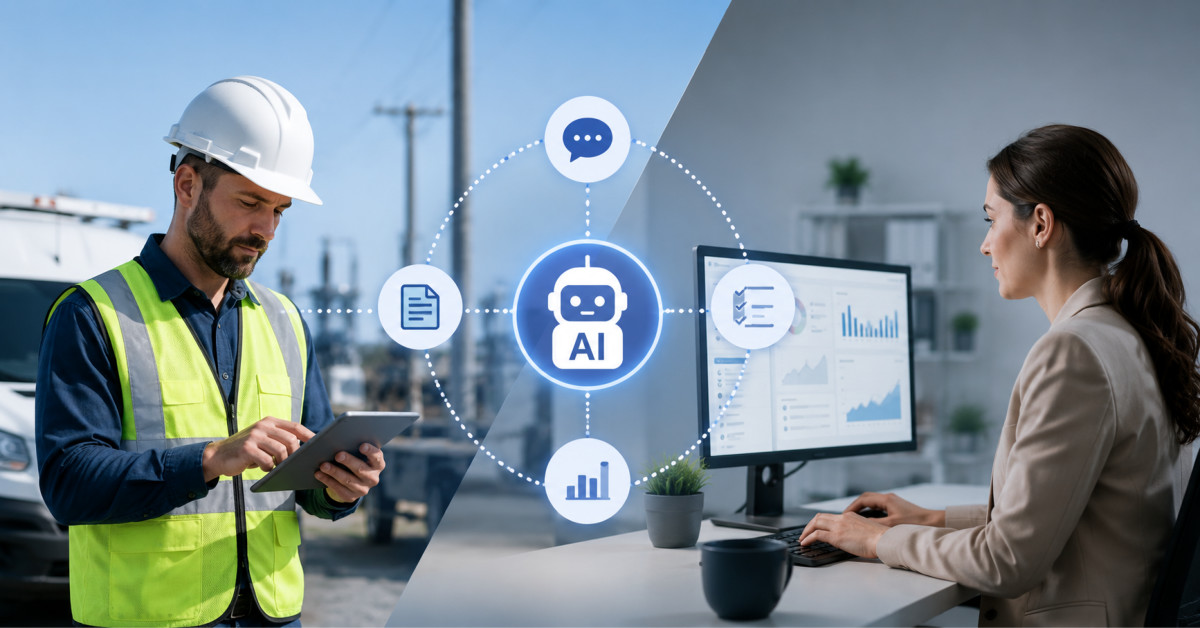
Agentic AI can reduce the field-office divide by turning scattered updates, documents, photos, and work orders into prioritized actions, but it should begin as a supervised coordination layer rather than an autonomous project manager. The best first use cases are document control, update summaries, exception alerts, and task routing.
The field-office divide is rarely caused by people refusing to collaborate. It is caused by work moving faster than the systems used to record, interpret, approve, and distribute the information everyone needs.
From miscommunications to missing paperwork, disruptions caused by poor collaboration between field and office teams are a common story that has long been a big challenge within many businesses.
When working on fast-paced projects, even the smallest of hiccups can have a knock-on effect.
This is where artificial intelligence (AI) is coming in. There are now various systems available to businesses that aim to overcome the long-standing disconnect that has added complexity to projects for years and years.
These systems are quickly growing in popularity, and now 82% of businesses say they are looking to increase their investment in AI over the next year, but what is the best way to do so?
There has long been a noticeable disconnect between the office team and those on-site, which results in ongoing frustrations and misunderstandings. Although the two teams need to work closely together to make a project run smoothly, being in different locations can bring added challenges. Let’s talk about some of the key ones.
Many people are familiar with the process of giving an AI tool a prompt and generating an instant response, but less realise that they are able to set up AI agents that can act as an ongoing assistant.
Over time, the system is able to build up an understanding of a business, its problems, and the specific actions required to achieve desired outcomes. The more information it is given access to, the more accurately it can carry out duties.
The aim is to get the AI agent to a stage where it can independently perform certain tasks, make informed business decisions, and manage workflows.
So far, 66% of companies using AI agents have seen measurable productivity gains, but this is only the beginning. The future of agentic AI is only expected to become more advanced as agents are able to take on more complex roles and improve everyday operations for businesses.
Although agentic AI is a relatively new concept, it’s quickly becoming a staple for businesses across many industries.
When it comes to field and office teams, the addition of an AI agent can create the link that has long been needed to achieve a more united workforce.
Instead of workers having to piece together the information they need from paper documents, old email threads, and various WhatsApp messages, an AI agent can be used as a middleman to interpret all of the information and simplify it.
Since the agent will provide information according to the latest updates, it means that all workers have access to the correct information and can collaborate more easily.
As the project moves forward, agentic AI makes it much easier to see real-time data. Any delays that have occurred on site or any hold-ups to the timeline will be flagged as they happen, allowing both field and office teams to act accordingly.
The agent is also able to use the information it has to create a list of action points based on priority. It can interpret all messages and project timelines to determine what tasks are the most pressing and what order the jobs need to be done in.
Agentic AI is becoming transformative for many businesses, improving their everyday operations and helping overcome the team divide that has long been a challenge.
Introducing an AI agent that can act as a virtual project manager means hours of admin time can be saved since team members no longer have to chase updates and dig to find the latest version of a document.
Although it is not going to be a magic fix that suddenly sees field and office workers working flawlessly together, it has shown huge improvements in the way projects are carried out, helping avoid unnecessary delays to the final deadline.
The best first agentic AI use case for a field service team is usually a supervised job-update and exception-summary workflow. The agent can collect technician notes, photos, work-order status, customer messages, and required documentation, then produce a plain-language summary of completed work, blocked jobs, missing evidence, and next actions. This is a strong starting point because it is high volume, repetitive, and easy to measure. Keep the agent read-only at first, require a human to approve its summary, and track correction rates before allowing it to create tasks or send routine internal reminders.
Agentic AI differs from field service automation because automation follows fixed rules, while an agent can interpret context, gather information from several systems, recommend next steps, and escalate exceptions. A standard automation can send a confirmation when a work order changes to complete. An agent can read the technician’s notes, check whether required photos and signatures are attached, compare the work with the latest scope, identify a possible issue, and prepare a summary for the supervisor. Use conventional automation for stable, predictable tasks and agentic AI for context-dependent coordination that still needs clear human oversight.
Agentic AI can help update project documents, but teams should limit automatic changes to low-risk, structured information with a clear source of truth. An agent can file a technician report, label uploaded photos, create a draft change log, identify a newer document version, or flag records that need review. It should not autonomously rewrite technical specifications, approve scope changes, alter safety documentation, or publish customer commitments without a qualified human review. The safest pattern is for the agent to prepare the update, cite the source information it used, and route the draft to the accountable document owner for approval.
An agentic AI system should first access only the minimum information required for one defined workflow, such as work-order status, approved job notes, current documents, technician updates, and assigned owners. Start with read-only access to a limited set of systems instead of connecting every platform in the business. The agent needs current, trusted data to be useful, but broad permissions create unnecessary risk. Add data sources only when a real workflow gap requires them, and document why each source is needed. Customer, employee, financial, and safety-sensitive data should have explicit access controls and audit logging from day one.
Measure agentic AI by whether it shortens coordination time, improves information completeness, and reduces preventable exceptions between field and office teams. Track the time from a field update to office acknowledgement, incomplete work-order rate, missing-document rate, document-revision incidents, average time spent preparing daily operational summaries, task-routing accuracy, and the percentage of agent outputs humans must correct. Add customer-facing metrics where relevant, such as missed appointments, delay notifications, and repeat visits. Review the numbers weekly during the pilot. If correction rates stay high, improve the workflow and source data before expanding the agent’s permissions.





