




Key Takeaways
- Outrank slower competitors by making your top products “agent-ready” with clear specs, variants, pricing, and policies that AI can compare and recommend with confidence.
- Follow a 30 to 90 day rollout by cleaning your catalog and policies in Week 1, enabling one AI platform in Weeks 2 to 3, then optimizing and tracking results weekly.
- Reduce customer confusion and support load by writing shipping, returns, warranty, and sizing answers so an AI agent can explain them in plain language before the buyer checks out.
- Test the new “prompt to purchase” path by searching for your own products in AI chats and fixing the missing facts that stop the agent from shortlisting you.
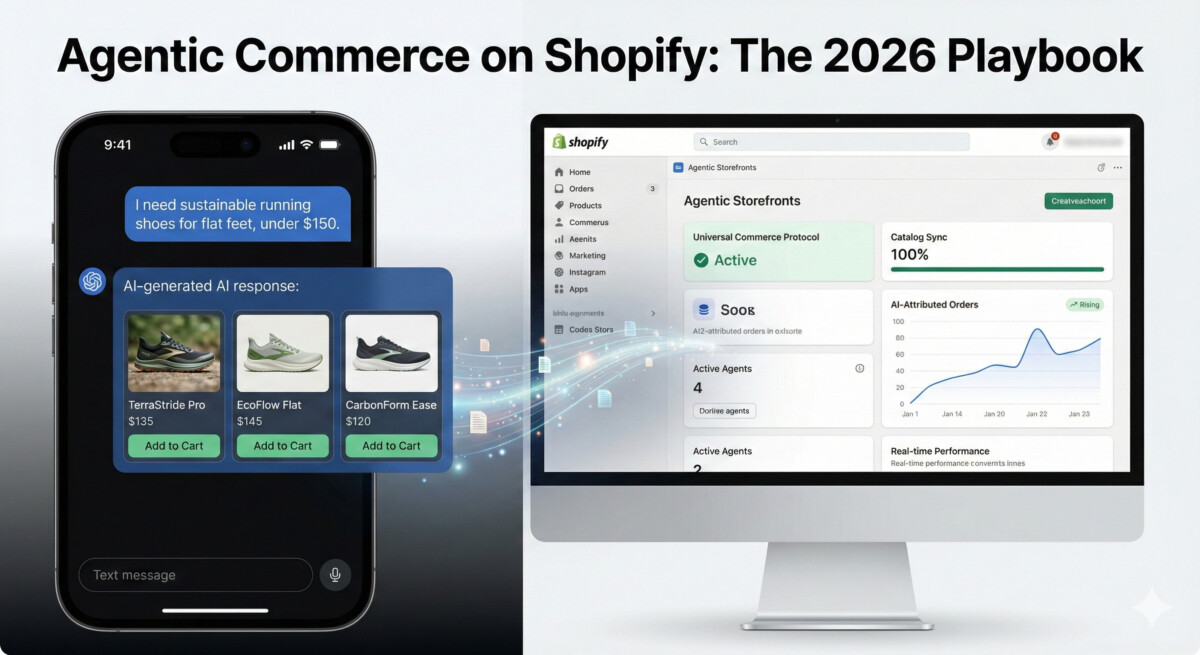
A shopper types, “sustainable running shoes under $150 with arch support” into an AI chat. It comes back with a short list, compares materials and fit notes, then offers checkout right there in the conversation. No tabs, no bouncing between product pages, no “I’ll buy later” drop-off.
That flow is agentic commerce, where AI agents can discover products, compare options, and complete checkout on the shopper’s behalf. If you’re running Agentic Commerce Shopify, this isn’t theory anymore, it’s a channel you can prepare for and measure.
EcommerceFastlane has been tracking the shift through patterns pulled from 400+ podcast interviews with Shopify operators and ecosystem builders, plus real Shopify insider experience. The pattern is consistent: when shopping moves into conversations, your product data, policies, and brand answers become the new storefront.
In 2026, Shopify is making this channel real with Agentic Storefronts, Shopify Catalog, and the Universal Commerce Protocol (UCP) co-built with Google, designed so commerce can work across AI platforms at scale.
Agentic commerce turns AI conversations into checkout surfaces, and Shopify’s UCP plus Catalog means merchants can show up where buyers ask, then sell without a traditional storefront visit.
This guide breaks down what agentic commerce is, where it happens (ChatGPT, Google AI Mode and Gemini app, Microsoft Copilot), how Shopify’s plumbing works (UCP, Catalog, Knowledge Base), and a practical plan to decide, launch, and measure results in 30 to 90 days.
For a quick visual walkthrough, start here:

Agentic Commerce in Plain English
Agentic commerce is what happens when shopping stops being “find a product page” and becomes “tell an AI what I’m trying to do, then let it handle the steps.” The key change is action: AI agents can move from advice to execution, including building a cart and routing you into checkout, often without the shopper ever visiting your storefront.
If you sell on Shopify, this matters because Shopify is actively turning these AI conversations into real checkout surfaces. So the question for 2026 isn’t “is this real,” it’s “is my catalog, policy info, and offer structure ready to be understood and recommended by an agent?”
From search boxes to conversations, how shopping behavior is changing
Traditional ecommerce trained shoppers to translate needs into keywords. That’s why “running shoes size 10” worked, it’s short, searchable, and maps to filters.
Agent-led shopping flips the input. Shoppers now describe a goal and constraints, then expect the AI to do the research, narrowing, and shortlisting for product discovery:
- Keyword search: “running shoes size 10”
- Conversation: “I run 3x a week, need arch support, under $150, prefer breathable materials, men’s 10”
That second prompt carries intent, usage context, budget, preferences, and fit requirements. In a search box, those details usually get lost across tabs and filters. In a conversation, they become the “spec” the agent optimizes for.
Here’s the part most merchants underestimate: this raises the bar for product data clarity. If your product page is heavy on brand voice and light on specifics, agents have less product data to work with. The winners tend to be the brands that make key facts easy to extract and compare, even when the shopper never sees your PDP.
Practical implications you can act on this week:
- Put hard constraints up front: price range, sizing notes, materials, compatibility, use-case.
- Make variants unambiguous (color names, size systems, pack counts).
- Write for comparison, not just persuasion (agents are building shortlists).
- Keep policies crisp and consistent, because agents pull those answers into the conversation.
If you want the bigger picture of how AI shopping agents are reshaping discovery across channels, see AI shopping agents trend 2026.
What makes agentic commerce different from conversational commerce and chatbots
A lot of brands hear “AI chat” and think “support bot.” That’s conversational commerce: a chat interface that answers questions, recommends products, maybe hands off to a human, and then points the shopper to a link.
Agentic commerce is different because the agent can take actions. When the commerce system supports it, the agent can move from “helpful assistant” to “transaction operator,” doing steps that used to require your site UX:
- Build and modify carts (including bundles and variants)
- Apply discount codes
- Initiate checkout and collect required details
- Handle subscription choices (cadence, first-ship date, prepaid vs. pay-as-you-go)
- Use loyalty credentials or member pricing
- Confirm special selling terms (final sale, pre-order timing, delivery constraints)
Think of it like the difference between a hotel concierge who suggests restaurants, and one who also books the table, applies your credit, and confirms dietary notes. The experience feels faster for the shopper, but it also means your operational rules become part of the shopping surface.
This is why Shopify’s infrastructure direction matters. Shopify isn’t only enabling chat-based discovery, it’s building standardized ways for agents to connect to real commerce flows. The engineering context is best understood through the Universal Commerce Protocol architecture overview, which explains how agents, platforms, and merchants can communicate consistently.
One more nuance: agentic commerce shifts what “good merchandising” looks like. Your best product might not win if the agent can’t confidently match it to the shopper’s constraints. That’s why “answer-first” product content and structured data are quickly becoming the new baseline (more on that later in the guide).
What we know in January 2026, early momentum, and what not to assume yet
The momentum is real, and it’s measurable. Shopify has publicly discussed rapid growth in AI-driven shopping activity over the last year, including 7x growth in AI-referred traffic and 11x growth in AI-driven orders, reported in mainstream coverage like TechCrunch’s reporting on Shopify’s AI order growth. Some updates shared around NRF 2026 point to the “agentic” framing becoming a central narrative for how shopping will work next, see Retail Brew’s NRF 2026 coverage.
But you need the sober version too, because this channel will punish sloppy expectations.
What not to assume yet:
- Instant scale for every niche. Some categories get traction faster (clear specs, common use-cases). Others lag (highly subjective products, complex fit, regulated claims).
- Perfect attribution. You’ll get directional signal, but don’t expect full query-level transparency or clean, last-click-style reporting across every agent surface.
- Full control of the shopping experience. Agents will summarize your brand in their own words, compare you next to competitors, and sometimes compress your story into a few lines. You influence the output through clean product data and clear policies, but you don’t “own the page” like you do on your site.
If you’re deciding where to focus first, start by understanding the mechanics of in-chat product discovery and checkout surfaces; ChatGPT Shopping integration for Shopify is a strong starting point. The pattern EcommerceFastlane has seen across hundreds of founder conversations is simple: merchants who treat agentic as “just another traffic source” get mediocre outcomes, merchants who treat it as “a new storefront made of data” learn faster and win earlier.
Where Agentic Shopping is Happening Right Now
Agentic shopping isn’t a future concept, it’s already showing up where people spend time: chats, search, and workplace assistants. The practical shift for Shopify merchants is simple: your product data and policy answers are now being read, summarized, and acted on inside other interfaces, not just on your storefront.
Here’s a quick snapshot of where merchants can reach shoppers through agentic commerce in early 2026:
| Platform | Best For | Checkout Type | Available Now |
|---|---|---|---|
| ChatGPT Shopping | Discovery and conversation | In-chat | Yes |
| Google AI Mode / Gemini | Search-driven intent | Embedded (UCP) | Rolling out |
| Microsoft Copilot | Workplace and B2B buying | Embedded | Yes |
| Perplexity | Research-focused shoppers | Varies | Yes |
Across 450+ podcast interviews, the pattern is consistent. The brands winning early aren’t “doing AI marketing.” They’re tightening the basics agents rely on: clear specs, consistent shipping and returns, and fewer unanswered edge cases.
ChatGPT Shopping, the fastest way to understand the new buyer journey
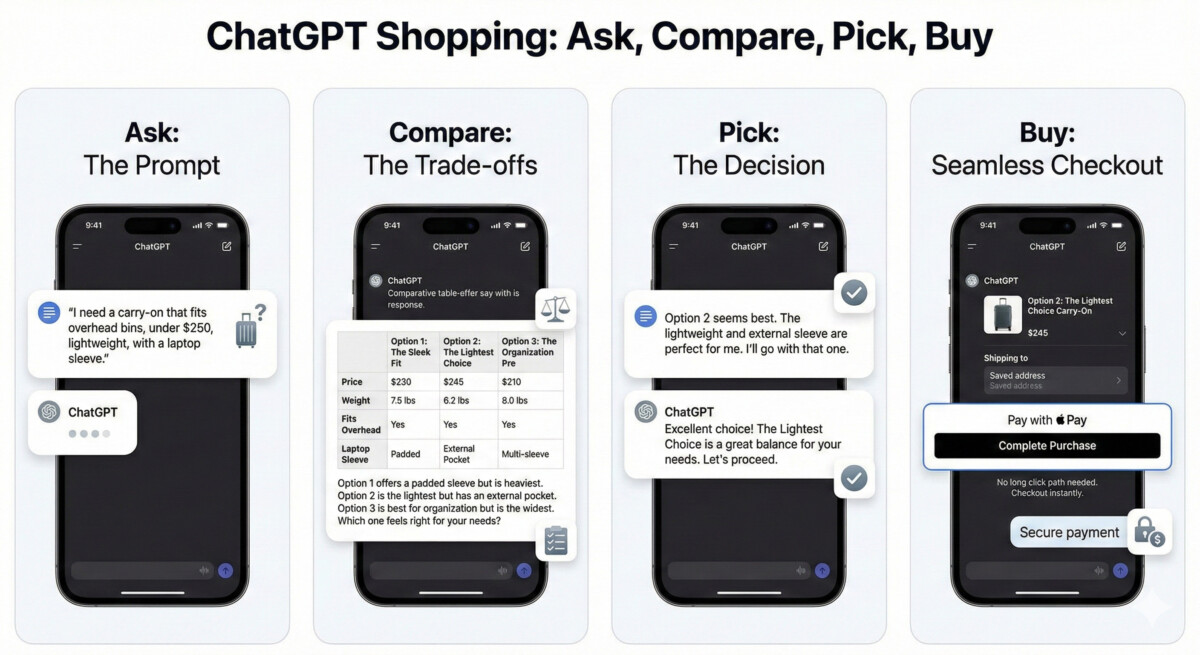
If you want to understand agentic commerce quickly, watch how buyers behave in ChatGPT. The flow is usually ask, compare, pick, buy, and it compresses what used to be five tabs into one conversation.
Here’s what that shopper journey looks like in real life:
- Ask: “I need a carry-on that fits overhead bins, under $250, lightweight, with a laptop sleeve.”
- Compare: ChatGPT lays out options and trade-offs, often in plain language.
- Pick: The buyer chooses based on fit to constraints and confidence in details.
- Buy: Checkout can happen inside the chat when it’s supported (you’re not counting on a long click path).
What drives selection inside chats is less about vibes and more about whether the agent can confidently say “this matches.” In practice, three things move the needle:
- Fit to constraints: price, dimensions, compatibility, ingredients, use-case, and availability.
- Clear specs: variants, materials, measurements, what’s included, and “who it’s for.”
- Trustworthy policy answers: shipping times, returns, warranty, and support, stated simply and consistently.
That’s why ChatGPT is often the first platform merchants test. Buyers are already shopping inside conversations, and the feedback loop is fast: if your product content is vague, you’ll feel it immediately in how (or if) you get recommended.
If you want a tactical playbook for making your catalog easier for AI to understand, start with EastsideCo’s guide to optimizing Shopify for ChatGPT Shopping. For the merchant-side entry point, OpenAI outlines how “Instant Checkout” works in ChatGPT merchant onboarding.
Google AI Mode and the Gemini app, what Shopify and Google are rolling out together
Google’s role in agentic shopping is obvious: people already go to Google Search with high intent, then bounce through results, reviews, and retailer sites. The whole point of Google AI Mode and the Gemini app is to shrink that journey into a tighter loop where the question, evaluation, and purchase can happen with fewer steps.
What matters for Shopify merchants is that Shopify and Google co-developed Universal Commerce Protocol (UCP) so “native checkout” can work consistently across agent surfaces. High-level, that means the agent can perform standardized commerce actions (the same kinds of steps a real shopper would take on your site), but inside Google’s experience when supported.
In plain English, UCP exists so an AI assistant can:
- Understand structured product info (including variants and availability)
- Present an embedded commerce experience (not just blue links)
- Trigger consistent checkout actions, like applying discount codes or confirming required terms
- Support offer presentation in the moment, when intent is highest
This is the deeper strategy: customers ask Google, Google helps them buy without a long click path. That changes how you think about merchandising. Your PDP still matters, but your “product data layer” becomes the storefront the agent reads first.
If you want the protocol context from Google’s side, see Google’s announcement on agentic commerce tools and the more technical breakdown in Google’s UCP explainer. On the EcommerceFastlane side, the strategic angle is covered in our NRF 2026 recap on Shopify and agentic commerce.
Microsoft Copilot with embedded checkout, why it matters for busy buyers and teams
Microsoft Copilot is the most “work-shaped” agentic surface, and that’s the opportunity. A lot of real buying decisions happen mid-task: someone is writing a brief, planning an event, ordering supplies, or replacing something that broke. In those moments, people don’t want to browse. They want to decide fast and move on.
That’s where embedded checkout comes in: an embedded checkout experience powered by Shop Pay that aims to let the buyer complete a purchase inside Copilot, without bouncing out to a stack of tabs. For Shopify merchants, this is less about brand storytelling and more about operational clarity.
Workplace shopping tends to reward:
- Fast confirmation: what’s in stock, when it ships, what it costs delivered
- Low-risk policies: returns, exchanges, warranty, and who to contact
- Procurement-friendly details: pack sizes, SKUs, compatibility notes, and predictable lead times
If ChatGPT is a conversation that feels like a personal shopper, Copilot is closer to a capable assistant helping someone finish their day. The copy that wins here is not clever. It’s precise.
This is also where B2B ecommerce and team buying can show up earlier than people expect. If a buyer is choosing between two similar options, the agent will default to the one with fewer unanswered questions.
For additional context on why Microsoft is pushing into embedded commerce, this write-up is useful: Stripe powering checkout inside Microsoft Copilot.
Perplexity and the long tail of new agents, why “set up once” matters
Beyond the big three, there’s a growing long tail of shopping-capable agents and discovery surfaces. Perplexity is part of that conversation, and the important point for merchants is not which new interface wins next. It’s whether your product and policy data can travel cleanly across interfaces as they appear.
Shopify’s direction here is pragmatic: set up once, then enable platforms as they show up, rather than rebuilding your commerce stack for every new agent. That “set up once” mindset only works if the foundation is solid:
- Product titles that include real constraints (size, material, compatibility)
- Variant data that’s unambiguous (color, pack count, sizing system)
- Policies written so an agent can answer confidently (shipping, returns, warranty)
Perplexity’s push into shopping has been covered in mainstream reporting, including CNBC’s overview of its shopping product: Perplexity’s shopping announcement. And if you want the broader industry framing around competing protocols and agent ecosystems, PayPal’s perspective is a helpful read: the AI shopping protocol moment.
If you’re trying to pressure-test whether your store is ready for this long tail, start with the basics in EcommerceFastlane’s Shopify AI visibility audit. That one piece will save you weeks of guessing.
How Shopify Makes Agentic Commerce Work Under the Hood
This guide section explains how Shopify makes agentic commerce possible without you wiring up a custom integration for every new AI channel. After 400+ EcommerceFastlane podcast conversations with operators and platform builders, the pattern is consistent: the winners treat this like a data and policy problem, not a “new marketing channel.”
Here’s the simplest mental model: Shopify is building a shared commerce “plumbing layer” so agents can (1) find the right product, (2) complete checkout correctly, and (3) handle what happens after the sale, across many conversation surfaces.
Universal Commerce Protocol (UCP), the shared language for discovery, checkout, and orders
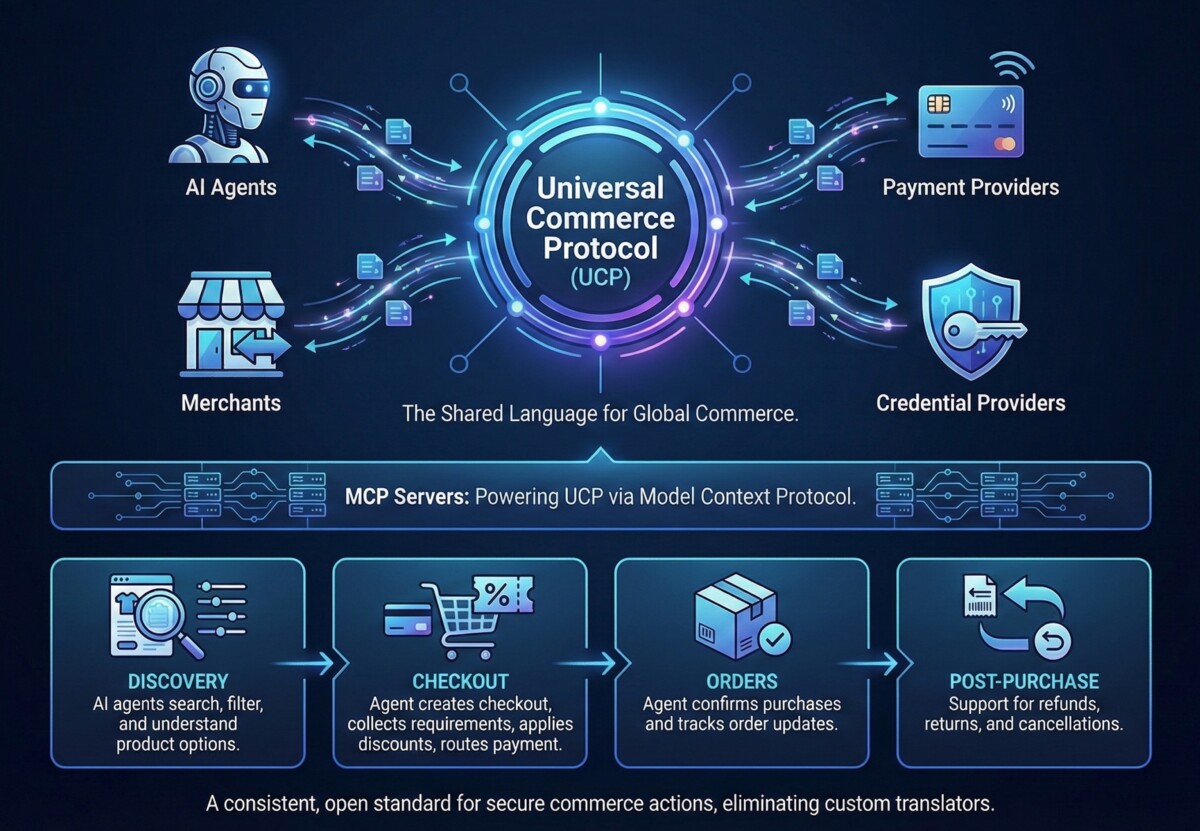
UCP is an open standard powered by the Model Context Protocol via MCP servers, giving AI agents, merchants, payment providers, and credential providers a consistent way to talk to each other, securely. Think of it as a common language for commerce actions, so an agent doesn’t need a custom translator for every store and every platform. The Universal Commerce Protocol covers a lifecycle:
- Discovery: the agent searches, filters, and understands product options.
- Checkout: the agent creates a checkout, collects what’s required, applies discounts, and routes payment correctly.
- Orders: the agent can confirm what was purchased and track updates.
- Post-purchase: support for actions like refunds, returns, and cancellations, where allowed.
Why this matters: open standards reduce one-off build work. Instead of your team building a separate integration for each AI surface, you align to a shared protocol that can travel with you as platforms change. For the protocol context from Google’s side, see Google’s UCP technical overview.
Shopify Catalog, why product data quality is now a growth lever
Shopify Catalog is where agentic discovery becomes real. Agents need structured data, structured and comparable product data, not clever copy. Shopify Catalog standardizes product info at scale so an agent can match a shopper’s constraints (budget, size, compatibility, ingredients, delivery timing) to the right items fast.
If you want more visibility in AI shopping results and better product data quality, these fields do the heavy lifting:
- Titles: include the “what” plus the constraint that matters (size system, capacity, material, compatibility).
- Variants: clear option names, accurate SKUs, and unambiguous mapping (color, pack count, length).
- Attributes: materials, dimensions, fit notes, ingredients, certifications, use-cases.
- Images: clean primary images plus variant-accurate photos.
- Pricing: correct list price, compare-at, localized pricing if applicable.
- Inventory signals: in stock, low stock, backorder, pre-order windows.
Here’s the key: marketing copy alone isn’t enough. Agents behave like comparison engines with a personality. They reward clarity and punish gaps. Tightening taxonomy and attributes is a compounding advantage, start with Shopify’s standard product taxonomy overview.
Agentic Storefronts, your admin control center for AI channels
Agentic Storefronts is the operational layer merchants have been asking for: control, governance, and the ability to turn channels on or off without a dev project.
Inside Shopify Admin, this is where you:
- Enable or disable specific AI channels as they roll out.
- Decide which products are eligible to appear and be transacted on.
- Review performance and outcomes, so you can treat this like a real channel with measurement, not a black box.
The “set up once, sell across conversations” idea only works if you keep control in one place. That’s the point: Shopify becomes the system of record for what’s allowed, what’s offered, and what happens when a buyer asks an agent to purchase.
If you’re thinking ahead about how carts may work across multiple merchants and surfaces, also read Shopify’s Universal Cart breakdown.
The Knowledge Base app, how you stop agents from guessing about your brand
When buyers shop in chat, they ask questions your PDP often doesn’t answer well: “How fast does this ship to California?” “Is this final sale?” “What if it doesn’t fit?” The agent will respond either way. Your choice is whether it answers using your rules or generic defaults.
If your policies are unclear, agents may fill gaps with broad, non-committal language, which can quietly kill conversion. The fix is simple: give the agent clean source material.
Use this checklist to keep answers accurate and consistent:
- Shipping times by region (including cutoffs, carriers, and handling time)
- Returns window and condition requirements
- Exchanges process (and who pays return shipping)
- Warranty coverage and exclusions
- Support contact and response expectations
- “What makes this product different” in plain language (no hype, just facts and proof)
If you want a practical primer on building a policy-first knowledge base that works for both humans and automation, see AI knowledge base basics for ecommerce.
Should You Turn This On?
This Agentic plan, a decision framework that fits your stage and your catalog, helps Shopify merchants decide whether to enable agentic commerce now, and how to roll it out without distracting from what already pays the bills. EcommerceFastlane has seen the same pattern across 400+ founder and operator interviews: the brands that win early treat agentic commerce like a new shelf in the same store, not a brand-new store. You don’t need a reinvention, you need clean product facts, clear policies, and a tight feedback loop.
Mini takeaway: If your catalog and policies are “answer-ready,” agentic commerce becomes a low-friction channel test. If they’re messy, turning it on just spreads the mess into more places.
Before you decide, ask one question: If a shopper asked an AI, “Is this right for me?” would your current product data and policies let the AI answer confidently, in two sentences? If not, fix that first.
Stage-based guidance for new, growing, and established Shopify stores
New stores (pre-product-market fit, under consistent demand):
Turning on agentic commerce too early is like putting up a billboard before you’ve finished your menu. You might get attention, but you’ll struggle to convert it.
Focus on the basics that agents need to recommend you without guessing:
- Clean catalog: consistent titles, variants that make sense, accurate inventory, and images that match each variant.
- Policies that read like rules: shipping time ranges, return windows, warranty terms, and clear support contact.
- Customer support basics: fast response times, a simple FAQ, and standard answers for common objections (fit, compatibility, ingredients, sizing).
Then test Agentic commerce. Keep your first test small: pick 20 to 50 best-selling SKUs, tighten them, and use those as your “agent-ready” set.
Growing stores ($10K to $100K per month, starting to build systems):
This is the sweet spot for a structured rollout. You’ve got enough volume to measure results, but you can still move quickly.
Run a 90-day experiment with clear KPIs, and treat it like any other channel test:
- Week 1 to 2 (setup and cleanup): tighten product data and policies for your top SKUs.
- Week 3 to 6 (enable and observe): turn on one platform first, watch what gets recommended and what doesn’t.
- Week 7 to 13 (optimize): improve descriptions, add missing attributes, and refine FAQs based on real questions.
KPIs that keep this honest:
- AI-attributed revenue (directional, not perfect)
- Conversion rate on agent-referred sessions vs. your store average
- AOV from agent-driven orders
- Top SKU coverage (how many of your best sellers are “answer-ready”)
Established stores ($100K+ per month, multi-team):
At this stage, the cost isn’t setup time. The cost is being late to a channel that starts influencing discovery and comparison.
Treat agentic commerce as a channel bet:
- Assign a single owner (merchandising, growth, or ecommerce, not “everyone”).
- Add it to your merchandising cadence (weekly SKU reviews, monthly category reviews).
- Add it to your analytics cadence (tracked alongside SEO, paid, email, affiliate).
This is also where you’ll care most about governance: what SKUs are eligible, how offers show up, and what rules the agent can apply during checkout, particularly in B2B ecommerce for team buying. If you want an outside view on how Shopify positioned Agentic Storefronts and AI commerce controls in its Winter 2026 push, this summary is a useful reference point: Shopify Winter 2026 AI commerce overview.
Which Products Tend to Work Best in Agent-Driven Buying
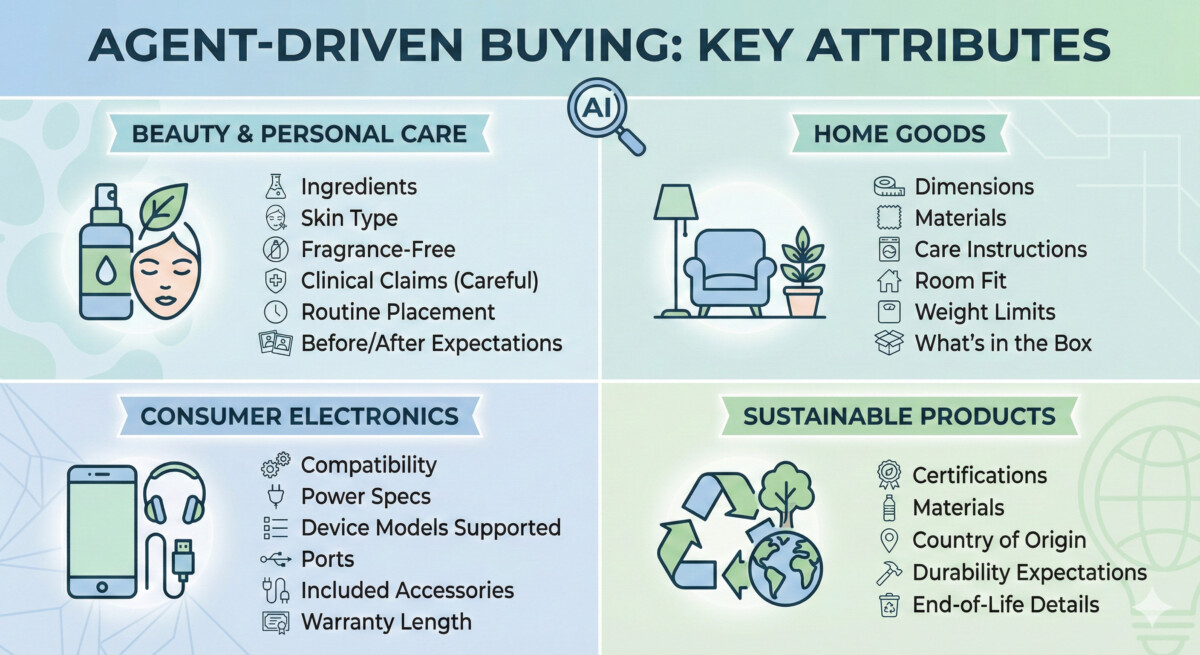
Agent-driven buying rewards products that are easy to match to constraints. Think of an agent like a sharp store associate with no patience for vague answers. If your product is measurable, comparable, and clearly “for” someone, it tends to surface more often.
Categories that usually map well:
- Beauty and personal care: ingredients, skin type, fragrance-free, clinical claims (careful), routine placement, and before/after expectations.
- Home goods: dimensions, materials, care instructions, room fit, weight limits, what’s included in the box.
- Consumer electronics: compatibility, power specs, device models supported, ports, included accessories, warranty length.
- Sustainable products: certifications, materials, country of origin, durability expectations, end-of-life details.
What these have in common is simple: clear specs plus clear use cases. An agent can say, “This matches your need because X, Y, Z,” and move the shopper toward a decision.
Highly subjective products can still win, but they need stronger proof points because the agent must justify the recommendation. If your product is about taste, identity, or “feel,” tighten your evidence:
- Reviews that answer objections (fit, comfort, longevity)
- Guarantees and risk-reversal (returns, trials, warranties)
- Comparisons that reduce ambiguity (“best for wide feet,” “firm feel,” “lighter than X”)
A practical exercise: look at your top 10 SKUs and list the top 5 questions customers ask pre-purchase. If you can’t answer those questions using your product page and policies alone, an agent won’t be able to either.
The brand control tradeoff, what you gain, what you give up
Here’s the tradeoff, stated plainly: you may give up control of layout and long-form storytelling, and you can gain high-intent shoppers at the exact moment they’re asking for a solution.
In traditional ecommerce, you control the journey: landing page, PDP, reviews, bundles, upsells, then checkout. In agentic commerce, the “page” becomes a conversation. Your product gets summarized, compared, and positioned next to alternatives, sometimes in a few lines.
That can feel uncomfortable, but it’s not random. You still influence outcomes through two levers:
- Strong product data: agents prefer specifics. If your product data, including title, variants, attributes, and descriptions, is precise, your product becomes easier to recommend with confidence.
- A complete Knowledge Base: policies, shipping timelines, returns, warranties, and FAQs stop the agent from making generic assumptions.
Think of it like supplying a press kit. If you don’t provide the facts, someone else writes the story for you.
What you gain:
- “Answer-ready” purchase moments where the shopper is already qualified (budget, use case, constraints).
- Faster decisions because comparison happens inside the chat.
- Incremental discovery from shoppers who would never browse your category pages.
What you give up:
- Pixel-perfect merchandising and on-site narrative control.
- Some context around your brand, because the agent compresses it.
- Predictable attribution, at least for now.
If you want the clearest explanation of why standards matter here, and how commerce actions can stay consistent across agent platforms, this overview of the protocol layer is helpful: Universal Commerce Protocol explainer.
The most important mindset shift: you’re not optimizing a “page,” you’re optimizing how well an agent can understand, compare, and confidently recommend your products. That’s why the boring stuff (clean attributes, clear policies) becomes a competitive advantage.
A 30 to 90 Day Rollout Plan
Agentic commerce rollout works best when you treat it like opening a new aisle in your existing store, not launching a new store. The fastest teams (from what EcommerceFastlane has seen across 400+ operator interviews) keep scope tight, fix the data layer first, then add platforms one at a time so ops and measurement don’t get messy.
Here’s the Agentic plan for the next 30 to 90 days: clean inputs, controlled exposure, tight feedback loops. Your catalog and policies become the “source of truth” that both humans and AI agents rely on, so the win is compounding, it improves classic conversion and support outcomes too.
Week 1, get the foundation right (catalog, policies, and eligibility)
Week 1 is about making your store “answer-ready.” If an agent can’t confidently answer basic questions (what it is, who it’s for, what it costs, when it arrives, how returns work), it will either skip you or create a weaker recommendation.
Use this Week 1 checklist, and keep it focused on your top revenue SKUs first (you can expand later):
- Clean titles and variants: Put the “non-negotiables” in the title (size system, material, compatibility, count). Make variant names unambiguous (Color: “Midnight Black” vs. “Black”; Size: “Men’s US 10” vs. “10”). Ensure consistency in your product data.
- Fill key attributes: Materials, dimensions, weight, compatibility, ingredients, certifications, what’s included. Consistency in product data matters more than fancy copy.
- Confirm inventory accuracy: Agentic surfaces punish stale availability. If you allow backorders or pre-orders, spell out timing in plain language.
- Add strong images: Clear primary image, true-to-variant photos, and at least one “proof” image (dimensions, included accessories, texture, label, or ingredient panel depending on category).
- Finalize shipping and returns: Reduce interpretation with Checkout Kit. Give ranges (handling + transit), return windows, condition rules, and who pays return shipping.
- Complete your Knowledge Base: Treat it like your staff playbook. If it’s missing, the agent will fill gaps with generic guesses.
This foundation helps both humans and agents. Humans get fewer surprises at checkout, and agents get clean facts to compare. If you want extra context on how Shopify is thinking about building “production-ready” agentic experiences for the Shopify Catalog, see Shopify Sidekick: building production-ready agentic systems.
Weeks 2 to 3, enable one platform first, then expand
Weeks 2 to 3 are where most teams overreach. Don’t. Pick one AI channel (usually the one already sending you the clearest signal) and treat it like a controlled launch. You’re trying to learn what agents highlight, what customers ask, and what breaks in ops, before you spread it across more surfaces.
Set simple guardrails:
- Start with best-selling SKUs only. Think 20 to 50 products, not your whole catalog. You want a tight loop between “what got surfaced” and “what needs fixing.”
- Exclude fragile or high-return items at first. If you have products prone to damage, fit issues, or complex expectations (furniture delivery windows, cosmetics shade matching, etc.), hold them back until support and fulfillment are calm.
- Watch operational load daily for two weeks. You’re looking for spikes in:
- WISMO tickets (“Where is my order?”)
- address changes
- cancel requests
- return initiation rate
- “I thought it included…” confusion
This is also the right time to align internally: who owns edits to product facts, who owns policy answers, and who reviews performance weekly. Without ownership, you’ll drift into “everyone and no one.”
Once your data quality and ops look stable, expand platform coverage. Shopify’s broader direction here is “set up once, then toggle channels on as they mature,” anchored by open standards like UCP. If you want a plain-English explainer you can share with your team, this helps: Universal Commerce Protocol strategic guide.
Ongoing, optimize for agent discovery (not just classic SEO)
Classic SEO asks, “How do I rank a page?” Agentic AI asks, “How do I get shortlisted when a shopper gives constraints?” That’s a different muscle for Commerce for Agents.
Write and structure product info so an agent can answer three questions fast: what it is, who it’s for, and what constraints it satisfies. A simple pattern that works:
- Start descriptions with specs and constraints (dimensions, materials, compatibility, certifications, what’s included).
- Add a short who it’s for section (use-cases, skill level, body type, room size, device model, skin type).
- Include common buyer questions directly in the description, in plain language:
- sizing and fit notes
- compatibility and “works with” lists
- materials and care instructions
- what’s in the box, or what’s not included
- warranty basics
Keep your attribute naming consistent across products. If one product says “stainless steel” and another says “SS,” you’re making matching harder than it needs to be.
Also, treat structured data as your long-term advantage. Shopify metafields are the right place to store durable facts, not just marketing copy, because agents can rely on them across channels. If you want to see how multimodal models and structured catalog data are being approached at scale, this recap is useful: multimodal LLMs and Shopify’s global catalogue.
How to measure success in Shopify, the few metrics that matter most
If you measure everything, you’ll learn nothing. For your first 90 days, track a small set of KPIs that connect directly to profit, customer experience, and operational stability:
- AI-attributed revenue and orders: Directional, but it tells you if the channel is real for your catalog.
- Conversion rate of AI traffic: Agent-referred shoppers often arrive pre-qualified. If conversion is weak, your product facts or policies are likely missing pieces.
- Average order value (AOV): Watch if agent-driven orders skew higher or lower than your store baseline.
- Return rate (overall and by SKU): This is your “truth metric.” If returns spike, agents may be setting the wrong expectation.
- Top products surfaced by agents: These aren’t always your hero SKUs. Let the data surprise you, then optimize those products first.
- Customer support contacts per order: If contacts per order rises, your Knowledge Base and product descriptions need more “answer-first” coverage.
Be honest about current limits: you may not see the exact shopper prompts or the full conversation path that led to a recommendation. That’s normal right now, and it’s why you need a baseline window. Run a 90-day baseline, then iterate weekly on the top 10 surfaced products and the top 10 questions support is answering.
If you want a practical way to visualize this alongside your other channels, use a simple dashboard approach like the one in Shopify KPI dashboard templates.
Conclusion
Agentic commerce is the biggest behavior shift since mobile shopping: product discovery and checkout are moving into conversations, and shoppers will increasingly expect “prompt to purchase” without tab-hopping. This Agentic AI trend is powered by Shopify with the Universal Commerce Protocol (UCP), Shopify Catalog, and Agentic Storefronts in the admin, plus embedded checkout partners across major AI surfaces. Agentic Commerce Shopify stands as the primary solution for merchants; the infrastructure is live, the setup path is simpler than past channel shifts, and the brands that learn early get disproportionate upside as adoption accelerates.
You don’t need to be technical to win here. You need clarity: clean product facts, consistent variants and pricing, and policies written so an AI agent can answer without guessing. If you want a practical lens for that, align your catalog and policies to an answer-first standard (this pairs well with this Shopify AI search strategy for 2026).
Your next step depends on your stage.
If you’re just starting, fix product data and shipping and returns first, then make a small SKU set “agent-ready.”
If you’re growing, run a 90-day test on one platform, track AI-attributed orders, conversion, AOV, and returns, then iterate weekly.
If you’re established, assign a single owner, set governance, and build a recurring optimization loop across merchandising, support, and analytics.
Curated and synthesized by Steve Hutt | Updated January 2026
📋 Found these stats useful? Share this article or cite these stats in your work – we’d really appreciate it!
