

Search doesn’t feel like “search” anymore…
Shoppers ask a full question in ChatGPT or Google’s AI results, get a tight summary, and move on. No scrolling. No ten blue links. Just an answer.
For Shopify brands, the new win isn’t only rankings. It’s getting cited inside the answer, meaning the assistant names your brand, pulls your wording, and points to your page as a source. That single moment can put you on a buyer’s shortlist before they ever visit your site.
After 400+ founder and operator conversations on the EcommerceFastlane podcast, the pattern is clear: the brands showing up in AI answers aren’t “doing more content.” They’re structuring the right content so machines can quote it, and humans can trust it.
One more shift matters in January 2026: Shopify products can be purchased inside ChatGPT through Shopify’s partnership and Instant Checkout. Visibility can happen before a click, and sometimes before your website even loads. That’s why this playbook is Shopify-specific, practical, and focused on becoming the answer.
Classic SEO taught us to win the click. AI search is teaching us that many clicks won’t happen.
AI systems summarize, compare, and recommend without sending traffic the way Google used to. That’s brutal if your strategy depends on “sessions” as the main KPI. But it can be great news if you understand the trade: fewer sessions can still mean more revenue if the visitor shows up late in the decision, already convinced.
If you’re still running SEO like it’s 2020, start here for a broader baseline, then come back to this article’s answer-first framework: Pressing SEO challenges of 2026 and how to overcome them.
AI search compresses the buyer journey. The shopper asks a long question, the assistant narrows options, then the shopper clicks only to confirm deal-breakers: price, shipping, returns, warranty, and whether the brand looks real.
Three AI-style queries that show how specific this has gotten:
If your Shopify store has the answers buried in marketing copy, AI has nothing clean to lift. You want your content to read like a good in-store associate: direct, specific, and confident. This is also why “about us” fluff doesn’t help much; the assistant is trying to solve a problem, not admire your brand story.
As of January 2026, Instant Checkout (launched September 29, 2025) allows U.S. users on ChatGPT Free, Plus, and Pro to buy from Shopify merchants inside ChatGPT. The core mechanic is simple: product discovery happens conversationally, and checkout can happen without leaving the chat. Real-time pricing and inventory sync matters because the assistant can’t recommend what’s out of stock, or quote a price you won’t honor.
It started with single-item purchases, then expanded to multi-item carts in late 2025. The big implication: your product data is now part of the shopping experience, not just your website.
You’ll also hear people toss around “commerce protocols.” Here’s the safe, high-level view:
Either way, the outcome is the same for your team: treat your Shopify catalog like a feed that a machine will shop from, not a page a human will patiently read.
For deeper context on AI discovery readiness, see ChatGPT Shopify AI discovery guide.
AI search engines don’t “rank” content the way traditional SEO does. They select sources they can understand fast, cross-check, and summarize without risk.
If you want the EcommerceFastlane view of how Google’s AI decides who to reference, this pairs well with today’s playbook: How to get Google AI to cite your Shopify brand.
In practice, AI systems reward pages that are easy to skim and hard to misunderstand. Think of your page like a label on a bottle: if the label is unclear, nobody buys it.
AI-friendly pages usually have:
Quick checklist of what gets ignored:
If you want a tactical on-page checklist that complements this, use AI-focused on-page SEO tips for Shopify.
AI assistants tend to prefer sources that look current and accountable. On Shopify, that means being painfully clear about the things support teams deal with every day:
On editorial pages, add author names and bios. Also, in key answer blocks, use your brand name instead of only “we,” so the model can connect the entity to the claim. “Acme Running recommends…” is easier to quote than “We recommend…”
Answer-first isn’t “write shorter.” It’s “write like you want to be quoted.”
If you want the broader EcommerceFastlane framework behind this approach, start with Shopify AI search SEO playbook 2026.
An answer block is a small section designed to be lifted cleanly into an AI response.
Recipe:
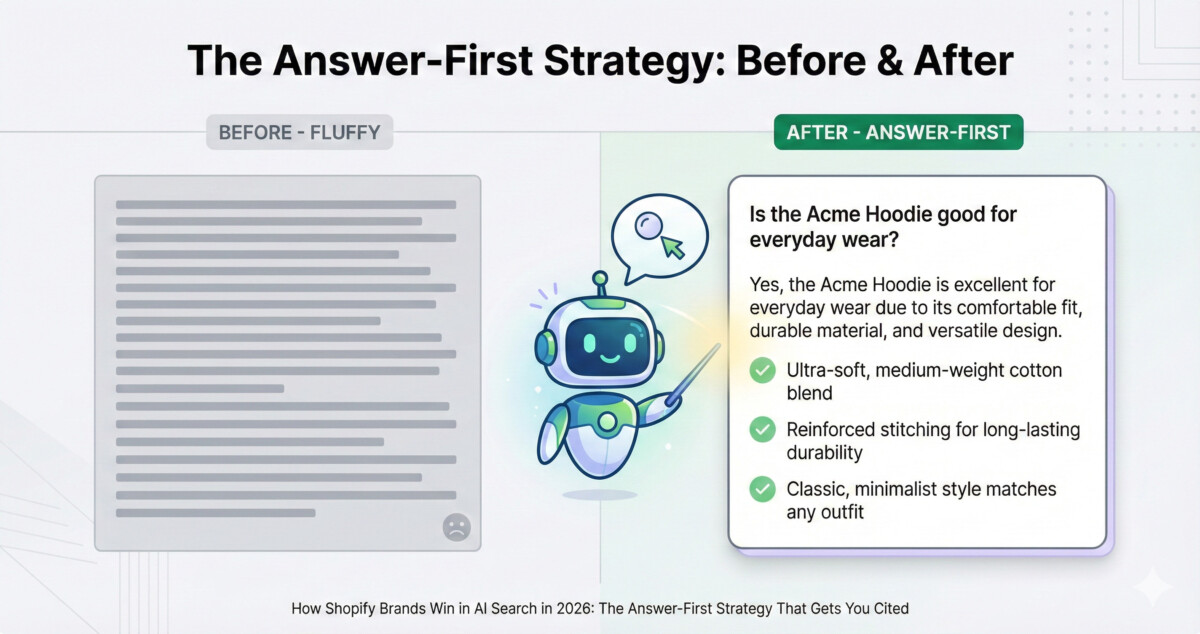
Here’s a mini before/after example you can hand to your team.
Before (fluffy):
Our hoodie is made with premium materials and designed for everyday comfort. You’ll love the soft feel and timeless look.
After (answer-first):
If you want a warm, everyday hoodie that doesn’t feel bulky, the Acme Heavyweight Fleece Hoodie is built for 40°F to 60°F days and holds its shape after washing. It’s best for casual wear, travel, and post-workout layering.
The “after” version gives an assistant something quote-ready, and gives a shopper the confidence checks they actually need.
With Instant Checkout and real-time sync, incomplete product data doesn’t just hurt SEO. It creates bad matches and bad recommendations.
Use this product data checklist on your top sellers and category leaders first:
Two common “missing detail” failures that cause AI to skip you:
For a classic product page SEO foundation that still matters in this new world, see Ecommerce product page SEO checklist.
Structured data is not a magic switch, but it helps machines interpret your page correctly. Prioritize this order:
Keep markup accurate and updated. Bad markup is worse than no markup because it breaks trust.
Validate changes using Google’s Rich Results Test: https://search.google.com/test/rich-results
If you’re also improving how your descriptions read for both humans and AI systems, this can help you build a repeatable workflow: AI-generated Shopify product descriptions.
You don’t “set and forget” AI visibility. You maintain it, the same way you maintain inventory health.
Use a tiered plan that respects your time:
When you refresh, update what AI and shoppers both care about: specs, pricing language, shipping promises, comparison tables, FAQs, visible dates, broken links, and review highlights.
Run a weekly prompt log. It takes 30 minutes and it keeps you honest.
Track a few simple KPIs:
Then connect it back to revenue. If you see AI referrals in analytics, watch conversion rate and revenue per visitor from those sessions. You’re looking for “fewer but better” visitors.
AI search is changing how shoppers find and choose products. Instead of scrolling through blue links, people ask a full question in ChatGPT or Google’s AI results, get a shortlist, and move fast. For Shopify brands, that means the new goal is not only “rank higher.” The goal is get cited inside the answer so the assistant names your brand, lifts your wording, and points to your page as the source that shaped the decision.
This article’s core insight is simple: brands that show up in AI answers are not publishing more posts. They are structuring the right pages so AI can extract the answer quickly and shoppers can verify trust details quickly (price, shipping, returns, warranty, real specs). That is why “answer blocks” matter. A tight 40 to 60 word direct answer near the top, followed by proof bullets and clear policies, gives both machines and humans what they need.
There is also a channel shift founders should not ignore. Public reporting around Shopify’s work to enable purchases inside ChatGPT (often described as “Instant Checkout,” with real-time pricing and inventory syncing) points to a future where discovery and checkout can happen inside a chat. Some coverage frames this through an “agentic commerce” protocol approach. The takeaway for your team is practical: your product data quality is now part of the shopping experience, not just your website.




