

The agents work. The deployment model is the problem. Most merchants have not noticed yet.
Ecommerce teams are adopting AI agents at a rapid pace. From automated support to demand forecasting and content generation, AI-driven tools are becoming standard infrastructure for online stores looking to scale without scaling headcount.
But there is a gap in the conversation most merchants are overlooking: where does all that customer data actually go?
A 2026 Info-Tech Research Group survey found that 72% of IT leaders now rank data sovereignty as their top AI-related concern, up from 49% one year earlier. For ecommerce operators handling purchase histories, browsing behavior, and support conversations, this is not a theoretical risk. It directly affects compliance, customer trust, and competitiveness.
Most AI agent platforms follow a cloud-first architecture. When a store connects an AI tool, customer data — order records, chat transcripts, product interaction logs — flows to external servers where the AI processes and stores it.
For brands operating under GDPR or CCPA, this creates immediate compliance exposure. But the issue goes deeper. AI agents are not static tools. They learn. An agent processing your support tickets for three months has built an understanding of your customers’ pain points, buying patterns, and preferences. When that intelligence sits on a third-party server, you have outsourced a layer of your own customer knowledge.
Gartner projects that over 40% of AI agent initiatives will be abandoned by 2027, largely due to data governance failures. The agents work. The deployment model is the problem.
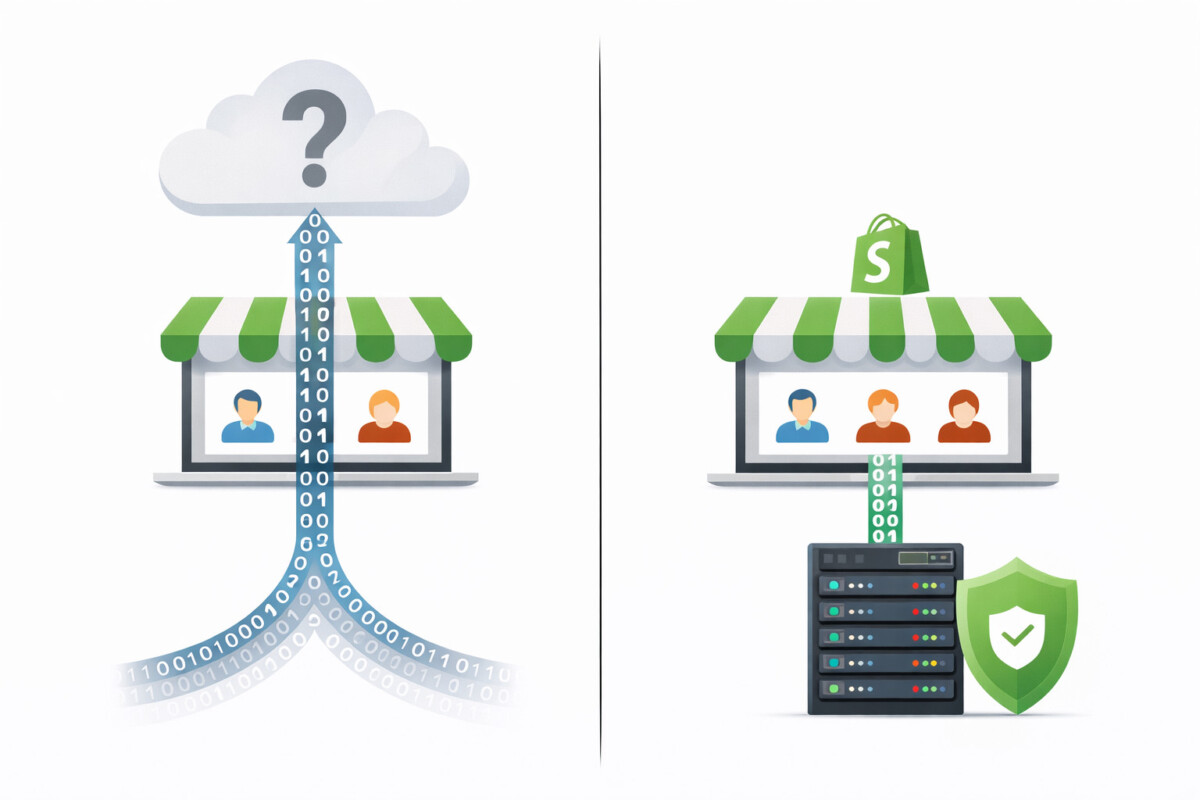
Local-first AI agents run entirely on hardware the merchant controls — a dedicated server, a workstation, or a NAS device. Data never leaves your environment. The agent reasons, learns, and acts locally.
What separates these from basic scripts is persistent intelligence with guardrails. OpenClaw, an open-source agent runtime built on this architecture, shows how mature the approach has become. Agents maintain long-term memory as transparent Markdown files rather than opaque cloud databases, making every decision auditable. They operate within permission-scoped boundaries — risky actions require human approval — and support scheduled tasks, event-driven triggers, and integrations with Slack, Telegram, and GitHub through the Model Context Protocol.
For ecommerce operators, this means intelligent automation that improves over time without sending customer data to an external provider.
The applications align directly with the operational challenges ecommerce teams face daily.
Automated Morning Briefings. An agent that runs at 7 AM, scans overnight orders, flags fulfillment exceptions, summarizes customer support tickets, and delivers a prioritized digest to your Slack channel. No more spending the first hour of the day manually triaging dashboards.
Customer Support Triage. A local agent can categorize incoming support tickets by urgency and topic, draft initial responses based on your store policies and FAQ, and escalate complex issues to human agents — all without exposing customer conversations to third-party AI services.
Inventory and Demand Monitoring. Agents can track stock levels, correlate sales velocity with seasonal patterns, and alert you before stockouts happen. The difference from cloud-based tools is that your sales data and supplier pricing stay entirely within your control.
Competitive Price Tracking. An agent can monitor competitor pricing on a schedule and flag significant changes, helping you adjust positioning without manually checking dozens of listings every week.
The biggest objection to self-hosted AI has always been complexity. Configuring runtimes, hardening security, and wiring integrations sounded like a job for a DevOps engineer.
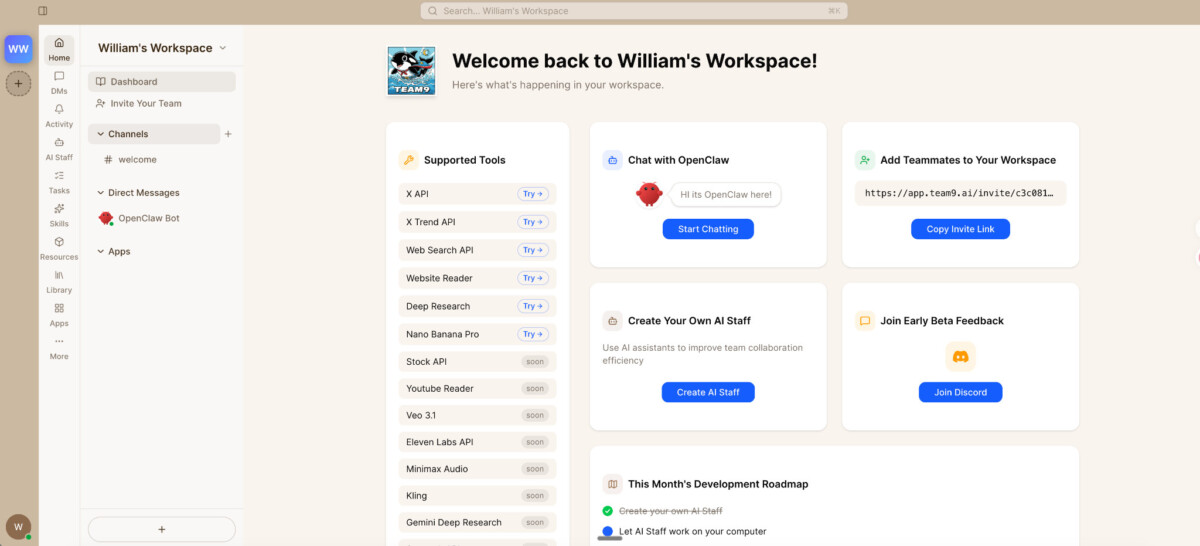
Team9 AI Workspace removes that barrier entirely. No manual installation, no security hardening checklist, no adapter configuration. Teams go from zero to a working agent environment in minutes with a single focused use case — a morning briefing, an inventory check, or a support triage bot.
Start with one well-defined problem, measure the results, and expand where the data supports it. One agent that saves you 30 minutes every morning is already delivering measurable ROI.
AI agents are delivering real value for ecommerce brands. But sending your most sensitive customer data to external clouds in exchange for automation is a trade-off that an increasing number of merchants are unwilling to accept.
Local-first AI agents eliminate that trade-off. They deliver persistent, intelligent automation while keeping customer data exactly where it belongs: inside your infrastructure, under your control. For ecommerce operators building long-term brand trust, that is not just a technical advantage. It is a competitive one.
A local-first AI agent is an AI system that runs entirely on hardware the merchant controls, such as a dedicated server or workstation, rather than sending data to external cloud infrastructure. The agent processes customer data, learns from it, and executes tasks within the merchant’s own environment. No customer information leaves the operator’s infrastructure, which eliminates third-party data processor exposure and simplifies compliance with regulations like GDPR and CCPA.
Cloud-based AI tools route your data to external servers where it is processed and often stored by the provider. Local-first agents process everything on hardware you own and control. The practical difference is that with cloud-based tools, your customer data is subject to the provider’s terms of service, data retention policies, and security practices. With local-first agents, your data governance policies are the only ones that apply. Local-first agents can match cloud tools on capability for most ecommerce automation tasks while eliminating the compliance and competitive exposure that cloud deployment creates.
It was 18 months ago. It is not today. Platforms like Team9 AI Workspace have removed the installation, security hardening, and configuration barriers that previously required DevOps expertise. A small ecommerce team can have a working local agent environment running in minutes, starting with a single focused use case. The recommended approach is to start with one well-defined problem, measure the results, and expand from there. Complexity compounds when teams try to automate everything at once. One agent solving one problem is a manageable and immediately valuable starting point.
The most common starting points are automated morning briefings that scan overnight orders and flag fulfillment exceptions, customer support triage that categorizes tickets and drafts initial responses based on your store policies, inventory and demand monitoring that alerts you before stockouts occur, and competitive price tracking that monitors competitor listings on a schedule. All of these use cases process customer or operational data locally without routing it to external servers. Tools like OpenClaw support integrations with Slack, Telegram, and GitHub through the Model Context Protocol, which means agents can deliver outputs to your existing workflow tools without compromising data sovereignty.
Data sovereignty means that your customer data is processed and stored under the legal jurisdiction and governance policies you control. Under GDPR, sending customer data to a third-party AI provider without proper data processing agreements and consent mechanisms creates compliance exposure. Under CCPA, similar obligations apply for California residents. Data sovereignty through local-first AI architecture eliminates the third-party processor from the chain entirely, which simplifies compliance significantly. A 2026 Info-Tech Research Group survey found that 72% of IT leaders now rank data sovereignty as their top AI-related concern, up from 49% one year earlier. Ecommerce operators are increasingly being held to the same standard as enterprise IT teams.





