

The dominant AI customer service trend of 2026 is voice: systems that answer inbound calls, qualify the caller, and book the appointment before hanging up. For multi-location service brands, that is where the measurable revenue sits. Chat and email automation matter less.
91% of service leaders report executive pressure to implement AI. Half of the companies that cut service headcount because of AI will be rehiring by 2027. Both numbers come from Gartner, and any serious buying decision has to hold them at the same time.
A caller who reaches voicemail at a service business usually does not leave a message. They hang up and dial the next company on the results page, and by the time anyone at your location notices the missed call, the job is booked somewhere else. The loss never appears in a report, because nothing happened. There is no abandoned form, no dropped cart, no ticket. There is only a phone that rang and a number that nobody called back.
That leak is the specific problem the 2026 wave of AI customer service tooling is aimed at, and it is why the conversation in franchising looks different from the conversation in software. Enterprise service teams are debating ticket deflection and chatbot containment rates. Multi-location operators running home services, personal care, pet care, fitness, and trade franchises are debating something simpler and more concrete: does the phone get answered, and does the call end with a slot on a calendar.
One of the companies built specifically around that question is Callvera.ai, a fast-growing AI call answering company founded by David Finneran and Cole Ruud-Johnson, built its service for franchise networks with heavy phone traffic. The system answers on the first ring, captures the caller’s details, and connects to the software a business already uses. Its published client list includes HorsePower Brands, Oxi Fresh, Heroes Lawn Care, Mighty Dog Roofing, iFOAM, Bumble Bee Blinds, Gatsby Glass, and British Swim School. The category it sits in is worth understanding on its own terms, because the trend is real and the claims around it are not all equally solid.
The four AI customer service trends that matter in 2026 are voice pickup on the first ring, live calendar booking during the call, coverage outside business hours, and a single inbox that holds calls, texts, and emails in one thread. Every other trend in this category is downstream of those four, and for a multi-location operator the first one carries most of the value.
The pressure behind the shift is documented. In a survey of 321 customer service and support leaders conducted in October 2025, Gartner found that 91% of respondents reported executive pressure to implement AI, with customer satisfaction, operational efficiency, and self service success named as the top three priorities for 2026. That is a real signal about boardroom mood. It is not a signal about results, and the two get conflated constantly in vendor material.
What separates the franchise version of this trend from the enterprise version is the channel. A software company with a support queue is optimizing deflection: fewer humans touching the same volume of tickets. A franchise with fifteen locations is optimizing capture. The call is not a cost to be contained, it is a lead worth several hundred to several thousand dollars, and the system either books it or loses it. Those are opposite objectives dressed in similar language, which is why AI service benchmarks lifted from enterprise contact centers rarely transfer.
The second thing worth noting is where the technology is heading. Voice pickup and booking are the current commercial reality, but the underlying direction is systems that take actions rather than produce text, which is the same shift now playing out in retail through agentic systems that act on a customer’s behalf. Answering a call and writing to a calendar is an early, narrow, unusually well suited version of that. It works precisely because the task is bounded.
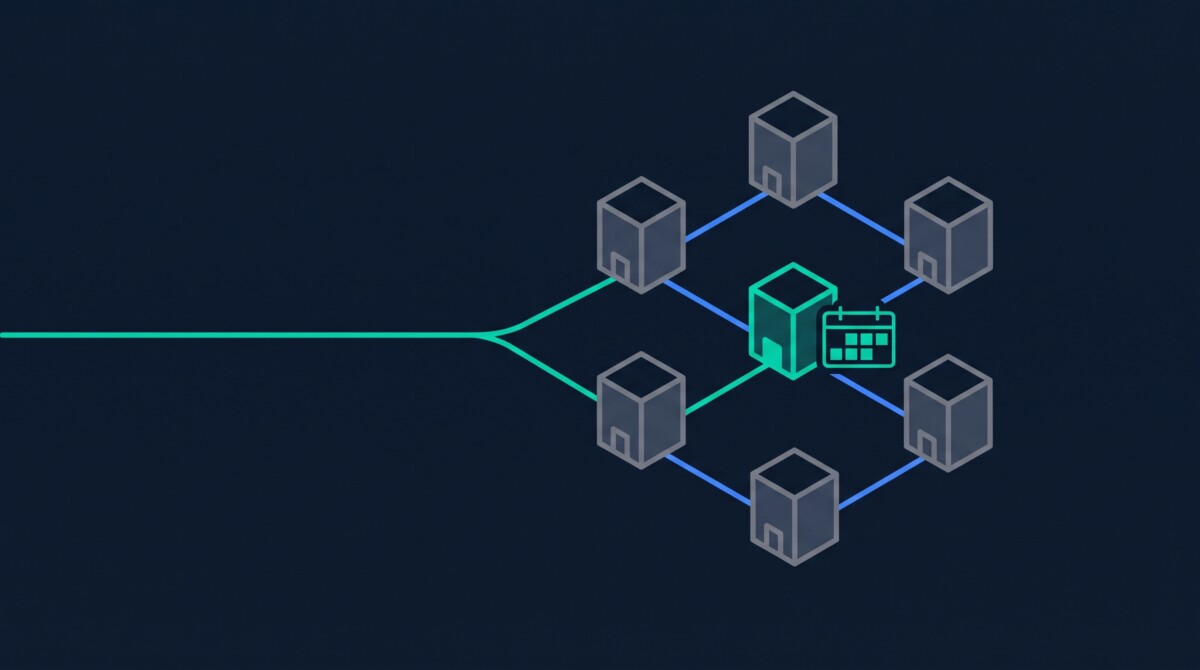
In a franchise deployment, one answering layer sits in front of every location rather than one system per branch. A caller who dials any location reaches the same greeting, the same qualifying questions, and the same booking flow, and the captured details route to the branch that owns that territory. The franchisor gets consistency across the network. The franchisee gets a front desk that never calls in sick.
Callvera’s own description of the flow runs in five steps: the call comes in, the AI agent identifies intent and matches the caller to a location and a service, the appointment is booked or the call is transferred live to a person, a follow up sequence runs, and the whole interaction is recorded and reported. Its published integration list covers ServiceTitan, HubSpot, Salesforce, Pipedrive, Google Calendar, QuickBooks, Twilio, Zapier, and Intercom, which matters more than it sounds. A system that books into a calendar your locations do not use has not removed any work, it has added a second place to check.
The results the company publishes are worth quoting carefully, because they are self reported rather than independently audited. Callvera states that franchises using the platform see a 36% increase in booked jobs. Its case studies report 45 to 55% of customer sales calls converted automatically for a nine brand franchise platform above $150M, and 90% of inquiries converted into booked jobs for a waste removal franchise above $50M. FranchiseWire’s coverage of the platform adds an operator account from HorsePower Brands describing how quickly the system retained training compared to onboarding live agents.
Treat all of those as directional. Vendor case studies select for deployments that worked and rarely publish the baseline the percentage is measured against, and a 36% lift on a brand with a 40% missed call rate is a very different achievement from the same lift on a brand already answering 90% of calls. Ask for the denominator before you model anything. That applies to every company in this category, not just this one.
At 5 to 20 locations, expect the honest gain to come mostly from hours nobody was covering. Above 50 locations, the larger prize is usually consistency: closing the gap between your best performing location’s phone handling and your worst. Franchise owners who want to see how the routing maps to their own territory structure can book a call with the Callvera team.
Intent detection is what separates a useful AI answering system from an expensive voicemail, and it works by reading what the caller asks for in the opening seconds rather than by screening the number. A caller describing a problem and a timeframe gets routed toward booking. A robocall, a solicitation, or a vendor pitch gets logged and closed without consuming anyone’s attention.
For a multi-location service brand this is not a small feature. Inbound lines at franchises absorb a heavy volume of non-customer traffic: marketing agencies, insurance solicitations, recruiters, and automated dialers. Every one of those that a human answers is a few minutes that a paying caller waited through. Shifting that filtering to the system is often the first measurable change operators notice, ahead of any booking lift, because it shows up immediately in how the front desk spends its afternoon.
The limits are real and worth stating. Intent classification is confident on clear requests and much weaker on ambiguity, accents outside the training distribution, callers who open with a long story before getting to the ask, and anyone who is upset. A well configured system hands those to a person quickly rather than pushing through. The configuration question to put to any vendor is not whether the AI can detect intent. It is what the system does when confidence is low, and how fast a human gets the call.
At a single location, the value here is modest, because the person answering already knows the difference between a customer and a cold call within two seconds. The economics change once you are paying for that judgment across dozens of phone lines simultaneously.
Booking the appointment during the call removes the callback loop, which is where most of the leakage between an inbound lead and a scheduled job actually happens. Manual scheduling means the caller states a preference, someone checks availability later, calls back, misses them, leaves a message, and waits. Every step in that chain is a chance for the customer to book elsewhere.
Live scheduling collapses it. The system checks open slots while the caller is still on the line, offers real times, writes the chosen one to the calendar, and sends a confirmation text before the call ends. The job exists before the caller has put the phone down, which also means the confirmation arrives while intent is at its peak rather than several hours after it has cooled.
This is the mechanism underneath most of the cost claims in the category. Gartner predicts that agentic AI will autonomously resolve 80% of common customer service issues by 2029, driving a 30% reduction in operational costs. Note both halves of that carefully. The 80% figure is a 2029 prediction about common issues, not a description of what any system does today, and the 30% cost reduction is the projected consequence of reaching it. Vendors quote the second number constantly while omitting the date attached to the first.
The sizing exercise is straightforward and you can do it this week. Take your inbound call volume for the last 90 days, your answer rate, and your booking rate on answered calls. Multiply the unanswered calls by your booking rate and your average job value. That number is the ceiling on what any answering system can recover for you, and it is the only figure that should drive the decision. Most operators who run it find the real gap is smaller than the vendor deck implies and still large enough to justify the spend.
Round the clock coverage matters because a standard eight hour shift leaves roughly two-thirds of the day unattended, and service inquiries do not respect business hours. A homeowner discovers a leak at 9pm. A parent books a swim lesson after the kids are down. A property manager calls on Sunday. Under a conventional setup, those callers reach voicemail and the business finds out on Monday whether they waited.
The honest version of this benefit is narrower than the marketing version. Evening and weekend calls are not uniformly valuable. Some are genuine emergencies with high job value and immediate intent, which is the best case. Some are price shoppers who will call five companies regardless of who picks up. Pull your own call records by hour before assuming after hours volume converts at the same rate as your Tuesday morning traffic, because in most franchise systems it does not.
Where it does reliably pay is the shoulder hours: the stretch just before opening and just after closing, when volume is still meaningful and staffing has already dropped off. That window is usually the largest single pocket of recoverable calls in a franchise phone log, and it is the part operators most often overlook because it does not feel like an off hours problem.
Coverage also changes the franchisor’s position on network consistency. When every location answers at 9pm as reliably as at 9am, the brand promise stops depending on which franchisee staffs well. That is a governance benefit rather than a revenue one, and for multi-brand platforms it is frequently the reason the purchase gets approved.
A single inbox that holds calls, texts, and emails together solves a specific failure: the customer who calls in the morning, texts in the afternoon, and has to explain the entire situation twice. When the records are linked, whoever picks up the thread sees the full history and answers from context rather than from a guess.
Customers move between channels within a single job routinely. They call to book, text to reschedule, and email about the invoice. Three separate systems mean three separate versions of the truth, and the customer experiences the gap between them as a business that is not paying attention. Consolidation is not a productivity feature so much as a credibility one.
Operators evaluating this should be clear about what they already own before buying another layer. Many existing platforms handle multi-channel consolidation well, and our comparison of shared inbox and helpdesk platforms with current pricing is a reasonable place to check whether the capability is already sitting unused in a tool you pay for. The same applies on the automation side, where a rundown of AI chatbot platforms and what each one actually automates is worth reading before adding a separate vendor for text and email.
This is the point in the stack where premature complexity does the most damage. The pattern shows up everywhere in multi-location operations: three overlapping tools bought at different times by different people, none fully configured, all billed monthly. If the phone is the channel losing you money, fix the phone first and leave the inbox consolidation for the following quarter.
The clearest limitation is that AI call answering does not reliably remove headcount, and buying it on that premise is how these deployments go wrong. Gartner predicts that by 2027, 50% of companies that attributed headcount reductions to AI will rehire staff for similar functions under different job titles. In the same October 2025 survey that produced the 91% pressure figure, only 20% of leaders reported actually reducing agent staffing because of AI.
Customer appetite is another constraint that vendor material tends to skip. A Gartner survey of 5,728 customers found 64% would prefer companies did not use AI for customer service at all. That does not make the technology a mistake, but it does mean the escalation path is part of the product rather than an edge case. A system that makes reaching a person difficult will cost you more in reputation than it returns in captured calls.
The category also has real competition, and Callvera is not the only option. CallRail’s Voice Assist covers similar ground for businesses already using CallRail for call tracking, and several field service platforms are building answering directly into their own scheduling products, which removes an integration rather than adding one. Any evaluation that looks at a single vendor is not an evaluation.
Finally, the technology inherits whatever mess it is pointed at. If your locations do not maintain accurate service areas, pricing, or availability, an AI agent will book jobs you cannot service, confidently and at scale. Configuration debt is the quiet failure mode here, and it surfaces about six weeks in, long after the contract is signed.
The 2026 trends converge on a single operational standard: every inbound call gets answered, qualified, and resolved into a scheduled job or a clean handoff, at every location, at every hour. That standard is achievable now in a way it was not two years ago, and the brands that hit it take share from the ones still running a phone tree and a voicemail box.
The sequence that works is unglamorous. Measure your current answer rate and your missed call cost before you shop. Pilot on a subset of locations rather than the whole network. Insist on the denominator behind every conversion claim you are shown. Build the business case on captured revenue, not on labour savings, because the labour savings are the part Gartner’s own data says most companies do not get. Operators who follow that order tend to keep the gains. Operators who buy on a percentage in a deck tend to churn within a year.
The same underlying shift is now running through retail and ecommerce, where the question of what AI should handle and where a human has to stay in the loop is being worked out on chat and email instead of the phone. If your brand operates in both worlds, the thinking in our piece on AI powered customer experience for retail and DTC brands maps onto the same decision from the other direction. The channel changes. The discipline does not.
Gartner predicts agentic AI will autonomously resolve 80% of common customer service issues without human intervention by 2029, with an associated 30% reduction in operational costs. Two qualifiers matter when reading that figure. It applies to common issues rather than all issues, which excludes the complex, emotional, and high value conversations that consume disproportionate human time. And it is a forecast for 2029, not a description of current capability. Systems deployed in 2026 handle a narrower band well, typically bounded tasks like answering, qualifying, and scheduling. Treat the 80% number as a direction of travel rather than a benchmark to hold a vendor against this year.
AI call answering rarely pays for itself at a single location where the owner or a dedicated receptionist already answers most calls during business hours. The economics improve sharply once you are covering multiple phone lines, multiple territories, or hours nobody is staffing. The honest test is your missed call rate. If you are answering above 90% of inbound calls during the hours you advertise, the recoverable revenue is thin and your money is better spent elsewhere. If you are below 70%, or if evening and weekend calls are going to voicemail entirely, the gap is usually large enough to justify a pilot even at one location.
The difference is that an AI system completes the booking, while a traditional answering service takes a message. A human answering service captures the caller’s details and passes them to your team, which means the callback loop stays intact and the job is still unbooked when the caller hangs up. An AI answering system checks live calendar availability during the call, offers real slots, writes the appointment into your scheduling tool, and sends confirmation. Answering services also bill per minute or per call, which penalises exactly the high volume periods where coverage matters most. The trade off is that human services handle ambiguity and emotion better.
Plan on redeployment rather than reduction, because the evidence on headcount cuts is not encouraging. Gartner predicts half of the companies that cut customer service staff citing AI will rehire for similar roles by 2027, and in its October 2025 survey of 321 service leaders only 20% had actually reduced agent staffing because of AI. What the technology reliably removes is the low value portion of the role: screening spam calls, playing phone tag over scheduling, and re-explaining context the system already has. What it does not remove is the person who handles the upset customer, the unusual request, and the job that needs judgment. Build the case on captured revenue instead.
Integration coverage is the single most important technical question to settle before signing, because a system that books into a calendar your locations do not use has added work rather than removed it. Callvera publishes integrations with ServiceTitan, HubSpot, Salesforce, Pipedrive, Google Calendar, QuickBooks, Twilio, Zapier, and Intercom, which is representative of what this category supports. Verify three things specifically: whether the integration writes appointments or only reads availability, whether it supports per location calendars rather than one shared calendar, and whether territory routing is configurable without vendor support. Ask to see it working against a sandbox of your own system before committing.
Measure answer rate, booking rate on answered calls, and average job value from AI booked appointments, all against a clean pre-deployment baseline from the same period last year. Those three numbers produce the only figure that matters: incremental booked revenue attributable to calls that previously went unanswered. Track two supporting metrics alongside them. First, escalation rate to a human, which tells you whether the system is over-reaching on calls it should hand off. Second, cancellation and no-show rate on AI booked jobs compared with human booked jobs, which catches the failure where the system books work your locations cannot actually service.




