

The brands winning the next round of e-commerce CRO aren’t the ones with the best hero video. They’re the ones with usable video on the 800 SKUs everyone else ignored because production was too expensive.
In the e-commerce world, product content is king. The more effectively you can communicate what your product does, how it works, and why it matters, the better your conversion rates. Most e-commerce businesses have invested heavily in creating detailed product documentation — specification sheets, user guides, comparison charts, FAQ documents. But the vast majority of this content sits in formats that shoppers never engage with.
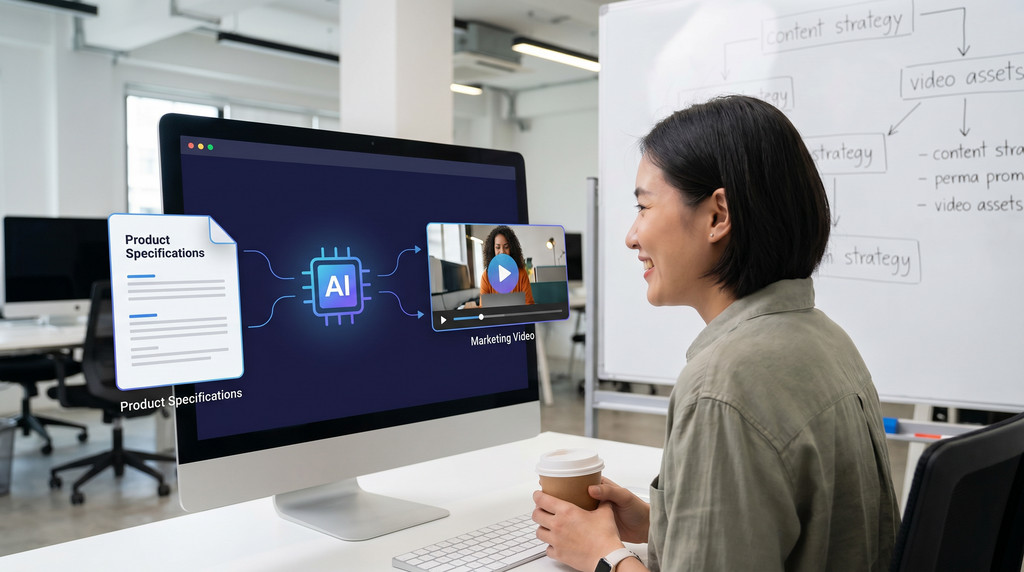
A growing number of e-commerce brands are discovering a surprisingly effective tactic: converting their existing product documents into short, professional video content using AI. It is not replacing their creative teams or their hero product shoots. It is filling a content gap that has always existed — the gap between the comprehensive information contained in product documentation and the visual, snackable content that actually drives purchase decisions.
Consider the typical e-commerce product page. You have a hero image, a few bullet points, a brief description, and maybe a promotional video if the product is a bestseller. Somewhere below the fold, there is a downloadable PDF with detailed specifications, installation instructions, or user guides. Only a tiny fraction of visitors scroll that far, and even fewer download and read the document.
Yet that document contains exactly the information that would move hesitant shoppers toward a purchase decision. The detailed comparison data, the step-by-step usage instructions, the specific use case descriptions — this is the content that addresses objections and builds confidence. The problem is not the content itself. It is the delivery format.
Product videos consistently outperform text and images in e-commerce metrics. According to recent research from Wyzowl, 82% of consumers say they have been convinced to buy a product or service by watching a video. Landing pages with video see conversion rates 80% higher than those without. But most e-commerce businesses only create videos for their top 10-20% of products because of the production cost.
AI document-to-video conversion changes this equation fundamentally. When you can convert a product specification sheet into a polished video in minutes rather than days, suddenly it becomes viable to create video content for your entire catalog — not just your hero products.
Most e-commerce catalogs contain products that need explanation. Whether you sell technical equipment, software subscriptions, home improvement products, or specialized clothing, there are products in your catalog that customers do not fully understand from photos alone.
By feeding your existing product documentation into an AI video platform like Leadde.ai, you can generate explainer videos for every product in your catalog. The AI reads the documentation, identifies the key selling points and usage instructions, and creates a narrated video with an AI presenter who walks the viewer through the product details.
These videos are not replacing your professionally shot product videos. They are filling the long tail — the hundreds or thousands of products that would never justify a custom video production budget but still benefit significantly from having video content on their product pages.
Post-purchase documentation is another content category that benefits dramatically from video conversion. Setup guides, user manuals, and FAQ documents are essential for customer satisfaction but are rarely read thoroughly. Converting these materials into video format reduces support ticket volume and improves the customer experience.
One electronics retailer reported a 35% reduction in post-purchase support inquiries after converting their product setup guides into AI-generated video tutorials. The content was identical — the same information from the same documents — but the delivery format made it accessible to customers who would never have read a 12-page PDF.
Sales teams in e-commerce need to understand product details to sell effectively, especially in B2B or high-consideration categories. Product knowledge documents are a standard part of sales enablement, but busy sales representatives rarely study them in depth.
Converting product knowledge documents into short video modules gives sales teams a more engaging way to learn about new products. A 3-minute video summary of a new product’s key features and differentiators is more likely to be watched than a 5-page product brief is to be read — and the information retention from video is significantly higher.
Begin by converting documentation for your top-selling products — the ones with the most traffic and the most at stake. Create explainer videos from existing product guides and A/B test the product pages with and without the video. Measure the impact on conversion rate, time on page, and bounce rate.
Once you have validated the approach, expand systematically to your broader catalog. Prioritize products with high traffic but low conversion rates — these are the products where better content explanation is most likely to move the needle. Also prioritize products with high return rates, which often indicate that customer expectations are not being set correctly by the existing product page content.
If you sell internationally, generate translated versions of your product videos for each market. Customers in non-English markets are significantly more likely to purchase when product information is presented in their native language. AI video platforms can generate localized versions in dozens of languages from a single source document, making multilingual product content economically viable even for smaller catalogs.
The highest-performing e-commerce teams treat video conversion as a standard step in their product content workflow. When a product manager creates a new product specification document, a video version is generated as a routine part of the process. When product details are updated, the corresponding video is regenerated. This systematic approach ensures that video content stays current without requiring a dedicated video production effort.
Track these metrics to evaluate the business impact of document-to-video conversion in your e-commerce operation: conversion rate changes on product pages with video versus without, average order value for customers who watched product videos, return rate changes for products with video explanations, support ticket volume for products with and without video content, and time-to-market for new product video content compared to traditional production.
The brands seeing the strongest results are those that view AI video creation not as a one-time project but as an ongoing capability. As your product catalog evolves, your video content evolves with it — automatically, affordably, and at a pace that traditional video production could never match.
Here is the competitive reality: your competitors are almost certainly not producing video content for their full product catalog. The production cost has historically made it impractical. AI document conversion gives you an opportunity to provide a richer, more engaging product experience across your entire catalog — not just your hero products — at a cost that makes economic sense even for lower-margin items.
The brands that move first on this will build an experience advantage that is difficult to replicate quickly. A comprehensive video library covering thousands of products is a significant moat, and the sooner you start building it, the wider that moat becomes.
AI doc-to-video is different from regular AI video generators because it uses your existing structured documents as the source of truth instead of a freeform prompt. You upload a product spec sheet, user manual, or PDF and the platform extracts key points, generates a script, and renders a narrated video with an AI presenter. Regular AI video tools start from a text prompt, which means the burden of structuring the content falls on the user. Doc-to-video tools handle that structuring automatically, which is what makes them practical for converting large catalogs of existing product documentation without rewriting it first.
AI doc-to-video typically costs $0.20 to $3 per minute of generated video depending on the platform and plan, which on a 500-SKU catalog usually works out to a few hundred dollars per month at full coverage. Compare that to traditional video production at $1,500 to $5,000 per product, where 500 videos would cost between $750,000 and $2.5 million. The economics are what make full-catalog coverage viable. Most platforms also offer flat-rate plans for high-volume merchants where the per-video cost drops further at scale.
Yes, AI-generated product videos can rank in search when they’re hosted properly, have accurate schema markup, and live on a page with strong supporting content. Google indexes video based on context, transcript, structured data, and the host page’s authority, not on whether the video was produced by humans or AI. The bigger factor is page speed: a video that adds a megabyte of script overhead to every product page can hurt mobile Core Web Vitals more than it helps. Use a video host that supports adaptive bitrate streaming and don’t autoplay multiple videos on the same page.
You avoid the obvious AI presenter look by treating the first draft as a draft, not a finished video, and by selecting platforms with higher-quality avatars and natural voice models. The cheapest tier of any AI video product produces output that reads as obviously synthetic, which can erode brand trust on product pages. The right approach is to test multiple presenter options, pick the one that aligns with your brand voice, and add a human review step before publishing. Some brands skip the avatar entirely and use voiceover-only video with B-roll generated from the product imagery, which sidesteps the uncanny valley problem completely.
You should roll it out gradually, not convert your whole catalog at once, because gradual rollout gives you the data to know which products and which video styles actually move conversion. Start with 20 to 50 high-stakes SKUs, A/B test product pages with and without video for 30 to 60 days, measure the lift, then expand to the next tier of products. Most brands that try to convert their entire catalog in week one end up with thousands of videos and no signal on whether the investment is paying off. The sequenced rollout also gives your team time to refine the production template and voice settings before scaling to the long tail.





