

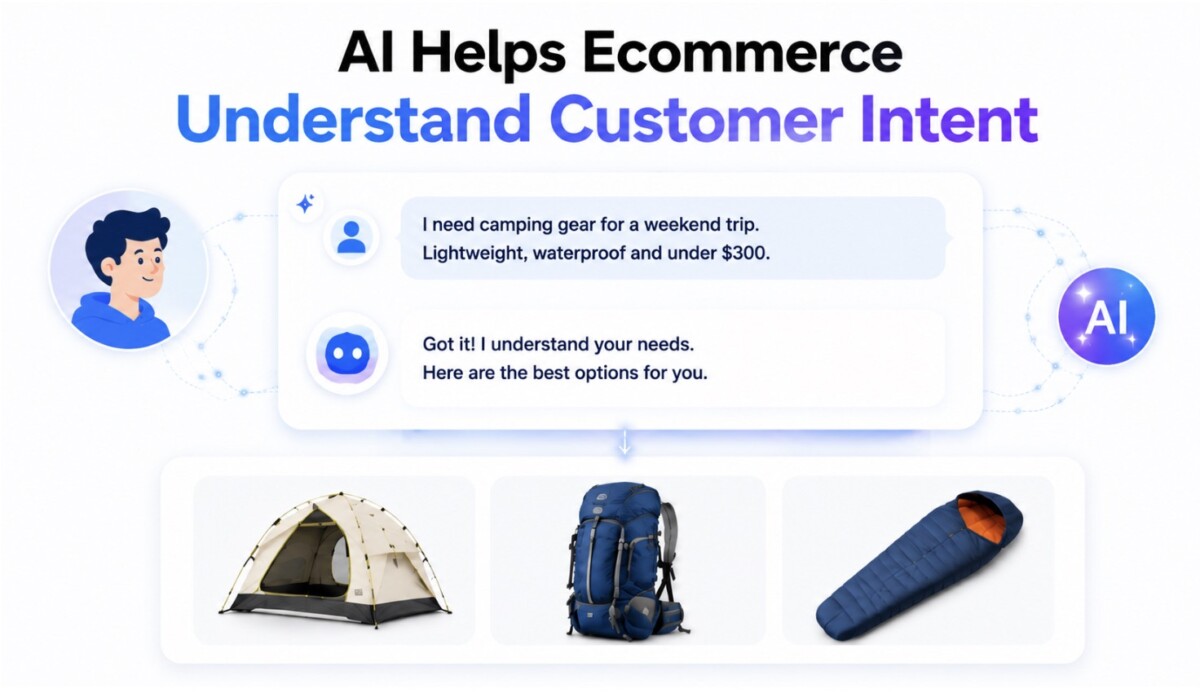
AI changes ecommerce personalization by weighing a shopper’s competing requirements instead of filtering attributes separately. For Shopify merchants, the practical work is structured product data, not a new personalization app. Complete attributes decide whether an agent can recommend you at all.
A shopper asking for a lightweight, waterproof, two person tent under $200 is not running four filters. They are describing a trade off, and the store that can answer a trade off wins the sale.
A customer shopping for a camping tent rarely wants a tent. They want something lightweight enough to carry, waterproof enough to trust, big enough for two people, and cheap enough to justify. Four conditions, one purchase, and none of them independent of the others.
The difficulty is not finding products that match each individual feature. Any store with decent filters can do that. The difficulty is identifying which option best fits the customer’s actual situation when several requirements have to be weighed against each other at the same time. Run those four conditions as four separate filters and you get forty results or zero results, and neither outcome helps the shopper decide.
This is the gap AI is closing, and it is the reason the personalization conversation has moved past product recommendations. Instead of treating each product attribute as an isolated signal, AI systems can interpret how requirements relate to one another, which factors deserve priority, and what the customer is ultimately trying to accomplish. For merchants, that shift has a very specific and very unglamorous implication, and this piece works through what it actually asks of your catalog.
Keyword search and filters break down when a purchase involves more than two competing conditions, because filters treat every attribute as an independent pass or fail test rather than as a trade off. Traditional ecommerce search works well when the customer already knows the brand, model, or category they want. Type in the name, narrow by size, buy. That path is still the majority of transactions for most Shopify stores and it is not going away.
A single considered purchase, though, usually involves several conditions at once. Customers care about size, material, features, price, and ease of use simultaneously, and those requirements do not compress neatly into one search query. Filters can isolate each attribute, but they treat those attributes as independent conditions with no relationship to one another. The shopper still ends up opening five product pages in five tabs, comparing specification lists, and working out on their own which differences will actually affect their experience.
That work is not free. Every additional comparison step is a place where the session ends. Merchants doing $50K to $500K per month typically see this most acutely in considered categories with three or more meaningful variables, where the product is good, the traffic is real, and the product detail page still converts below category average because the shopper cannot resolve a trade off without help.
Customers may also need to compare running costs, check measurements against a space they already own, or calculate the quantity a project requires. For questions with clear numeric answers, resources such as all-in-one calculators and tools can carry part of that load during the purchase process. But when the decision has several conditions influencing the final choice, the platform has to do more than confirm whether a product meets each requirement in isolation. It has to help the shopper understand how those conditions interact.
AI systems rank a shopper’s stated requirements by importance rather than testing each one independently, which is why a described situation produces a better match than a stack of filters. When a customer supplies several purchase requirements, the problem is not finding products that pass every condition. It is recognizing that the conditions carry different weight depending on how the product will actually be used.
Consider someone buying a laptop for remote work. They care about weight, battery life, performance, and price. Filters can surface lightweight models, long-lasting models, or high-performance models, but they cannot determine how those conditions should be prioritized for this specific buyer. If the laptop travels on a daily commute, weight and battery life outrank raw processing power. If it lives on a desk and runs design software, that ordering reverses. Same four attributes, opposite recommendation.
The useful output is not a longer list of matches. It is an explanation of the trade off, so the shopper understands why one option fits their pattern of use better than another. That is a fundamentally different job than sorting by relevance score.
Here is where merchants underestimate the stakes. Research from Yale, Columbia, and the University of Chicago found that a missing product attribute can cut selection probability by 20 to 40% when an AI system is evaluating options against a shopper’s stated constraints. The same body of work found that a rating gap as small as 4.1 versus 4.4 stars regularly flipped which product ranked first. A human shopper would call that difference negligible. A machine applying the shopper’s criteria with consistent weighting does not. If you want the full breakdown of the signals involved, how AI shopping agents actually decide what to buy walks through all five and what each one demands from your catalog.
The larger shift is from product level queries to task level queries, where the shopper describes an outcome rather than an item and the system assembles everything that outcome requires. In many shopping situations the customer does not begin with a product at all. They begin with an event, a project, or a job to be done, and the products are only components of it. When a platform can only respond to product keywords, the customer has to decompose the task themselves and search each category separately.
Walmart has been the most visible retailer building against this. Its own account of building for an agentic commerce future describes Sparky, its shopping assistant, as a system that helps shoppers compare products, build lists, and plan for occasions by synthesizing reviews and product data into a single response. A customer can describe a watch party rather than searching for chips, then serving bowls, then folding chairs. The results Walmart has reported publicly are worth sitting with: leadership has said app users who engage with Sparky spend roughly 35% more than those who do not, and that about half of Walmart app users have interacted with it.
Traditional search asks what product you are looking for. Intent driven systems ask what you are trying to accomplish, and that changes the starting point of the entire interaction. Once a platform understands the larger task, it can connect snacks, serving supplies, and decorations inside one shopping context. The value is not showing more items. It is surfacing needs the customer had not searched for yet.
Shopify merchants are already inside this shift whether or not they have opted into it. AI referred traffic to Shopify grew roughly sevenfold between January 2025 and early 2026, and product discovery now runs through ChatGPT, Google’s AI surfaces, and Perplexity in parallel with organic search. Getting your product data ready for ChatGPT discovery covers the specific fields that channel reads, and the retailer’s guide to ACP, UCP, and MCP explains the infrastructure underneath all of it.
Personal AI adds the standing context a shopper never types into a search box, such as travel habits or how they pack, and that context often determines which product actually fits. Ecommerce AI can interpret the conditions a customer describes inside the current session. Plenty of purchase decisions, though, are shaped by longer-term factors that existed well before the customer arrived on your product page.
A shopper choosing luggage has established travel habits, common destinations, and a preferred way of packing. Those details determine which size, weight, and internal structure will suit them, and almost none of it appears in a single product search. The shopper knows it. Your store does not, and no amount of onsite behavioral tracking will surface it from one session.
Personal AI for everyday life represents one direction this could go. Rather than optimizing a single transaction, personal AI connects a current decision to longer-term areas of a person’s life, including travel, hobbies, learning, and planning. Macaron, a consumer-facing personal AI agent, takes this life-first approach across recurring everyday needs.
Two honest caveats belong here. First, personal AI is not a merchant tool and it is not a replacement for your onsite search or your recommendation logic. It sits on the consumer’s side of the transaction, which means you do not control it, cannot configure it, and will not get reporting from it. Second, this layer is early, and adoption is a consumer behavior question rather than a merchant implementation question. The merchant takeaway is narrower than the trend narrative suggests: if a shopper’s personal context is going to be matched against catalogs, the catalog that describes its products in precise, machine-readable terms is the one that gets matched. That is the same conclusion every other version of this shift arrives at.
The practical work is attribute completeness inside Shopify metafields, not a personalization app. This is the least exciting sentence in the article and the only one that changes revenue. A system weighing a shopper’s competing requirements can only weigh attributes it can read. “Premium quality construction” is marketing copy. “Full-grain leather, 1.2mm thickness, water-resistant, 340g” is data, and only one of those two can be matched against a stated constraint.
Start with metafields on your highest-revenue SKUs. Material, dimensions, weight, capacity, compatibility, use case, care requirements, and warranty terms are not optional fields to fill in when someone gets around to it. They are the vocabulary a machine uses to connect your product to a described situation. Configure Shopify’s Search & Discovery app to expose those metafields as filters while you are in there, since the same structured data serves both onsite search and external discovery.
Review infrastructure is the second layer. Okendo and Judge.me both output clean AggregateRating schema, which is what makes review data machine-readable rather than decorative. Prompt for specificity in review requests, because a review that says “great for wide feet, held up over 200 miles” carries three matchable attributes and “love it, great product” carries none. For onsite recommendation logic, Rebuy remains the reasonable default for Shopify merchants above roughly $200K per month, though it is worth saying plainly that it will not fix a catalog with incomplete attributes underneath it.
An AI system cannot recommend what it cannot read. Every other tactic in this shift is downstream of that one constraint.
The failure pattern here is familiar to anyone who has watched stores stall between $500K and $2M. Premature complexity kills more brands at that stage than any competitor does. Merchants install a personalization app, an AI merchandising tool, and a feed manager before anyone has audited whether the underlying product data is complete. Three new monthly bills, no change in outcome, because all three tools are reading the same thin catalog.
Your first move depends entirely on stage, and the most common mistake is running the $2M playbook on a $50K catalog. The sequence below reflects what actually moves the needle at each level, along with what to deliberately leave alone until the prior step is finished.
Under $50K per month, the entire job is attribute completeness on the SKUs that already sell. Ten products done properly beats four hundred done partially, and this is a two hour task rather than a project. Between $50K and $500K, review schema becomes the constraint, because rating and volume are weighted heavily and 25 reviews is roughly where the data starts registering as statistically meaningful.
From $500K to $2M, the constraint stops being tactical and becomes organizational. Catalog data quality decays quietly unless one named person owns a weekly review, and “the team owns it” reliably means nobody does. Above $2M, add agent visibility to the reporting cadence you already run for SEO, paid, and email, so you can see the channel move rather than inferring it from a traffic line six months later. Your store now has two customers makes the strategic case for why that reporting line deserves a permanent seat.
Intent based personalization still fails on three fronts: shoppers who will not delegate, privacy comfort that varies widely by category, and catalogs where the underlying data is simply wrong. Walmart’s own consumer research is useful here precisely because it cuts against the hype. It found 27% of respondents prefer AI recommendations while 24% trust social media influencers, which is a narrower gap than the AI narrative implies, and almost half of respondents said they were unlikely to use an agent to handle an entire shopping trip.
Read that honestly. Shoppers are adopting AI for comparison, narrowing, and question answering. They are not, in the majority, handing over the whole decision. A merchant who rebuilds their storefront on the assumption that agents now do all the buying is optimizing for a behavior most of their customers have not adopted yet.
The privacy boundary is real too. The same longer-term context that makes personal AI useful is context most shoppers have not agreed to share, and comfort with it varies enormously between buying running shoes and buying anything health or finance adjacent. Personalization that feels like service at one level of intimacy feels like surveillance one step further, and there is no universal line.
The filter worth applying to all of it is the 18 month question. Will this matter in 18 months? Structured, accurate, complete product data will, because every discovery surface built between now and then reads the same fields, and none of that work is wasted if a given platform loses. A workflow built specifically around one assistant’s current behavior probably will not. Build the asset you own, not the integration you rent.
The next phase of ecommerce personalization will not be judged by how many relevant products a platform can display. It will be judged by how well it supports the decision behind the purchase, and that support runs on data quality long before it runs on any tool. For merchants, the opportunity is not predicting the next click. It is building a clean path from a customer’s stated intent to a choice they can act on with confidence.
AI understands customer intent by interpreting a shopper’s described situation and ranking their stated requirements by importance, rather than testing each attribute as an independent filter. When a shopper says they need a lightweight waterproof tent for two people under $200, a filter based system treats those as four separate pass or fail conditions. An intent based system recognizes that the conditions trade off against one another and that their relative weight depends on how the product will be used. It then explains why one option fits better. The accuracy of that interpretation depends entirely on how completely and precisely the merchant has described their products in structured, machine-readable fields.
AI shopping systems read structured attribute data, review score and volume, pricing and availability, and policy text, and they ignore almost everything designed for human persuasion. Lifestyle photography, brand storytelling, and homepage design carry no weight in the match. What matters is whether material, dimensions, weight, capacity, compatibility, use case, and care requirements exist as discrete, readable fields rather than as adjectives buried in a description. Research from Yale, Columbia, and the University of Chicago found that a missing attribute can reduce selection probability by 20 to 40%. A missing field is not a small gap in that context. It functions as a disqualifier.
No. Personalization apps operate on your own storefront and have almost no bearing on whether an external AI system can match your products to a shopper’s request. That match depends on your product data, your review schema, and your policy clarity. This ordering matters most for merchants between $500K and $2M per month, where the instinct is to solve a visibility problem by installing another tool. Complete your metafields on your top selling SKUs first, get clean AggregateRating schema in place through a review app such as Okendo or Judge.me, then evaluate whether a personalization layer adds anything on top. Most of the time the data work alone changes the result.
Filters test attributes independently, while intent based search weighs them against one another based on the shopper’s described situation. Shopify’s Search & Discovery app lets you expose metafields as filters, which handles the case where a shopper knows exactly what specification they need. It does not handle the case where a shopper has four competing requirements and no idea which one to compromise on. Both matter, and they are powered by the same underlying data. That is the useful part: the metafield work you do to improve onsite filtering is the same work that makes your catalog readable to external AI discovery surfaces. One effort, two channels.
Start by running your own category queries in ChatGPT, Perplexity, and Google’s AI surfaces exactly as a customer would phrase them, then record which brands appear and what reasons are given. The attributes mentioned in those answers are the attributes those systems found in structured data. If your product appears but the description is vague, your data is incomplete. If it does not appear at all, the problem starts at catalog structure. From there, complete the metafields on your top 10 revenue SKUs, verify your review app is outputting AggregateRating schema, and rewrite your shipping and return policies so a clear answer can be extracted in one sentence.





