

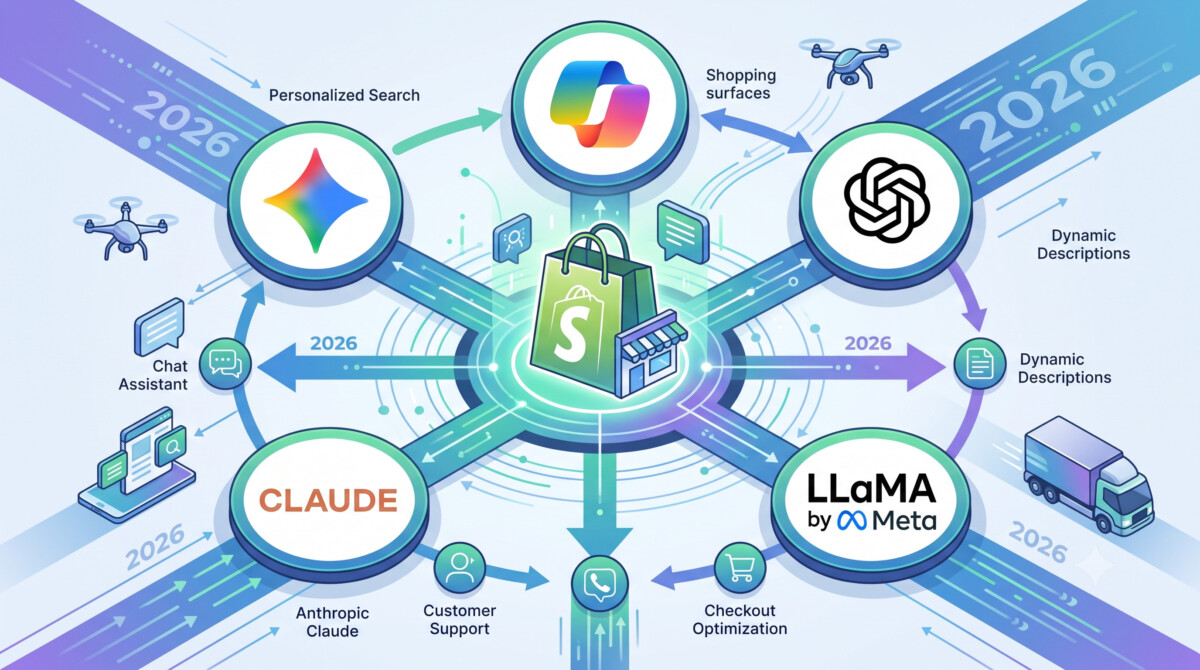
ChatGPT still carries roughly 63% of measurable AI shopping referrals as of spring 2026, but Claude, Gemini, and Perplexity now split nearly a third of the market between them. Shopify merchants optimizing for ChatGPT alone are covering a shrinking share of AI driven discovery.
Eight months ago, one AI assistant carried 89% of measurable AI referrals. Today four of them split nearly all of it, and each one decides what to recommend in a different way.
A merchant I spoke with this spring had done everything the 2025 playbook told her to do. Product feed connected, FAQ schema in place, answer first product descriptions rewritten over a winter of evenings. Her reward was real: ChatGPT referrals showed up in her GA4 and converted well. Then she asked me a question that stopped me: “So I’m done, right?” She had optimized for one AI assistant at the exact moment the market stopped being one AI assistant.
The five surfaces below are listed alphabetically. This piece does not rank them, because there is no single best AI shopping surface for every Shopify merchant, and any list that claims otherwise is selling you something. The value here is in understanding how each surface differs in scale, retrieval logic, citation behavior, and checkout integration, then using the comparison grid and the Best For section to match surfaces to your stage.
The share data that anchors this piece comes from Goodie’s longitudinal AI search market share report covering 2.8 million referral sessions, published in May 2026. One honest caveat before we start: that panel skews B2B, so treat the exact percentages as directional for consumer commerce rather than gospel. The trend it documents, ChatGPT falling from 89% to 62.6% of measurable AI referrals in eight months while Claude, Gemini, and Perplexity multiplied their shares, is corroborated across enough independent sources that the direction is not in question.
The five surfaces here are the ones where consumers actually run shopping journeys and where measurable referral data exists as of mid 2026. To qualify, a surface needed meaningful referral share in independent tracking data, an active shopping or commerce integration path relevant to Shopify merchants, and consumer scale. Together, ChatGPT, Claude, Gemini, and Perplexity account for nearly 99% of measurable AI referrals, with Microsoft Copilot holding the remaining measurable sliver alongside a live checkout program. Grok and DeepSeek were considered and excluded because neither carries a commerce integration or measurable shopping referral volume. Amazon’s Rufus was considered and excluded because it is a closed ecosystem assistant that recommends within Amazon’s catalog rather than an open discovery surface a Shopify merchant can optimize for. Meta AI was excluded on the same measurability grounds despite Meta joining the UCP governance council in April 2026.
Referral share figures below are brand averaged shares of measurable B2B AI referrals, March to April 2026, per Goodie. Participation costs current as of July 2026.
ChatGPT is the highest volume AI shopping surface by a wide margin, carrying 62.6% of measurable AI referrals as of March to April 2026 and roughly 900 million weekly active users as of February 2026. OpenAI’s own data puts shopping related queries at around 50 million per day, about 2% of everything typed into ChatGPT. When people say “AI traffic,” this is still mostly what they mean, and the conversion quality backs up the volume: Similarweb pegs ChatGPT referred ecommerce traffic converting at roughly 11.4% against 5.3% for organic search, and a Visibility Labs study across 94 seven and eight figure ecommerce brands found ChatGPT sessions converting 31% higher than non branded organic on commercial pages, with session volume growing 1,079% across 2025.
For Shopify merchants, participation runs through structured product data and Shopify’s native infrastructure rather than a separate integration project. As of July 2026, being surfaced in ChatGPT’s shopping results costs nothing; discovery is organic against your product feed quality. The full setup path is covered in the agentic commerce guide for Shopify merchants, and the short version is that clean, constraint rich product data (sizes, materials, compatibility, delivery timing) is what the retrieval layer feeds on.
Two honest limitations. First, the checkout ground has been unstable: OpenAI launched Instant Checkout with Stripe in September 2025 with a 4% transaction fee, then retired that first version on March 5, 2026 after roughly 30 Shopify merchants had integrated, replacing it with ChatGPT Apps where retailers like Walmart and Etsy run their own in chat experiences. Merchants who built specifically for version one absorbed the churn. Second, its dominance is eroding; a channel strategy built on ChatGPT alone covered 89% of AI referrals a year ago and covers about 63% today. Best fit: every merchant from $100K up, as the default first surface. Skip if: nothing, honestly, but treat it as the floor of an AI strategy rather than the whole strategy.
Claude is the fastest growing AI shopping referrer of 2026, moving from 1.4% to 18.5% of measurable AI referrals in eight months, and it converts better than any other surface, at roughly 16.8% per ToolGlance’s 2026 aggregation, with the highest average session value in Superprompt’s tracking at $4.56 per visit. The pattern across every dataset is consistent: low absolute volume, unusually high intent. Claude users tend to arrive at a store having already done comparative research inside the conversation, which compresses the consideration stage before the click ever happens.
Participation is entirely organic as of July 2026. Anthropic runs no ads and no paid placement inside Claude, so there is no fee, no feed program, and no checkout integration to configure. Discovery runs on the same fundamentals that drive citations elsewhere: content and product pages structured as direct answers, consistent entity references, and third party corroboration Claude’s web search can retrieve. A transparency note you would expect from this publication: this article was drafted with Claude as a production tool, and the numbers above come from the independent sources cited, not from the model’s self assessment.
The limitations are the mirror image of the strengths. Absolute volume is a fraction of ChatGPT’s; an 18.5% share of a channel that is itself around 1% of total web traffic means most merchants under $500K will count Claude referred sessions in the dozens per month, not the thousands. There is no native shopping or checkout program, so every Claude journey ends in a click out to your store, which is good for attribution but means no in assistant purchase path exists to optimize. And several monitoring platforms still treat Claude tracking as a paid add on rather than a core surface, so measuring your presence there costs more tooling attention than measuring ChatGPT. Best fit: merchants from $500K up with considered purchase products where research heavy buyers concentrate. Skip if: you are under $100K and need volume before you need conversion quality.
Google Gemini is the surface with the deepest structural tie to Shopify, because the Universal Commerce Protocol that powers agentic checkout in Google’s ecosystem was co-developed by Google and Shopify and unveiled at NRF in January 2026. Gemini’s referral share quadrupled over eight months to 10.6%, the Gemini app passed 750 million monthly active users in Q1 2026, and the protocol’s governance council expanded on April 24, 2026 to include Amazon, Meta, Microsoft, Salesforce, and Stripe alongside founders Google, Shopify, Etsy, Target, and Wayfair. If you sell on Shopify, you are on the platform that co-authored the standard the industry is converging on, and enabling the channel runs through Shopify admin rather than a custom build, as covered in the piece on why your store now has two customers.
Participation costs nothing as of July 2026 beyond product data quality. The Gemini ecosystem rewards the same structured catalog work Google Shopping always has, and AI Overviews now appear on 48% of Google searches as of March 2026, with brands cited inside them earning roughly 35% more organic clicks than uncited brands.
Two limitations deserve real weight. First, attribution: Gemini is the weakest of the five at passing referrer data, and its Deep Research mode passes none, so a meaningful slice of Gemini driven visits lands in your GA4 as Direct traffic. You will almost certainly undercount this surface. Second, the same AI Overviews that reward cited brands reduce organic click through rates by roughly 61% on queries where they appear, so Gemini’s rise partly cannibalizes the Google organic traffic you already earn. The channel giveth and taketh. Best fit: every Shopify merchant, at every stage, because the Shopify native path makes participation nearly free. Skip if: never entirely, but do not expect your analytics to show you what it is doing without extra measurement work.
Microsoft Copilot is the smallest of the five by referral share, holding roughly flat at 4% of measurable AI referrals through early 2026, but it is one of only two surfaces with a live, open checkout program. Copilot Checkout launched on January 8, 2026, anchored on PayPal as the payment processor and supporting Shopify, Stripe, and Etsy sellers at launch. Its referral volume grew 25.2 times across late 2025, which sounds explosive until you remember the base was tiny; the honest read is a niche surface with real commerce plumbing.
What makes Copilot distinct is distribution. It rides inside Windows, Edge, and Microsoft 365, which gives it a desktop heavy, work adjacent audience that the mobile first assistants do not concentrate. For merchants whose buyers research from an office (B2B adjacent products, home office gear, professional equipment, higher ticket considered purchases), Copilot’s audience skew is a feature. Participation as of July 2026 costs standard payment processing through the PayPal anchored flow, with no separate platform fee announced for merchants at the surface level.
The limitations are straightforward. The share is flat while every other challenger grows, so this is not where momentum lives. The audience skew that helps considered purchases works against impulse and lifestyle categories. And the checkout partner coverage is narrower than the UCP coalition backing Gemini’s path, so if you are sequencing integration effort, Copilot Checkout reasonably comes after your Shopify native channels are live. Best fit: merchants over $500K with desktop researched, considered purchase catalogs. Skip if: your buyer is mobile first and impulse driven, or you are under $250K and need to concentrate effort on the two largest surfaces first.
Perplexity holds 7.3% of measurable AI referrals, more than double its share from eight months prior, and it owns one distinctive commercial trait: the highest average order value of any AI surface, with Alhena’s tracking across 94 mid market ecommerce brands showing Perplexity referred visits converting at 57% higher AOV than ChatGPT visits. Perplexity’s users are researchers by disposition, its interface foregrounds citations more aggressively than any other assistant, and the buyers who click through tend to be late stage and well qualified.
Retrieval logic is where Perplexity demands a different discipline from you: it weights recency heavily. A comparison page refreshed last month will outcompete a better page refreshed last year. That maps directly onto a content refresh cadence; the merchants winning Perplexity citations are the ones treating their category and comparison content as living documents with visible update signals, not publish and forget assets. Participation is organic and free as of July 2026, with no merchant checkout program on the surface itself.
The limitations: volume is modest in absolute terms, so like Claude this is a quality channel rather than a scale channel. Citation churn is real; the same recency weighting that lets you win placements quickly means you lose them quickly when you stop refreshing. And the agentic side of Perplexity has hit legal friction: a US federal judge issued a preliminary injunction in March 2026 blocking Perplexity’s Comet browser from making purchases on Amazon, a ruling that signals agent actions on surfaces that have not opted in can be shut down, and that the protocol led, opt in model is the durable path. Best fit: merchants from $250K up with strong comparison content and the operational discipline to refresh it quarterly. Skip if: you have no content refresh habit, because your citations will decay faster than you earn them.
The right surface mix depends on your stage, not on any surface’s headline share. If you are between $100K and $500K in annual revenue, concentrate on ChatGPT and Gemini through Shopify’s native channels and stop there. Both cost nothing to participate in, both run on the same clean product data work, and together they cover roughly three quarters of measurable AI referral volume. Your constraint at this stage is attention, and splitting it five ways is the premature complexity trap I have watched sink merchants at this stage for years. Before you optimize anything, spend one hour setting up measurement using the GA4 setup guide for tracking AI referral traffic, or you will never know whether the work paid off.
If you are between $500K and $2M, keep the ChatGPT and Gemini foundation and add two targeted plays: a quarterly refresh cadence on your comparison and category content to compete for Perplexity citations, and a monthly check on whether Claude referrals are appearing in your analytics, because at 16.8% conversion those sessions are worth roughly three times a typical organic visit even at low volume. Considered purchase catalogs at this stage should also evaluate Copilot Checkout, since the desktop research audience matches the buying pattern.
Above $2M, you have the volume to justify a genuine multi-surface program: per surface visibility tracking through one of the platforms covered in the roundup of LLM monitoring tools for brand visibility, content mapped to each surface’s retrieval logic, and quarterly review of share shifts, because the Big Four of mid 2026 may not be the Big Four of mid 2027. The trade off to accept honestly at every stage: multi-surface coverage costs ongoing refresh discipline, and in my experience a merchant who covers two surfaces well consistently beats one who covers five badly.
There is no single best AI shopping surface for every Shopify merchant, which is why this list is unranked. ChatGPT brings the volume, Claude brings the conversion quality, Gemini brings the Shopify native infrastructure and the protocol the industry is standardizing on, Copilot brings a desktop checkout path, and Perplexity brings high value researchers who reward freshness. The market restructured once in the past eight months and will likely restructure again, so the durable investment is not loyalty to any surface: it is clean structured product data, answer first content, and a measurement setup that shows you where your buyers actually come from. If you have never verified whether AI assistants mention your brand at all, start with the diagnostic in why your Shopify store is invisible in AI search, then come back to the Best For section above and pick your lane. The merchants who win this channel will be the ones who treated it as a system, not a trend.
There is no single best AI shopping platform for every Shopify merchant; the right choice depends on your revenue stage and catalog. ChatGPT carries the most volume at roughly 63% of measurable AI referrals as of spring 2026, which makes it the default first surface for merchants from $100K up. Gemini is effectively free to participate in through Shopify’s native channels because Shopify co-developed the Universal Commerce Protocol with Google. Claude converts highest at roughly 16.8%, and Perplexity delivers the highest average order values. Merchants under $500K should concentrate on ChatGPT and Gemini; the Best For section above maps the rest by stage.
Shopify merchants get products into ChatGPT and Gemini primarily through Shopify’s native infrastructure rather than custom integrations. Enabling the AI channels in your Shopify admin connects your catalog to ChatGPT, Google AI Mode, and the Gemini app through one setup, backed by the Universal Commerce Protocol. From there, discovery is organic and depends on product data quality: titles that carry the constraints buyers state (size system, material, compatibility, capacity), complete attributes, accurate delivery timing, and answer first product descriptions. As of July 2026 there is no fee to be surfaced in either assistant’s shopping results.
Claude converts best for ecommerce among the major AI assistants in 2026, at roughly 16.8% per aggregated 2026 tracking, with the highest average session value at $4.56 per visit. ChatGPT converts at roughly 11.4% against 5.3% for organic search per Similarweb, and Perplexity converts at a 57% higher average order value than ChatGPT despite lower volume. The consistent pattern across independent datasets is that AI referred visitors arrive late in the research process with high intent. The trade off is volume: ChatGPT sends dramatically more sessions than the higher converting challengers.
ChatGPT shopping and Google AI Mode differ mainly in protocol, checkout path, and attribution. ChatGPT runs on the Agentic Commerce Protocol developed with Stripe, launched Instant Checkout in September 2025, retired that first version in March 2026, and now emphasizes merchant controlled ChatGPT Apps. Google AI Mode and Gemini run on the Universal Commerce Protocol co-developed with Shopify and governed by a council that added Amazon, Meta, Microsoft, Salesforce, and Stripe in April 2026. Attribution also differs: ChatGPT passes referrer data inconsistently for paid users, while Gemini is the weakest of the five at passing referrer data at all.
Selling through AI assistants costs little to nothing at the discovery layer as of July 2026, with fees appearing only at checkout programs. Being surfaced organically in ChatGPT, Claude, Gemini, Copilot, or Perplexity results carries no platform fee; discovery runs on product data quality. ChatGPT’s original Instant Checkout charged merchants a 4% transaction fee on top of standard payment processing before OpenAI retired it in March 2026. Copilot Checkout, live since January 8, 2026, runs on standard PayPal anchored payment processing. Shopify’s native AI channels carry no additional platform fee beyond your existing plan. Budget your real cost in hours of product data and content work, not platform fees.




