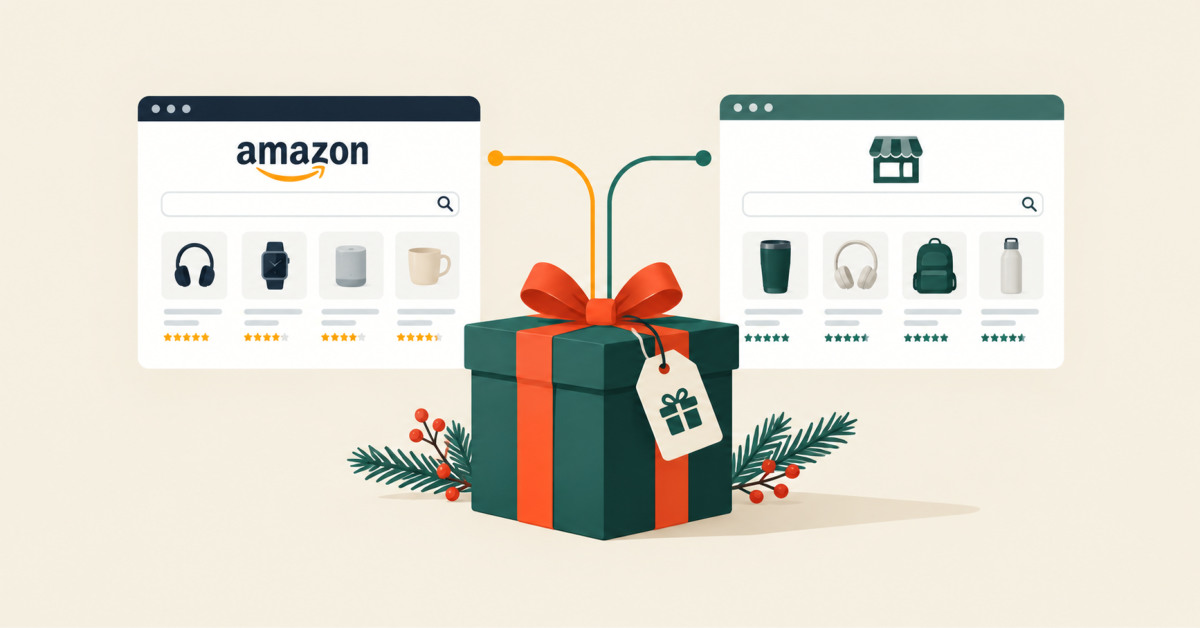
For a giftable product under $40, Amazon usually wins the first holiday sale on delivery certainty, while your own store wins what a marketplace cannot hold: gift sets, personalization, direct support, and the second order. Lock channel inventory before Amazon’s October 15 peak window.
A $29.99 gift sells at the same price on Amazon with Prime shipping. Your store will not win that sale on speed, so it has to win a different sale entirely.
Here is the situation a lot of gift product brands are in this September. A $29.99 item is live on the brand’s own store, live on Amazon at the same price with Prime shipping, and maybe live on TikTok Shop too. Three storefronts, one price, one inventory pool, and roughly ten weeks until the heaviest gift buying of the year.
The VidaBay Snap is a useful example because its maker has put that entire setup in public. The Snap is a battery-free color E Ink photo magnet that updates when you tap a phone against it, sold at $29.99, and the brand runs a direct store, an Amazon storefront, TikTok Shop, and regional distributors side by side. That is exactly the channel mix many small Shopify gift brands are weighing right now, just further along.
Most founders in this position ask which channel will sell more. For an impulse priced gift, that is the wrong question. The better one, which this piece calls the channel test, is which sale each channel is uniquely positioned to win, and whether your inventory is allocated to match before the calendar makes the decision for you. If you sell a physical product between about $20 and $50 that people buy for someone else, this is written for you, whether you are doing $5K months or $500K months.
Gifts under $40 break the usual advice because the buyer is optimizing for delivery certainty and low risk rather than a brand relationship, which hands the first sale to whichever channel feels safest. The standard playbook says drive traffic to your own store, own the customer, and treat marketplaces as overflow. That logic holds for considered purchases and replenishment products. It weakens fast when the price is low enough that nobody researches, and the buyer’s real worry is whether the thing arrives before the 24th.
The shopper data backs this up. In the survey of 1,205 US mobile holiday shoppers covered in our BFCM 2026 data report, 37% said a marketplace is where they feel most in control of buying, against 26% for a brand’s app and just 21% for a brand’s website. Fear of stockouts as a reason to shop early climbed from 33% to 42%. A gift buyer with a deadline and a $30 budget is exactly the person who picks the familiar checkout and the familiar delivery promise.
Two things follow for a small brand. First, trying to pull that specific buyer away from Amazon with ad spend is usually a losing trade at this price point, because the click costs a meaningful share of a $30 order and the buyer was comfortable where they were. Second, your own store is not irrelevant; it is just competing for a different purchase. The buyer who wants three in mixed colors, a version with a case, or something the listing does not offer is a buyer your store can win outright.
There is also a pattern worth naming for brands in the $500K to $2M range. The instinct in September is to add a channel because demand feels guaranteed. The brands that hurt themselves in Q4 are rarely short of channels. They are short of inventory discipline across the channels they already have, which is where the rest of this piece goes.
VidaBay’s own distribution page shows a four part channel map for a $29.99 product: a direct store, an Amazon storefront, TikTok Shop, and regional distributors, with the direct store deliberately positioned around what marketplaces cannot offer. This is not a product review, and we are not recommending you stock it. We covered what the device does and where it falls short in our hands-on look at the Snap itself. What matters here is the structure, because it is visible and it is typical.
In North America, the brand sells through its official U.S. Amazon storefront, through TikTok Shop, and through a Florida distributor. Elsewhere it uses authorized partners in Poland, Hong Kong, and Japan so shoppers can buy in local currency with local delivery. Each of those channels does one job well: Amazon answers the delivery question, TikTok Shop creates discovery for a product that demos in seconds, and distributors reach buyers who never visit a brand site.
The VidaBay official store is where the strategy shows. The single unit sits at the same $29.99 as elsewhere, so the store does not try to win on price. Instead it sells a three-pack at $83.99, a magnet and leather case set at $49.99 against a $58.98 separate price, a $3 automatic discount for mixing three colors, and 30-day returns. Its distribution page makes the positioning explicit, pitching direct warranty support, first access to new accessories, and exclusive bundles as the reasons to buy direct. It also offers 20% off a second order to buyers who post photos in the brand’s Reddit community, and describes that reward as something not available on marketplaces.
That is the channel test applied. The marketplace gets the fast single unit. The store gets the set, the accessory, the community, and the next order. You do not need VidaBay’s scale to copy the shape; you need to decide, SKU by SKU, which of those jobs each channel is doing for you this quarter.
A $29.99 order on Amazon FBA gives up roughly a quarter of its price to referral and peak fulfillment fees before advertising, while TikTok Shop’s base fee is far lower until creator commissions stack on top. The numbers below are illustrative, built from published fee schedules for a small, light product, so run your own SKU through each platform’s calculator before you commit inventory.
On Amazon, most categories carry a 15% referral fee on the total sale price, which is about $4.50 on $29.99. Amazon’s 2026 fee update raised FBA fees by an average of $0.08 per unit and added no new fee types. For fulfillment, Amazon’s own example of a small standard item, a phone case, goes from $2.49 to $2.68 during peak season, and a 3.5% fuel and logistics surcharge applies on top. Illustrative total: about $7.27 per unit, or 24% of the price, before storage, returns, or sponsored ads.
On TikTok Shop, most US categories pay a 6% referral fee, so about $1.80 on the same order. The catch is that creator commissions are seller-set and sit on top. Illustrative example: a 15% creator commission adds $4.50, putting a creator-driven sale at $6.30 before shipping.
Your own store looks cheapest on paper and often is not, because the platform fee is small but you are paying for every visitor. That is the real comparison: marketplace fees are a toll on demand that already exists, while store margin depends on what it costs you to create demand. At $29.99, that math favors the marketplace for the single unit and favors your store only when the order is bigger.
Your own store wins the holiday sale when it sells something a marketplace listing cannot: a curated set, a personalized version, direct warranty support, or an incentive tied to the second order. Matching Amazon’s single unit price and hoping loyalty carries the difference is not a strategy. Giving the buyer a reason that only exists on your site is.
Sets are the most direct lever, because they lift order value above the point where paid traffic makes sense. VidaBay’s three-pack saves the buyer $5.98 against three singles, and its magnet and case set saves $8.99. Neither discount is deep; the value is that the set is a finished gift. If you are building these for the first time, our bundle strategy guide covers how to pick pairings and keep bundle inventory from overselling, which matters more in Q4 than any other time.
Personalization is the second lever for gift products specifically. A gift message, engraving, a preloaded image, or a choice of packaging turns a commodity listing into something a buyer cannot get elsewhere at any price. Keep it operationally honest, though: every personalization step adds handling time, so publish a clear order-by date and stop offering it when your team cannot meet that date.
The third lever is the one most small brands leave on the table, which is the second order. The holiday buyer who purchased direct is a customer you can email in January. The buyer who purchased on a marketplace mostly is not. VidaBay’s 20% reward for a community post is one version; a January replenishment or accessory offer in the order confirmation is another.
Stage matters here. If you are under $500K a year, pick one store-only offer and do it well. Between $500K and $2M, a small set range plus one post-purchase offer is enough, and more than that is usually premature complexity. Above $2M, store-exclusive sets become a deliberate channel strategy that protects margin while Amazon handles volume.
Inventory decides your Q4 channel split, because Amazon’s peak fees start October 15 and Amazon is telling sellers to get stock into its network by October, which means your allocation is effectively locked weeks before the first gift is bought. According to Amazon’s 2026 holiday fulfillment fee announcement, peak charges run from October 15, 2026 through January 14, 2027, averaging $0.32 more per unit. Amazon also warned sellers to expect lower capacity limits as its fulfillment centers shift focus to customer orders in November and December.
That turns a demand question into a supply question. Every unit you send to FBA in early October is a unit your own store cannot sell as part of a set in December. Every unit you hold back is a unit that may miss Prime eligibility if inbound capacity tightens. There is no clean answer, only an explicit one, and the brands that get hurt are the ones who never wrote the split down.
Accessories deserve special attention. VidaBay’s Bluetooth dock, the accessory that makes the product work smoothly on many Android phones, is currently sold out on its store, with the next restock expected in early October. For any brand, an accessory that unlocks part of your market is a single point of failure in Q4, and it should be forecast with the same care as the hero product.
The downside of getting this wrong is real. On a recent eCommerce Fastlane episode on multichannel inventory, host Steve Hutt described a Shopify brand from his merchant success years whose lighted makeup mirror took off after an influencer promotion. With a three-month lead time from China, the brand could not fulfill the demand and eventually closed. A viral holiday moment on a $30 gift can move faster than any reorder.
If you sell on Amazon and Shopify together, sync inventory before you add volume. Shopify Marketplace Connect includes the first 50 marketplace orders per month free, then charges 1% per additional order, capped at $99 a month, which is a small price against a single week of overselling in December.
Compatibility returns hit gadget gifts hardest in January, because the buyer and the user are different people, and the recipient discovers the mismatch after the holiday. A self-purchaser checks whether a device works with their phone. A gift buyer often does not know which phone the recipient has, and a no-questions return from a disappointed recipient erases the margin on that sale and then some.
The Snap shows why this matters. Its official store lists one-tap transfer for iPhone 13 through 17, while many Android phones need the separate Bluetooth dock. In TechRadar’s month-long hands-on test, the reviewer reported a mixed experience with an Android phone and found the frames did not display blue. Neither is unusual for a first generation gadget. Both become return reasons when the person unwrapping it has the wrong phone or a photo of the ocean.
Returns also carry platform costs beyond the lost sale. TikTok Shop refunds the referral fee on returned orders but keeps a refund administration fee of 20% of that referral fee, capped at $5 per SKU. Amazon has its own returns processing charges in several categories. Budget for a January return spike on any compatibility dependent gift rather than discovering it in February.
The practical fix costs almost nothing. Put the same compatibility line, in the same words, on every channel’s listing, near the price rather than buried in specifications. Add a one-line “check the recipient’s phone” note to the gift checkout or order confirmation. If a companion accessory solves the compatibility issue, sell it as a set on your store so the gift arrives working. At $500K and above, add a gift receipt insert that points the recipient to a setup video before they request a return.
Before October 15, the job is to assign each channel a single sale to win and allocate inventory to match, not to add another channel. That is the load bearing claim in this piece: for a gift product under $40, opening a brand new sales channel after October 1 costs more in split inventory and setup errors than it returns in holiday revenue. The platforms will still be there in January, and so will the data from this season to decide properly.
If TikTok Shop is on your list, be honest about the work it requires. It rewards products that demo in seconds, and a gift gadget often does. It is a content operation rather than a listing, though, and our look at how TikTok Shop grew to $15.82 billion in US sales is clear that brands treating it like a catalog stall. If you cannot publish creator video weekly through December, it is a January project.
The sequence for the next four weeks is short. Write down which sale each channel is for. Set your FBA inbound quantity and ship it in early October. Build one store-only set and one post-purchase offer. Put identical compatibility and order-by dates on every listing. Then leave the channel map alone until January, when this season’s numbers will tell you what to change.
Most gift brands under $40 should sell on both, with each channel assigned a different job. Amazon tends to win the fast single-unit gift purchase because shoppers trust its delivery promise, and in a survey of 1,205 holiday shoppers, 37% said a marketplace is where they feel most in control of buying versus 21% for a brand’s website. Your Shopify store should focus on what a marketplace listing cannot offer: curated sets, personalization, direct support, and an incentive for a second order. If you are under $500K a year and not on Amazon yet, do not launch it in October. Set it up properly in January, when the holiday deadline pressure is gone.
Amazon typically takes about $7 to $8 of a $29.99 FBA sale during the 2026 holiday season, before advertising and storage. Most categories pay a 15% referral fee on the total sale price, which is about $4.50. Peak fulfillment fees apply from October 15, 2026 through January 14, 2027, and Amazon’s own example of a small standard item rises from $2.49 to $2.68 per unit, with a 3.5% fuel and logistics surcharge added on top. That illustrative total is roughly $7.27, or about 24% of the price. Your exact figure depends on category, size tier, and weight, so run your specific product through Amazon’s Revenue Calculator.
Send holiday inventory to Amazon FBA in early October 2026 at the latest. Amazon has advised sellers to get stock into its facilities by October to protect Prime delivery speeds for Black Friday and Cyber Monday, and it has warned that capacity limits may tighten as fulfillment centers prioritize customer orders in November and December. Peak fulfillment fees are charged on units shipped from October 15 onward, so timing does not avoid them, but late inbound shipments risk missing Prime eligibility during the weeks that matter most. Your exact inbound deadline depends on your shipping plan, so confirm it in Seller Central before you book freight.
Give holiday shoppers something on your website that the Amazon listing does not have, rather than trying to beat Amazon on price or delivery speed. Store-only gift sets, a small accessory bundle, gift messaging or personalization, direct warranty support, and a reward tied to the next purchase all create a reason to buy direct. VidaBay, for example, keeps its single unit at the same $29.99 everywhere but sells a three-pack, a magnet and case set, and a color-mix discount on its own store. Undercutting your own marketplace price on the single unit usually just trains buyers to shop around. Compete on the order, not the unit.
TikTok Shop is worth adding before Black Friday only if you can publish product video consistently through December and your product demonstrates in a few seconds. The base fee is attractive, with most US categories paying a 6% referral fee, but creator commissions are seller-set and stack on top, and returned orders keep a refund administration fee. TikTok Shop behaves like a content channel rather than a listing, so a shop without steady creator content rarely moves. If you are under $500K a year and already stretched across your store and one marketplace, treat TikTok Shop as a January project and use this holiday season to learn which products people actually gift.