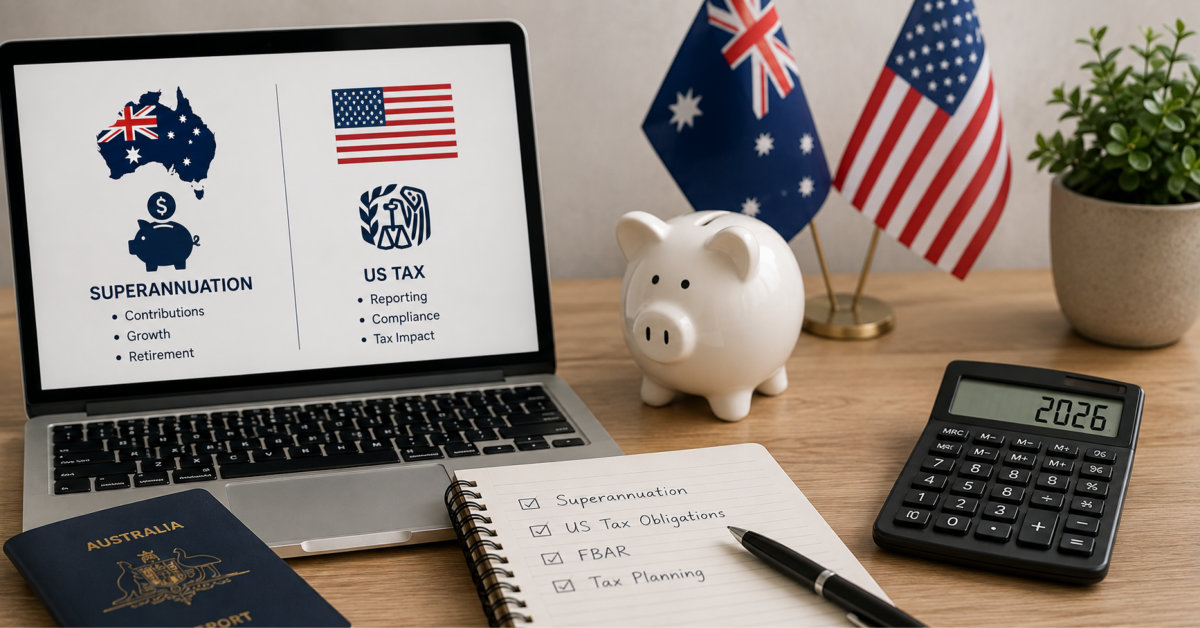
US citizens in Australia owe annual US filings no matter how much Australian tax they pay, and superannuation is the asset that trips them up most, because the tax treaty never addressed it and the reporting thresholds start at $10,000.
Your employer is putting 12% of your salary into a fund you cannot touch for decades, and the country you left has never formally decided how to tax what happens inside it.
On 1 July 2025 the superannuation guarantee reached 12% of ordinary time earnings, the highest rate in the system’s history. On 1 July 2026 Division 296 began applying additional tax to earnings on balances above $3 million. Both changes were designed around Australian residents, and both landed on the desks of Americans in Australia who had never thought of their super as anything other than a number on a statement.
That is the pattern. For most Americans who move to Australia, wealth building does not start with a plan. It starts with a better job, a first home, and an employer quietly making contributions to a fund nobody reads the statements for. What began as a two year assignment becomes a decade, and somewhere in there the balances get large enough that the structure around them starts to matter more than the returns inside them.
This piece is written for the person in the middle of that, whether you are three years in and renting, or fifteen years in with a business, a mortgage, and a seven figure balance sheet. The specifics differ enormously by stage. The sequence of surprises does not.
A pay rise changes the size of your financial position, not its shape, because money flows into whatever structure already exists. A software engineer in Sydney gets promoted. A consultant in Melbourne starts clearing bonuses. A founder hires their fifth person and starts paying themselves properly for the first time. In every case the extra income lands in the same accounts, under the same ownership, inside the same default super fund that was picked on day one of the job.
The Australian system makes this easy to ignore, because it does a lot of the saving for you. Your employer contributes 12% of ordinary time earnings, subject to a maximum contribution base of $62,500 per quarter for the 2025 to 2026 year. Concessional contributions, which include that employer money plus anything you salary sacrifice, are capped at $30,000 a year and taxed at 15% inside the fund rather than at your marginal rate. If you earn $180,000, the system is moving roughly $21,600 a year into a structure you did not design and cannot access for decades.
For someone in their first three years in Australia, that automation is a gift. For someone twelve years in with a growing balance and a US passport, it is a compounding position taken on their behalf in a jurisdiction that has never told them how the other half of their tax life will treat it. Business owners have it harder still, because a sole trader receives no superannuation guarantee at all and has to decide deliberately whether to contribute, while a founder paying themselves through a company does receive it and often does not notice.
The fix is not complicated, and it is the same discipline that applies to planning, allocating, monitoring, and evaluating the money inside a business. Income and long term goals need to be working on the same plan rather than running in parallel and meeting for the first time at retirement.
Buying property in Australia reprices every other financial decision you make for the next decade, because the mortgage sets your cash flow floor and the cash flow floor sets everything else. Australia has a deep cultural attachment to property ownership, and for good reason. A home provides stability, security, and a sense that the move has become permanent. It also quietly constrains contributions, investment capacity, and flexibility about where you live next.
For a US citizen there is a second layer that almost nobody flags at the time of purchase. Australia’s main residence exemption can remove capital gains tax on the family home entirely. The United States has no equivalent. The US exclusion for gain on a main home caps at $250,000 for a single filer and $500,000 for a couple filing jointly. A Sydney or Melbourne property held for fifteen years can produce a gain well past those caps, and the excess is taxable to the US even when Australia takes nothing.
There is a third layer that catches people on the way out. When a US person repays or refinances a mortgage denominated in a foreign currency, movements in the Australian dollar against the US dollar between the day the loan was taken out and the day it is discharged can produce a taxable foreign currency gain for US purposes. The property has not been sold. The bank has simply been repaid. The gain exists only in the eyes of one tax authority.
Property remains an excellent wealth building tool, and the point here is not to avoid it. The point is that the debt versus equity question a founder already knows how to run inside a business, weighing repayment obligations against retained control and forecast cash flow, is the same question a mortgage asks of a household balance sheet. The capital structure and working capital decisions that govern a company govern a household too. Property works best as part of the picture rather than as the whole of it.
Superannuation compounds into one of the largest assets most long term residents own, and it does so without another decision from the account holder after the first one. Ask a newly arrived American about retirement planning and super is rarely the answer. Retirement feels distant. The statements arrive twice a year and get filed unread.
Then the arithmetic does its work. Employer contributions at the 12% rate that took effect on 1 July 2025, plus investment growth inside a concessionally taxed environment, plus twenty years, produces a balance that frequently exceeds every other asset the household owns apart from the house. Australian superannuation is an ordinary part of retirement planning here, and for Americans it is also the single asset most likely to create a US problem nobody warned them about.
The Australian rules alone are now more complex than they were two years ago. Division 296 became law on 13 March 2026 and applies from 1 July 2026. Under it, individuals whose total super balance exceeds $3 million pay an additional 15% on the proportion of earnings relating to the balance above that threshold, with a further 10% applying above $10 million. Both thresholds are indexed to inflation, the $3 million figure in $150,000 increments and the $10 million figure in $500,000 increments, and the tax applies to realised earnings rather than paper gains. The ATO’s guidance on how the additional tax on large super balances is calculated and paid sets out the mechanics.
If your balance is under $500,000, Division 296 is background noise and the US treatment below is your real issue. If you are a founder in your fifties who has been salary sacrificing hard, or you hold a self managed fund holding business real property, it is now a live planning constraint on both sides of the Pacific.
The United States has never issued formal guidance classifying Australian superannuation, so US practitioners default to one of a small number of positions and disagree with each other about which is right. The treaty is the root of it. The current US Australia tax treaty was negotiated before the superannuation guarantee system began in 1992, and it contains no article addressing superannuation specifically. There is no equivalent of the clean pension deferral that the US treaties with the United Kingdom and Canada provide.
In the absence of an article, three treatments get argued. The most favourable analysis treats employer funded super as an employees’ trust, with US tax deferred until distribution. The least favourable treats the fund as a foreign grantor trust, which means the growth inside it is taxable to you annually even though you cannot withdraw a dollar of it. The middle position treats employer contributions as includable in US income in the year they are made while the fund’s internal earnings are handled separately. Which analysis your accountant adopts changes your US tax bill materially, and it is a question worth asking directly rather than assuming.
There is a related problem with credits. The 15% tax paid inside a super fund is paid by the fund trustee, not by you. Foreign tax credits generally require that you paid the foreign tax. That mismatch means the Australian tax already collected on your super earnings often cannot be used to offset the US tax that a grantor trust analysis would create, which is how the same dollar gets taxed twice.
One piece of genuine relief exists. Revenue Procedure 2020-17, published in the Internal Revenue Bulletin for the week of 16 March 2020, exempts qualifying tax favoured foreign retirement trusts from the Form 3520 and Form 3520-A filing requirements that otherwise carry a $10,000 minimum penalty for failure to file. Many superannuation accounts qualify. Relief from those two forms does not remove the income tax question above, and it does not touch the two reporting forms covered further down.
The wrapper around an investment usually decides its US tax treatment more than the investment itself does. Most people focus on what they are buying. Shares, managed funds, a business interest, an investment property. Far less attention goes to how the thing is held, which is the variable that determines whether a perfectly sensible Australian investment becomes a US filing burden.
The clearest example is the passive foreign investment company regime. Australian managed funds and locally domiciled exchange traded funds are generally PFICs for US purposes. That triggers Form 8621, and under the default excess distribution method the US tax calculation allocates gains back across the holding period and adds an interest charge, which can produce an effective rate well above what the same investment would face if it were held in a US domiciled fund. An Australian who buys a Vanguard Australia index fund has made a reasonable decision. An American who buys the same fund has created an annual filing obligation and a punitive default calculation.
Fund type matters here too. A large APRA regulated industry fund is generally the lower risk structure for a US person, because the member does not control the underlying assets. A self managed fund is the higher risk structure, because a US grantor with a US beneficial interest invites the argument that the fund’s assets are attributed directly to them, and any foreign equities inside it are then examined individually under the PFIC rules. Americans who set up an SMSF for the flexibility often discover the US cost of that flexibility years later.
None of this is a criticism of how people actually make decisions. Opportunities get evaluated first and structure gets attention later. That is as true for founders choosing between operating structures, where the reasoning behind liability protection, pass through taxation, and ease of formation only becomes concrete once there is something worth protecting, as it is for households choosing between an industry fund and an SMSF.
Financial success in Australia expands your US filing footprint rather than shrinking it, because the United States taxes citizenship rather than residence. Many Americans living in Australia continue to file a US return every year regardless of how long they have been away, how much Australian tax they pay, or whether they ever intend to return.
Two reporting regimes sit on top of that return, and both are triggered by balances rather than by income. The FBAR, filed with FinCEN rather than the IRS, is required when the aggregate value of your foreign financial accounts exceeds $10,000 at any point during the calendar year. Not $10,000 at year end, and not $10,000 in any single account. The aggregate high water mark across every account, including your super. Almost every American with an Australian salary crosses this line in their first year.
Form 8938 sits higher. For a US person living abroad, the thresholds are $200,000 of specified foreign financial assets on the last day of the tax year or $300,000 at any time during it for a single filer, and $400,000 or $600,000 respectively for a couple filing jointly. A mid career professional with a $350,000 super balance and an offset account has already crossed it.
This is where growth creates complexity. A larger portfolio, a significant super balance, a business interest, and a property are each individually unremarkable. Together they can trigger four separate US filings. That is the point at which some people start working with a US tax accountant in Australia, not because compliance is the goal in itself, but because they want to know how the pieces interact before a decision locks the answer in.
Three moments convert a manageable cross border position into an expensive one: a business sale, the first superannuation withdrawal, and a permanent move back to the United States. Each compresses years of accumulated structural decisions into a single taxable event, and each is far cheaper to plan for eighteen months out than eighteen days out.
A business sale is the sharpest of the three, because Australian and US rules diverge on small business concessions, on the treatment of goodwill, and on timing. Founders preparing for a transaction spend months on clean financials, documented operations, and transferable intellectual property, which is the right work. The cross border question deserves the same lead time and rarely gets it.
Superannuation withdrawal is the second. Once you reach 60 and meet a condition of release, withdrawals from a taxed fund are generally tax free in Australia. Whether the US agrees depends entirely on which classification your position has been taking for the preceding twenty years, which is why the classification question is worth resolving early rather than at the point of the first payment.
The move home is the third, and the most underestimated. Returning to the United States ends any reliance on the foreign earned income exclusion and changes which country has the primary taxing right over what. There is also a mechanical trap in the calendar. The Australian tax year ends on 30 June and the US year ends on 31 December, so income and credits routinely land in mismatched years, and a credit you expected to offset a US liability can arrive twelve months late.
Most Americans in Australia learn these rules late because nothing goes wrong until the balances get large enough to matter. That is not a failure of judgment. It is the ordinary sequence: the decisions get made first, and the consequences of those decisions only become visible once there is enough money involved for them to be visible at all.
Building wealth in Australia is genuinely rewarding. Careers grow, the super system does real work in the background, and the property market has been kind to people who bought early. The part that gets learned late is that accumulating wealth and understanding wealth are separate skills, and that the second one arrives on a delay.
Everything above describes how the rules generally operate, not what any individual should do. Cross border positions turn on specifics: your visa history, your fund type, your entity structure, your filing status, and which classification your prior returns have already taken. That last point matters more than most people expect, because consistency with prior positions is itself a planning constraint. The most valuable financial decisions are not always the ones that help you earn more. Sometimes they are the ones that let you see clearly what you have already built, and what it is going to cost to keep it.
There is no settled answer, because the IRS has never issued formal guidance classifying Australian superannuation. US practitioners generally take one of three positions: that employer funded super is an employees’ trust with US tax deferred until distribution, that the fund is a foreign grantor trust whose internal earnings are taxable to you annually, or that employer contributions are includable in US income when made. The position your accountant takes materially changes your US tax bill, and it should be a deliberate choice rather than a default. Consistency matters too, because changing position after years of filings creates its own complications.
Yes. Foreign pension accounts are financial accounts for FBAR purposes, and superannuation is included. The FBAR is required when the aggregate high value of all your foreign financial accounts exceeds $10,000 at any point during the calendar year, measured across every account rather than per account. Your super balance, your everyday transaction account, and any offset or savings account all count toward that aggregate. The FBAR is filed with FinCEN rather than the IRS, and filing it does not satisfy the separate Form 8938 requirement. Most Americans earning an Australian salary cross the $10,000 line in their first year.
No. The current treaty was negotiated before the superannuation guarantee system began in 1992 and contains no article addressing superannuation. It provides nothing equivalent to the pension deferral available under the US treaties with the United Kingdom and Canada. The treaty also contains a savings clause, under which the United States reserves the right to tax its own citizens as though the treaty did not exist, which limits how much protection any treaty article offers a US citizen in the first place. In practice the treaty resolves less about super than most people assume.
Yes, on the Australian side, and it applies on the same terms as it does to anyone else. Division 296 became law on 13 March 2026 and applies from 1 July 2026 to individuals whose total super balance exceeds $3 million, adding 15% to the proportion of earnings relating to the balance above that threshold and a further 10% above $10 million. Both thresholds are indexed. US citizenship does not change the Australian calculation. What it does change is the follow on question of whether the extra Australian tax produces any usable US foreign tax credit, which depends on how your super is classified for US purposes.
Yes, in most cases. The United States taxes on the basis of citizenship rather than residence, so US citizens and green card holders generally file an annual return regardless of where they live or how long they have been away. Filing does not always mean owing, because the foreign earned income exclusion and foreign tax credits often eliminate US tax on Australian salary income, particularly given Australia’s higher marginal rates. Those mechanisms cover wage income well and cover superannuation, PFIC holdings, and foreign currency gains far less well, which is where the real exposure usually sits.