

Ecommerce was slow to gain traction in the automotive industry. But now, with a wave of new manufacturers of electric vehicles (EVs) entering the market and more buyers shopping for cars online, even the biggest incumbents are shifting into high gear.
Whether you sell vehicles, parts, or accessories, digital channels are now essential for long-term growth. This guide shows how the right ecommerce platform can cut complexity and help you scale.
Automotive ecommerce is the online buying and selling of vehicles, auto parts, accessories, and related services. But it’s more complicated than shopping for apparel.
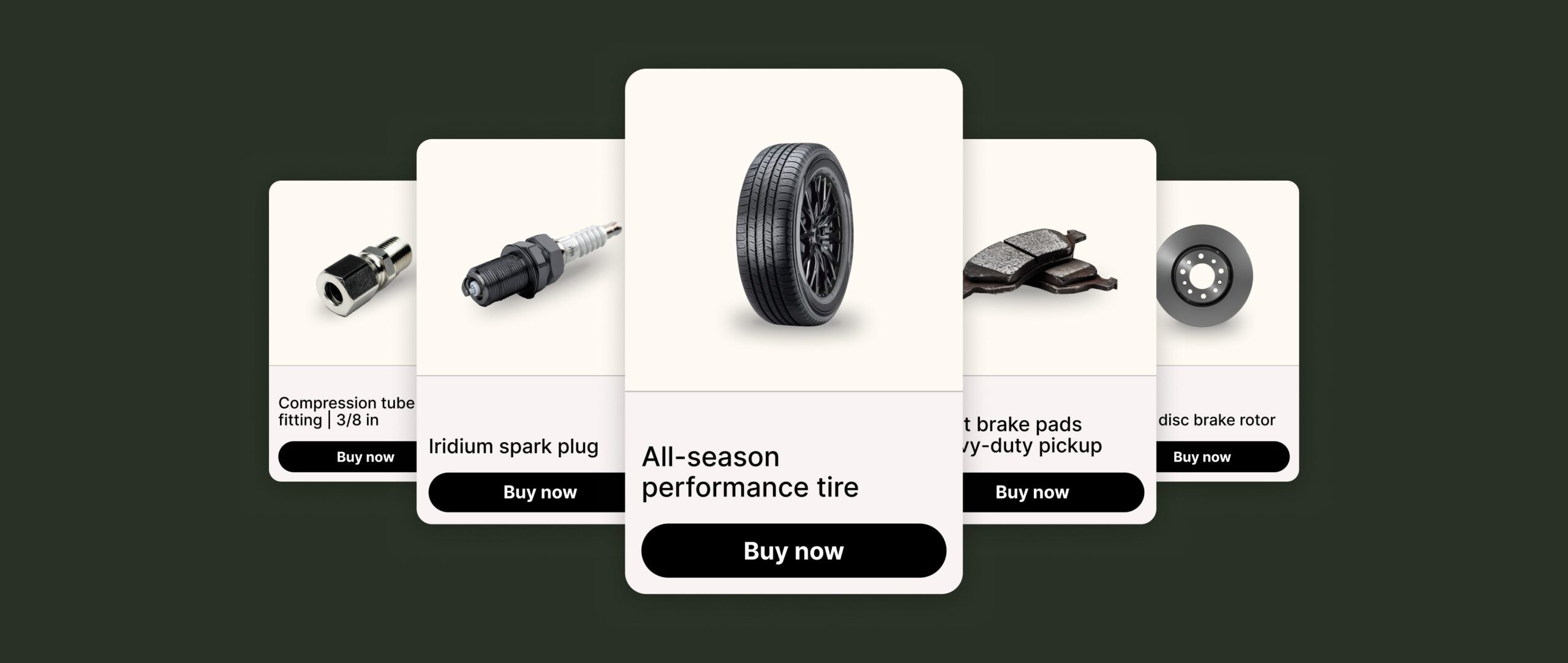
If a customer is buying brake pads, they have to fit that exact 2018 Honda Civic, not just any car. That’s why automotive websites need specialized technologies such as part finders and fitment data.
Unlike standard online stores, these platforms are built to handle the technical details, making sure customers find the perfect match for their specific ride every time. Some reasons retailers need specialized tech are:
The automotive ecommerce market is projected to reach $208 billion in 2030, as consumers increasingly research and purchase parts online.
Mobile is now the leading source of ecommerce activity globally, accounting for 77% of ecommerce traffic and 56% of revenues, according to a 2024 benchmark report. Mobile-first design is non-negotiable for auto parts retailers.
Brands like UroTuning can sell performance parts for a Porsche 911 Carrera GTS, for example, offering simple checkout options like Shop Pay that outpace other accelerated checkouts by at least 10%.

Selling complete vehicles online involves regulatory requirements, including state-specific licensing, financing compliance, and delivery logistics that differ from parts sales. Most automotive ecommerce businesses focus on parts and accessories, where these barriers are lower.
If you’ve ever wondered how a website knows which spark plugs fit a 2015 Toyota Camry but won’t fit a 2015 Corolla, the answer is ACES and PIES. These are the industry’s common languages that make online part shopping work.
Not every ecommerce platform handles ACES/PIES natively. If you have a large catalog (over 1,000 items), make sure your platform can connect with data providers like SEMA Data or ASAP Network.
Without that connection, you have to manually type in every single vehicle a part fits for every product you sell. That one alternator might fit 45 different vehicles—meaning you have to create a list or spreadsheet and manually link each part number to all 45 vehicle combinations.
If you have 1,000 parts, you’re now managing 45,000 manual connections. If you make one typo, the customer buys the wrong part, and you pay for the return shipping.
When evaluating auto parts commerce platforms, prioritize those with these features built in so you don’t have to pay for custom development:

Shopify gives automotive businesses the tools to launch, manage, and scale complex online operations. It supports large product catalogs with detailed vehicle fitment data, integrates with enterprise resource planning (ERP) and inventory management systems (IMS), and delivers fast, reliable shopping experiences across desktop and mobile.
With an ecosystem of apps for inventory, shipping, and marketing, and a global network of Shopify Partners specializing in automotive ecommerce, Shopify removes the technical barriers that slow growth.
Here are four examples of how Shopify helped automotive brands solve real challenges and accelerate growth:
These stories show that whether you’re automating back‑office workflows, scaling B2B ecommerce operations, or fine‑tuning customer‑facing features, Shopify delivers the flexibility and horsepower manufacturers and retailers need to meet today’s ecommerce demands.
Automotive ecommerce platforms range from commerce platforms with extra plugins to niche systems built for car parts retailers. Here is how to evaluate your options.
Shopify serves automotive businesses through third-party apps and integrations. It offers great flexibility and beautiful designs, but you have to build your automotive features by adding various apps for things like fitment search, ACES/PIES data, and distributor links.
Shopify is best for businesses of all sizes that value customization options and unified commerce capabilities. It also offers apps like Convermax for YMM search, which pulls data from various sources so shoppers can find the right parts for their cars.

Dedicated platforms like X-Cart Automotive and WebShop Manager are built from the ground up for parts. They usually include native ACES/PIES support, built-in YMM search, and preconfigured connections to distributors.
Digitization affects every part of the automotive supply chain differently.
No matter the role, the shift requires coordination across product data, payments, logistics, and customer support. That’s where modern ecommerce platforms—those built for flexibility, scalability, and system integration—can make a meaningful difference.
OEMs tend to use platforms like RevolutionParts or SimplePart to connect their catalogs directly to factory data. Since aftermarket parts sellers have a larger catalog, they focus more on software-as-a-service (SaaS) platforms like Shopify for user experience and customization.
💡Did you know? Many OEMs are finding creative workarounds, such as enabling build-and-price tools online, and then routing purchases through preferred dealerships. Others are launching DTC pilot programs for accessories or EVs, where laws are more flexible. Shopify supports hybrid models that allow OEMs to test DTC while maintaining dealer relationships.
| Platform | ACES/PIES support | YMM search | VIN lookup | WD integrations | Best for |
|---|---|---|---|---|---|
| Shopify | Via vetted apps | Via apps | App-dependent | Via apps | Businesses of all sizes with a priority on design and unified commerce |
| Magento | Custom or extensions | Custom development | Custom development | Custom integration | 50k+ SKUs with full customization |
| X-Cart Automotive | Native | Built-in | Built-in | Turn14, Keystone | Aftermarket-focused stores |
| WebShop Manager | Native | Built-in | Built-in | Extensive WD network | Large catalogs |
| RevolutionParts | Native with OEM focus | Built-in | Built-in | OEM/Factory systems | Dealerships and OEM parts |
To keep up with the speed of the industry, most successful auto retailers connect their platform directly to warehouse distributors. It turns your website into a real-time extension of their warehouse.
The biggest advantage is speed. As Amy Snyder, cofounder of Snyder Performance Engineering, puts it, “My team doesn’t have to wait for an order to get manually plugged in. By the time somebody places an order, it can literally be packed and shipped within a couple minutes… We don’t need to question it. It saved us a ton of money and time because things aren’t happening twice.”
By automating the link between your store and its suppliers, you gain three advantages:
Managing 50,000+ SKUs manually is impossible. Catalog data providers such as SEMA Data, ASAP Network, and DCi provide ACES/PIES-compliant product feeds. These services populate your store with accurate fitment info, descriptions, and images. While they charge monthly fees, they eliminate thousands of hours of manual data entry.
“We source from over eight or nine sources, and so that’s just millions—hundreds of millions of dollars of inventory—that we can pick and choose from… we’re kind of cherry-picking the best to put ad spend behind,” says Sean Reyes, founder at Shock Surplus.
If you do carry some of your own stock alongside these distributor feeds, your platform needs to be smart enough to show a unified available stock number. It should check your shelf first, then the closest distributor, so the customer sees a single, accurate stock status.
💡 Tip: Shopify offers robust APIs and partner apps that make it easier to integrate legacy systems into your online operations. Brands that invest in seamless system connectivity gain real-time inventory management, accurate pricing, and faster fulfillment—all critical for delivering a consistent customer experience.
As mentioned earlier, most shoppers today browse and buy on their phones. Automotive brands face several challenges related to mobile shopping, including:
Electric vehicle adoption is shifting online automotive behavior. EV owners show significantly higher mobile usage rates and a stronger preference for viewing detailed technical specifications before purchase. If your catalog includes EV parts or accessories, a mobile-optimized technical data display becomes even more critical.
Prioritize your mobile design by following these practices:
Selling automotive parts on eBay Motors and Amazon Automotive can drive sales, but marketplaces enforce strict rules that differ from your own online store.

EBay Motors requires parts compatibility data for most listings so buyers can use their My Garage tool to find parts. You have to provide:
EBay accepts ACES-formatted data, which automates the process. If you don’t use ACES or an automated tool, type in the fitment info for every single listing.

Amazon has even more restrictions. The automotive categories require:
For automotive merchants, marketplaces deliver massive reach but can dilute brand identity and margin control. Tools like Shopify’s Marketplace Connect enable synchronized listings, unified inventory management, and consolidated order processing—so you can scale across channels without fragmenting your operations.
The automotive ecommerce platform you choose impacts your search rankings. Google measures how well your website runs. So if it’s slow or clunky, you won’t get high rankings in Google’s search results pages.
Automotive sites face a unique technical challenge: massive databases. When a customer searches for a 2019 Ford F-150 cold air intake, the website has to scan through more than 100,000 products in a split second to filter out everything that doesn’t fit. These heavy database queries can slow down your site, hurting your Core Web Vitals scores.
Google penalizes sites that fail these metrics. If your fitment search takes too long to load, a metric called Largest Contentful Paint or LCP, Google assumes your site provides a poor experience and will rank your competitors higher.
There are two ways to set up your architecture to handle the database:
Since you can’t make your catalog smaller, you can make your platform faster:
📚 Read: Enterprise SEO: A Complete Guide For Getting Found Online
Platform selection determines your operational capabilities, growth potential, and profitability for years. The cheapest option up front often becomes the most expensive through technical limitations, manual workarounds, and the eventual pain of a massive migration.
When you’re first figuring out how to start an online car parts business, this choice is your foundation. If you plan to carry 10,000 SKUs within two years, start with a platform that can handle that scale now.
To fully understand your return on investment (ROI) for a platform, it’s important to look at what the platform saves you compared to its cost. Two perspectives automotive retailers consider are:
The best automotive ecommerce solution depends on your company’s situation. Here is a framework to follow.
| Your situation | Priority | Recommendation |
|---|---|---|
| New business, <5,000 SKUs, tight budget | Low entry cost and ease of use | General platform with apps |
| Established, 5,000–50,000 SKUs, technical team | Automation and deep integrations | Specialized automotive platform or mid-market SaaS |
| Large operation, up to 50,000+ SKUs, complex needs | Scalability and enterprise support | Enterprise automotive platform or a custom build |
Your ecommerce website is your digital showroom. Choose an ecommerce platform that supports expansive product catalogs, high-resolution imagery, and custom storefront templates. Incorporate robust search filters and faceted navigation so shoppers can quickly drill down by fitment, brand, price, and vehicle compatibility.
From year-make-model lookups to fitment charts and variant bundles, automotive ecommerce demands robust data management. Shopify supports bulk uploads, product hierarchies, and ERP integrations. These are vital for syncing inventory, pricing, and availability in real time.
Brands like UroTuning use vehicle-specific filters to streamline shopping and reduce returns. They unified product and customer data, introduced a “Save Your Vehicle” selector, and leveraged Shopify Flow and Scripts to automate order-routing, dynamic pricing, and compatibility-based promotions. The result was a 50% increase in sales, over 2,000 hours of website updates saved, and a 50% increase in conversion rate.
Stand out with personalized recommendations, responsive support, and rich product content. Tools like 3D modeling and augmented reality (AR) give buyers confidence. Simplify checkout with Shop Pay and reinforce trust with clear information on shipping, returns, and warranties. The customer experience doesn’t end at car purchase—it’s your retention engine post-purchase.
Modern shoppers move between digital and physical touchpoints. Offer buy online, pick up in-store (BOPIS), sync inventory across channels, and meet car buyers where they are. That could be on your site, in a showroom, or on social media. Shopify supports true omnichannel selling without adding complexity.
Don’t limit yourself to direct-to-consumer sales. Many automotive merchants are thriving with wholesale and B2B sales. Use Shopify’s native B2B features to offer tiered pricing, minimum order quantities (MOQs), and custom catalogs—just like Boost Auto, which turned a small operation into a B2B powerhouse.
By tapping into Shopify’s app ecosystem and building custom vehicle-fitment tools, Boost Auto scaled their storefront from a one‑person garage operation into a robust online retailer, automating complex product configurations and cross‑selling workflows.
On the wholesale side, they leveraged Shopify’s native B2B features—price lists, volume discounts, and seamless ERP integration—to streamline order fulfillment and expand into high‑volume partnerships without adding manual overhead.
Customer loyalty starts after the transaction. Keep buyers informed with real-time tracking through the Shop App, offer easy returns and exchanges, and launch rewards programs that drive repeat business. A smooth post-purchase experience builds trust and long-term value.
Stay ahead of the curve by aligning with industry shifts:
When automotive brands replace siloed legacy systems with a unified ecommerce platform, they accelerate digital innovation—from EV build‑and‑price configurators and VR showrooms to compliant parts catalogs and real‑time inventory sync.
Early adopters report up to a 50% lift in sales, a 40% drop in returns, and 30% faster order‑to‑delivery times by layering in fitment tools, back‑office automations, and marketplace integrations.
Shopify enterprise plans give you the APIs, workflows, and partner network you need to meet today’s buyer expectations and power your next phase of growth.
Automotive ecommerce refers to the buying and selling of vehicles, auto parts, accessories, and related services online. It gives shoppers a way to research, compare, and buy automotive products online—not just at dealerships or in-store.
In regular retail, a medium blue t-shirt fits most people who wear a medium. In the automotive world, a brake pad for a 2018 Honda Civic usually won’t fit a 2019 model or even a 2018 Civic with a different engine size. It requires technology like YMM tools, VIN lookups, and industry data integrations.
An entry-level automotive store typically costs $44–$79/month using a platform like Shopify combined with a fitment search app.
Mid-market businesses with larger catalogs (10,000–50,000 SKUs) should budget $300–$600/month for advanced platforms and integration tools. High-volume enterprise operations managing 50,000+ SKUs generally start at $2,300/month for specialized architecture and dedicated support.
Yes, Shopify is a capable solution for automotive brands of all sizes, from local shops to enterprise-level retailers. It balances ease of use with a powerful API, and it can be tailored to meet the specific technical demands of the auto industry.
The automotive industry in 2026 is expected to see continued growth, driven by a shift towards electric vehicles and a rise in hybrid models. While new vehicle sales are projected to reach their highest level since 2019, affordability remains a challenge, and the market is expected to be impacted by economic pressures, regulatory changes, and evolving consumer expectations.




