

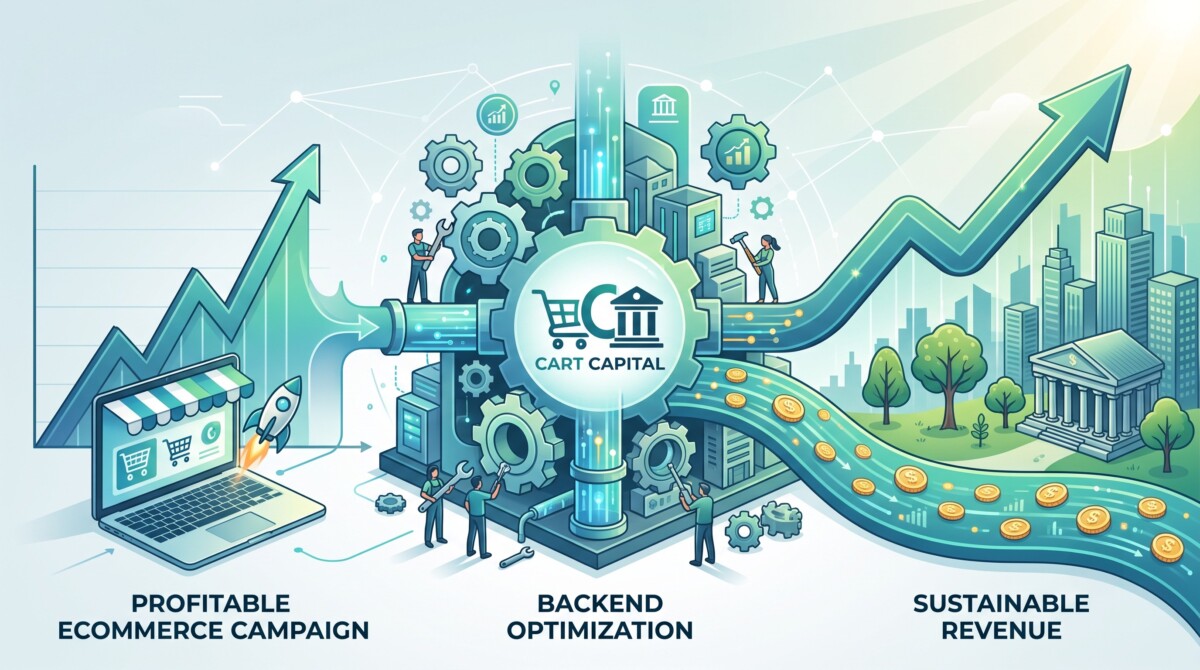
Backend optimization turns one-off profitable campaigns into durable ecommerce revenue by building systems that increase repeat purchase rate, customer lifetime value, and contribution margin per buyer instead of relying only on paid acquisition.
Winning campaigns create a spike in revenue; winning systems turn those spikes into a revenue base that keeps paying you long after the ads cool off.
A profitable ad campaign feels like winning. Traffic floods in, orders pile up, and the numbers look incredible. Then reality hits. Customer acquisition costs climb. Repeat purchase rates stall. What looked like a breakthrough turns into a treadmill where every dollar earned needs another dollar spent to keep it going.
The problem is not the frontend. Most eCommerce operators obsess over creative, targeting, and conversion rates while ignoring the systems that determine whether a customer buys once or ten times. Backend optimization is the unsexy work that separates brands built to last from brands that burn out the moment ad costs spike.
Cart Capital has managed over 150 eCommerce brands contributing to more than $50 million in revenue. The Florida-based operation specializes in building and managing AI-optimized direct-to-consumer brands with a focus on systems that compound over time rather than quick wins. Their approach centers on the reality that frontend performance means nothing without backend infrastructure designed to maximize lifetime value.
A campaign drives traffic. A system drives profit. The distinction matters because most brands treat backend operations as an afterthought. They pour resources into acquiring customers but fail to build retention mechanisms that turn those customers into recurring revenue.
Research consistently shows that increasing customer retention by just five percent can boost profits by 25 to 95 percent. Yet the majority of eCommerce spend goes toward acquisition. This imbalance creates a cycle where brands need constant campaign wins just to stay afloat.
The team emphasizes that backend optimization is where real eCommerce success lives. According to the company, problem solving and open-mindedness separate operators who last from those who don’t. ECommerce moves fast and no two brands are identical, which means the ability to diagnose what’s not working and adapt quickly becomes the core capability.
Backend optimization is not a single tactic. It’s a full operational stack designed to extract maximum value from every customer relationship. This includes post-purchase email sequences, SMS retention flows, subscription management, upsell and cross-sell logic, customer segmentation, churn prediction, reactivation campaigns, and fulfillment speed optimization.
Each element serves a specific function. Post-purchase sequences keep customers engaged immediately after buying when interest peaks. SMS flows create direct communication channels that bypass crowded inboxes. Subscription models turn one-time buyers into predictable recurring revenue. Upsell logic increases average order value without additional ad spend. Segmentation ensures messaging relevance. Churn prediction flags at-risk customers before they disappear. Reactivation campaigns recover lost revenue. Fast fulfillment builds trust that encourages repeat orders.
The operational approach involves managing every piece of this stack as part of a unified system. Instead of treating retention as a separate function, it gets baked into the brand architecture from day one. Everything gets measured. The company’s philosophy is clear: if it isn’t tracked, it doesn’t exist.
Acquisition costs rise over time. Competition increases. Platforms change algorithms. Winning creatives stop working. Brands that depend entirely on frontend performance get crushed when these shifts happen. Brands with strong backend systems absorb the impact because their existing customer base generates revenue without additional ad spend.
This compounding effect explains why mature eCommerce operations can scale profitably while newer brands struggle. A customer acquired today who makes three purchases over six months delivers triple the revenue of a one-time buyer at the same acquisition cost. Multiply that across hundreds or thousands of customers and the difference becomes exponential.
Cart Capital promotes discipline over shortcuts, execution over promises, and long-term brand building over quick wins. This philosophy directly addresses the tendency among eCommerce operators to chase immediate results instead of building infrastructure that performs over time. Short-term goals get set weekly around operational milestones and campaign performance. Long-term goals are built around the outcomes committed to at the start of each engagement.
Effective backend optimization requires three components: data infrastructure, automation, and continuous testing. Data infrastructure means tracking every meaningful customer interaction so decisions get made with complete information. Automation ensures retention mechanisms fire consistently without manual intervention. Continuous testing identifies which tactics actually move metrics versus which just look good on paper.
Many brands skip these steps because they require upfront investment and patience. Building a robust email sequence takes time. Configuring SMS flows requires testing. Setting up subscription logic involves technical work. Analyzing churn patterns demands consistent data collection. The payoff comes later, which makes it easy to deprioritize when immediate revenue pressures dominate.
The company handles product research, store development, supplier relationships, marketing, fulfillment, and retention as an integrated operational stack. This approach recognizes that backend optimization cannot exist in isolation. Fulfillment speed affects repeat purchase rates. Product quality determines churn. Supplier reliability impacts customer satisfaction. Everything connects.
Not every brand is ready for backend optimization. Some operators want fast results and resist the systematic work required to build retention infrastructure. Others lack the patience to let compounding effects develop. The wrong partner can derail progress faster than no partner at all.
According to the team, one of the biggest obstacles they’ve faced is learning that not every partner is the right partner. Early experiences taught them that the wrong person in an engagement can be more detrimental to the business than no engagement at all. This insight shaped their selective approach. They don’t let just anyone in. It takes the right person on the other end of that conversation to build something successful together.
This selectivity reflects a deeper truth about backend optimization. It requires alignment between operators and stakeholders around long-term thinking. Brands that chase quick wins will always underinvest in retention systems because the payoff is not immediate. Brands that commit to sustainable growth recognize that backend infrastructure is not optional.
The shift from campaign dependence to sustainable revenue happens when backend systems generate more value than frontend acquisition. This does not mean stopping acquisition. It means building infrastructure where each new customer contributes to a growing base of repeat buyers who reduce overall reliance on paid traffic.
Revenue architecture treats the business as a system rather than a series of campaigns. Customer lifetime value becomes the primary metric. Retention rate matters more than conversion rate. Average order frequency gets tracked as closely as cost per acquisition. The entire operation optimizes around maximizing value per customer rather than maximizing customers per campaign.
Cart Capital’s approach centers on the belief that most people fail in eCommerce not because the model doesn’t work, but because they try to build alone without the right team, systems, or experience behind them. Backend optimization exemplifies this principle. It requires expertise across email marketing, SMS strategy, subscription management, data analysis, automation, and customer psychology. Few solo operators possess all these skills, which is why so many brands never develop strong retention systems.
Backend optimization lives or dies on measurement. Vanity metrics like open rates and click-through rates mean nothing if they don’t translate to revenue. The metrics that matter include repeat purchase rate, customer lifetime value, average order frequency, churn rate, reactivation rate, and contribution margin from existing customers.
These numbers tell the real story of whether a brand is building sustainable revenue or just cycling through one-time buyers. A brand with a 40 percent repeat purchase rate and growing lifetime value has fundamentally different economics than a brand with a 10 percent repeat rate, even if both show similar monthly revenue.
The operational team’s standard is clear: hitting the target outcome set at the start of an engagement and then finding ways to exceed it. Success is not just delivery, it’s delivery plus improvement. This philosophy applies directly to backend optimization, where the goal is not simply implementing retention systems but continuously improving their performance over time.
Backend optimization is not glamorous. It doesn’t produce the instant gratification of a viral ad or a record sales day. It’s the disciplined, systematic work of building infrastructure that extracts maximum value from every customer relationship. But it’s also the difference between brands that survive and brands that scale.
The brands winning long-term in eCommerce are the ones treating backend systems with the same intensity they apply to frontend campaigns. They recognize that acquisition opens the door, but retention determines whether the business thrives or just survives.
A brand is ready for serious backend optimization once it can acquire customers profitably but sees repeat purchase rates and lifetime value lagging behind acquisition performance. If you have at least one channel that brings in new customers consistently and your main constraint is that those buyers are not coming back often enough, it is time to shift meaningful attention and budget toward lifecycle systems rather than chasing another short-term campaign win.
The first backend system most growing brands should implement is a robust post-purchase email and SMS sequence that welcomes customers, sets expectations, and presents a clear path to a second purchase. This touchpoint arrives when interest is highest and gives you a chance to reinforce trust, educate on product use, and position the most logical next purchase. Once this sequence is in place and performing, you can layer on segmentation, replenishment flows, and higher-complexity automation.
Backend optimization often produces early wins within 60 to 90 days but shows its full value over six to twelve months as more cohorts flow through the improved system. Simple changes such as better post-purchase flows or faster fulfillment can move repeat purchase behavior quickly, while deeper efforts like subscription programs and churn prediction take longer to fully reflect in LTV. The key is to track cohort performance over time instead of judging success only by month-to-month revenue swings.
Backend optimization can improve lifetime value and reduce effective acquisition cost, but it cannot fully compensate for consistently unprofitable acquisition. If you are losing money on every first purchase with no realistic path to break-even on future orders, retention systems will struggle to save the model. The strongest results come when profitable or near-profitable acquisition is paired with robust backend systems that multiply the value of each new customer rather than trying to fix a fundamentally broken offer or funnel.
Whether to build in-house or partner depends on your team’s skills, bandwidth, and appetite for learning by trial and error. If you have experienced lifecycle marketers, CRM specialists, and solid data infrastructure, building internally can make sense. If you are strong on product and acquisition but weak on lifecycle, segmentation, and automation, a specialist partner like Cart Capital can compress the learning curve and implement proven systems faster. The non-negotiable is that someone owns backend performance with clear metrics and authority to make changes.





