


CATTIX helps marketing teams break through the limits of manual campaign management by continuously analyzing Google Ads and local SEO data, generating and executing optimization actions, and improving its decisions over time as an AI marketing assistant.
The real constraint in modern campaign management is no longer strategy; it is the sheer volume of decisions humans can make and execute in time. CATTIX exists to handle that volume.
Most marketing teams reach a breaking point at some predictable moment. The ad budget keeps growing, the number of campaigns multiplies, and the time required to monitor, adjust, and optimize everything starts exceeding what any team can realistically handle. Reports pile up, search term lists go unchecked for weeks, and by the time someone spots a problem — a keyword bleeding budget, a location dragging down performance — the damage is already done.
The response to this problem used to be hiring more people. Today, a growing number of businesses are taking a different route: delegating the repetitive, data-heavy layer of campaign management to an AI marketing assistant that operates continuously and learns from every data point it processes.
Digital advertising is not a set-and-forget channel. Google Ads campaigns require ongoing attention across multiple dimensions simultaneously — and the volume of decisions compounds quickly as accounts scale. A few situations where manual management consistently falls short:
Each of these gaps represents budget spent on outcomes that are worse than what the same spend could achieve with tighter management. The problem is not strategy — it is execution capacity and the speed at which humans can process and act on data.
CATTIX is built around a self-improving cycle: the platform collects data from connected accounts, runs it through an AI decision engine, generates specific actions tailored to each account, and then analyzes the outcomes of those actions to improve its next round of recommendations. The loop runs continuously, which means the platform gets more accurate over time rather than staying static.
This is meaningfully different from dashboards or reporting tools that surface data and leave interpretation to the user. CATTIX moves from data to action — and in AI Mode, it executes those actions automatically without requiring manual approval for each step.
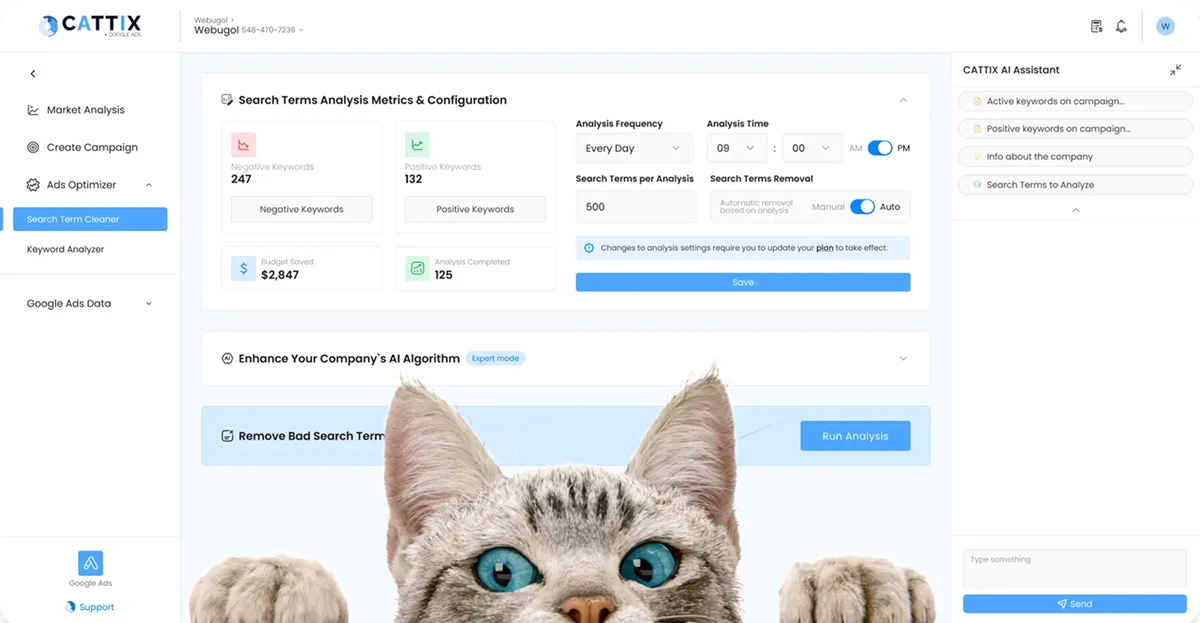
The Google Ads side of the platform covers the full optimization cycle through a set of specialized modules. The Search Term Cleaner identifies irrelevant and underperforming queries and removes them before they accumulate wasted spend. The Keyword Analyzer evaluates performance at the keyword level to surface opportunities for bid adjustments and targeting refinements. The Asset Optimizer reviews ad creative performance and flags elements that are underdelivering. The Market Analyzer and Campaign Creator work together to identify competitive gaps and build new campaigns around them with a structured approach.
The practical outcome for most accounts is a tighter relationship between spend and results — less budget going to traffic that does not convert, more going to the queries and audiences that do.
For businesses with multiple physical locations, local search presence requires ongoing maintenance that is easy to deprioritize under workload pressure. CATTIX handles this through three dedicated modules: the Location Optimizer surfaces optimization opportunities specific to each location’s local search performance, the Post Generator automates the creation of locally relevant content to keep profiles active, and the Review Replier generates responses to customer reviews to maintain engagement without manual effort for each reply.
Consistent local SEO activity at scale — across dozens or hundreds of locations — is operationally difficult without automation. CATTIX makes it repeatable.
Beyond the automated modules, CATTIX includes Adwise Chat — a conversational interface that lets users query their marketing data and run modules directly through a chat-based interaction. Instead of navigating reports to find a specific insight, users can ask the question and get an answer drawn from their actual account data.
What separates an AI system that improves from one that simply automates is the feedback loop. CATTIX is designed so that every action taken and every outcome measured feeds back into the AI’s decision model. A keyword adjustment that produced a positive result informs how the platform handles similar situations in other accounts. A search term pattern that consistently signals low intent gets weighted accordingly over time.
This means the platform’s value to an account compounds rather than plateaus. The longer it operates on a set of data, the more precisely its recommendations reflect the actual patterns in that account — not generic best practices applied uniformly.

Getting started with CATTIX does not require a lengthy onboarding process. The steps are straightforward: create an account, connect a Google Ads account, and receive an initial set of AI-generated actions tailored to that account’s current state. A 15-day free trial gives teams enough time to see how the platform interacts with their actual data before committing.
For agencies managing multiple client accounts, CATTIX offers a dedicated agency workflow that allows the same optimization logic to run across an entire portfolio from a single interface.
The ceiling on manual campaign management is real and predictable — at some point, the volume of decisions required outpaces what a team can handle without either adding headcount or accepting lower performance. An AI marketing assistant that runs continuously, learns from outcomes, and executes actions across Google Ads and Local SEO simultaneously is a structural answer to that constraint, not just a faster version of the same manual process. For businesses that have hit that ceiling, or want to avoid hitting it as they scale, that distinction matters.
Manual workflows hit a ceiling because the number of campaigns, keywords, search terms, and locations grows faster than the team’s ability to monitor and adjust them. As accounts scale, it becomes impossible to review every report and act on every insight in time, which leads to wasted spend and missed optimisation opportunities.
CATTIX differs from traditional dashboards by moving from data to action through an AI decision engine. Instead of simply surfacing metrics, it generates specific optimisation steps—such as removing poor search terms or adjusting bids—and, in AI Mode, can execute those steps automatically while learning from the outcomes.
CATTIX improves Google Ads performance by cleaning out low‑intent search terms, analysing keyword‑level data for bid and targeting refinements, flagging underperforming creative assets, and identifying new campaign opportunities. These actions reduce wasted spend and direct budget toward queries and audiences that convert more reliably.
CATTIX helps multi‑location businesses by automating local SEO tasks that are hard to sustain manually, such as optimising each location’s profile, generating locally relevant posts, and replying to customer reviews. This keeps local signals strong across many locations without requiring individual attention for every profile.
Getting started with CATTIX requires creating an account and connecting at least one Google Ads account, after which the platform generates an initial set of actions based on current data. Many teams begin seeing value within the 15‑day trial as they apply or approve optimisations and observe improvements in spend efficiency and performance.





