

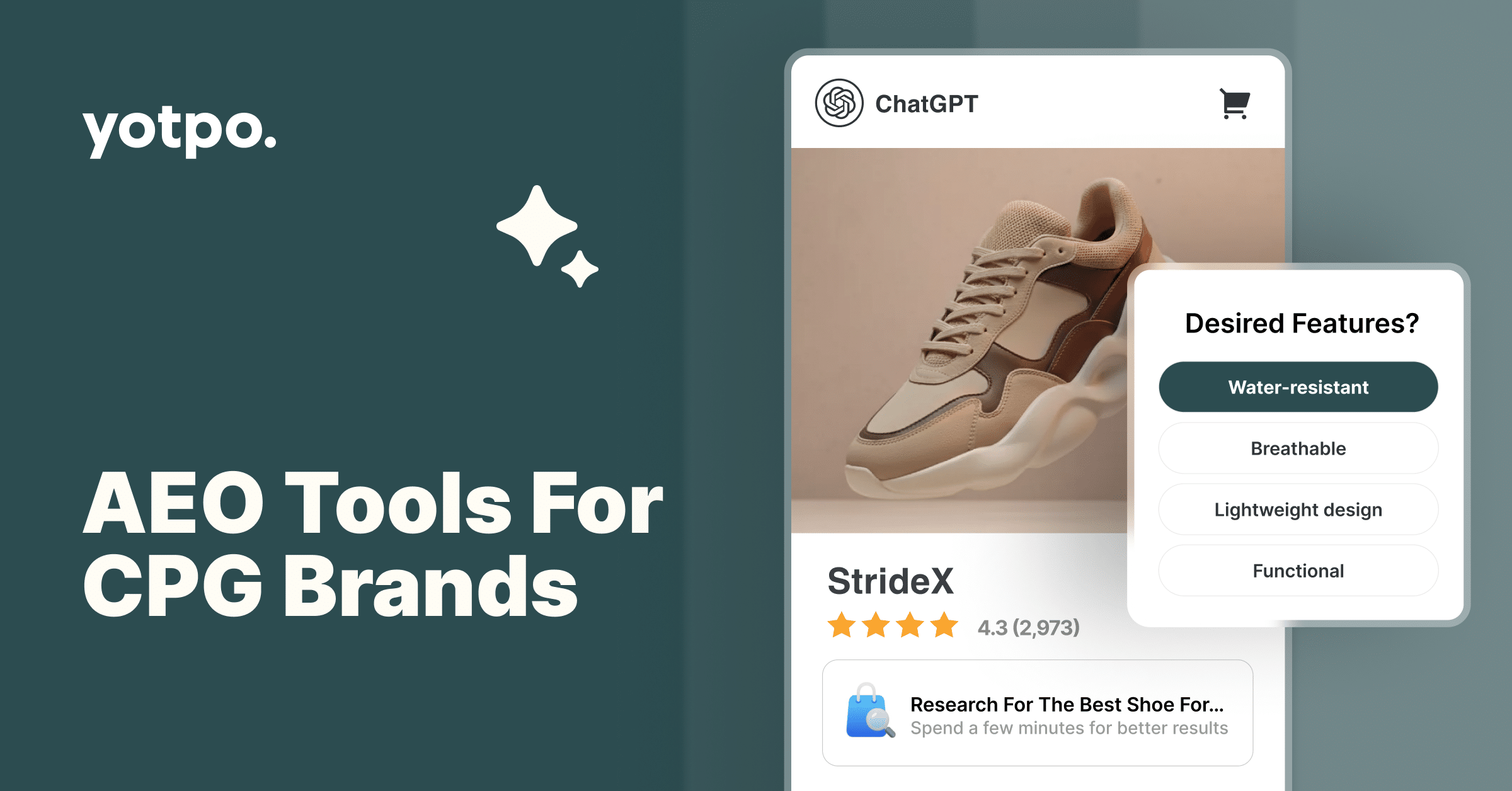
Vetting a new marketing tool usually involves comparing feature sets and pricing, but choosing Answer Engine Optimization (AEO) software comes with a unique learning curve. You aren’t just tracking keywords anymore; you’re measuring how often AI models cite your products as the definitive answer.
For CPG marketing directors, the right platform needs to do the heavy lifting: diagnose SKU-level feed errors, provide unified dashboards for your developers and content teams, and offer pricing that actually scales with your catalog.
Let’s walk through a practical framework to help you confidently evaluate the best AEO software for your tech stack.
The digital commerce ecosystem is currently undergoing a profound structural realignment. The traditional paradigm of search—defined for over two decades by scanning a page of blue links—has evolved. Modern consumer intent is now met with synthesized, conversational answers provided directly by Large Language Models (LLMs) and AI engines.
This evolution introduces a concept known as “decision compression.” Shoppers no longer want to click through multiple websites to compare ingredients or check product compatibility; they expect the AI to do the heavy lifting. Because of this, informational queries are increasingly resolved directly within the search interface.
In fact, industry data suggests that 60% of Google searches are expected to be entirely “zero-click” by the end of 2026. For ecommerce brands, the goal has fundamentally shifted from merely capturing website traffic to earning inclusion as a foundational, trusted source for AI models.
Because the journey from product discovery to purchase is shrinking, traditional ranking metrics like “Position 1” on a Search Engine Results Page (SERP) are losing their standalone value. To measure success accurately in this new environment, brands must track their “Share of Model” (SoM) and citation rates.
Share of Model evaluates how often your brand is recommended across various AI engines compared to your competitors. When your product is cited by an AI, it carries a unique “Quality Premium.” Consumers inherently trust the synthesized answers provided by these engines, which means the referral traffic you do receive is highly qualified. This AI-referred traffic consistently demonstrates higher engagement and meaningfully lower bounce rates because the model has already validated the shopper’s intent before they ever reach your site.
“Marketers need to look beyond the click,” advises Amit Bachbut, Director of Growth Marketing. “Contextualizing your Share of Model means understanding how often AI engines trust your content enough to cite it as the definitive answer for your category. That trust is your new baseline for visibility.“
Answer Engine Optimization is a multidisciplinary effort. It requires the content team to format text for extraction, the technical team to manage structured data, and the marketing team to measure overall impact. Therefore, the software you choose must act as a single source of truth.
When evaluating tools, prioritize platforms that offer unified, intuitive reporting. A dense, overly technical dashboard might appeal to your development team but could alienate content marketers. The ideal platform translates complex AI visibility data—such as which specific LLM is dropping your product feed—into clear, actionable insights that every stakeholder can understand and act upon immediately.
Consumer Packaged Goods (CPG) brands manage massive, complex catalogs filled with flavor variations, bundle sizes, and changing inventory. Because of this complexity, high-level domain analytics are not enough. Your AEO software must offer profound SKU-level granularity.
Look for tools that can specifically diagnose missing product feeds or schema errors at the individual Product Detail Page (PDP) level. If an AI crawler cannot definitively parse the price, availability, or ingredients of a specific SKU, it will simply omit that product from its synthesized answers. Platforms that provide automated alerts and one-click remediation for these errors are invaluable, saving technical teams hundreds of hours in manual catalog auditing.
Budgeting for AEO software requires a different approach than budgeting for traditional SEO tools. Because tracking brand visibility across multiple AI engines requires constant, resource-heavy API polling, pricing models can vary wildly.
When evaluating software, you will typically encounter two structures: tiered SaaS subscriptions based on prompt frequency, and custom enterprise contracts based on SKU volume. To project a positive Return on Investment (ROI), closely analyze your catalog size.
If you have a highly specialized, small product line, a tiered subscription might be cost-effective. However, if you are a large omnichannel CPG brand with thousands of product variations, a custom enterprise contract with unlimited data refreshes will likely prevent unexpected API overage charges.
We are rapidly approaching the era of agentic commerce—a framework where AI assistants do not just recommend products, but autonomously complete transactions on behalf of the consumer.
As you evaluate AEO software for 2026 and beyond, inquire about the platform’s readiness for this shift. Check if the tool supports emerging data standards like the Universal Commerce Protocol (UCP) and the Agentic Commerce Protocol (ACP). Software that helps structure your product feeds to meet these protocols ensures your catalog is not only visible for discovery today, but is technically prepared for the automated, clickless purchases of tomorrow.
Evaluating the software landscape requires understanding that not all tools track AI visibility in the same way. Some prioritize deep technical feed management, while others focus heavily on semantic narrative tracking and public relations. Consider these seven prominent platforms when auditing your tech stack.
For CPG brands juggling thousands of SKUs across flavors, sizes, and retail channels, Yotpo Discover is the AI visibility platform purpose-built for that complexity. It treats hero vs. non-hero SKUs, varying buyer lifecycles, and cross-channel regions as first-class concerns, not generic AI dashboard afterthoughts.
Most AEO tools hand you a Share of Model score and stop there. Discover pairs prompt-level visibility tracking across ChatGPT, Gemini, and Google AI Overviews with three commerce-trained agents that take action on the gaps it surfaces.
The Onsite Agent diagnoses and fixes the schema, internal linking, and PDP-level errors that block AI parsing, the kind of SKU-level remediation CPG teams need at scale. The Content Agent generates AEO-ready buying guides and publisher outreach briefs grounded in your real review and order data.
The Activation Agent mobilizes verified reviewers and loyalty members onto the Reddit threads, retail marketplaces, and forums LLMs cite for consensus signals, building the Trust Moat that decides whether your brand gets recommended in your category.
Powering all three is Yotpo’s data moat: billions of authentic shopper voices, plus deep integrations with Shopify, Salesforce Commerce, and Adobe Commerce. CPG brands like Beekman 1802 and David Protein use Discover to align AI visibility with their broader catalog strategy.
Get your AI visibility score at commerce-gpt.yotpo.com or visit the Yotpo Discover page to join the waitlist for early access.
For CPG brands looking for comprehensive coverage, Goodie stands out by tracking visibility across 11+ different AI models. Rather than just monitoring mentions, Goodie emphasizes its Agentic Commerce Optimizer, a feature set specifically designed to help AI agents understand and recommend products autonomously.
It excels in diagnosing specific issues that prevent an AI from confidently suggesting your product—such as broken pricing data or weak PDP copy—and offers direct feed remediation. Due to its robust capabilities, Goodie operates on a custom enterprise pricing model tailored to brand scale and category depth.
Nudge positions itself as a specialized platform for connecting AI discovery directly to product sales. The tool features a unique “Catalog Optimizer” that scores and fixes individual product pages specifically for how shopping agents evaluate them.
One of its standout features is the ability to create prompt-aligned, shoppable funnels based on the exact decision criteria shoppers ask AI assistants. For larger teams, Nudge provides necessary enterprise-grade security, including SOC 2 Type II compliance and seamless integration into existing commerce stacks.
Profound is highly regarded by technical marketers, frequently achieving top-tier AEO scores for its rigorous data collection. The platform’s true differentiator is its ability to analyze Query Fan-Outs—the process where an LLM takes a single user prompt and breaks it into 5 to 20 synthetic sub-queries behind the scenes.
By identifying these underlying parallel searches, Profound helps brands build highly specific topic clusters. Additionally, it offers log-level AI crawler data and live snapshots, making it an incredibly powerful tool for brands that need to connect AI visibility directly to downstream revenue attribution.
While many tools track if a brand was mentioned, Revere AI is designed to analyze how the brand was described. This platform focuses on perception intelligence, tracking the sentiment, attributes, and brand associations that LLMs assign to your products.
Revere’s platform identifies exactly which third-party sources (like a mid-tier blog review or a specific forum thread) are disproportionately shaping an AI’s generated response. This makes it an essential tool for PR and brand strategy teams focused on narrative control in categories where premium positioning drives the purchase.
Evertune approaches the landscape through the lens of Generative Engine Optimization (GEO). Built by data scientists, it leverages large-scale tracking to give enterprise brands statistical confidence in their visibility across multiple platforms, including ChatGPT, Claude, and Meta AI.
Evertune is particularly useful for omnichannel CPG brands because it helps decode the exact variables that cause an AI engine to rank one brand higher than another. It provides actionable playbooks designed specifically for how LLMs process multi-retailer inventory trends.
Not every brand requires a massive enterprise contract to begin optimizing for AI. Peec AI serves as a highly effective, cost-efficient entry point for growing brands. It offers multi-country and multi-language tracking, alongside daily AI search visibility snapshots.
While it may lack the complex automated remediation features of the larger enterprise platforms, its accessible pricing and straightforward reporting make it a sensible choice for teams just starting to build their Answer Engine Optimization frameworks.
While often used interchangeably in marketing discussions, Answer Engine Optimization (AEO) and Generative Engine Optimization (GEO) address two distinct phases of how AI evaluates and surfaces information.
AEO is primarily a technical and structural discipline. Its core focus is on ensuring that your existing content is formatted in a way that AI models can easily parse, extract, and cite. LLMs are, at their core, pattern-matching machines; they prefer information that is cleanly organized and immediately accessible.
A foundational competency of AEO is mastering the 40-60 Word Rule. This content structuring pattern dictates that immediately following an H2 or H3 heading, you should provide a direct, standalone answer in roughly 40 to 60 words. This block of text acts as the perfect “extraction target” for an AI.
It is long enough to provide complete context, yet concise enough to be directly quoted without losing its meaning. Coupling this precise writing structure with robust JSON-LD schema markup—such as Product, FAQ, and AggregateRating schema—ensures the AI does not have to guess your product details.
If AEO is about making your content easy to extract, GEO is about ensuring your brand is the one chosen to be extracted in the first place. Generative Engine Optimization focuses on building a “Trust Moat” by managing the broader perception of your brand across the internet.
AI models synthesize answers by looking for consensus. If your own website claims your beverage is the best-tasting, but every third-party review site and social forum disagrees, the AI will heavily weight the external consensus over your internal marketing copy. GEO requires actively managing how your brand is discussed off-site to ensure the LLM forms a positive, authoritative baseline opinion of your products.
“Building a trust moat isn’t about perfectly structured data; it’s about fostering genuine community advocacy,” notes Eli Weiss, VP Retention Advocacy. “When your customers validate your brand across multiple third-party channels, they generate the authentic consensus that AI engines rely on to form their recommendations.”
One of the greatest challenges Large Language Models face is the stagnation of their training data. Between major updates, an AI engine’s knowledge can become stale. To counteract this, AI crawlers actively seek out pages that are consistently updated with fresh, highly relevant semantic content. User-Generated Content (UGC)—specifically customer reviews—provides this continuous stream of live data.
Beyond just frequency, customer reviews mirror the exact conversational language that shoppers use when prompting AI assistants. When a customer writes, “This is the best gluten-free snack for my afternoon energy slump,” they are providing the exact lexical matching an LLM looks for when another user asks a similar question. Driving AI-referred traffic to pages rich in this conversational data creates a compounding effect on sales. In fact, shoppers who are exposed to customer reviews and UGC convert 161% higher than those who interact with a standard, review-less page.
Modern content architecture for e-commerce leans heavily on the “Inverted Pyramid” framework. In this structure, you provide the most crucial, extractable answer at the very top of your Product Detail Page (PDP), followed by supporting details, and finally, broader context.
However, AI models look for validation immediately following that extractable answer. Embedding authentic customer reviews directly beneath your product descriptions acts as the perfect validation signal for an AI crawler. Gathering just 10 reviews on a product yields a 53% uplift in conversion, but more importantly, it provides the critical mass of consensus that AI engines require to confidently cite your product.
“User-generated content bridges the gap between technical optimization and human trust,” notes Mira Talisman, Growth CRO Team Lead. “When an AI engine crawls your product page, a steady stream of conversational reviews acts as real-time training data. It proves to the model that your marketing claims are validated by actual consumer experiences.“
Consumer Packaged Goods, specifically within the food and beverage sector, sit at a unique inflection point in the AEO landscape. Unlike purchasing a piece of electronics based on objective technical specifications, purchasing food is highly subjective. It relies on taste, texture, dietary nuance, and aroma—attributes that consumers historically researched across multiple blogs and forums.
Today, those multi-step research journeys are being compressed. Transactional queries for food brands are shifting toward AI-generated summaries at nearly 14%, meaning shoppers are bypassing traditional recipe blogs and direct manufacturer websites, opting instead to ask AI for direct grocery and pantry recommendations. This creates a massive window of opportunity. Food brands that establish their AI consensus now will become the baseline reference point for LLMs before the market fully saturates.
Furthermore, food discovery is inherently visual. As AI models evolve into multimodal engines capable of analyzing both text and imagery, incorporating visual UGC becomes a distinct competitive advantage. Brands that feature customer photos on their product pages experience a 137% purchase likelihood lift.
For a food brand, providing an AI crawler with high-quality, user-submitted photos alongside descriptive text ensures your product is not only cited correctly but is positioned as the most appetizing, trusted answer available.
Before implementing any structural changes, you must establish your baseline visibility. Utilize your chosen AEO tools to query the top LLMs for informational and transactional keywords related to your CPG category. Document your current Share of Model (SoM) to understand where you are successfully being cited and where competitors are currently favored.
Once your baseline is established, audit your high-value PDPs. Transition your product descriptions to follow the 40-60 Word Rule, ensuring that key details (like nutritional facts, allergen information, and sourcing) are formatted as clear, concise Answer Blocks. Create entity-rich pages by ensuring your core product data is consistently presented in a standardized format across your entire site.
Beautifully written content is only useful if AI crawlers can categorize it. Deploy robust JSON-LD schema markup across your catalog. For CPG brands, prioritizing Product, Article, and AggregateRating schema is critical. This code acts as a direct translation layer, feeding the AI specific data points without requiring the model to parse the context of your page design.
As AI engines begin experimenting with sponsored placements within synthesized answers, your organic visibility will play a crucial role. Models prefer to serve ads that align with their organically generated consensus. Building your organic authority now makes your future paid campaigns significantly more efficient. Additionally, maintaining a strong rating profile helps paid efforts immensely; for instance, Google Ads that utilize Seller Ratings see a 17% increase in CTR.
“Maintaining impeccable technical hygiene is non-negotiable,” advises Amit Bachbut, Director of Growth Marketing. “Your schema markup and site architecture act as the foundation. Without those clear, machine-readable signals, even the most compelling brand narrative will struggle to surface in AI-generated answers.“
To efficiently build the authentic consensus and structured data that AI models require, consider utilizing Yotpo Reviews and Yotpo Loyalty as foundational pillars of your generative strategy. Yotpo Reviews leverages AI-powered Smart Prompts—which are 4x more likely to capture high-value, conversational topics—ensuring your PDPs are constantly refreshed with the exact lexical phrases shoppers use in LLM prompts.
By syndicating these reviews seamlessly and actively managing customer retention through tier-based Yotpo Loyalty programs, you build a compounding cycle of brand advocacy. Furthermore, generating reviews via seamless SMS Review Requests (powered through integrations like Klaviyo or Attentive) creates a high-volume stream of authentic User-Generated Content that organically builds your brand’s Trust Moat across search engines and AI models alike. And when paired with Yotpo Discover, that Trust Moat becomes operational: your authentic shopper data feeds the AI agents that act on visibility gaps across your site, content, and the third-party platforms LLMs cite most.
As we look toward 2027, the scope of Answer Engine Optimization will expand beyond text-based queries. Multimodal search—where consumers upload images of ingredients or use voice commands to reorder pantry staples—will become standard. This means visual UGC and conversational language will carry even more weight in AI algorithms.
The most successful CPG brands will be those that treat AEO not as a periodic marketing campaign, but as a permanent structural component of their technical stack. By continuously managing customer sentiment, structuring data for easy extraction, and keeping your product catalog agile, your brand can secure its position as the definitive, trusted answer in the era of AI discovery.
Search Engine Optimization (SEO) focuses on driving traffic to your website by ranking high on a page of search results. Answer Engine Optimization (AEO) focuses on structuring your content so that Large Language Models (LLMs) extract and cite your brand as the definitive answer directly within the search interface.
AI engines evaluate PDPs by looking for clear, extractable information (like ingredients, price, and availability), supported by robust schema markup. They also look for validation in the form of User-Generated Content, scanning customer reviews for conversational keywords that match user queries.
Agentic commerce refers to an environment where AI assistants autonomously complete transactions on behalf of consumers, rather than just suggesting products. CPG brands must ensure their product feeds are structured to communicate seamlessly with these AI agents using protocols like the Universal Commerce Protocol (UCP).
ROI can be measured by tracking your “Share of Model” (how often you are cited compared to competitors) and analyzing the quality of AI-referred traffic. Traffic originating from AI engines typically exhibits much lower bounce rates and higher conversion rates because shopper intent is pre-validated.
Schema markup is a standardized vocabulary that translates your website’s content into a machine-readable format. Using Product, FAQ, and AggregateRating schema ensures that AI crawlers do not have to guess your product details, making your brand significantly easier to cite in synthesized answers.
Generative Engine Optimization relies on building a “Trust Moat” through external consensus. Customer reviews provide a continuous stream of fresh, conversational validation. When multiple shoppers leave positive, detailed reviews, the AI engine views your brand as an authoritative and trustworthy recommendation.
The 40-60 Word Rule is a formatting best practice for AEO. It suggests that immediately following a header on your website, you should provide a clear, standalone answer of roughly 40 to 60 words. This acts as the perfect “extraction target” for an AI engine to quote.
Top AEO tools typically offer either tiered SaaS subscriptions based on the volume of AI prompts tracked, or custom enterprise contracts based on your total SKU count and catalog complexity. Smaller brands may prefer tiered models, while large CPG catalogs benefit from unlimited enterprise data refreshing.
AI models synthesize answers by aggregating information from across the web. If third-party blogs, forums, and review sites share a positive sentiment about your product, the AI adopts that consensus. Negative external sentiment can override positive claims made on your own website.
Ensure accessibility by maintaining an updated XML sitemap, utilizing comprehensive JSON-LD schema markup, and fixing any SKU-level feed errors immediately. Choosing an AEO tool with granular feed remediation capabilities will help you automate this technical upkeep.





