


Product recommendations drive up to 31% of ecommerce revenue, and shoppers who interact with recommendations are 4.5x more likely to add products to their cart and complete a purchase.
An ecommerce product recommendation engine helps enterprise brands connect shoppers with relevant products across search, category pages, carts, and content experiences using real-time behavioral and catalog data.
This guide explores how recommendation engines work, the technologies behind modern product discovery, and how Nosto helps ecommerce teams personalize shopping experiences at scale.
Nosto’s ecommerce product recommendation engine combines real-time shopper behavior, merchandising intelligence, semantic artificial intelligence (AI), and personalization into a unified agentic Commerce Experience Platform (CXP).
Here’s what sets Nosto apart:
As your catalog grows, it gets harder to predict what people want to buy. An ecommerce product recommendation engine solves that problem by instantly matching items to each shopper’s unique intent, browsing habits, and past purchases across their entire buying journey.
Modern ecommerce product recommendation engines use AI to update recommendations instantly across your search pages, carts, and emails. This improves product discovery and boosts your sales at scale.
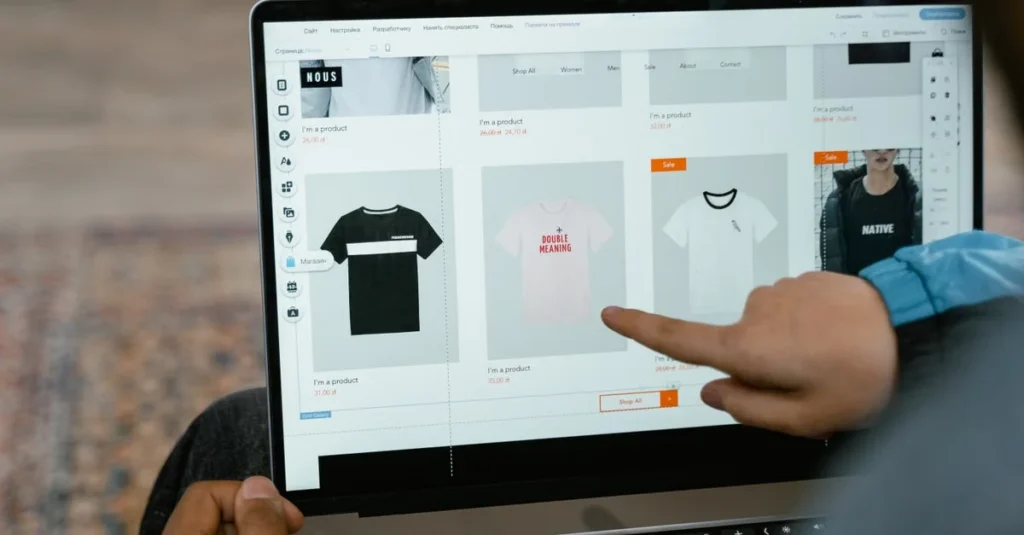
Almost all ecommerce product recommendation engine platforms have the same core workflow: they collect signals, understand intent, rank items, and deliver ecommerce product recommendations across your storefront.
When you build an ecommerce recommendation system, you create a seamless way to guide your shoppers. Here is a simple way to look at how a product recommendation engine for ecommerce operates.
Different product recommendation algorithms solve different product discovery challenges, so most enterprise ecommerce platforms combine multiple models.
Here’s a table to help you understand where each approach fits best:
| Algorithm type | What it uses | Where it works best |
| Collaborative filtering | Clicks, purchases, co-views, shopper behavior patterns | Large catalogs with strong traffic and repeat behavior |
| Content-based filtering | Product attributes like category, brand, material, price, and color | Catalogs with rich metadata and structured product hierarchies |
| Visual AI and image similarity | Product images and visual embeddings | Fashion, beauty, home decor, and visually driven assortments |
| Real-time behavioral signals | Session activity like clicks, scrolls, and add-to-carts | Live session personalization and fast-changing shopper intent |
The right platform fits your daily operations just as much as your tech stack. A system built for a small storefront might fail when you try to manage thousands of stock-keeping units (SKUs), multiple regional storefronts, and fast-moving inventory.
Below are some tips to help you choose the right product recommendation platform for your brand.
Start with your business outcomes first. Decide if you need to prioritize a higher average order value (AOV), better search experiences, more repeat purchases, or more efficient merchandising workflows.
When you clarify where you want recommendations to have the biggest impact, you make your platform evaluation much easier.
Recommendation quality depends heavily on data quality and connectivity. Platforms should integrate cleanly with systems like customer data platforms (CDPs), email service providers (ESPs), point-of-sale (POS) systems, and product information management (PIM) platforms so recommendations can adapt around live customer and catalog signals.
Ignore the generic ‘AI-powered’ marketing copy and look at how the platform actually works. Make sure it uses a mix of different recommendation rules and has reliable fallback options for first-time visitors who have no browsing history. The platform should also give your team a clear view of why specific products are being shown.
Recommendation engines work best when you continuously test and optimize them long after the initial launch. Strong vendor support makes a massive difference as you expand your personalization strategies across new marketing channels and regions.
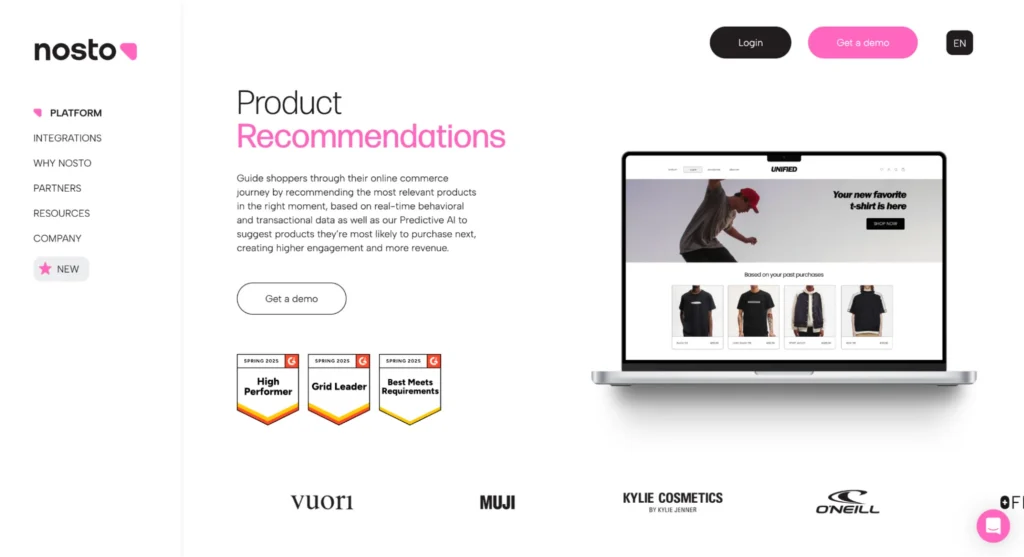
A lot of the product recommendation engines operate in isolation, creating disconnected experiences between search, merchandising, content, and product discovery.
Nosto takes a different approach. Its agentic CXP unifies every product discovery touchpoint through a shared intelligence layer, allowing brands to personalize recommendations, search results, category pages, and content experiences using the same real-time shopper data and behavioral signals.
Here are 5 reasons enterprise ecommerce brands choose Nosto to power product recommendations at scale.
Nosto’s Product Recommendations use real-time behavioral and transactional data to continuously adapt recommendations based on shopper intent.
Here are a few ways the platform helps brands make recommendations more relevant throughout the customer journey:
Shoppers rarely discover the right product in a single click. Instead, they move between search, category pages, and product recommendations before making a purchase.
Nosto brings search, recommendations, merchandising, and personalization together through a shared intelligence layer that continuously learns from real shopper behavior.
Enterprise teams need to balance AI automation with actual business goals. Nosto’s Category Merchandising lets merchandisers guide how products are discovered without losing the benefits of automation.
Some of the controls available to merchandising teams include:
Personalization shouldn’t stop at product recommendations. Nosto’s Content Personalization helps brands create connected
Experiences across content, merchandising, and product discovery.
This approach helped JoJo Maman Bébé create personalized homepage experiences for different customer segments during a seasonal campaign.
By combining Content Personalization with Product Recommendations, the retailer increased overall click-through rates by 28%, while engagement within its baby apparel audience increased by more than 42%.
As ecommerce operations become more complex, teams spend more time analyzing data, managing campaigns, and coordinating optimization efforts across channels.
Huginn, Nosto’s AI agent for Commerce, helps reduce that operational overhead. It continuously analyzes commerce data, surfaces opportunities, and supports execution across the platform.
Here’s how Huginn expands your team’s capacity:
Book a demo to see how Nosto helps ecommerce teams personalize product discovery and merchandising at scale.

These are the questions Heads of Ecommerce and Chief Digital Officers ask most often when scoping a product recommendation platform.
Predictive AI analyzes shopper behavior, transactional data, and product affinities to anticipate what each customer is most likely to engage with or buy next. As shoppers browse your store, recommendations continuously adapt in real time, making product discovery more relevant across every stage of the buying journey.
Yes, product recommendation engines, like Nosto, can easily manage massive, shifting inventories across multiple categories and regions. To keep suggestions accurate, the system relies on clean product data, fast indexing, and algorithms that can process huge volumes of shopper behavior in real time.
Your recommendation engine works best when it combines browsing activity, purchases, product attributes, inventory levels, and image recognition into one view.
Merging your online and in-store data gives the system a full understanding of customer behavior, which directly improves your overall recommendation quality.
The implementation timeline depends on your catalog size, integrations, and setup complexity. Simpler deployments can launch within a few weeks, while enterprise configurations with custom data pipelines and multi-channel marketing can take a few months.
As catalogs grow and shopper journeys become less predictable, helping customers find relevant products becomes harder. Product recommendations help bridge that gap by guiding shoppers toward products they’re most likely to engage with.
Nosto brings those capabilities together through a commerce-focused CXP powered by experience.AI™, and Huginn, its AI commerce agent. By connecting recommendations, merchandising, search, and real-time shopper behavior into one system, Nosto helps ecommerce teams deliver more adaptive product discovery at scale.
Schedule a demo to see how Nosto powers adaptive product discovery at scale.





