
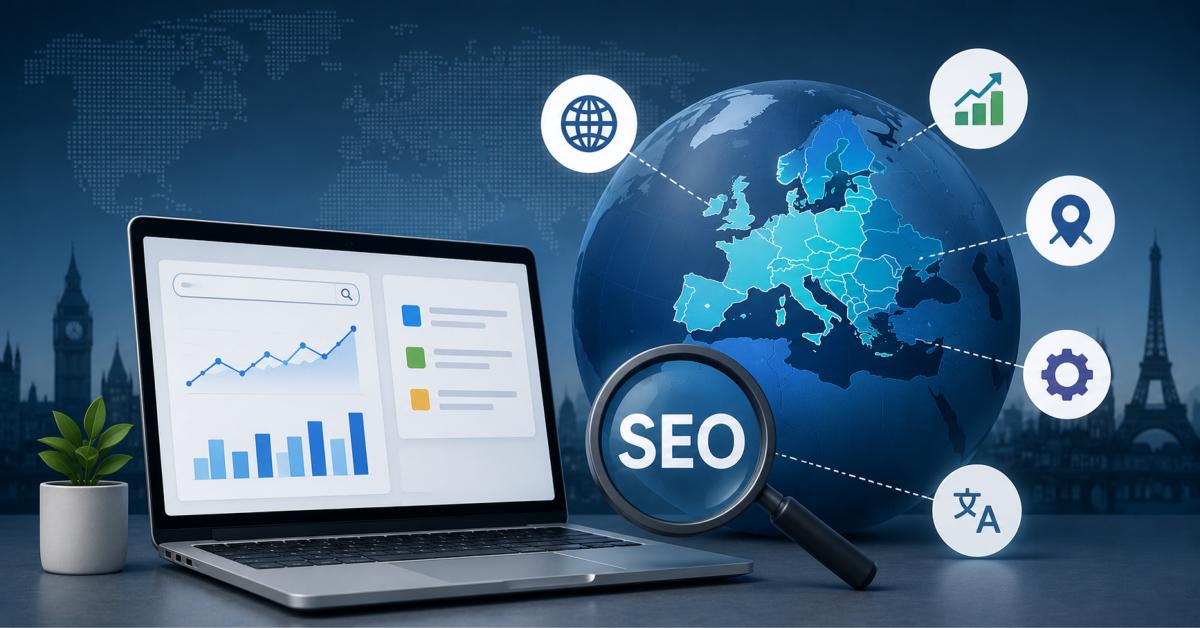
European brands do best with international SEO when they treat each country as its own search market, match agencies to specific constraints like language, vertical or channel mix, and insist on clear AI-search reporting instead of generic traffic charts.
Across Europe, the win is rarely “find the biggest agency”—it’s “find the team whose native languages, vertical focus and reporting match the problem you actually have.”
Search visibility across Europe has never been a single-market problem, but 2026 has made that more obvious than ever. A brand selling into France, Spain, Germany and the Netherlands is not running one SEO campaign in four languages. It is running four campaigns with different competitors, different search behaviour, different SERP layouts and, increasingly, different answers being generated by AI assistants before a user ever sees a blue link.
That shift has changed what a strong search partner looks like. Technical fluency with hreflang and multi-regional site architecture is still the baseline. On top of it, brands now need content that survives being summarised by an AI system, native-language judgement in each market, and reporting that separates a genuine market entry from a vanity traffic spike.
This guide profiles five European agencies that handle that complexity well, each from a different angle.
The list is deliberately varied rather than a ranking of size. Agencies were assessed against five criteria:
Google’s own documentation on managing multi-regional and multilingual sites remains the reference point for the technical side, and it is worth reading before any agency conversation. It makes the questions a brand should be asking much sharper.
Keyweo is the clearest fit on this list for a brand whose problem is expansion itself rather than optimisation of one market.
The agency was founded in Barcelona in February 2018 by two French entrepreneurs and built its international dimension in from the start, staffing consultants native to the markets it works in rather than adding language coverage later. It now operates across roughly a dozen markets from offices in Barcelona and Paris, covering SEO, paid search and paid social under one roof.
That combination matters more than it sounds. Market entry rarely runs on organic search alone; the first six to twelve months usually require paid search to buy visibility while organic authority is still being built, and the two channels need to share the same keyword research and the same understanding of local intent. Splitting them across two agencies in two countries is where most expansion programmes lose time.
The service range covers the full sequence — semantic and technical audits, competitive and backlink analysis, SEO-oriented content production, netlinking, migration support and ongoing consulting — with local and international SEO handled as distinct disciplines rather than one blended offer. For a company moving from a single domestic market into Southern Europe or francophone markets, working with an international SEO agency that already has native consultants and live campaigns in those markets removes a research phase that would otherwise take a quarter.
Best suited to: small and mid-sized companies expanding into new European markets, particularly across France, Spain and Southern Europe, that want organic and paid search managed together.
Blue Array took the opposite structural decision: it does one thing. The agency is an organic search specialist covering SEO, generative engine optimisation and digital PR, without a paid media arm.
That focus has a practical consequence. Because it does not compete for full-service budgets, Blue Array works comfortably alongside other agencies and in-house teams, and a meaningful share of its work is delivered as embedded or partner-side consultancy. For a brand with a capable in-house marketing function that simply lacks senior organic search expertise, that model is often a better fit than a full-service retainer.
Its digital PR capability is the other differentiator. Authority in competitive UK verticals is increasingly built through earned coverage rather than link acquisition at scale, and the agency treats the two as one discipline.
Best suited to: UK-market brands and in-house teams that need deep organic search and digital PR expertise without changing their wider agency setup.
OMNIUS is the specialist on this list, working exclusively with B2B SaaS, fintech and AI companies. It declines work outside those verticals, and caps how many clients it onboards.
The narrow focus buys something real. B2B SaaS search is a distinct problem: long buying cycles, buying committees rather than individual purchasers, and a direct line between content and pipeline that generic traffic reporting hides completely. An agency that only works in this space arrives already knowing the metrics that matter — pipeline contribution, activation, retention — instead of learning them during onboarding.
It has also moved early on generative engine optimisation, building proprietary tooling to track how often client brands are cited across AI assistants. For software companies whose buyers now open an AI assistant before a search engine, that measurement layer is becoming a requirement rather than an experiment.
Best suited to: growth-stage B2B SaaS, fintech and AI companies that want SEO and AI-search visibility run as a single programme.
Wolfgang Digital has been operating from Dublin since 2010 and has built its reputation on performance rather than organic search alone, combining SEO and content with paid search, social and email.
Two things distinguish it. The first is commercial framing: the agency reports against revenue and profit rather than sessions and rankings, which suits retail and e-commerce clients where the relationship between traffic and margin is anything but linear. The second is ownership. In 2024 it became the first Irish company to transition to an employee ownership trust, which means the people running an account hold a stake in the business rather than passing through it.
Its published research work — including consumer studies on how people actually use AI assistants for purchase research — also gives it a clearer read on shifting search behaviour than most agencies of comparable size.
Best suited to: e-commerce and retail brands in Ireland and the UK that want organic search integrated with paid performance channels.
Webcertain approaches international search from the localisation side rather than the SEO side, and that origin shapes everything it does.
Founded in York in 2003 and now part of TransPerfect, the agency runs campaigns across a wide range of languages using native-language specialists, with translation and localisation handled in-house rather than subcontracted. In practice this means keyword research is conducted in the target language from the start, not translated from an English seed list — a distinction that decides whether a market entry lands or quietly underperforms for a year.
Its client base sits mainly in enterprise B2B, technology, travel and education, and it runs the International Search Summit event series, which has kept it close to how multilingual search is actually evolving across markets.
Best suited to: enterprise and large B2B organisations entering multiple non-English markets simultaneously, where translation quality and search performance need to be managed together.
The five profiles above solve different problems, and the most common procurement mistake is choosing on reputation rather than fit.
Ask who does the work in each target market and in what language. Ask how hreflang and site architecture will be handled if the site is being restructured. Ask what the agency’s position is on AI search visibility and how it intends to measure it. Ask for a case study from a market comparable to the one being entered, and for the reporting that accompanied it. Finally, ask what happens in month four if results are behind plan — the answer says more about a working relationship than any pitch deck.
For companies trading across borders, it is also worth reviewing the wider commercial picture before committing budget. Eurostat publishes comparable data on e-commerce activity and internet use across EU member states, which helps establish whether a target market justifies the investment in the first place.
There is no single best international SEO agency in Europe, and any list claiming otherwise is selling something. There are agencies with genuine native capability across multiple markets, agencies with unmatched depth in one, and specialists whose value lies in knowing one vertical better than anyone else.
The brands that succeed across European markets in 2026 are usually the ones that identified their actual constraint first — language coverage, technical debt, vertical expertise or channel integration — and then chose the partner built for that constraint, rather than the largest agency that answered the brief.





