

Turning raw traffic into decisions you can act on is one of the hardest parts of running a Shopify store. The gap between collecting numbers and truly understanding buyer behavior keeps widening as stores add channels, currencies and markets.
Picking the right analytics stack means weighing privacy compliance, pricing models, data ownership and how deep the behavioral insights actually go. Some tools shine at cookieless tracking. Others focus on product-level profitability or session replays. A few bundle tag management, consent controls and A/B testing into a single dashboard.
The ten platforms below span that whole range. You’ll find real pricing, standout features and the specific use case where each tool works best, so you can match capabilities to the metrics that genuinely move revenue.
| # | Tool | Free plan | Cheapest paid plan | GDPR compliant | Key takeaway |
| 1 | Matomo | Yes (On-Premise, free forever) | €19/mo (Cloud) | Yes (CNIL-approved) | Full data ownership with 100% unsampled accuracy, self-hosted or EU cloud |
| 2 | Shopify Analytics | Yes (built-in) | Included in Shopify plans | – | Native real-time dashboards with ShopifyQL and AI-assisted query building |
| 3 | Amplitude Analytics | Yes (up to 50K MTUs) | $49/mo (annual) | Yes (SOC 2, ISO 27001) | AI-powered product analytics with behavioral cohorts and experimentation |
| 4 | Plausible Analytics | 30-day trial | €9/mo | Yes (cookieless) | Lightweight script 54× smaller than GA, fully EU-hosted, open source |
| 5 | Mixpanel | Yes | Event-based pricing | Yes (GDPR, CCPA) | Event-driven product analytics with AI agents and 354% ROI per Forrester |
| 6 | Google Analytics | Yes | Free (GA4) | Partial | Machine-learning insights with cross-device attribution at zero cost |
| 7 | Simple Analytics | Yes (starter) | €15/mo | Yes (EU-based) | Cookieless layer capturing 100% of traffic, integrates with Looker Studio |
| 8 | Triple Whale | Yes | From $59/mo | Supports GDPR compliance | Shopify-focused attribution, profitability and customer analytics combining store and advertising data |
| 9 | Polar Analytics | Free trial available | Custom pricing | Supports GDPR compliance | Centralized Shopify analytics for revenue, profitability, attribution and multi-store reporting |
| 10 | Piwik PRO | Yes (500K actions/mo) | Custom pricing | Yes (HIPAA, TTDSG) | Integrated analytics suite with built-in Consent Manager and CDP |
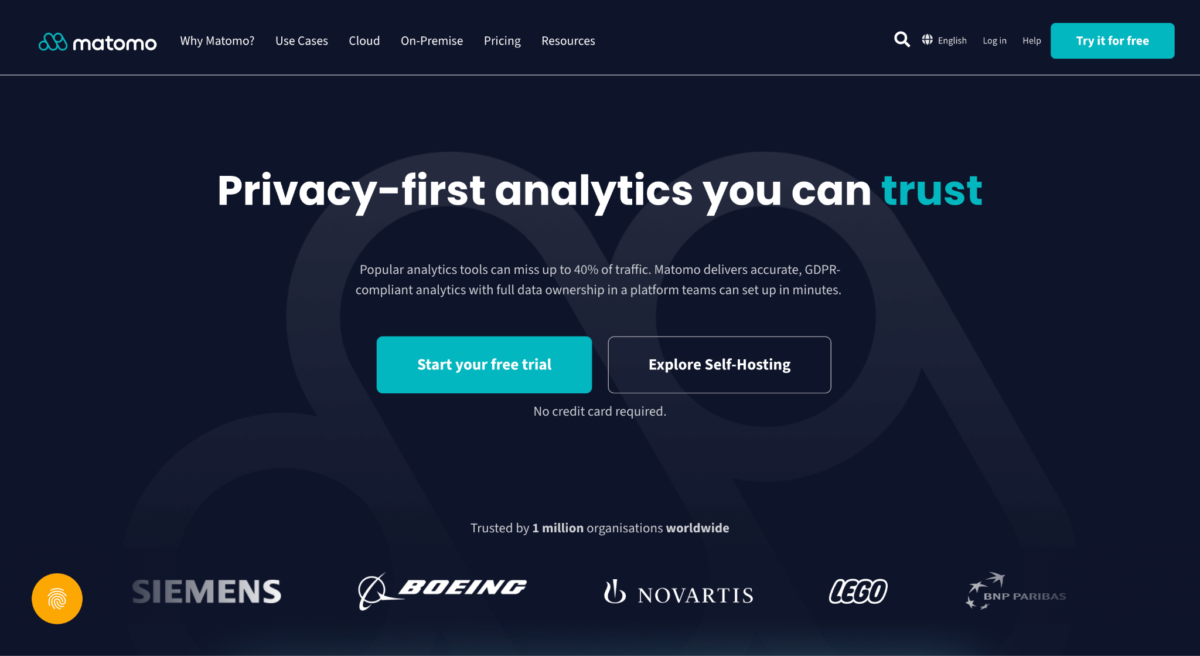
Matomo hands you 100% unsampled data with full ownership, whether you self-host or pick its EU-based cloud. Approved by the French data authority CNIL, it’s one of the rare platforms that can gather analytics without a cookie consent banner when you configure it correctly. More than a million websites across 190+ countries run on it.
The cloud plan opens at €19 per month for 50,000 hits. Matomo On-Premise, on the other hand, costs nothing, forever. You download it, install it on your own servers, and keep absolute control over every data point. That flexibility speaks to brands with strict data-residency rules, or teams that just want to dodge recurring SaaS fees.
Matomo goes well past pageviews and sessions. It bakes heatmaps and session recordings right into the platform. You also get a built-in Tag Manager, so Google Tag Manager becomes optional. Conversion funnels, user-flow analysis and A/B testing are included too, with no hidden add-on costs, which is rare among full-featured suites.
Privacy controls run deeper than most rivals. The integrated GDPR Manager lets visitors exercise their rights (information, consent withdrawal, erasure) through a self-service workflow. Cookieless tracking leans on a `config_id` mechanism that respects privacy while still delivering meaningful behavioral data. The platform carries ISO 27001:2022 certification, one more layer of trust for enterprise buyers.
Customization stretches to white-label dashboards, so agencies can rebrand the interface for clients. More than 75 plugins on the Matomo Marketplace push functionality further, from custom dimension tracking to advanced log analytics. The reporting API exposes every metric programmatically, and over 100 integrations link Matomo to CRMs, ad platforms and data warehouses.
For Shopify merchants who want granular, privacy-compliant analytics without giving up depth, Matomo’s blend of unsampled accuracy, flexible hosting and all-inclusive features is hard to beat. The On-Premise edition stays one of the only truly free analytics platforms that never monetizes your visitors’ data.
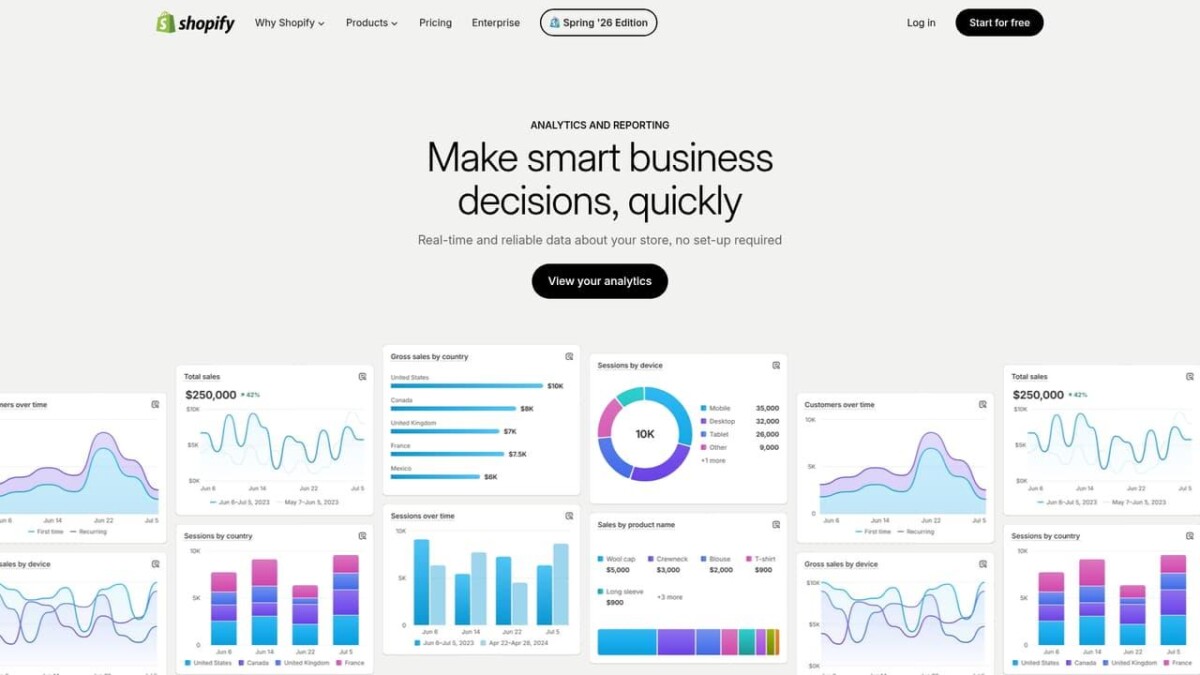
Shopify Analytics ships inside every Shopify plan at no extra cost, which makes it the default starting point for most merchants. Real-time dashboards update instantly, tracking sales, sessions and conversion metrics the moment a transaction lands.
ShopifyQL, the platform’s dedicated query language, opens up custom reporting without pushing you into a third-party BI tool. Every standard report supports it, and the AI assistant Sidekick can draft queries from plain-language prompts. Type “show me top products by revenue last quarter” and you’ll get a formatted answer in seconds.
Multi-channel attribution is where Shopify Analytics earns its place for stores selling across email, social, paid ads and organic search. The Campaigns feature assigns revenue to specific sources, so you learn whether that Instagram push actually drove purchases or just likes. Each campaign auto-generates shareable tracking links and QR codes for offline-to-online attribution.
Flash sale monitoring deserves a shout. During high-traffic events like BFCM or limited drops, real-time geographic data shows where orders cluster. You react mid-event, shifting ad spend or inventory based on live demand signals instead of waiting for next-day reports.
The drag-and-drop dashboard builder lets you rearrange widgets, pin the metrics you check daily and hide the rest. Want to go deeper? The Shopify App Store adds hundreds of analytics integrations, while the API grants programmatic access to raw data for teams building their own pipelines.
There’s one obvious ceiling. Shopify Analytics only covers your Shopify ecosystem. Cross-platform behavioral analysis or product analytics beyond the store needs a dedicated tool alongside it. Still, as a free, zero-config baseline, it packs more ecommerce-specific reporting than many merchants ever outgrow.
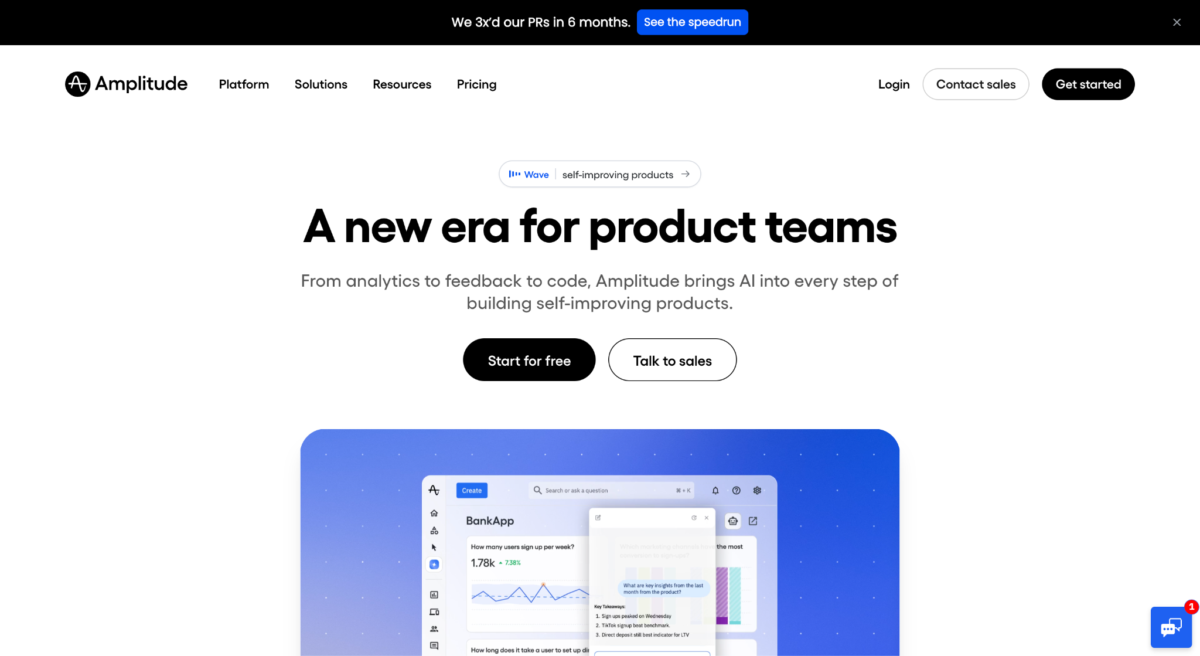
Amplitude is a product analytics platform that tracks every click, scroll and interaction to reveal how people engage with your store once they arrive. Its free Starter plan supports up to 50,000 monthly tracked users, a generous ceiling for growing Shopify brands testing product-led growth.
The Plus plan opens at $49 per month on annual billing. For that, you get advanced behavioral cohorts, retention curves and funnel analysis that pinpoints exactly where shoppers ditch a checkout or bail on a product page. The platform holds SOC 2 Type 2, ISO 27001 and ISO 27018 certifications, plus GDPR, HIPAA and CCPA compliance.
AI is what sets Amplitude apart from simpler dashboards. Built-in AI agents watch your data around the clock, surfacing anomalies before your team even knows to look. The MCP integration with Claude and Cursor means you can query your analytics from AI coding environments, blurring the line between data analysis and product development.
Web experimentation is native here. You build A/B tests inside Amplitude without bolting on separate tools, then wire experiment results to downstream behavioral metrics like retention and lifetime value. Guides and in-app surveys pull in qualitative feedback next to the quantitative data.
With 139 third-party integrations spanning ad platforms, CDPs and data warehouses like BigQuery and Amazon Redshift, Amplitude slots into complex stacks. Forrester has named it a Leader, scoring it highest across 21 evaluation criteria in the digital analytics category.
For Shopify merchants who care about why shoppers behave the way they do, not just how many pages they viewed, Amplitude’s depth of behavioral insight and experimentation tools justify the step up from free alternatives.
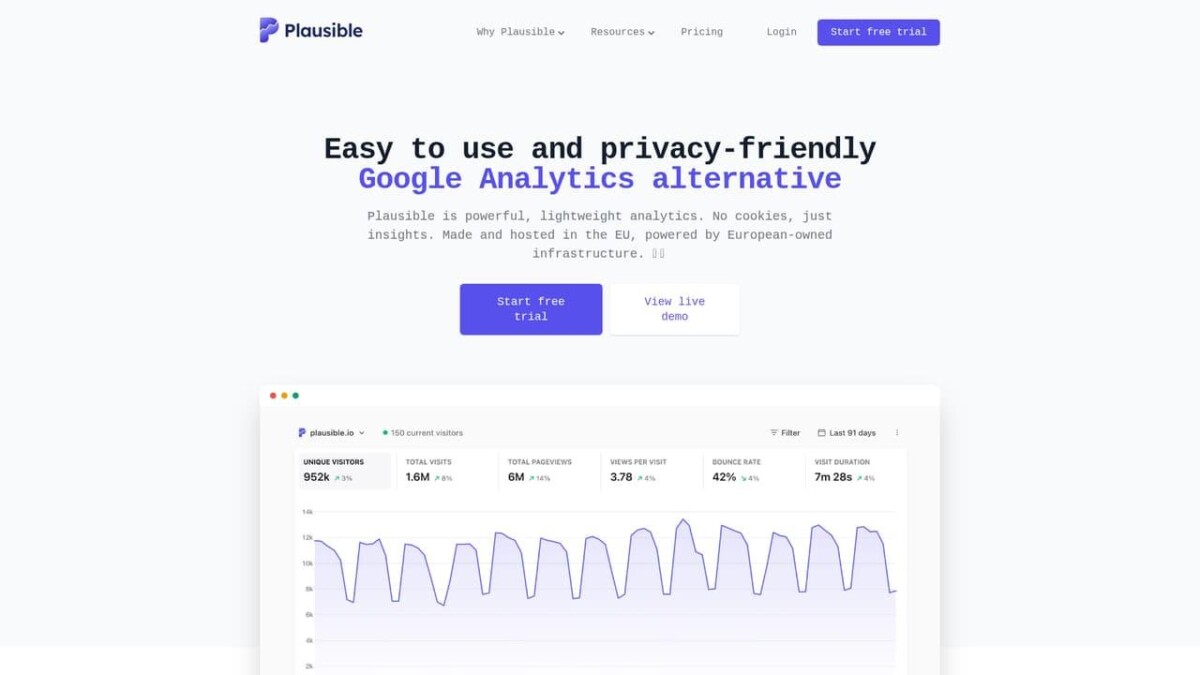
Plausible’s analytics script weighs just 1.5 kB, making it 54 times lighter than Google Analytics. That works out to nearly 80 kB less JavaScript per visitor, a measurable lift to page load speed and Core Web Vitals scores that Shopify merchants can’t afford to shrug off.
Plausible sets no cookies, uses no persistent identifiers, and does no cross-site or cross-device tracking whatsoever. It doesn’t process personal data at all, so you can skip the cookie consent banner entirely and stay fully GDPR compliant. Every byte of visitor data lives on EU-owned servers that never leave the European Union.
More than 20,000 paying customers use the platform, from solo bloggers to sites handling hundreds of millions of monthly visits. The paid plan starts at €9 per month for up to 10,000 pageviews, scaling smoothly without performance drop-off. The 30-day free trial asks for no credit card.
The dashboard packs every essential metric onto a single page: top sources, pages, countries, devices and goals. No nested menus, no multi-tab report builders. You get a clear snapshot within seconds of logging in, which makes it ideal for store owners who want quick daily check-ins rather than analyst-grade deep dives.
Environmental impact is a deliberate design call. Plausible estimates its infrastructure produces roughly 4 kg of CO2 per year for a site with 100,000 monthly visitors. The codebase is fully open source, so you’re free to self-host, audit the code or migrate your data whenever you like.
For Shopify stores that put speed and privacy first without giving up the essentials, Plausible delivers exactly what it promises: a lightweight, transparent alternative that respects visitors while keeping merchants informed.
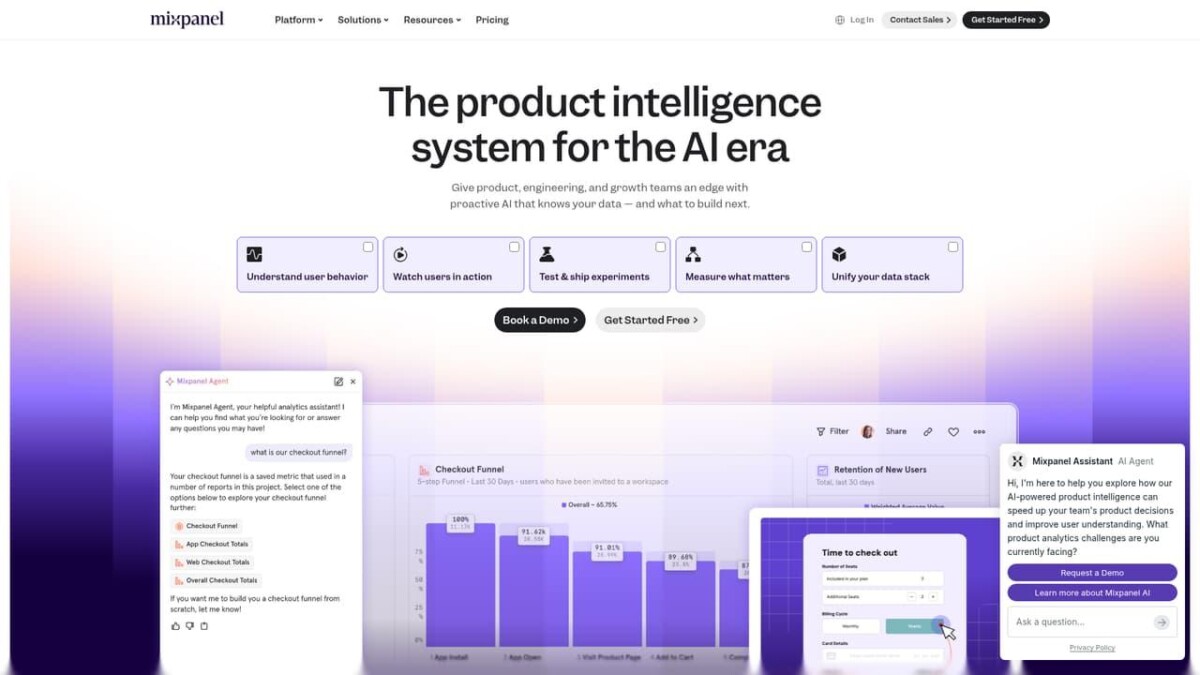
Mixpanel tracks events instead of pageviews, which hands Shopify merchants a fundamentally different lens on customer behavior. Every button click, filter and cart change becomes a discrete data point you can query, funnel and segment without writing SQL.
The platform serves 29,000 customers globally and offers a free tier to get you going. Paid plans follow event-based pricing, scaling with real usage rather than locking you into a fixed tier. GDPR and CCPA compliance come standard, with optional Business Associate Agreements for HIPAA-covered organizations. Data sits on US servers by default, but the Cloud Data Residency program lets you store and process everything in Europe.
AI threads through the whole experience. Mixpanel AI Analytics deploys agents that continuously monitor metrics and push insights before you think to ask. Session Replay captures user interactions with AI-generated summaries and “Magic Playlists” that auto-curate sessions matching specific behavioral patterns. The Experiments Agent automates test setup and validates results with statistical rigor.
Metric Trees model how individual product metrics connect to broader business outcomes. Rather than isolated dashboards, you get a visual map linking sign-up flow tweaks to revenue impact. Mixpanel also works headlessly through Slack, Claude, ChatGPT or simple Python calls, so you don’t even need to open the app to query data.
A Forrester study attributed 354% ROI and a six-month payback period to Mixpanel deployments, backed by a 4.5-out-of-5 rating across more than 1,300 reviews. Over 100 integrations connect it to ad platforms, CDPs and data warehouses. Its proprietary Arb database engine runs queries fast enough to surface behavioral trends in real time.
For Shopify teams ready to move past surface-level metrics into event-driven product intelligence, Mixpanel’s depth is tough to match at this price.

Google Analytics is still the most widely installed web analytics platform, and GA4 costs nothing. For Shopify owners starting out, that zero price tag paired with direct integration through Shopify’s admin makes it the fastest route to baseline traffic reporting.
Machine learning sits at the heart of GA4. The platform automatically flags unusual traffic spikes, catches conversion anomalies and predicts which users are likely to buy or churn. These predictive audiences feed straight into Google Ads campaigns, closing the loop between analytics insight and ad targeting with barely any manual work.
Cross-device and cross-platform analysis under a single property is GA4’s structural advantage. A shopper who finds your store on a phone, browses on a laptop and converts on a tablet shows up as one continuous journey rather than three disconnected sessions. That stitching leans on Google signals and first-party data, though it works best when users are logged into Google accounts.
Attribution modeling has moved past last-click. GA4’s data-driven attribution spreads credit across touchpoints with algorithmic weighting, giving you a more honest read on which channels really contribute to revenue. Custom audience lists built from these insights sync automatically with Google Ads and Display & Video 360.
The reporting interface supports custom explorations with drag-and-drop dimensions and metrics. Share reports through scheduled emails or embedded dashboards in Looker Studio. API access lets data engineering teams pull raw event data into their own warehouses.
The privacy question won’t go away. GA4 transfers data to US-based servers, and several European data protection authorities have flagged that as problematic under GDPR. Shopify merchants selling mostly to EU customers should weigh this carefully, especially in regulated sectors where data residency rules apply.
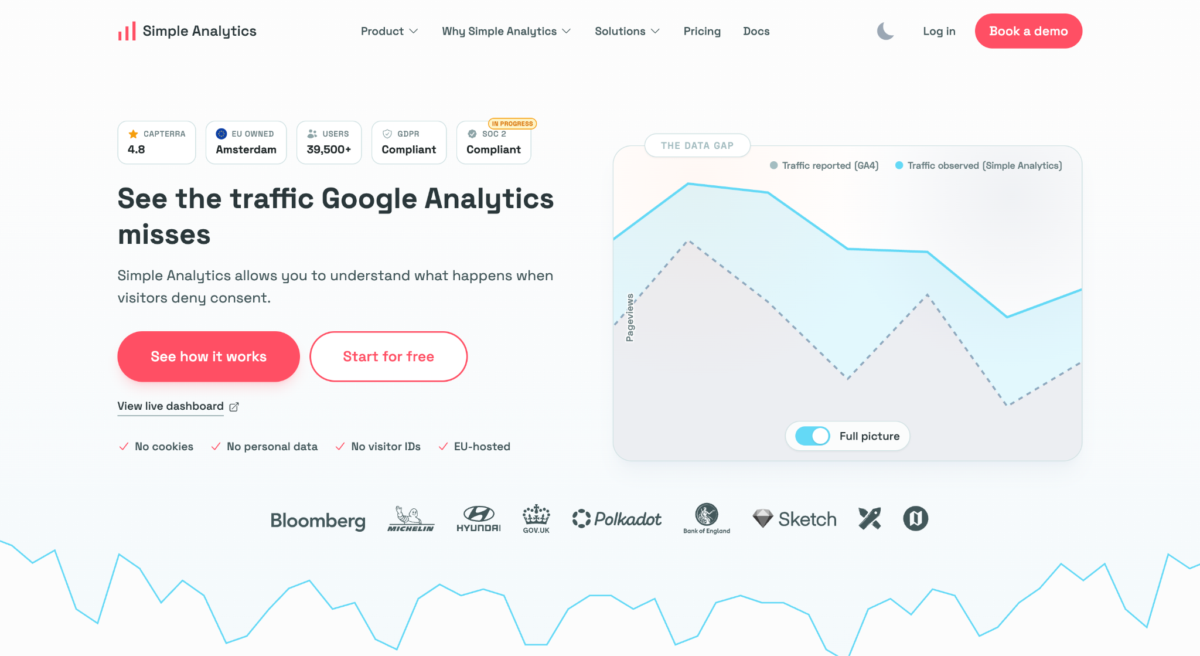
Simple Analytics runs from Amsterdam with every server inside the EU, collects zero personal data and uses no cookies at all. That setup captures 100% of traffic, including visitors who reject consent banners on cookie-dependent platforms, giving Shopify merchants a more complete picture of actual site visits.
Pricing starts at €15 per month for the Simple plan (up to 10 sites, one user). The Team plan at €40 per month adds a second seat, supports 20 sites and includes advanced export options. A free starter tier lets beginners test the waters without committing budget.
The dashboard takes a deliberately minimal approach. One screen shows pageviews, referrers, top pages, device breakdowns and goal completions. An AI assistant helps interpret the data, turning numbers into plain-language explanations so you don’t need an analyst on staff to follow what’s happening.
Goal and funnel tracking let you watch specific conversion events like newsletter sign-ups or checkout completions. Campaign data and UTM parameters flow into the same dashboard, so you get attribution visibility without hopping between tools. Data exports run through the API or direct connectors to Looker Studio and Power BI.
Security stands out, even among privacy-focused rivals. Simple Analytics encrypts stored data and keeps the encryption key in a remote location protected by two-factor authentication. Eight years of operation since 2018 and an ongoing SOC 2 certification process add credibility for enterprise buyers weighing risk.
For Shopify merchants who need a cookieless analytics layer that complements rather than replaces a primary platform, Simple Analytics fits neatly as a lightweight, privacy-safe source of truth for traffic measurement.

Triple Whale is an ecommerce analytics platform built specifically for Shopify brands. It brings store, advertising and customer data together in a single dashboard, giving merchants a clearer view of how marketing activity translates into revenue and profit.
The platform connects Shopify data with channels such as Meta Ads, Google Ads, TikTok, Klaviyo and other marketing platforms. Instead of comparing conflicting numbers across several dashboards, teams can monitor spend, revenue, customer acquisition cost and return on ad spend from one environment.
Attribution is one of Triple Whale’s main strengths. Its first-party tracking technology follows customer journeys across marketing touchpoints and helps merchants evaluate which campaigns contribute to purchases. Different attribution models can be compared depending on how the business wants to assign conversion credit.
Profitability reporting adds product costs, shipping expenses, payment fees and advertising spend to revenue data. This allows teams to optimize around contribution margin and net profit rather than relying only on top-line sales or platform-reported ROAS.
Customer analytics cover repeat purchases, lifetime value and cohort performance. Merchants can identify which channels attract the most valuable customers over time, rather than judging campaigns solely by the revenue generated from the first order.
Triple Whale also provides creative analytics, forecasting and AI-assisted analysis. Teams can compare advertising creatives, investigate changes in performance and receive summaries of the metrics that require attention.
The platform is most useful for Shopify brands running paid acquisition across several channels. Smaller stores with limited advertising spend may not need its full attribution and profitability stack, but growing merchants can use it to connect marketing decisions directly with business outcomes.

Polar Analytics is an ecommerce business intelligence platform designed for Shopify brands that need to consolidate data from several stores, advertising accounts and marketing tools.
The platform connects Shopify with sources such as Meta Ads, Google Ads, TikTok, Klaviyo and Google Analytics. Data from these systems is standardized and displayed through unified dashboards, reducing the time spent exporting spreadsheets and reconciling conflicting reports.
Ecommerce metrics include revenue, orders, average order value, customer acquisition cost, repeat purchase rate, lifetime value and contribution margin. Teams can combine commercial and marketing data to understand whether growth is genuinely profitable.
Multi-store reporting is one of Polar Analytics’ strongest capabilities. Merchants operating several Shopify stores, brands, currencies or markets can view consolidated performance while retaining the ability to analyze each storefront separately.
Attribution tools help teams connect campaigns and customer touchpoints with purchases. Cohort analysis then shows how customers acquired during different periods or through different channels behave over time, providing a longer-term perspective than first-order ROAS.
Custom dashboards and metrics allow businesses to adapt reporting to their own definitions and operating model. Automated reports can be shared with marketing, finance and leadership teams without requiring each stakeholder to navigate the full platform.
Polar Analytics also provides AI-assisted analysis for investigating performance changes and querying ecommerce data. This helps non-technical users answer business questions without building reports manually or writing database queries.
The platform is better suited to established Shopify brands than very small stores seeking basic traffic numbers. For merchants that need centralized reporting, profitability analysis and visibility across several stores or channels, Polar Analytics provides a far more relevant solution than a standalone heatmap tool.
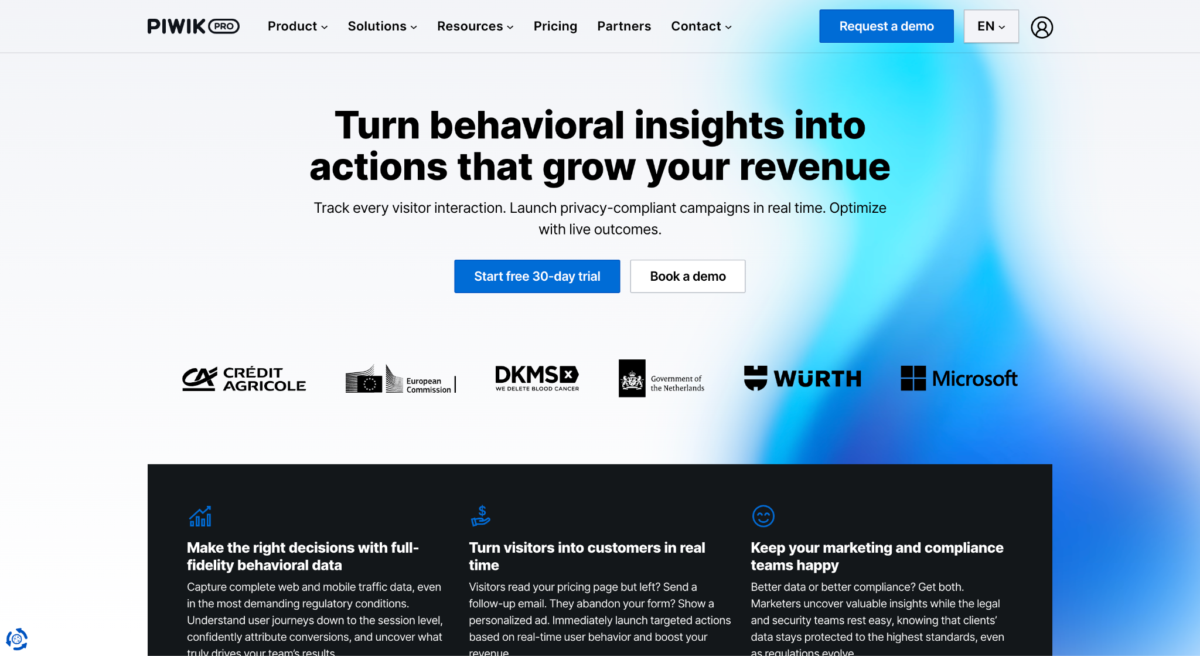
Piwik PRO folds analytics, tag management and consent management into a single privacy-focused suite. The free Cloud plan supports up to 500,000 monthly actions with EU hosting, a practical entry point for Shopify merchants who need GDPR compliance without juggling multiple vendor contracts.
Regulatory coverage reaches beyond GDPR. Preconfigured settings address HIPAA, TTDSG and other regional frameworks, easing the legal review burden for stores in healthcare or the German market. The built-in Consent Manager collects visitor permissions and centralizes compliance workflows, so you skip a separate cookie consent tool.
Data stays unsampled. Every event, pageview and custom action lands in reports at full fidelity, and the drag-and-drop segment editor lets you slice audiences without touching code. Conversion funnels pinpoint exact abandonment steps, while integrations with Google Ads and Google Search Console line up paid and organic performance in one view.
Dashboards refresh every 30 minutes, with real-time notifications for critical metric changes. The drag-and-drop builder means non-technical teammates can construct custom report views without developer support. Data retention defaults to 14 months and extends on premium plans.
Raw data access runs through API, Google BigQuery, CSV export or a native Tableau connector. That openness appeals to teams with existing BI infrastructure who want analytics feeding into centralized reporting pipelines alongside CRM and ad platform data.
The Enterprise plan adds a dedicated technical representative available around the clock, incident monitoring and email support. A Customer Data Platform module activates collected data for personalization and audience targeting, pushing Piwik PRO past passive reporting into active marketing orchestration for stores ready to scale their data operations.
Start by pinning down what you need to measure. Basic traffic reporting works fine with Shopify Analytics or Google Analytics. If you want behavioral depth like session replays or heatmaps, tools like Hotjar or Clarity fill that gap.
Think about your privacy obligations next. Stores selling to EU customers benefit from GDPR-native platforms like Matomo or Plausible. Finally, match the pricing model to your traffic volume so costs don’t spike out of nowhere as the store grows.
Many merchants combine two tools well. A quantitative platform (Matomo, GA4 or Plausible) handles traffic, attribution and conversions. A behavioral layer (Hotjar, Clarity) adds visual context through heatmaps and recordings.
Running more than two creates data management overhead and can drag down page loads. Before adding a third, check whether your existing platforms already cover that job through plugins, integrations or built-in features you haven’t switched on yet.
Script weight swings a lot. Plausible’s script is 1.5 kB, Fathom’s is 2 kB, while Google Analytics generally loads a significantly larger JavaScript payload than privacy-first alternatives. Heavier scripts hit Core Web Vitals scores, which shape both SEO rankings and shopper experience.
Load scripts asynchronously where you can, and audit your tag setup quarterly. Drop tools you no longer check. Two lightweight analytics scripts running together often weigh less than one poorly configured heavyweight.
Yes. Matomo, Fathom and Plausible all support conversion tracking through event-based measurement. You define custom goals (add-to-cart clicks, checkout completions, newsletter sign-ups) and the tool records them without personal data or cookies.
UTM parameter tracking and referrer attribution work independently of cookies, so you keep campaign-level visibility. The tradeoff is cross-device stitching: cookieless platforms can’t follow a single user across multiple devices, which limits some attribution models.
Watch the billing metric. Some platforms charge per monthly tracked users (Amplitude), others per events (Mixpanel), others per pageviews (Plausible, Fathom). Pick the metric that aligns with your growth pattern so costs scale predictably.
Free tiers from Shopify Analytics, Google Analytics and Amplitude can cover many stores before paid plans become necessary. Self-hosted options like Matomo On-Premise wipe out recurring fees entirely, though you absorb server and maintenance costs instead. Model your expected traffic for the next twelve months before signing an annual plan.





