

The sample tells you what a vendor can do on their best day. The right questions tell you what they will do on yours.
When brands start comparing the best video brochure companies, the first thing they usually notice is the screen. That’s understandable, but it’s rarely the most important buying criterion. A video brochure is a hybrid product: part printed piece, part presentation tool, and part fulfillment project. The right partner needs to do more than assemble a nice-looking sample. They need to deliver dependable production quality, practical customization, clear communication, and a process that holds up under real campaign pressure.
Video remains a major part of modern marketing. Recent research from Wyzowl shows that 91% of businesses use video as a marketing tool, and 93% of marketers say video is an important part of their strategy. Content Marketing Institute has also reported that many B2B organizations planned to increase investment in video.
A strong sample can open the conversation, but it should not close it. What matters is whether the same level of quality will be maintained throughout the full order.
Buyers should look closely at screen resolution, speaker clarity, battery performance, button responsiveness, case construction, and print finish. It’s also worth asking whether the company performs unit testing and final inspection before shipment. Operational details like that matter far more than a polished demo.
The best vendors can also explain tradeoffs clearly. A larger screen creates more visual impact, but it affects format, weight, and budget. A lower-profile unit works better for direct mail, while a premium hardcover piece suits executive presentations. Strong companies don’t just show options. They help buyers choose the right format for the intended use.
Customization matters, but not all customization is equally useful. The real question is whether a supplier can tailor the piece to the campaign without making the project harder to execute.
A good video brochure company guides choices around format, cover style, paper stock, finish, screen size, memory, controls, and packaging. That matters because different campaigns call for different builds. A leave-behind for sales meetings, a launch mailer, and an event invitation might all use video brochures, but they don’t need the same specifications.
What buyers should listen for is confidence without vagueness. A capable partner can explain why a particular format makes sense for the job, not just list features. That kind of guidance often prevents expensive overbuilding on one end or disappointing underperformance on the other.
For many buyers, production timing isn’t a secondary concern. It’s central to the purchase.
Video brochure campaigns are often tied to launches, fundraising windows, executive briefings, field sales initiatives, or events with little scheduling flexibility. That makes production speed and workflow clarity worth evaluating early.
The most useful questions are simple: What is the normal production timeline? What qualifies as a rush order? When do proofs, video loading, testing, and assembly happen? Who owns each step? If a supplier is unclear here, the risk usually shows up later in the process.
Video brochures aren’t ordinary printed collateral. Because they typically include lithium batteries and electronic components, shipping and mailability are part of the buying decision.
The International Air Transport Association notes that batteries can pose safety risks when not handled in accordance with the appropriate transport rules. USPS Publication 52 and related postal guidance also outline mailing conditions for lithium batteries, including packaging and marking requirements where applicable.
That doesn’t mean every buyer needs to become a shipping specialist. It does mean the vendor should be able to explain how battery-powered pieces are prepared, packed, labeled, and routed when mailing is involved. If a company can’t answer those questions with confidence, that’s not a small gap. It’s a meaningful concern.
A video brochure order can involve design files, print proofs, video formatting, hardware setup, testing, and delivery coordination. That makes communication quality part of product quality.
The strongest vendors usually have a clear approval process, one accountable point of contact, and a habit of flagging issues before they become delays. Buyers should know who is reviewing art, who is validating video specs, who is managing production, and what happens if something changes midstream.
That level of support is especially important as video becomes more central to marketing planning. The more visible the campaign, the less room there is for avoidable production problems.
A lower quote can be appealing, but video brochures are rarely a product where the cheapest option tells the whole story.
Buyers should ask what the quote actually includes. Does it cover video loading, testing, assembly, packaging, and shipping coordination, or only the base unit? Are there setup charges, revision fees, or minimum-order requirements? Can the company recommend ways to simplify the build without weakening the final experience?
That kind of clarity matters because premium formats often come with hidden operational differences. A lower base price won’t always translate to a lower total cost once revisions, freight, prep work, or fulfillment requirements are added back in.
The best video brochure companies tend to have a few things in common. They understand both print production and playback hardware. They can explain options without creating confusion. They offer realistic timelines, not vague promises. They treat shipping and fulfillment as part of the job. And they support the buyer with enough clarity to reduce risk, not add to it.
That combination is usually a better buying signal than the sample alone. A great video brochure should look impressive in the recipient’s hands, but the supplier behind it should make the purchase feel controlled, informed, and straightforward from the start.
Choosing among video brochure vendors isn’t just about finding the most polished demo or the lowest price. It’s about choosing a company that can combine production quality, practical customization, operational reliability, and informed support in one package.
For marketers, agencies, and brand teams, that is the real filter worth using before the order is placed. A memorable format can create a strong impression, but the buying experience behind it should be just as well handled.
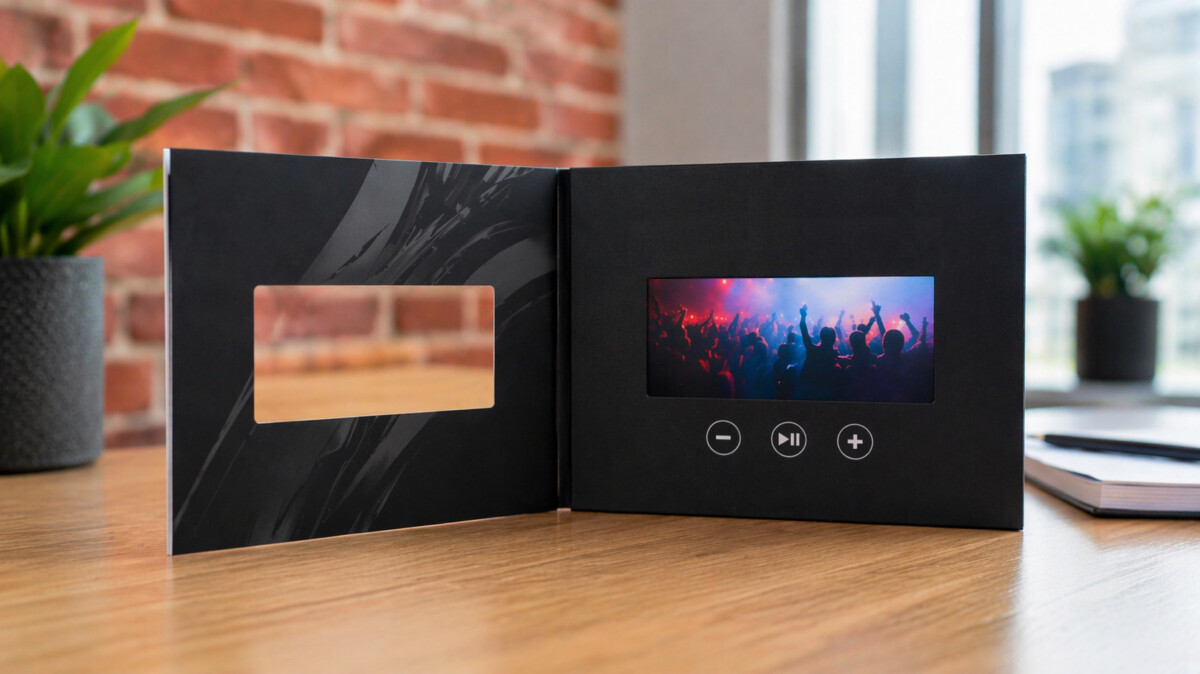
A video brochure is a printed marketing piece with an embedded LCD screen, speaker, and rechargeable battery that plays video content when opened. The video is loaded onto internal memory before shipment. When the recipient opens the brochure, the video plays automatically or via a button, combining the tangibility of print with the engagement of video.
Video brochure pricing depends on screen size, print finish, memory capacity, quantity, and fulfillment requirements. Entry-level units for orders of 100 or more typically start in the $25 to $50 per-unit range. Premium configurations with larger screens, hardcover construction, and custom packaging can reach $80 to $150 per unit or higher. Always confirm what the quote includes before comparing across suppliers.
Video brochures containing lithium batteries can be mailed under specific conditions governed by USPS Publication 52 and related postal guidance. Requirements typically include packaging and marking standards for lithium battery content. A qualified vendor should be able to explain exactly how their pieces are prepared for postal compliance. If a vendor cannot answer this question confidently, treat it as a meaningful operational risk.
Most video brochure manufacturers support MP4 files encoded in H.264 at standard resolutions (720p or 1080p depending on screen size). Some vendors also support AVI or MOV formats. Confirm the required specifications with your vendor before finalizing your video file, as incompatible formats can delay production and require re-encoding.
Standard production timelines for video brochures typically run 10 to 21 business days from approved files to shipment, depending on quantity, customization complexity, and the vendor’s current capacity. Rush options are available from some suppliers at additional cost. Always confirm the timeline against your actual deadline before placing the order, not after.
Common screen sizes range from 4.3 inches to 10 inches diagonally, with 4.3-inch, 5-inch, 7-inch, and 10-inch being the most widely available configurations. Smaller screens suit direct mail formats where weight and thickness matter. Larger screens work well for leave-behinds, event pieces, and executive presentations where visual impact is the priority. Your vendor should help you match screen size to campaign use case, not just present options.
Battery life varies by screen size and video length, but most video brochures support 1.5 to 3 hours of continuous playback on a full charge, which typically translates to 10 to 30 full plays depending on video duration. Units are rechargeable via USB. Ask your vendor for specific battery performance data for the configuration you are considering, and request testing confirmation before shipment.





