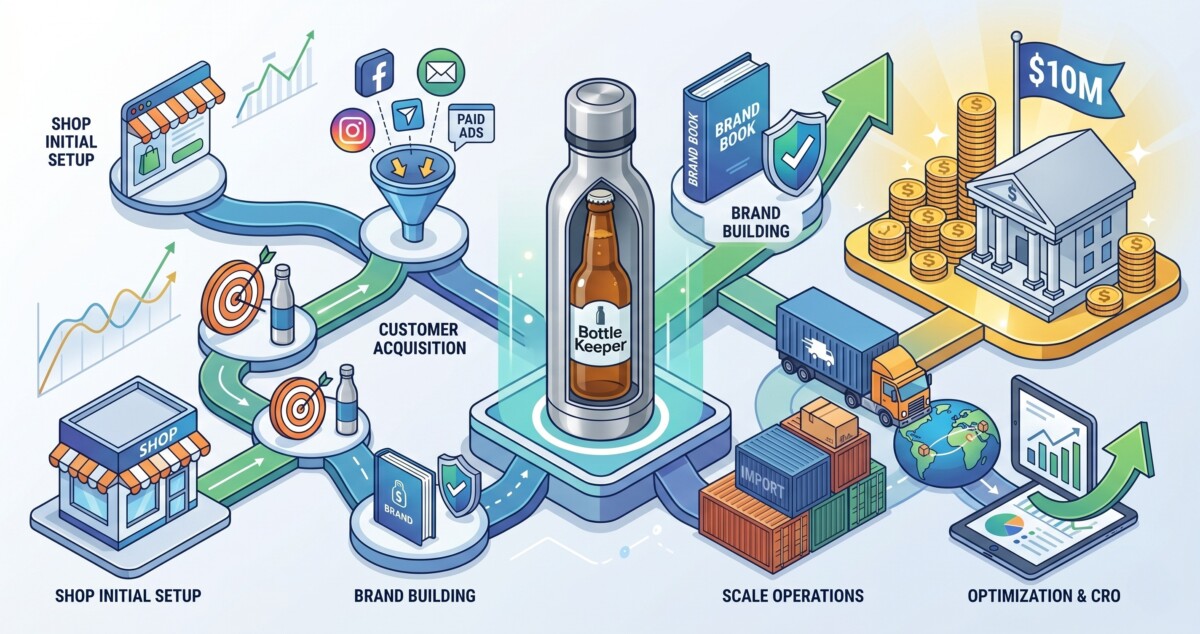
Your mom telling you your product is amazing means literally nothing. The only feedback that matters comes from people with zero emotional connection to you, because those are the people who will have to buy this thing when you are a real business. – Adam Callinan, founder of BottleKeeper
Adam Callinan built BottleKeeper from a $20,000 founder investment into more than $60 million in total sales, with a team of four people and not a single outside investor. Then private equity came knocking. The exit worked because the business was built on financial discipline, not luck.
I had Adam on Episode 449 of eCommerce Fastlane and the conversation confirmed something I have seen across 450+ conversations with Shopify founders: the brands that scale profitably are not doing anything exotic. They are doing the fundamentals better than everyone else.
Here is the six-step playbook Adam used to get there.
Most founders get excited, dump money into building product, then hope people show up. Adam has a word for that approach: gambling.
His validation process has two distinct phases, and the second one is the step most founders skip entirely.
Phase one is signal testing. Before BottleKeeper manufactured anything, Adam built a simple landing page, shot a basic product-in-action video, and spent $500 on Google Ads to drive traffic. He was looking for signals: Are strangers clicking? Are they watching the video? Are they submitting their email? Those signals told him interest existed. But interest is not buying, and buying is the only thing that matters.
Phase two is real purchase validation. Adam launched a crowdfunding campaign on Fundable with a deliberately low $5,000 goal. The campaign hit nearly 300% of that goal. Strangers in six different countries pre-ordered BottleKeeper at full price, generating $13,000 that funded the first production run. Total founder investment at that point: $20,000 split between Adam and his co-founder.
The distinction matters because interest and buying are completely different signals. People will click on anything. People will tell you they would buy your product. None of that is validation. Only a credit card swipe at your actual price point is validation.
If you are a pre-launch founder, this is your roadmap. Do not skip the pay-real-money step. If you are already at $500K or above, apply this same validation logic to new product lines and SKU expansion before you commit capital. The principle scales even when the numbers do not look the same.
The pattern I see constantly in founders who struggle at $500K to $2M: they validated interest on their initial product or on subsequent SKU additions, but they never validated willingness to pay at a real margin. Email signups, social followers, and friends saying they would totally buy that are not validation. Only money is validation.
Think of fixed expenses as dead weight in a boat. Every dollar of fixed expense must be covered by revenue before you see a cent of profit. And in ecommerce, revenue is inconsistent by definition. Slow seasons happen. Campaigns underperform. One bad month with high fixed expenses is not uncomfortable. It can be fatal.
BottleKeeper scaled past $60 million in total sales with four employees. That is not a coincidence. It is the result of a deliberate constraint Adam placed on the business from day one: do not hire until the business literally cannot function without the person, not just when it gets uncomfortable.
The most common early-stage mistake is generating some revenue, feeling momentum, adding $50,000 per month in fixed costs, and suddenly going from profitable to losing money without the revenue even changing. The revenue did not fail. The cost structure failed.
In 2026, this approach is more achievable than ever. AI, automation, and modern SaaS tools mean you do not need ten people to do ten jobs anymore. The founders building toward exits are the ones running lean today, not the ones planning to get organized later.
For early-stage founders at $0 to $1M: every app subscription, every contractor, every tool is a fixed cost. Audit ruthlessly. For growth-stage founders at $1M to $5M: the temptation to professionalize with hires is strongest at this stage. Resist until the process breaks, not when it gets hard.
After 450+ podcast conversations, I can tell you the most consistent pattern I see in founders who struggle: they can tell you their ROAS to the decimal point, but they cannot tell you their contribution profit per order. That is like knowing your car’s RPM but not checking whether there is fuel in the tank.
Adam’s framework for thinking about this is what he calls the Profit Pyramid. At the top are the metrics founders obsess over: CTR, impressions, social content, going viral. In the middle are the metrics that matter more: AOV, conversion rate, LTV, CAC. At the foundation is the financial reality of the business, anchored by one metric above all others: contribution profit.
Here is the formula, presented as a reference you can apply directly to your own store:
That is the entire profit equation. Everything else is commentary.
The way to use contribution profit is to plot it over time and draw a trend line. If it is trending up, what you are doing is working. If it is flat, you are treading water. If it is trending down, something must change before the situation becomes critical.
This single metric answers every important business question. Is the new agency working? Is the discount helping or hurting? Did the price increase perform? The answer is always in the contribution profit trend line.
The disconnect Adam sees even in $50M companies is that the CFO and CMO do not speak the same language. Finance wants marketing to do more with less spend. Marketing wants more spend to drive volume. They are operating from different data. Contribution profit is the shared language that ends that conversation.
To understand the full profit picture for your Shopify store, the Shopify profit and loss guide is a strong foundation for building this out. If you want to identify where margin is leaking before you start tracking contribution profit, work through the profit leak audit checklist first. And when you are building out your variable cost list, do not underestimate what Shopify itself takes out of every order. The real Shopify fee breakdown will show you costs that most sellers miss until they start scaling.
Adam built Pentane to automate exactly this calculation. It connects Shopify revenue, ad platform spend, and accounting data in real time and surfaces the contribution margin and net margin numbers without requiring a finance degree to interpret. If you want to understand what the tool does and how it compares to alternatives, the Pentane review covers it in depth.
Pricing is the single biggest lever you can pull to impact profitability in an ecommerce business. And most founders set their prices emotionally, not mathematically.
BottleKeeper started at $20. That price felt expensive to Adam at the time, which is an emotional response, not a financial one. Over the next two years, he added a tether for the lid at roughly $0.10 per unit, a built-in bottle opener at tooling cost only, and powder coating instead of anodized paint at about $0.15 per unit. The same core product that started at $20 was selling for $40 within two years. Doubled the price with pennies in added cost.
Here is the math that makes this so powerful. The table below shows what a 10% price increase actually does to your required revenue when contribution margin improves:
Based on a business with $200,000 in fixed expenses. A 10% price increase led to an 80% improvement in contribution margin per dollar and cut the required revenue nearly in half.
Adam’s experience at BottleKeeper: conversion rate sometimes did not drop at all when they raised prices. The fear of raising prices is almost always bigger than the actual impact. But the only way to know is to test it.
The key instruction here is to test it with data, not your gut. Run the test, look at the data, find the balance between price and conversion rate. Use the margin calculator to run these numbers against your own store before you make any changes.
For early-stage founders: you almost certainly priced too low. Your initial price was emotional, not data-driven. Test a 10% to 15% increase this week. For growth-stage founders: layer in perceived value additions alongside the price increase. Better packaging, a small accessory, premium materials. Things that cost pennies but justify meaningful price increases in the customer’s mind.
The most common mistake in early-stage ecommerce is picking an ad budget based on comfort level instead of math. You pick a number you can afford, hand it to an agency or start running campaigns yourself, and implicitly ask the platform to turn that budget into something profitable. The math rarely works, and it is not because the agency failed or the campaigns underperformed. It is because the budget was wrong from the start.
Here is the example Adam walks through. A business with $100,000 in fixed expenses sets a $10,000 monthly ad budget. At that budget level, the required break-even ROAS is 22x. That will never happen. The agency cannot win, you cannot win, and everyone ends up frustrated with each other. But the problem was never performance. It was the budget being structurally wrong before the first ad ran.
The relationship between ad budget and required ROAS is an inverse curve shaped like an upside-down hockey stick. As budget increases, the required ROAS decreases rapidly. For a business with $100,000 in fixed expenses and 50% variable margin:
Now factor in discounts, and the math gets even more unforgiving. The table below shows what happens to your required break-even ROAS at the $100K budget level when you layer in a site-wide promotion:
A 30% discount requires more than 50% more marketing performance than running no discount at all. Unless conversion rate improves dramatically, discounts are eating your margins alive.
The reframe: stop asking how much you are comfortable spending. Start asking how much you need to spend to break even or hit a 5% to 10% net margin, what ROAS that requires, and whether that ROAS is realistic based on your trailing performance.
For a detailed breakdown of how margins should dictate ad budget with the specific Shopify math behind it, that piece goes deeper into the break-even ROAS calculation by margin tier. The full conversation with Adam on this topic is in Episode 449.
For founders spending under $5,000 per month on ads: run the break-even ROAS calculation before spending another dollar. You may discover your budget is set up for failure before the first ad runs. For operators managing $20,000 or more in monthly ad budgets: model the discount impact on required ROAS before approving any site-wide promotion.
Here is the test Adam uses: can the founder go on vacation for a month and have everything continue to operate without them? If the answer is no, that is not a business. It is a job that depends on one person showing up every day.
The principle is simple: solve every problem with process and automation first, hire only when the process physically breaks.
BottleKeeper’s customer service is the clearest example. Ninety-five percent of support tickets are the same ten questions: tracking, wrong color, exchanges, returns. All of that can be automated with pre-written responses and workflows. With today’s AI tools, it is even easier than it was when Adam was running BottleKeeper. Their automated system held up until 2,000 to 3,000 orders per day during peak season before it needed human intervention.
Adam’s approach to every hire: he ran the role himself first. That meant he could hand the new person a fully documented system and get them productive in about an hour. He was not hiring people to figure out how to do a job. He was hiring people to execute a job that already had a documented playbook.
The exit connection is direct. When private equity acquired BottleKeeper, they were buying products, brand, and patents. They had their own team. The handoff only worked because systems were already in place for the business to run without the founders. A business that requires the founder to operate is not an asset. It is a liability that happens to generate revenue.
This maps directly to the ten-person, ten-million-dollar brand framework. AI and automation in 2026 make this approach more achievable than ever. The brands building toward exits are documenting processes today, not planning to get organized later.
These six steps are not isolated tactics. They are a sequence, and the sequence matters. Validate first. Stay lean. Learn your numbers. Price with data. Budget with math. Build systems from day one.
BottleKeeper by the numbers: $20,000 total founder investment. Four employees at peak. $60 million-plus in total sales. Acquired by private equity.
The anti-pattern that most founders follow is the opposite of every step in this playbook. They skip validation. They hire too early. They ignore financial metrics. They price emotionally. They guess their ad budget. They build everything around themselves. Then they wonder why the business stalls or fails to attract buyers.
The founders who do this right are not smarter or better funded. They are more disciplined about the fundamentals. Start with real validation. Keep fixed costs ruthlessly low. Track contribution profit as your primary operating metric. Test prices up with data. Set your ad budget from the math, not your comfort level. Document every process before you hire into it.
To hear Adam walk through this framework in his own words, Episode 449 is the full conversation. If you want the tool he built to automate the contribution profit and ad budget math he describes, the Pentane review covers exactly what it does and who it is built for.
Contribution profit is revenue minus all variable and sales-related costs. For a Shopify store, that means subtracting cost of goods sold, shipping, fulfillment, payment processing fees, Shopify transaction fees, and paid advertising spend from your total revenue. What remains after those deductions is the money available to cover fixed expenses and generate net profit. The formula is: Contribution Profit = Revenue minus (COGS + shipping + fulfillment + payment processing fees + Shopify fees + paid ad spend). Net Profit = Contribution Profit minus fixed expenses. Tracking this metric over time is more useful than any single snapshot. A trend line moving up means what you are doing is working. A trend line moving down means something needs to change before the situation becomes critical. Tools like Pentane automate this calculation by pulling directly from Shopify data, your ad platforms, and your accounting software in real time.
The right question is not how much you are comfortable spending. It is what ROAS you need to break even at your current budget level, and whether that ROAS is realistic based on your actual performance. Calculate your break-even ROAS by dividing your total costs (fixed expenses plus ad spend) by the contribution margin you generate per dollar of revenue before ad spend. If the required ROAS is above 5x to 6x, your budget is likely too low relative to your fixed expenses. The inverse relationship between budget size and required ROAS means increasing your budget can actually lower the performance bar your marketing team needs to clear. A business that needs a 22x ROAS at $10,000 per month only needs a 4x ROAS at $100,000 per month. The math, not the comfort level, should set the budget.
Test in 10% to 15% increments and monitor conversion rate impact over a 2 to 4 week window. Many brands discover that conversion rate does not drop at all when they raise prices, especially when the price increase is accompanied by a clear reason for the customer to see value in the higher price. The key is to add perceived value alongside the price increase. Better packaging, a small product enhancement, premium materials. Things that cost pennies but justify meaningful price increases in the customer’s mind. BottleKeeper added a tether, a built-in bottle opener, and powder coating at a combined cost of roughly $0.25 per unit and doubled the price over two years. Test it, look at the data, and find the balance between price and conversion rate. The fear of raising prices is almost always bigger than the actual impact on conversion.
BottleKeeper scaled to $60 million in total sales with four employees through three interconnected disciplines: aggressive automation and systems building from day one, extremely low fixed expenses by delaying every hire until the business literally could not function without the person, and building every process as a documented system before hiring anyone to execute it. Adam Callinan ran every role in the company himself before making the first hire. That meant he could hand a new team member a complete system with documented processes and get them productive in about an hour. Customer service was automated to handle 95% of tickets, holding up through 2,000 to 3,000 orders per day during peak season. The constraint of building a business that could operate without the founder ultimately made the private equity exit possible.
Use a two-step process. First, build a simple landing page with a product video and spend a few hundred dollars in paid ads to test interest signals: clicks, video views, email submissions. Second, and critically, get strangers to pay real money at your actual retail price through pre-orders or crowdfunding. BottleKeeper’s Fundable campaign hit nearly 300% of its $5,000 goal with strangers in six countries pre-ordering at full price, generating $13,000 that funded the first production run. The price must be your actual retail price, not a discounted beta price. Email signups and friends saying they would buy are not validation. Only money from people with zero emotional connection to you is validation.