

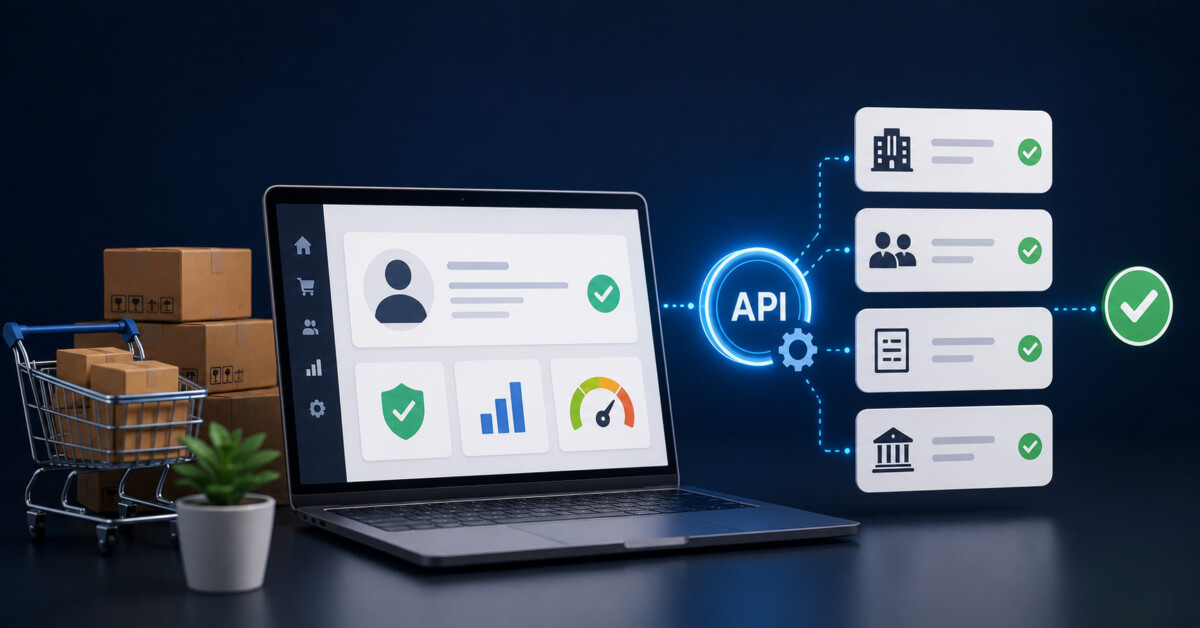
Business information APIs let e-commerce companies treat company verification like any other part of the stack, pulling real-time data on business identity, risk, and ownership into onboarding and checkout instead of relying on slow manual checks.
As soon as “customer” means “company” instead of “person,” knowing the real entity behind an order stops being a nice-to-have and becomes a risk decision you cannot afford to guess on.
Online retailers used to treat “know your customer” as a problem for banks. That’s no longer true. As e-commerce has expanded into B2B marketplaces, wholesale platforms, buy-now-pay-later checkout, and cross-border trade, merchants now face many of the same verification and risk questions that financial institutions have dealt with for decades: Is this business real? Is it creditworthy? Who actually owns it? And can we find that out in seconds, not days?
That shift is why business information APIs have quietly become one of the more important pieces of infrastructure behind modern online stores and marketplaces.
Most online retailers are set up to collect and verify data about individual shoppers — email addresses, shipping details, payment cards. But a growing share of e-commerce revenue now comes from B2B transactions: wholesale accounts, dropshipping partners, marketplace sellers, corporate procurement, and invoice-based purchasing. In each of these cases, the “customer” is a company, not a person, and the questions a merchant needs answered are different:
Manually researching each of these questions doesn’t scale once an online store starts onboarding dozens or hundreds of business accounts a month. That’s the gap that company-data APIs are built to close.
At its core, a business information API lets an e-commerce platform send a lightweight query — a company name, a domain, a registration number, or even a corporate email address — and get back a structured profile in return: legal name, registration status, industry classification, estimated size, financial history, ownership structure, and credit indicators, depending on the provider and the data available in that market.
For platforms that want to keep sign-up friction low, this is a meaningful shift. Instead of asking a new B2B buyer to fill out a ten-field onboarding form, a merchant can ask for just a company domain or email address and let the business information API auto-populate the rest — legal entity name, address, sector, and size — in the background. The buyer sees a short form; the merchant still ends up with a complete company profile.
Wholesale and B2B account onboarding. Marketplaces that sell to other businesses — think wholesale suppliers, SaaS tools sold to retailers, or B2B ordering portals — use these APIs to confirm that a new account belongs to a genuine, active company before extending trade credit or wholesale pricing.
Fraud and risk screening at checkout. Buy-now-pay-later and invoice-based checkout options are now common even in consumer-facing e-commerce. Before approving a business account for deferred payment, platforms can run an automated credit and risk check rather than relying on self-reported financials.
Marketplace seller verification. Any platform that lets third parties sell through it — from niche vertical marketplaces to larger multi-vendor sites — has a strong incentive to confirm that a seller is a legitimate, registered business rather than a shell account, particularly in categories prone to counterfeit goods or chargebacks.
CRM and lead enrichment. Sales and account-management teams supporting B2B e-commerce accounts often pull the same company data into their CRM automatically, so that a lead captured through a short form arrives already enriched with firmographic details, rather than requiring manual research before the first outreach call.
Ongoing monitoring. Some providers support webhook-based updates, so that if a business customer’s registration status changes, ownership shifts, or a credit risk flag appears, the merchant’s system is notified automatically rather than having to re-check the account periodically.
Not all business information APIs are built the same way, and the differences matter for an e-commerce operation:
The broader pattern here mirrors what’s happened elsewhere in e-commerce infrastructure: functions that used to require a human — verifying an identity, checking a credit history, researching a company — are being pushed into automated, API-driven pipelines that run in milliseconds instead of days. For consumer checkout, that trend played out years ago with instant identity and payment verification. For B2B e-commerce, company verification is now going through the same transition.
For online retailers and marketplaces expanding into wholesale, B2B sales, or deferred-payment options, the practical takeaway is straightforward: the same automation that streamlined consumer onboarding is now available for business accounts too, and it’s increasingly a standard piece of the stack rather than a specialized tool reserved for banks and lenders.





