


Canadian startups do not win by matching American capital. They win by being local in ways American capital cannot be.
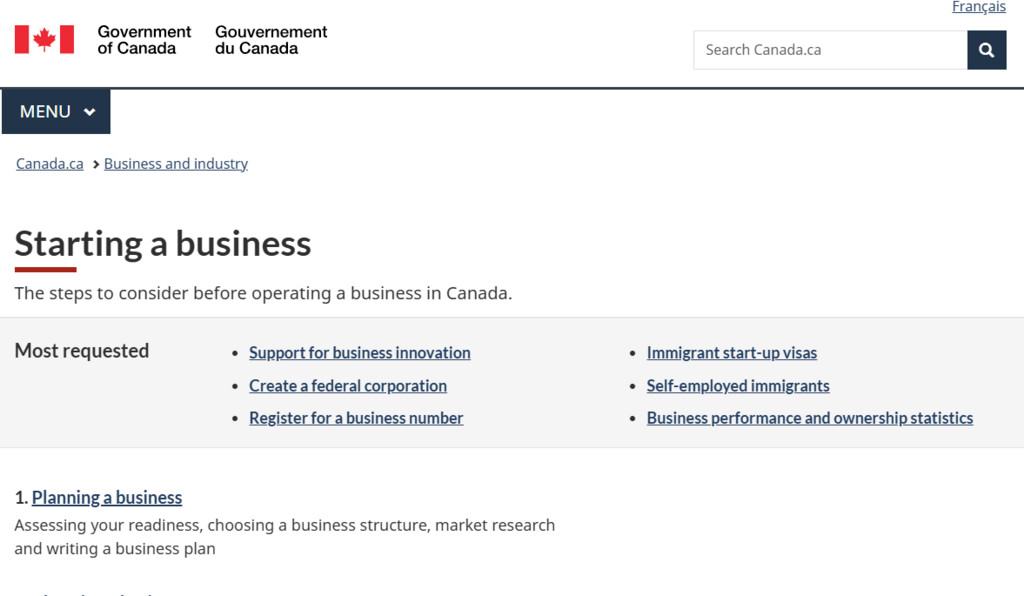
How to outrank American multinationals on a shoestring, avoid the offshore SEO graveyard, claim government grants, and navigate the immigration minefield as a founder.
Canadian startups in 2026 inhabit a paradox. The domestic digital landscape looks terrifying on the surface – American multinationals armed with nine-figure marketing budgets dominate national search results, GDP growth grinds along near 1%, and the cost of capital is punishing. Yet buried inside this apparent catastrophe is a genuine competitive opportunity that most foreign operators never bother to exploit: Canada is remarkably un-competitive across hundreds of specific keyword verticals, and the brands that learn to exploit that gap are quietly eating the lunch of companies fifty times their size.

The United States-Mexico-Canada Agreement effectively erased the commercial border for American corporations. With a combined North American GDP exceeding $23 trillion and tariff-free access to Canadian consumers, US companies treat Canada as a frictionless extension of their domestic operations – and they pour capital into Canadian search accordingly. The result is a SERP landscape where national, high-volume terms are utterly monopolized by brands with domain authority built over decades.
But here is the structural vulnerability those giants cannot fix: American corporations optimize for American searches. The population math alone tells the story – the US has roughly 330 million residents to Canada’s 38 million, so Canadian keyword volumes are a fraction of their US equivalents. A niche informational query generating 360 monthly US searches might pull just 6 in Canada. Because the volumes look too small to justify multinational attention, keyword difficulty in Canadian niches plunges. A startup can claim page-one rankings for genuinely valuable commercial terms with far less capital expenditure than the same campaign would require south of the border.
The strategic implication is direct: forget competing for “digital marketing agency” nationally. Own “Vancouver SEO consultant,” “SEO agency North Vancouver,” and a hundred variations of that pattern across your service geography. The traffic volumes are smaller. The conversion quality is exceptional.

The platform you build on either enables or permanently caps your SEO ceiling. Two platforms dominate the Canadian startup conversation: Shopify and WordPress with WooCommerce.
Shopify is genuinely excellent for what it is – a frictionless, fully managed e-commerce engine with native Canadian tax handling and provincial shipping logic. For founders who need to move fast and treat organic search as a secondary acquisition channel, it works. But Shopify’s rigid URL taxonomy (those immutable /collections/ and /products/ paths) makes a fully architected content strategy nearly impossible to execute. The native blogging infrastructure is rudimentary. If your primary plan for defeating US competitors involves producing hundreds of hyper-local, authoritative content pieces, Shopify will eventually feel like a cage.
WordPress with WooCommerce, by contrast, grants absolute control over URL structure, canonical tags, schema markup, and site hierarchy. Plugins like Yoast SEO or Rank Math give technical SEO practitioners the surgical precision required for competitive content campaigns. For businesses operating nationally – particularly those needing bilingual French-English compliance – WordPress’s open-source flexibility is essential. The trade-off is real: WordPress demands ongoing maintenance, security patching, and either internal technical capacity or a retained development partner. For founders who are prepared for that reality, it remains the superior vehicle for SEO-first growth.
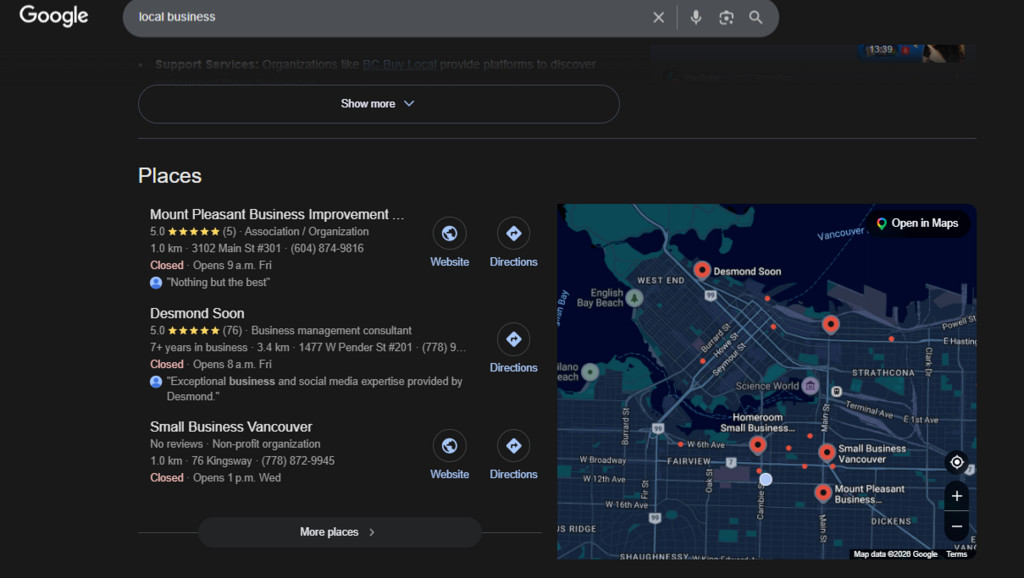
If there is a single tactic that neutralizes the financial superiority of American multinationals, it is local SEO executed with genuine discipline. Search algorithms actively prioritize geographical proximity, and 46% of all Google searches carry local intent. Nearly 78% of mobile local searches result in an offline conversion or inquiry. For businesses with service areas, capturing local search traffic is not a supplementary tactic – it is survival.
The centerpiece of every local SEO strategy is the Google Business Profile optimization. When a user searches with local intent, Google bypasses standard organic listings to surface the “Local Pack” – a map with three geographically relevant businesses. Appearing in this pack allows a scrappy startup to rank visually above the organic listings of multinationals spending thousands per month on national SEO. Getting there requires meticulous attention: absolute Name/Address/Phone consistency across every Canadian directory (Yellow Pages, Yelp Canada, 411.ca), regular image and video updates to signal operational activity, and ongoing management of the profile’s category assignments.
Reviews deserve special attention because 2026 algorithms do not merely count star ratings – they parse review velocity, recency, and the semantic keyword density inside the review text. A steady stream of recent reviews mentioning specific services and geographic locations functions as organic keyword seeding for the profile. Startups should build a systematic process for requesting reviews that naturally prompts clients to name the service they received and the city where they received it.
On the technical side, implementing LocalBusiness schema markup on your website ensures that AI Overviews and generative search results correctly parse your geographic relevance and service areas. As zero-click search experiences grow, structured data is increasingly the difference between being cited as an authoritative source and being invisible.
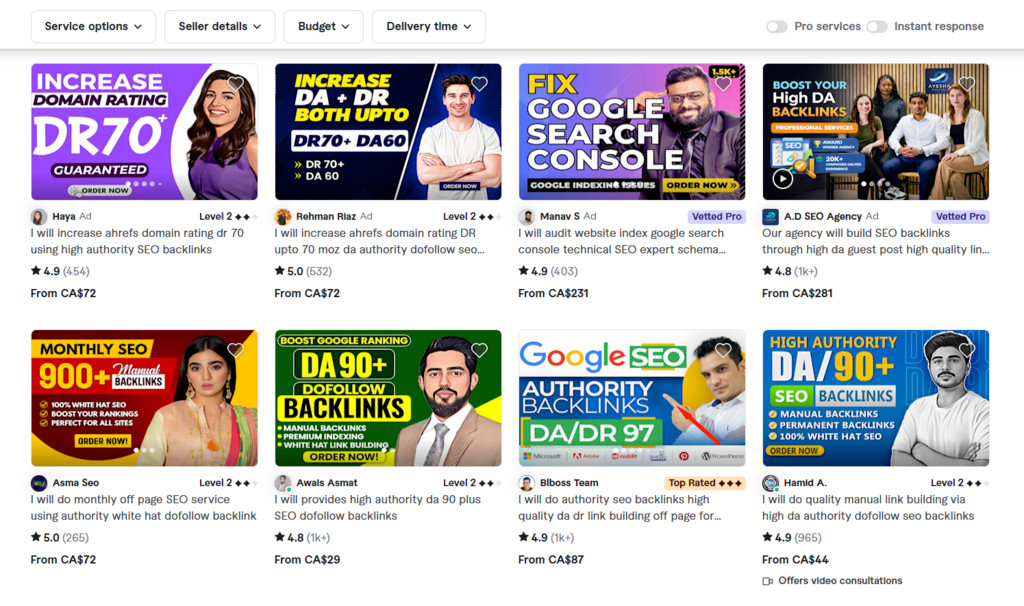
Capital-constrained founders face an obvious temptation: offshore SEO on Upwork or Fiverr costs a fraction of domestic agency rates. The math looks compelling until you understand the operational consequences.
Offshore SEO contractors frequently operate at roughly one-quarter the effective velocity of an integrated local team. Time zone disparity, communication friction, the constant need for cultural context clarification, and task-by-task contract structures compound into a massive drag on execution speed. More critically, low-cost offshore providers are financially incentivized to generate fast, superficial results – which frequently means deploying black-hat techniques: purchased spam backlinks, private blog networks, automated low-quality content. These tactics invite algorithmic penalties that can blacklist a domain entirely. For a startup already operating with tight runway, losing 12 to 24 months of marketing momentum to a Google penalty is often existential.
The domestic alternative is not automatically safe, however. Canadian agencies carry significant overhead – executive salaries, commercial real estate in Vancouver or Toronto, mandatory payroll contributions. To protect margins, a substantial portion of Canadian agencies quietly subcontract their actual technical SEO execution to the same offshore white-label providers a startup was trying to avoid. The startup pays premium Canadian agency rates – often $3,000 to $6,000 per month – and receives offshore-quality execution wrapped in local account management.
The optimal path for capital-constrained founders is a lower-cost, independent local provider within Canada. A local consultant – even an affordable one – shares your timezone, your cultural context, your language nuances, and critically, your legal jurisdiction. You can meet face to face. You can verify methodologies. You have real accountability. These advantages compound in ways that no amount of cheap offshore labour can replicate.
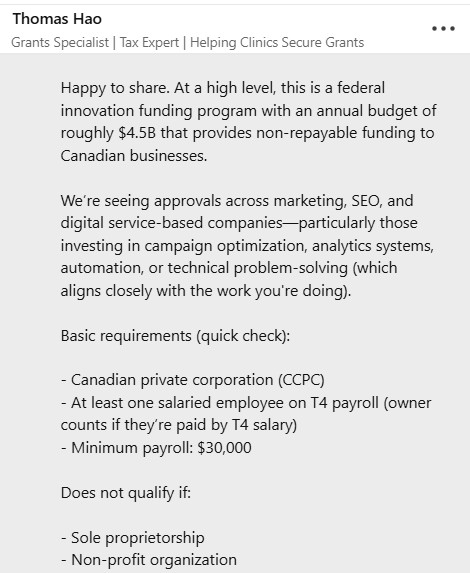
British Columbia offers some of the most accessible non-dilutive digital marketing funding in the country, and most eligible startups never apply.
The Innovate BC Go-To-Market Microgrant provides between $10,000 and $50,000, covering up to 75% of eligible project costs. Eligible expenses explicitly include third-party consultant fees, SEO, paid digital advertising, branding, and marketing playbook development. The program operates on a reimbursement basis – startups incur costs first, then submit proof of payment to recover 75%. The 25% cash contribution requirement ensures mutual commitment, but for a startup spending $40,000 on a domestic SEO engagement, recovering $30,000 is a transformative capital event.
The BC Digital Marketing Grant for Small Businesses operates at a smaller scale – $500 to $3,000 – but with dramatically lower friction. It is designed precisely for foundational digital marketing activities including website infrastructure, social media advertising, and SEO implementation. The program explicitly permits using funds to hire a professional digital marketing agency, making it a direct subsidy for the domestic partnership strategy described above.
At the federal level, the Canada Digital Adoption Program and CanExport SMEs – which covers up to 50% of international SEO and market localization costs up to $50,000 – extend the same logic nationally. These programs routinely change intake windows and eligibility criteria. The imperative is to monitor them actively rather than assuming the funding has disappeared.
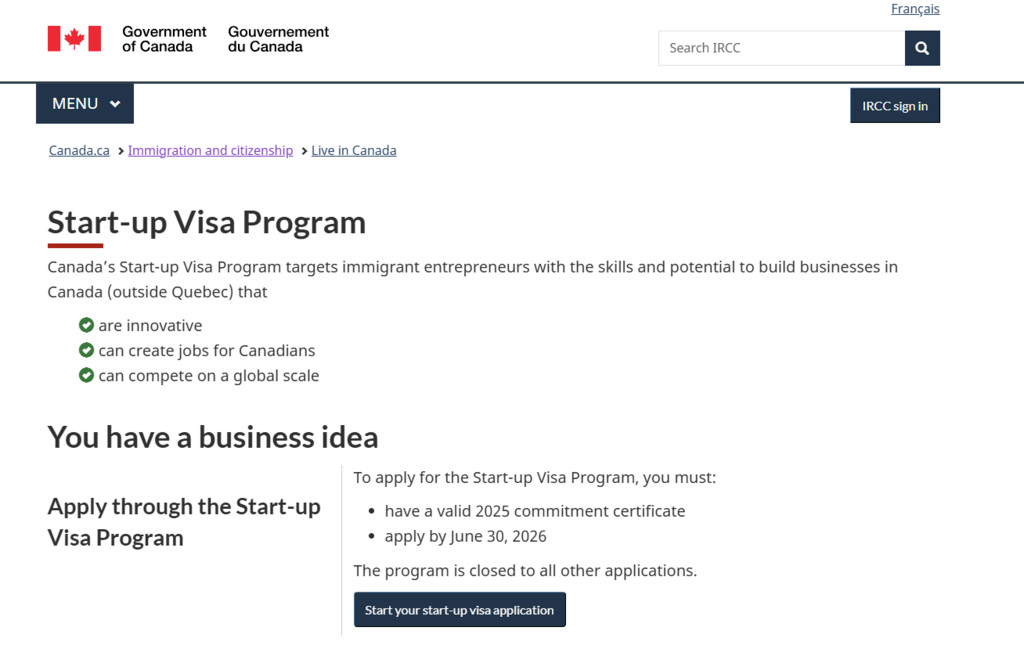
Canada’s immigrant founder population drives a disproportionate share of the country’s entrepreneurial energy. Nearly 62% of founders who arrived in Canada within the last decade view the country as a landscape of genuine opportunity. Yet the immigration policy framework creates a structural paradox that destroys careers when founders fail to understand it.
The Canadian Experience Class – the primary Express Entry pathway for skilled workers seeking permanent residency – explicitly excludes self-employment from qualifying work experience calculations. Under Regulation 87.1(3)(b), any period of Canadian self-employment is legally invisible for CEC purposes. A founder operating a sole proprietorship, or holding substantial ownership and management control of an incorporated entity, is classified as self-employed by IRCC regardless of how their day-to-day work functions. Eighty-hour weeks building a Canadian company earn exactly zero CRS points under the CEC.
The institutional logic behind this exclusion is a distrust born of documented fraud: bad actors have historically used shell companies, fabricated payroll records, and manipulated T4 slips to create false impressions of arm’s-length employment. Because self-employment income is easily manipulated, IRCC treats it as inherently suspect within the standard Express Entry pool.
The practical consequence for honest migrant founders is severe. To protect their PR pathway, they must maintain legitimate full-time employment with an established third-party Canadian employer running concurrently with their startup operations – with zero operational or financial overlap between the two. Any attempt to blur these lines constitutes misrepresentation under Section 40(1)(a) of IRPA. The penalties are not administrative slaps: immediate PR refusal, a mandatory five-year re-entry ban, and a permanent immigration fraud record that follows the applicant globally.
The Federal Self-Employed Persons Program exists as an alternative, but its eligibility criteria are effectively limited to artists and athletes of world-class standing. It is not a viable pathway for tech founders, and processing times regularly exceed a decade. The only safe path for most migrant founders: maintain impeccably documented third-party employment throughout the PR process, keep startup finances entirely separate, and consult a regulated immigration consultant before making any structural decisions about corporate ownership.
A Google search for Canadian SEO services returns results heavily optimized by agencies that are expert at marketing themselves but frequently lack the infrastructure to deliver substantive long-term results. The most reliable vetting mechanism is still physical: face-to-face networking at domestic marketing events where practitioners demonstrate knowledge rather than sell it.
DigiMarCon Canada runs major multi-day exhibitions in both Toronto and Vancouver, drawing verifiable practitioners in search, programmatic advertising, and growth strategy. The SocialNext conference series – SocialWest in Calgary, SocialEast in Halifax, SocialPacific in Vancouver – prohibits sales pitches from the stage and focuses exclusively on actionable peer-to-peer knowledge transfer. DX3 Canada targets the convergence of retail, marketing, and technology for e-commerce founders specifically.
At these events, a founder can directly interrogate a prospective SEO partner about their specific methodologies, ask point-blank whether execution is managed locally or offshore, and evaluate their genuine fluency with Canadian search dynamics. That direct accountability is not available through any digital procurement process.
Canadian startups do not win by matching American capital – they win by being local in ways that American capital cannot be. That means hyper-local SEO built around geographic terms no multinational bothers to target, a technically superior CMS architecture that can scale a content strategy over years, a Google Business Profile maintained with daily discipline, and a review acquisition strategy that seeds the profile with the precise keywords that drive revenue.
It means avoiding the twin traps of cheap offshore execution and expensive domestic white-labelling, building a transparent relationship with a genuine local partner – made more financially feasible by provincial and federal grants that most eligible founders never claim.
And for the significant portion of Canadian founders who arrived here from somewhere else: it means understanding that building a successful startup and building a PR pathway are two separate operations that must be managed in parallel, with absolute discipline, and no overlap that an IRCC officer could one day describe as misrepresentation.





