


China’s Finance Minister Lan Fo’an announced that a more proactive fiscal policy will be implemented in 2025, with “sustainable strength and efficiency.”
The main goal is to significantly increase consumption and investment to expand domestic demand.As China is the world’s “most promising super-sized market,” Lan conveyed that new measures have been taken to stimulate consumption on both the supply and demand sides.
At the China Development Forum held on March 23-24, Lan emphasized that despite economic difficulties, the country’s experience in macroeconomic and fiscal management has grown. China’s ultra long-term growth potential is supported by its strong foundation, resilience, and vast consumer market. Lan also noted that proactive steps have been taken to address risks and that fiscal maneuverability remains high.
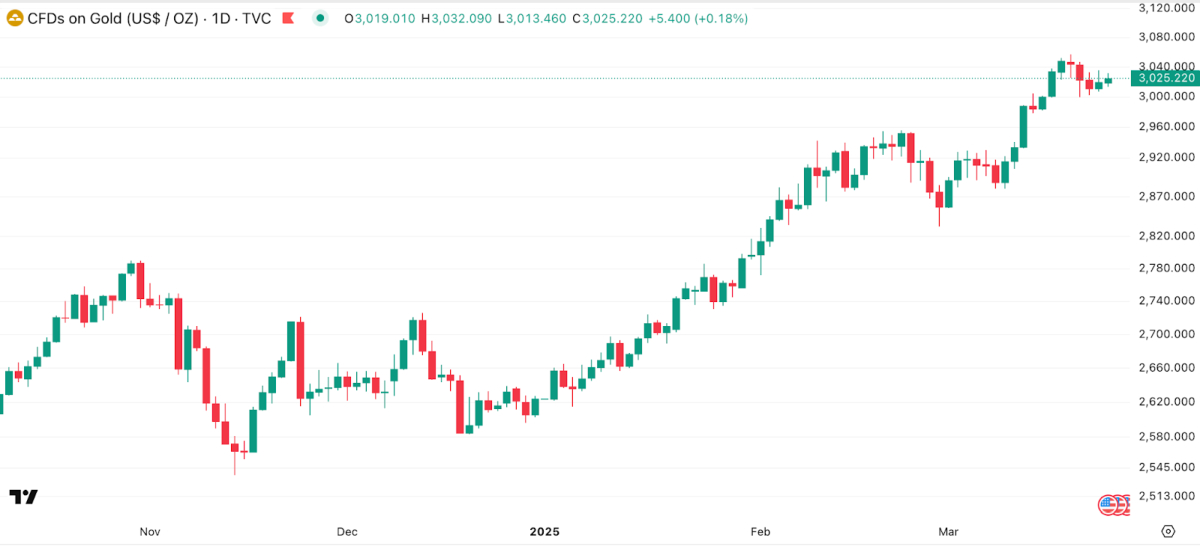
This comes as the gold price remains above $3,000 per ounce, indicating strong demand for a safe-haven asset. China is one of the top six largest holders of gold, with 2,280 tonnes as of December 2024. Still, it trails far from the U.S., which holds 8,133 tonnes.
In this context, 1.3 trillion yuan (about $181 billion) of ultra-long-term special bonds will be issued in 2025. This figure, increased by 300 billion yuan compared to last year, is aimed at supporting consumption and investment. In contrast, U.S. Treasury bonds (e.g., 10 year Treasury Yield) generally fund major government expenditures, including finance deficit, social programs, and defence.
Lan stated that financial resources have been allocated to education, science, technology, and talent development, with the aim of accelerating the growth of new-generation productive forces.
Additionally, the central government’s budget share has been increased to support the integration of technological and industrial innovations.
These steps aim to strengthen China’s global competitive advantage and improve the coordination of funding channels to expand effective investments.
Speaking to international business leaders, Lan pointed out that China’s high-standard opening-up policy will be supported by fiscal mechanisms. He emphasized that reforms that guarantee equal treatment for all types of businesses and improve the business environment will continue, while reiterating China’s commitment to contributing to global economic stability.
Within the forum’s theme, “Unleashing Development Dynamics for Global Economic Stability,” analysts are closely monitoring the impact of China’s fiscal policies on regional and global markets.
However, we should keep a close eye on the U.S. tariffs, which could disrupt global supply chains and trade flows and affect market confidence. China’s measures could play a critical role in boosting investor confidence and ensuring the sustainability of economic growth.
China intends to pursue a more active government spending approach in 2025, focusing heavily on increasing domestic consumption and investment. The primary goal is to stimulate internal demand within what it considers the world’s most promising large market.
The government plans to issue 1.3 trillion yuan (about $181 billion) in special ultra-long-term bonds, an increase from the previous year. These funds are specifically targeted to support projects and initiatives that encourage people and businesses to spend and invest more within China.
Unlike typical US Treasury bonds which fund a wide range of government activities including deficits and social programs, these specific Chinese bonds are earmarked primarily to stimulate consumption and investment. China is also allocating separate funds specifically towards advancing education, science, and technology development.
Finance Minister Lan Fo’an stated that fiscal measures will support China’s policy of high-standard opening-up. He affirmed continued reforms aimed at ensuring equal treatment for all business types and improving the overall business environment, suggesting a favorable climate for foreign companies.
China is directing financial resources towards education, science, and technology to accelerate the development of what it calls “new-generation productive forces.” This strategic investment aims to enhance China’s global competitiveness and drive innovation across industries.
While the Finance Minister expressed confidence, citing growing management experience and resilience, he acknowledged economic difficulties and mentioned proactive steps taken to address risks. External factors, like potential US tariffs, also present uncertainties that could affect economic stability and market confidence.
Significant US tariffs could disrupt global supply chains and trade patterns involving China, potentially dampening the positive effects of the fiscal stimulus. Such disruptions can negatively affect market confidence both within China and globally, creating headwinds against the planned economic expansion.
The article mentions China’s significant gold holdings alongside the fiscal plans, possibly as an indicator of seeking stability, but it doesn’t state a direct link where gold reserves fund this specific bond issuance. The gold holding reflects a broader strategy for reserve management, while the bonds are a distinct fiscal tool for economic stimulation.
Businesses operating in or trading with China should monitor the specific sectors receiving investment, particularly those related to consumption, technology, and innovation. Understanding the policy’s emphasis on equal treatment and market opening can help businesses align their strategies to potentially benefit from the increased domestic demand and supportive environment.
Beyond the headline spending figure, a deeper implication is China’s strategic shift towards relying more heavily on domestic demand and technological self-sufficiency for sustainable growth. This could reshape global trade dynamics and investment flows as China cultivates its internal market and technological capabilities more intensely.





