

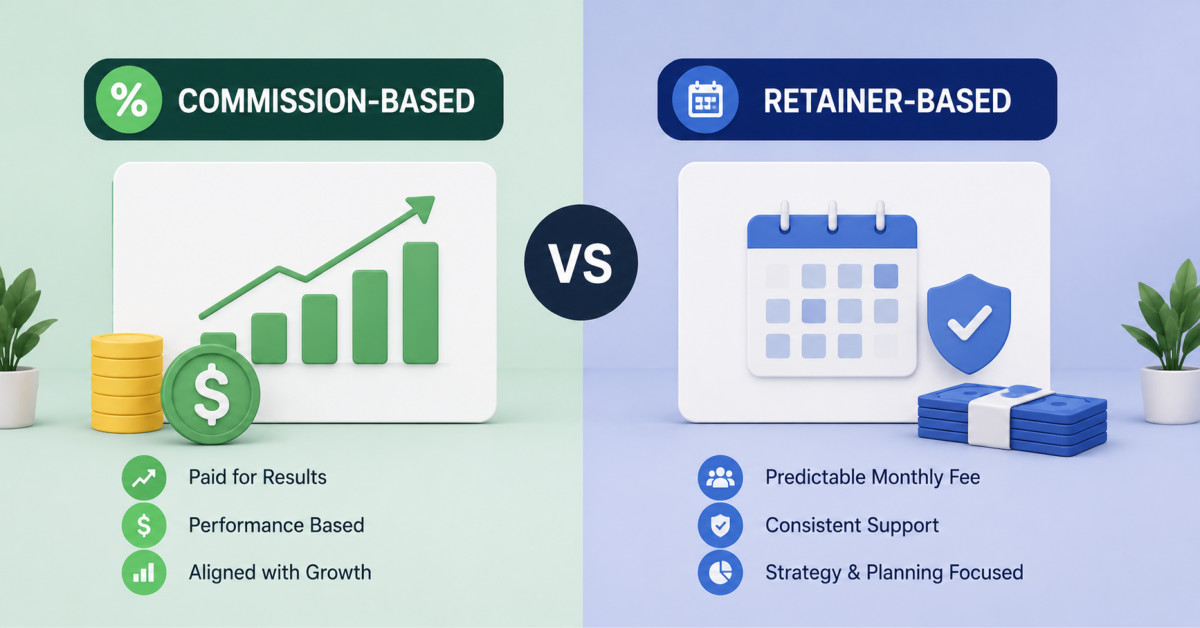
Commission-based agencies tie some compensation to defined results such as incremental revenue or sales, while retainer agencies charge for an agreed scope of expertise and delivery. For most Shopify brands, the right choice depends less on the pricing label than on attribution quality, contribution margin, operational control, and contract discipline.
A revenue-share agreement is not automatically more aligned than a retainer. It is more aligned only when the baseline, attribution, margins, costs, and decision rights are clear enough that both sides are optimizing for profitable growth.
When deciding between a commission-based marketing agency and a retainer-based marketing agency, it isn’t just about agency fees.
There are a number of differences between the two models in terms of how agencies are paid, how performance affects their compensation, how financial risk is allocated, and the way the partnership is structured.
As an eCommerce business, knowing these distinctions can assist you in picking the agency model that is right for you at this time and fits your resources and development objectives.
Here is how the two models compare.
Commission-based marketing agencies determine at least part of their fees based on an agreed result, while retainer agencies are primarily paid a recurring fee for an agreed scope of work.
A retainer marketing agency typically charges a fixed recurring fee for ongoing services. The amount is generally determined by the services, deliverables, workload, and team resources being provided under the contract.
A commission-based marketing agency links some or all of its compensation to a measurable outcome. The agency might charge a fixed amount for each qualified lead, appointment, acquisition, or sale, or earn a percentage of sales or revenue. Some agencies operate entirely on variable compensation, while others combine a base fee with a commission component.
| What Differs | Retainer-Based Agency | Commission-Based Agency |
| Fee structure | Recurring fixed fee for an agreed scope | Commission only or a base fee plus commission |
| Fee calculation | Based primarily on services, workload, and resources | Based on an agreed result such as a lead, sale, profit, or revenue share |
| Fee changes | Usually changes when the scope or agreement changes | Can increase or decrease according to the volume or value of agreed results |
Agencies’ scope of work is frequently influenced by the payment model.
The agency that operates based on a retainer fee typically starts with a set list of services and deliverables. The agreement can include a number of campaigns, advertising channels, landing pages, social media posts, email flows, strategy meetings, or reporting hours.
A commission-based marketing agency may work across a broader range of activities that influence the agreed performance result. For example, an agency paid based on leads may have a more focused scope, while one paid based on sales, revenue, or profit may need to influence more areas of the customer journey.
| What Differs | Retainer-Based Agency | Commission-Based Agency |
| Scope | Defined around contracted services and deliverables | Often broader to influence the agreed performance result |
| Priorities | Primarily focused on delivering the contracted scope | Often prioritizes activities that influence the agreed result |
| Additional work | Frequently requires a new scope and charge | May be included if it contributes to the agreed outcome and is covered by the agreement |
| Flexibility | Structured around predefined deliverables | May be more adaptable depending on the agreement |
This is not to say that commission-based marketing agencies offer unlimited services. A commission-based agreement still needs clear boundaries around responsibilities, channels, attribution, and what work is included.
Commission-based marketing agencies can take on more performance-related financial risk than retainer agencies.
With a retainer, the business agrees to pay the agency for its ongoing services and resources. The agreed fee generally remains payable as long as the agency delivers the contracted scope, even when the expected marketing results are not achieved.
With a commission-based marketing agency, some or all of the agency’s compensation depends on producing the agreed billable result. If fewer results are generated, the agency’s variable compensation may decline.
In other words, the retainer model puts more risk on the brand, whereas the commission-based model spreads the risk between the brand and the agency.
| What Differs | Retainer-Based Agency | Commission-Based Agency |
| Weak performance | The agreed fee generally remains constant if the scope is delivered | Variable compensation may decrease if fewer billable results are generated |
| Strong performance | The agreed fee generally remains unchanged | Variable compensation may be raised |
| Performance risk | Carried mainly by the brand | Distributed evenly between the two sides |
Commission-based marketing agencies can have a different partnership mindset because their incentives are structured differently.
The primary goal of a retainer agency is to provide the agreed scope well, maintain a good working relationship, and ensure the client is happy.
A commission-based marketing agency operates on a different level of incentives. It is easier to see the link between its success and the performance of the business because part of its compensation is tied to the revenue it is able to help generate. This provides more motivation to find issues, alter the strategy, and concentrate on actions that will boost income.
| What Differs | Retainer-Based Agency | Commission-Based Agency |
| Ownership | Carries out the agreed work primarily | Accepts greater accountability for work that impacts the agreed result |
| Relationship | Takes a more service provider approach | Works more closely around the agreed performance goal |
| Area | Retainer-Based Agency | Commission-Based Agency |
| Payment structure | Fixed or scope-based fee | Commission only or a base fee plus commission |
| Scope of work | The services and deliverables are specific | More wide-ranging work connected to the agreed performance result |
| Financial risk | A brand carries more performance risk | An agency shares part of the performance risk |
| Compensation | Primarily based on work and resources provided | Connected more directly to agreed performance results |
| Flexibility | Structured according to the original scope | Can adapt depending on the agreed outcome and scope |
| Relationship | Often works as a specialist service provider | Can be more closely aligned around specific performance results |
Commission-based marketing agencies may be more suitable for some businesses, while retainer-based agencies may be more suitable for others depending on the stage of your business, your marketing requirements, the data at your disposal, and the level of support you’re looking for from the agency.
| Consider This | Pick a Retainer-Based Agency When | Pick a Commission-Based Agency When |
| Marketing needs | You require certain services like paid ads, SEO, or email marketing | You want the agency’s compensation tied to a specific measurable result |
| Business stage | Your brand understands what to do and has an internal team that can do it or at least help out | Your business has enough data to set and measure meaningful performance targets |
| Performance data | You have little or no sales history, or results are difficult to measure | You have reliable data for the metric used to calculate commission |
| Agency role | A team is required to carry out a well-defined scope | A partner whose compensation is directly connected to the agreed result |
Here are five agencies that offer commission-based marketing that you might consider choosing. Examine each option and determine which is best suited for your business objectives.
Ideal for: Founder-driven eCommerce businesses looking for full-funnel growth solutions.
IMP Marketing seamlessly combines paid media, email and SMS, CRO, Shopify setup and management, creative, and growth strategy into one partnership. It uses a commission-based model tied to revenue, which is well suited to brands that are looking to expand beyond their growth ceiling.
Ideal for: B2B tech, SaaS, and cybersecurity businesses.
Digi-Tx takes a hybrid approach of a smaller retainer and commission-based pricing tied to revenue. It has services for strategy, content, SEO, paid media, website development, and lead generation in the technology space.
Ideal for: Businesses in the UK that need lead generation assistance.
Revenue Share Digital develops customer acquisition platforms with SEO, paid advertising, email automation, landing pages, and CRM integration. It provides commission-based options tied to revenue as well as lead buying options and gives more emphasis to service businesses.
Ideal for: B2B and B2C businesses looking for sales-focused performance marketing.
FunnelKake uses a hybrid approach of a low monthly retainer plus commission on the sales it generates. It provides SEO, PPC advertising, remarketing, website design, social media marketing, email marketing, and content strategy to support the sales funnel.
Ideal for: Established eCommerce and DTC businesses that are looking to expand their growth team.
Genero is a full-service growth agency that works with paid media, content, tech, CRO, and SEO. It has a commission-based model tied to revenue, which aligns agency fees with marketing income, making it the right platform for brands with wider marketing growth strategies.
Here are five agencies that are typically thought of when it comes to traditional marketing partnerships. They may charge different prices depending on the services and work agreed upon.
Ideal for: Companies looking for a wide range of channels and a full-service agency.
WebFX has eCommerce solutions such as SEO, PPC, content, email, CRO, and web development. It features public pricing materials, including monthly digital marketing and eCommerce service ranges.
Ideal for: Companies focused on paid media, creative, lifecycle marketing, and performance strategy.
Disruptive Advertising provides digital marketing solutions and tailor-made client proposals to eCommerce and other industry sectors. Companies should confirm what services they require and what the commercial model will be.
Ideal for: DTC companies that care about contribution margin and profitable growth.
Common Thread Collective is an eCommerce growth agency. It provides tools and services to predict contribution margin, paid media forecasts, and financial results. Certain public pricing options include a monthly fee or one that varies month to month.
Ideal for: Small and medium-sized eCommerce companies looking for web development, PPC, SEO, or integrated digital marketing.
SmartSites is an eCommerce development company, ad agency, and retail marketing company. Typically, pricing is done through a custom offer rather than a public commission-based rate.
Ideal for: Larger companies requiring full-funnel media, commerce, measurement, and marketplace assistance.
Tinuiti describes itself as an independent full-funnel marketing agency. It provides paid media, marketplaces, commerce, analytics, CRM, and measurement for larger and more complex brands.
Commission-based marketing agencies and retainer-based agencies differ in the way they benefit businesses. Retainer partnerships provide a clear-cut scope and support structure, while commission-based partnerships tie part of the agency’s compensation to an agreed performance result.
If your needs are specific and well-defined, then a retainer model might be more appropriate. A commission-based model may be more suitable when you want the agency’s incentives tied more closely to measurable performance.
The best model is the one that fits your needs, goals, and measurement capabilities. Whatever model you choose, set clear expectations, discuss cost upfront, and agree on what success looks like.
The main difference is how the agency is paid: a retainer agency receives a recurring fee for an agreed scope of work, while a commission-based agency ties part or all of its compensation to a measurable outcome such as leads, sales, or incremental revenue. Retainers provide more predictable agency cost and usually work well for specialized services. Commission models can create stronger commercial alignment, but only when the agreement clearly defines attribution, the baseline, costs, margin protections, and which growth levers the agency can actually influence.
Commission-based marketing agencies are not automatically less risky because the financial risk shifts into the contract’s definitions and measurement rules. A brand may pay less when sales decline, but it can still overpay if the agency earns commission on returning customers, branded demand, discounted revenue, or sales it did not create incrementally. Protect the business by using a realistic baseline, clear attribution rules, contribution-margin guardrails, refund and discount adjustments, and a cap or review mechanism for variable fees. Revenue without profitable incrementality is not a good outcome.
A Shopify brand should choose a retainer agency when it needs a defined specialist capability, wants predictable monthly costs, or cannot reliably attribute a specific revenue outcome to the agency’s work. Retainers work particularly well for technical SEO, Shopify development, lifecycle marketing, content production, creative systems, and complex analytics work where value compounds over time but cannot be credited cleanly to one channel. They also suit earlier-stage businesses that need stronger fundamentals before attempting a revenue-share partnership.
A revenue-share marketing agency contract should include the baseline, attribution model, commission rate, reporting source, channel scope, margin protections, cost treatment, decision rights, and exit terms. Define whether commission applies to gross sales, net sales, incremental revenue, or contribution profit. State how returns, taxes, discounts, shipping, ad spend, creative costs, subscription renewals, repeat customers, and offline sales are handled. The agreement should also explain who owns advertising accounts and data, how disputes are resolved, and what happens if the brand delays approvals or restricts access to key conversion levers.
A hybrid agency pricing model is often the most practical option because it gives the agency a stable base to staff and execute the work while rewarding verified performance above an agreed threshold. A small retainer can cover strategy, creative, analytics, and operational capacity that cannot be funded reliably by variable pay alone. The performance component then rewards incremental, margin-protected growth. Hybrid pricing still needs the same contract discipline as pure revenue share, especially around baseline calculations, attribution, cost treatment, and the agency’s real level of control.




