





Quick Decision Framework
- Who This Is For: Shopify merchants and DTC brand operators at any stage who want to understand what DeepSeek actually is, how it applies to ecommerce, and where it delivers measurable results without requiring a computer science degree to evaluate.
- Skip If: You are looking for a plug-and-play Shopify app you can install in five minutes. DeepSeek is an AI model, not a native Shopify integration. You will need either a developer or a no-code tool like Make to connect it to your store.
- Key Benefit: A clear, honest picture of where DeepSeek fits in your ecommerce stack, which use cases deliver real ROI, and how to get started without overcomplicating it.
- What You’ll Need: Basic familiarity with AI tools (no coding required to understand this guide), and an honest look at where your current customer experience has gaps that cost you revenue.
- Time to Complete: 10 minutes to read. 30 minutes to decide whether DeepSeek belongs in your stack and what to try first.
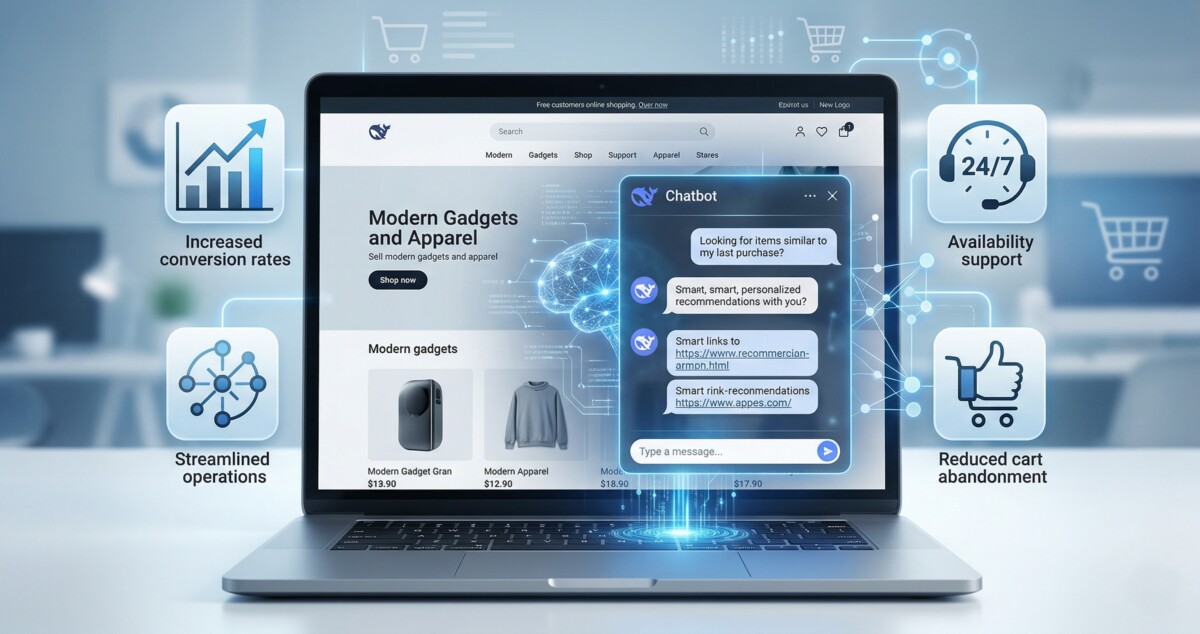
A shopper lands on your product page at 11 PM with a question about sizing. Your support team is offline. Your FAQ doesn’t cover it. They leave. That sale, and possibly that customer, is gone. AI-powered chat changes that equation entirely. And DeepSeek is one of the most capable, cost-effective engines now making it possible for brands of every size.
What You’ll Learn
- What DeepSeek actually is and why its open-source model makes it structurally different from ChatGPT and other proprietary AI tools.
- What the data says about AI chatbot performance in ecommerce, including conversion lift, cart recovery rates, and support cost benchmarks you can use to build a business case.
- Which specific ecommerce use cases deliver the clearest ROI: customer support, product content, personalization, and cart recovery.
- Where AI-powered chat still falls short, and how to set honest expectations before you invest time or money.
- How to think about getting started without a full technical overhaul, including the no-code options that exist right now.
Seventy percent of online shopping carts are abandoned. The average Shopify store converts somewhere between 1.5 and 3 percent of visitors. And most brands are still answering customer questions the same way they were five years ago: a static FAQ page, a support inbox, and a team that goes offline at 6 PM.
AI has changed what is possible here, and DeepSeek, the open-source model that sent shockwaves through the AI industry when it launched in late 2024, is one of the most compelling options now available to ecommerce operators who want enterprise-grade AI capabilities without enterprise-grade costs. This guide breaks down what it is, where it fits, and how to think about putting it to work in your store.
What Is DeepSeek and Why Does It Matter for Ecommerce?
DeepSeek is an open-source large language model developed by a Chinese AI research team and released publicly in December 2024. It comes in two variants that matter for ecommerce operators. DeepSeek-V3 is the general-purpose flagship model. It handles conversational tasks, content generation, and multilingual output at a level comparable to GPT-4o for most everyday applications. DeepSeek-R1 is the reasoning-focused model, built for complex, multi-step problem-solving. Think of it as the “think before you answer” variant, better suited to data analysis, pricing logic, or nuanced customer scenarios.
Both models are released under an MIT license, which means they are free to use, modify, and deploy commercially. That is a significant distinction from OpenAI’s ChatGPT or Anthropic’s Claude, which operate on closed, subscription-based models where you rent access rather than own the capability.
The cost advantage is real and dramatic. DeepSeek-R1 was trained at a total cost of roughly $5.5 to $6 million. For context, GPT-4’s training reportedly cost an order of magnitude more. The result is a model that delivers comparable performance at a fraction of the price to run.
For a brand handling thousands of customer conversations per month, that cost difference has a real impact on unit economics. The open-source model also means developers can self-host DeepSeek on their own infrastructure, giving brands full control over data privacy, customization, and cost predictability. That is something that is structurally impossible with closed-source alternatives.
In practice, most ecommerce teams are using DeepSeek as the backend engine powering tools that customers interact with through a branded interface. The end customer never sees “DeepSeek.” They just experience a smarter, faster, more helpful shopping experience.
What the Data Actually Says About AI Chat in Ecommerce
Before getting into specific use cases, it is worth grounding this conversation in what the research shows. Because the numbers are striking, and they explain why this technology has moved from interesting experiment to competitive necessity so quickly.
Shoppers who interact with AI chat convert at a rate of 12.3 percent, compared to just 3.1 percent for unassisted visitors. That is nearly a 4x conversion lift from a single touchpoint. Of the roughly $4 trillion in annual abandoned cart value globally, an estimated $260 billion is recoverable with the right intervention. AI chatbots can recover 15 to 25 percent of lost sales when they are proactive, personalized, and integrated with real-time inventory and pricing data. Eighty-two percent of customers prefer chatbots to waiting for a human support agent for routine questions. AI chatbots cut customer support costs by up to 30 percent by automating inquiries that do not require human judgment. And conversational AI delivers a 249 percent ROI over three years, with payback periods as short as six months for brands that implement it thoughtfully.
The global AI chatbot market is on track to reach $46.6 billion by 2029, growing at 24.5 percent annually. AI chatbot traffic surged 81 percent year over year in 2024 to 2025. This is not a niche technology. It is rapidly becoming a baseline expectation for competitive ecommerce operations.
The key qualifier in all of this: those results come from intelligent, integrated, proactive AI systems, not the basic rule-based bots that give chatbots a bad reputation. DeepSeek’s advanced natural language processing and reasoning capabilities are what make the difference between a bot that frustrates customers and one that actually converts them. This is also directly connected to the shift to agentic commerce, where AI is moving beyond answering questions and into completing transactions on a shopper’s behalf.
Where DeepSeek Delivers for Ecommerce: The Real Use Cases
Let’s get specific. Here are the applications where DeepSeek-powered AI creates the most measurable impact, with honest context about what to expect from each.
Customer Support Automation
Handling returns, answering FAQs, tracking orders, clarifying product details: these tasks consume a disproportionate amount of support team bandwidth, and most of them follow predictable patterns. DeepSeek-powered support automation handles this category of inquiry with high accuracy, freeing your human team to focus on complex, high-value interactions that actually require judgment.
The numbers are compelling. AI chatbots resolve 70 percent of customer queries in fewer than 11 messages. Support costs drop by up to 30 percent. And customer satisfaction often improves because 24/7 availability and instant responses are genuinely better than waiting hours or days for a reply to a simple question. For businesses that want implementation details, this guide to building a website support chatbot with DeepSeek API is a practical next step.
Cart Abandonment Recovery
Cart abandonment is one of the most expensive problems in ecommerce. Nearly 70 percent of online carts are abandoned, and the primary reasons are almost always the same: unexpected shipping costs, unanswered questions about returns or sizing, or last-minute uncertainty about whether the product is right for them. AI-powered chat addresses all three root causes in real time.
Instead of waiting to send a recovery email hours later, DeepSeek-powered systems can detect exit intent and intervene immediately with a personalized message that addresses the specific concern. A DTC skincare brand reduced cart abandonment by 22 percent in 30 days using an AI agent that engaged exit-intent visitors with personalized offers and real-time support. A fashion retailer with a 78 percent abandonment rate deployed an AI agent and recovered 24 percent of abandoned carts within weeks, while simultaneously reducing support tickets by 30 percent. The key word is “well-implemented.” Generic bots that send static “Don’t forget your cart!” messages do not move the needle. DeepSeek’s conversational intelligence is what enables the dynamic, context-aware interventions that actually convert.
Personalized Product Recommendations
Personalization has always been the holy grail of ecommerce. The challenge has been doing it at scale without a massive data science team. DeepSeek changes that equation by enabling deep learning-based personalization that analyzes browsing history, past purchases, and real-time behavioral signals to surface genuinely relevant recommendations.
This goes well beyond “customers who bought this also bought that.” DeepSeek’s natural language understanding allows it to process product descriptions, customer reviews, and behavioral signals so recommendations are based on contextual meaning, not just keyword matching. A customer who spent 10 minutes in your hiking boot category and then searched for “waterproof” gets different suggestions than one who browsed casually for two minutes. AI-powered recommendations increase Average Order Value by 10 to 15 percent and significantly reduce the time customers spend searching for products.
Product Content Generation at Scale
Writing compelling, SEO-optimized product descriptions for hundreds or thousands of SKUs is a significant bottleneck for any merchant with a large catalog. DeepSeek can eliminate it. Because DeepSeek is open-source and customizable, merchants can fine-tune it on their existing product copy to ensure the AI writes in their brand voice rather than generic marketing language. One retailer used a DeepSeek integration with Google Sheets to generate descriptions for over 2,000 products across different categories in a single afternoon. The descriptions came out unique, on-brand, and search-optimized, work that would have taken weeks of manual effort.
Upselling and Cross-Selling
AI systems are significantly better than static rule-based recommendation engines at identifying upsell and cross-sell opportunities because they can analyze purchasing patterns across thousands of transactions and surface connections that are not obvious from manual analysis. A customer buying a camera is likely to need a memory card, a case, and a cleaning kit. But the right recommendation at the right moment during checkout, not on a product page they have already scrolled past, is what converts that insight into revenue. DeepSeek-powered systems identify these moments and present recommendations in a conversational way that feels helpful rather than pushy.
Order Tracking and Post-Purchase Support
“Where is my order?” is consistently among the most common support inquiries for any ecommerce brand, and it is also one of the easiest to automate well. DeepSeek-powered order tracking allows customers to check their order status instantly, in natural language, without navigating to a separate tracking page or waiting for a support response. Integrated with your fulfillment system, the AI can provide accurate, real-time updates and proactively notify customers about delays or delivery confirmations, turning a potential frustration point into a positive touchpoint.
Sentiment Analysis and Feedback Collection
DeepSeek’s natural language processing capabilities extend to analyzing unstructured text at scale: customer reviews, support conversations, social media mentions. For ecommerce brands, this means the ability to identify product quality issues, emerging customer concerns, and sentiment trends before they become significant problems. Post-purchase feedback collection through AI-powered chat also achieves higher response rates than traditional email surveys because the conversation feels natural and the ask comes at the right moment in the customer journey.
Challenges and Honest Considerations
No technology is a silver bullet, and DeepSeek is no exception. Here is what to think through before you commit to implementation.
DeepSeek is more powerful than a plug-and-play Shopify app, but it also requires more setup. Accessing the full capabilities of the API requires some technical knowledge, or a third-party integration layer like Make or Zapier. If you do not have developer resources, start with an integration tool rather than building directly against the API.
Handling customer data through any AI system requires attention to privacy regulations: GDPR, CCPA, and whatever applies to your markets. DeepSeek’s open-source nature actually helps here, because self-hosting means your data does not leave your infrastructure. But you still need to think through data handling, retention policies, and customer consent. It is also worth noting that DeepSeek is a Chinese-developed model, which raises data sovereignty considerations for some brands and markets. Self-hosting on your own infrastructure addresses most of the practical risk if this is a concern.
AI chatbots are excellent at handling predictable, high-volume interactions. They are less suited to genuinely complex, emotionally charged, or high-stakes situations. A customer dealing with a significant order error, a complaint that requires empathy and judgment, or a scenario that falls outside the AI’s training data: these still need a human. The best implementations use AI to handle the routine efficiently while routing genuinely complex cases to human agents seamlessly. The goal is not to replace your support team. It is to let them focus their time on the interactions where human judgment actually matters.
An AI system that is not monitored and updated will drift in quality over time as your product catalog changes, your policies evolve, and customer expectations shift. Build a feedback loop into your implementation from day one. Review conversations regularly, identify gaps in the AI’s knowledge base, and update your training data accordingly. The brands tracking how AI shopping agents are reshaping discovery are already building these feedback loops into their operations.
How to Get Started Without Overcomplicating It
The most common mistake brands make with AI implementation is trying to do everything at once. Pick the use case with the clearest ROI for your business right now and build from there. For most ecommerce brands, that is either customer support automation or cart abandonment recovery, because both have well-established benchmarks and relatively straightforward implementation paths.
Tools like Make already offer pre-built DeepSeek-Shopify integrations for common workflows. You do not need to build against the API directly to start seeing results. Start with a no-code or low-code integration, prove the value, and then invest in more sophisticated custom development if the business case supports it. If you want a practical starting point for evaluating where your store is ready for AI-driven experiences, the Shopify AI visibility audit is a useful first step.
The difference between a generic AI chatbot and one that actually represents your brand is the quality of the training data you provide. Feed it your product catalog, your FAQs, your return and shipping policies, your historical support conversations, and examples of your brand voice. The more context the model has, the more accurately it will represent your business in customer interactions.
Define what success looks like before you go live. Common metrics to track: conversion rate of AI-assisted sessions versus unassisted, cart abandonment rate before and after implementation, Average Order Value from AI-influenced transactions, support ticket volume and cost per ticket, and customer satisfaction scores for AI-handled interactions. Run a 60 to 90 day baseline before drawing conclusions. AI performance improves over time as the system learns from real interactions, so early numbers often understate long-term impact.
Why Moving Now Creates a Compounding Advantage
Early adoption of AI-powered customer experience tools creates a compounding advantage that is hard for later movers to close. Every conversation your AI handles generates signal about your customers, your products, and your conversion funnel. The earlier you start collecting that data, the better your system performs, and the harder it is for competitors who start later to catch up.
Brands that automate routine support interactions now are building cost structures that allow them to compete more aggressively on price, marketing, or product investment as they scale. Shoppers who experience excellent AI-powered support from one brand bring those expectations to every other brand they interact with. The bar is rising. Brands that meet it early build loyalty. Brands that fall behind it lose customers to competitors who do not.
Every month without AI-powered cart recovery is a month of recoverable revenue left on the table. At an industry-average abandonment rate of 70 percent, the opportunity cost of inaction is real and measurable. This connects directly to where ecommerce is heading: an answer-first content and commerce strategy where the brands with the clearest product data and the most responsive customer experiences win the AI-driven discovery moment.
DeepSeek’s open-source model, frontier-class performance, and dramatically lower API costs make it one of the most compelling options available to ecommerce brands right now, whether you are a solo founder running a Shopify store or a multi-team operation managing a complex catalog across multiple channels. The question is not whether AI will transform ecommerce. It already is. The question is whether your brand will be on the leading edge of that transformation, or playing catch-up to competitors who moved first.
Frequently Asked Questions
What is DeepSeek and how does it apply to ecommerce?
DeepSeek is an open-source AI model developed by a Chinese research team and released in December 2024. For ecommerce, it serves as a powerful, cost-effective foundation for AI-powered applications including customer support chatbots, personalized product recommendations, cart abandonment recovery, and product content generation at scale. Its open-source nature means it can be customized and fine-tuned on your specific product catalog and brand data, unlike proprietary models that operate as black boxes. Most merchants access it through a no-code integration layer like Make rather than building directly against the API.
How do AI chatbots actually improve ecommerce conversion rates?
AI chatbots improve conversion through several mechanisms: they engage shoppers in real time with personalized product recommendations that increase conversion rates and Average Order Value; they intervene proactively when customers show exit intent, recovering 15 to 25 percent of abandoned carts; they answer product and policy questions instantly, reducing the friction that causes shoppers to leave without buying; and they handle routine support inquiries 24/7, ensuring customers always get a fast response regardless of when they shop. Shoppers who interact with AI chat convert at 12.3 percent versus 3.1 percent for unassisted visitors.
Is DeepSeek expensive to implement for a Shopify store?
DeepSeek is significantly less expensive than comparable proprietary AI models, costing approximately 50 times less than GPT-4 Turbo for equivalent workloads. Initial setup costs depend on your approach. Using a no-code integration layer like Make is the most accessible starting point and requires no developer resources. Custom API development offers more flexibility and control but requires technical expertise. The ROI case is strong: conversational AI delivers a 249 percent ROI over three years with payback periods as short as six months for brands that implement it thoughtfully and measure results consistently.
Can AI chatbots replace my human customer service team?
AI chatbots handle high-volume, predictable interactions well: FAQs, order tracking, return policy questions, product details. They resolve 70 percent of customer queries in fewer than 11 messages and reduce support costs by up to 30 percent. They are not suited to genuinely complex, emotionally sensitive, or high-stakes situations that require human judgment and empathy. The best implementations use AI to handle routine inquiries efficiently, freeing human agents to focus on interactions where their skills actually matter. The goal is augmentation, not replacement. Your support team’s time becomes more valuable, not less.
What is the difference between DeepSeek-V3 and DeepSeek-R1 for ecommerce?
DeepSeek-V3 is the general-purpose model, fast, conversational, and well-suited to customer-facing applications like support chat, product recommendations, and content generation. DeepSeek-R1 is the reasoning-focused model, designed for complex, multi-step problems where accuracy and logical consistency are critical. For most ecommerce applications, V3 is the right starting point. R1 becomes relevant for more sophisticated use cases like dynamic pricing logic, complex data analysis, or scenarios where the AI needs to reason through multiple variables before responding. Start with V3, and consider R1 only when you have a specific use case that demands deeper reasoning capability.
