

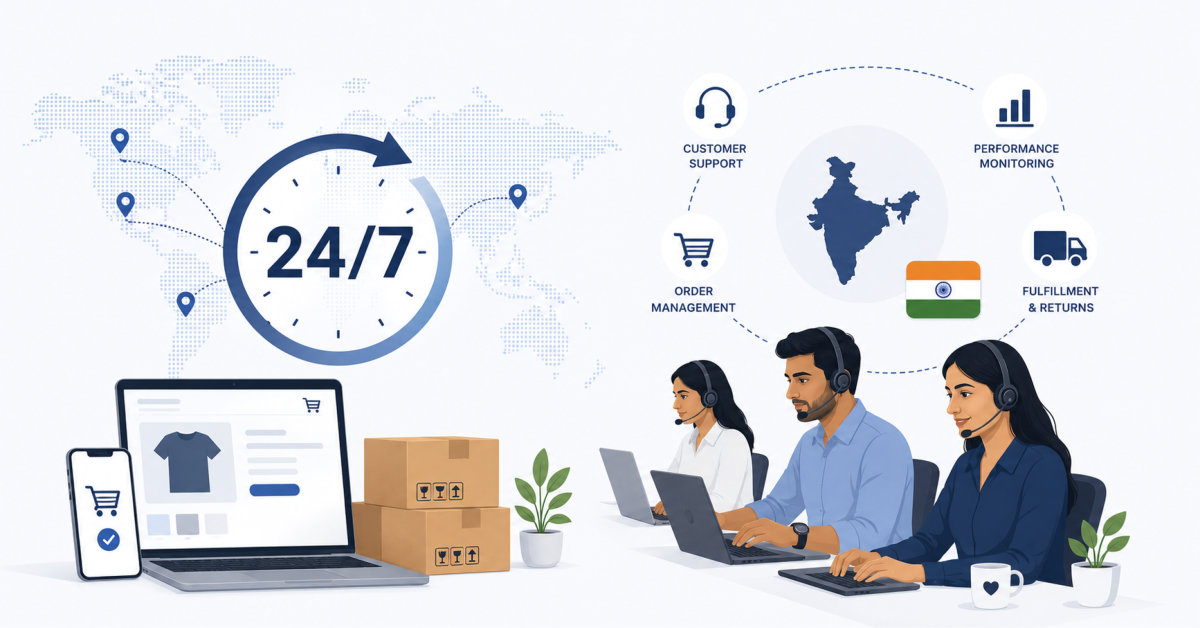
Growth creates a new problem for ecommerce brands: more orders also mean more exceptions.
Product feeds break. Marketplace listings go offline. Payment failures remain unresolved. Return requests pile up. Customers ask where their orders are while the main operations team is asleep.
Most brands respond by adding people to existing departments. But adding another customer support agent or operations coordinator does not always solve the coverage gap.
A better option is to build a small ecommerce operations pod in India.
An India ecommerce operations pod is a small, cross-functional team that handles defined ecommerce workflows from India.
It does not replace the brand’s strategy, creative or leadership teams. Instead, it keeps essential operational work moving across time zones.
A typical pod may manage:
The pod works best when it owns clear queues, decision rules and measurable outcomes.
This is different from sending random administrative tasks to an offshore assistant. The pod becomes part of the brand’s operating system.
Traditional outsourcing usually starts with tasks.
A brand creates a long list of activities, sends them to an external provider and measures how many items the provider completes.
But ecommerce work is rarely that simple.
A delayed order may require the operator to check the fulfilment platform, contact the warehouse, review the customer’s history, approve a replacement and update the CRM. Treating each step as a separate task creates delays and unclear ownership.
An operations pod should instead be organised around business events.
| Business event | Pod responsibility | Desired outcome |
|---|---|---|
| Order has not shipped | Check fulfilment status and escalate | Order shipped or customer updated |
| Payment has failed | Review failure reason and follow recovery process | Payment recovered or case closed |
| Product listing is suppressed | Identify the listing issue and coordinate correction | Listing restored |
| Customer requests a return | Verify eligibility and initiate the workflow | Return completed within policy |
| Inventory reaches its threshold | Confirm data and notify the responsible owner | Stockout prevented |
| Product data is inconsistent | Correct the feed or catalogue record | Accurate product information |
This approach gives each queue a clear end state.
A pod does not need to manage the entire ecommerce business. It should start with three focused queues.
This queue covers operational issues that may stop or reduce sales.
Examples include:
The pod should document the issue, estimate its impact, complete approved fixes and escalate anything outside its authority.
Customer service teams often answer questions but lack the authority or system access needed to solve the underlying problem.
A customer recovery queue focuses on cases where the customer relationship or order is at risk.
The pod may handle:
The goal is not to close tickets quickly. It is to prevent avoidable cancellations, chargebacks and customer loss.
Small data errors can create large operational problems.
An incorrect SKU may affect the storefront, warehouse system, advertising feed and marketplace listing at the same time.
The data hygiene queue can manage:
This work is repetitive, but it directly affects merchandising, fulfilment, marketing and customer experience.
A five-person pod does not need five managers. It needs clear workflow ownership.
| Role | Main responsibility |
|---|---|
| Ecommerce operations lead | Owns queues, escalation rules and reporting |
| Customer recovery specialist | Manages complex order and customer cases |
| Marketplace operations specialist | Handles listings, feeds and marketplace issues |
| Catalogue and CRM coordinator | Maintains product and customer data |
| Reconciliation analyst | Reviews order, payment, refund and inventory records |
Smaller brands can begin with two or three people and combine related responsibilities.
The first hire should usually be the operations lead. Without one accountable owner, work gets distributed across several people but no one owns the result.
The correct structure depends on how the work is managed.
Misclassification becomes a concern when a business calls someone a contractor but manages that person like a full-time employee.
For recurring, company-directed roles, an Employer of Record is often a cleaner structure. The EOR legally employs the team through its Indian entity and manages local employment contracts, payroll, tax deductions, statutory benefits and HR compliance. The ecommerce company continues to control daily work and performance. Brands can review this detailed guide to using an Employer of Record in India before choosing a structure.
A successful launch begins with workflow design, not recruitment.
Review the previous 60 to 90 days of operational issues.
Identify:
Select three to five workflows for the first pod. Do not transfer every operational task at once.
For each workflow, document:
Clear authority prevents both unnecessary escalations and uncontrolled decisions.
Training should use real cases, not only presentation slides.
Give each team member examples of:
The team should also understand how its work affects revenue, customer retention and brand trust.
Start with one channel, marketplace, product category or customer segment.
Run the pilot long enough to identify weak handoffs and missing permissions.
Expand only after the team can complete the selected workflows without constant intervention from the main office.
Ticket count alone does not show operational value.
Brands should track four additional measures.
Coverage debt is the number of urgent operational issues still unresolved when the core market begins its next working day.
A successful pod should reduce this number over time.
This measures how many open cases include:
Incomplete handoffs force the next team to repeat the investigation.
Revenue recovery measures the value protected through actions such as:
Not every issue will produce a direct revenue figure. But the pod should identify cases where its action protected an order or sales channel.
This measures how often a customer contacts the brand again about the same unresolved problem.
A falling repeat contact rate usually signals better case ownership and stronger resolutions.
An offshore pod should not receive unrestricted access to every platform.
Use role-based access and give each person only the permissions required for their workflows.
A basic control model should include:
Access should follow the workflow. A catalogue coordinator may need to edit product data but should not need permission to issue refunds or export the complete customer database.
An EOR is useful when the brand wants to hire and directly manage employees in India but does not yet have an Indian company.
The EOR becomes the legal employer. It manages local payroll, employment documentation, statutory contributions, benefits and offboarding while the ecommerce business manages the person’s everyday responsibilities.
Peorient’s analysis of real employer costs in India places contractors as the better fit for short, independent projects and an EOR as a practical option for teams that need speed, direct management and continuing employment. Its current guide suggests that establishing an entity generally becomes more economical after the company has built a larger, committed workforce, often around 30 to 50 employees. This is a planning benchmark, not a fixed legal threshold.
The provider choice should also match the expansion plan.
A global platform may make sense when a brand is hiring across many countries and wants one central system. An India-focused provider can make more sense when the company needs local payroll knowledge, India-specific compliance support and direct help with employee operations.
Remunance is an India-focused EOR provider that supports employment contracts, onboarding, payroll, tax compliance, statutory benefits and ongoing HR administration. This lets a DTC or Shopify brand build an India team while retaining operational control of the employees.
An EOR can act as the first operating layer, not necessarily the final structure.
Consider establishing an entity when:
The advantage of beginning with an EOR is that the brand can first test its recruitment plan, operating model and actual headcount needs.
It can build the entity after the business case is proven rather than before the first hire.
Yes. It can use an Employer of Record that employs the workers through its Indian entity and manages the local employment obligations.
Common roles include customer recovery, marketplace operations, catalogue management, CRM operations, order reconciliation, reporting and inventory coordination.
No. A call centre mainly manages customer conversations. An operations pod owns business workflows and may work across customer service, marketplaces, fulfilment, data and finance systems.
Contractors are suitable for independent, project-based work. Recurring roles with fixed schedules, direct supervision and continuing company responsibilities may be more appropriately structured as employment.
Many brands can start with two to five people. The correct size depends on queue volume, operating hours, system complexity and the number of workflows being transferred.
Begin with recurring issues that remain unresolved overnight, affect revenue or customer trust, and can be handled through clear decision rules.
An EOR legally employs individuals whom the client company manages day to day. An outsourcing company generally manages its own staff and delivers a contracted service or outcome.
An India ecommerce operations pod should not be treated as a collection of low-cost assistants.
It should be built as a controlled operating unit with clear queues, system permissions, escalation rules and commercial metrics.
Start with the problems that lose revenue or create customer frustration while the main team is offline. Give the pod ownership of the complete resolution process. Then measure how much work it prevents from returning to the core team.
The strongest outcome is not simply lower staffing cost.
It is an ecommerce operation that keeps moving after the main office signs off.
Remunance helps international companies hire, employ and manage teams in India without establishing a local entity. Its Employer of Record services cover onboarding, India-compliant employment contracts, payroll, statutory compliance, employee benefits and ongoing HR support.





