
Overconfidence hides in your roadmap, not just your channels; here’s how to spot it and fix it.
The real growth killers in ecommerce aren’t always channel shifts or new competitors—they’re the silent blind spots in your own thinking.
The real growth killers in ecommerce aren’t always shifts in channels or emerging competitors—they often come from the blind spots in your own thinking. One of the most dangerous cognitive biases is the Dunning-Kruger effect. This bias causes individuals to overestimate abilities, often placing them at what’s humorously called “Mt. Stupid,” where confidence is high but competence is low. At the same time, truly skilled people may underestimate their strengths, creating a challenging dynamic for leadership.
Here’s why every ambitious ecommerce leader needs to understand this: the Dunning-Kruger effect seeps into product roadmaps, marketing strategies, and key decisions. It can push teams to launch features without sufficient user feedback, overlook critical retention issues, or let the loudest voice steer the strategy. Meanwhile, talented team members might hold back, doubting their contributions despite their real value.
If your goal is sustainable growth—not just short-term spikes—you must recognize how this cognitive bias can warp your decision-making and company culture. I’ve witnessed it firsthand, from eight-figure DTC brands missing obvious opportunities to Shopify Plus teams losing revenue. In this article, we’ll explore how to identify the Dunning-Kruger effect, safeguard your team culture from its pitfalls, and foster habits that encourage genuine learning rather than misplaced confidence.

Let’s put it on the table: the Dunning-Kruger effect isn’t just another pop-psychology buzzword. For anyone scaling a serious ecommerce business, this cognitive bias shapes the decisions your team makes when nobody’s watching—and it’s sneakier than you think. Understanding what the Dunning-Kruger effect is, and why you and your team aren’t immune to its influence, is a key move if you want real operational improvement and sustainable growth.
At its simplest, the Dunning-Kruger effect describes a pattern where people with limited skills or competence in a specific area often have more confidence in their abilities than is justified. This is especially common in situations where the feedback loop is unclear or there isn’t a clear scoreboard. People lacking competence often find it difficult to recognize their own gaps—what some refer to as the “Mt. Stupid” stage, where unconscious incompetence breeds overconfidence. Conversely, those with true expertise may underestimate their own skill levels, assuming that what feels effortless for them is easy for everyone else.
What causes this mismatch? It’s partly ignorance, yes, but it’s also that without enough experience, you’re not just unaware of what you don’t know—you literally can’t spot the holes.
Picture your last major roadmap review. Did everyone bring data and critical scrutiny—or did the loudest, most confident voice win? This is a common pitfall for ecommerce teams because:
These factors aren’t just personality quirks—they’re baked into how business operates when uncertainty is high and feedback is fuzzy. This plays out in everything from feature prioritization and user research to hiring decisions.
A crucial clarification: the Dunning-Kruger effect doesn’t mean that less intelligent people are always more confident. It’s tied to specific skills or experience within a particular context. Classic research showed that people who scored lowest on grammar and logic tests significantly overestimated their competence. You can explore a clear definition and history of the effect here.
The reverse also matters. High performers, who have mastered skills that feel second nature to them, often assume others operate at the same level. This explains why a top retention team might quietly doubt whether their funnel is “good enough” — while a newcomer confidently proposes “innovations” without recognizing hidden pitfalls.
Unchecked, the Dunning-Kruger effect leads to wasted quarters, missed test cycles, and scaling headaches. When teams believe their ads are perfectly dialed in, they stop experimenting. When someone thinks they lack data skills, they avoid high-leverage analytics efforts. Both scenarios slow real learning and impede compounding growth.
Want a quick test? Ask yourself: when was the last time a confident pitch from a team member launched without rigorous scrutiny—only for the data to reveal their rosy forecast was wildly off?
Awareness of this cognitive bias is the first step; action is how you gain an edge. Learn more about how the Dunning-Kruger effect manifests in different business settings at The Decision Lab, or dive into concrete examples and deeper research from Britannica.
The bottom line: you can’t solve what you can’t see. Recognizing the Dunning-Kruger effect in yourself and your teams is the crucial first move toward smarter decisions and bigger wins.
If you’re serious about building a lasting ecommerce brand, recognizing how the Dunning-Kruger effect subtly influences your daily operations is essential. This phenomenon isn’t just a “soft” mental trap—it impacts your decisions in critical areas like talent development, campaign strategy, and sustained growth. In this section, I’ll explain why understanding these blind spots gives founders and marketers a vital edge, not just empty advice.
I’ve witnessed countless founders overestimate abilities and shut down crucial lines of inquiry with, “We know our customers.” That’s often the red flag. Overconfidence doesn’t always come as flashy bravado—it can show up as skipping essential customer research or disregarding a competitor’s sharper moves.
Some of the most damaging behaviors I see linked to overconfidence include:
Ignoring reality has tangible costs. Overconfidence sets the tone for the entire team; when leadership has blind spots, the whole organization ends up repeating mistakes rather than outpacing competitors. This misalignment wastes time and resources—the exact opposite of successful scaling. If you want a parallel in another fast-moving field, consider traders who ride beginner’s luck and face steep losses when markets shift. Ecommerce, a VUCA world of volatility and complexity, faces the same risks. Both overconfidence and procrastination silently drain your team’s potential—learn more about ways to stop procrastinating effectively.
The other side of this coin is more subtle but equally costly. If you’ve worked alongside quietly brilliant analysts or operations leads, you understand the challenge. Those who underestimate their own expertise often shy away from big projects, let others claim credit, and fail to advocate for improvements they identify immediately.
This underestimation translates into:
For founders aiming to build multi-year businesses, overlooking hidden talent is like leaving money on the table. Check out hiring new ecommerce employees: 5 essential focus areas to create frameworks that not only attract but fully activate and develop this talent. Investing in ongoing learning ensures your best people continue to push themselves—and your business—forward.
If you notice a quiet rockstar on your team, ask: Are they allowing imposter syndrome to dictate their voice? Give them a nudge. Your engaged bench of A-players can deliver category-defining wins. Often, what holds them back isn’t ability—it’s the silent side of the Dunning-Kruger effect.
Learning to recognize the Dunning-Kruger effect is essential not just for identifying overconfident team members, but also for understanding how hidden skill gaps and self-doubt influence critical decisions in a 7- or 8-figure ecommerce business. Being able to recognize these subtle patterns early supports faster feedback cycles, encourages continuous learning, and drives more strategic success.
The Dunning-Kruger effect often emerges when a lack of skills is masked by overconfidence. This rarely looks like bragging in meetings; instead, you might notice:
Such behaviors can quietly lead a brand off course—whether it’s skipping usability tests or ignoring seasoned advice in operations, this bias undermines both incremental and exponential growth. To overcome these hidden challenges, consider how experienced founders use intellectual humility and humility-driven leadership to pivot their thinking.
To better recognize the Dunning-Kruger effect, it helps to understand the four stages of competence, a framework that illustrates the shift from novice to expert while promoting honest self-assessment and self-awareness:
Recognizing where you and your team members fall within these stages of competence can transform how you assign projects, make hiring decisions, and provide coaching. It also helps avoid common traps like conflating beginner’s luck with true skill or overlooking emerging talent. For deeper insights into self-assessment and team development, explore expert interviews and learning journeys featured on the EcommerceFastlane podcast.
Real progress for ecommerce founders isn’t about avoiding the Dunning-Kruger effect altogether. It’s about spotting the warning signs early, embracing the natural learning curve, and fostering a culture where feedback and intellectual humility drive every major win.

If you’re serious about long-term growth, simply recognizing the Dunning-Kruger effect isn’t enough. You need practical strategies to keep blind spots in check—for yourself and your team. What I’ve seen drive success in fast-scaling ecommerce brands (and quietly derail many others) is prioritizing regular feedback, encouraging honest dialogue, and cultivating habits that keep ego—and lack of humility—in balance, no matter how sharp your edge.
A feedback-driven culture isn’t just for show—it’s the engine that keeps your teams aligned and self-aware. Organizations that embrace open communication and consistent peer review detect errors sooner, accelerate innovation, and attract top talent. The challenge? Many businesses think they excel at feedback, but often these conversations remain surface level, overly gentle, or disappear once projects “go live.”
When feedback becomes the norm, employees are less likely to overestimate their skills and more open to constructive criticism without defensiveness. The outcome is faster learning cycles, reduced “pet project” waste, and a genuine sense of collective accountability.
Want proven ways to get your team speaking up and combating blind spots? Explore these employee engagement tips for ecommerce. There’s a direct link between the culture you nurture and your ability to outpace competitors.
To see this approach in action, listen to guests on the Ecommerce Fastlane podcast share candid stories of failed campaigns and their eventual rebounds. These aren’t just war stories—they’re a playbook for making feedback your brand’s superpower.
Let’s get real: overcoming challenges related to self-awareness and humility as a founder or marketer is a daily battle against your own ego. High performers often either overplay their wins or silently downplay their strengths—both of which create obstacles to true growth.
Here are tested tactics anyone can implement today:
Looking to build newfound confidence that lasts? Push through early self-doubt by acting before you feel “ready.” This approach—explored in Start Your YouTube Channel with Confidence—helps break through perfectionism and inertia.
For leaders building brands from the ground up, regular ego checks based on humility and self-awareness create a foundation for sustainable growth. When done right, you see more clearly, move faster, and become the kind of leader others want to follow. The brands that win aren’t those with the loudest voices—they’re the ones sharpening their edge month after month, no matter how high they climb.
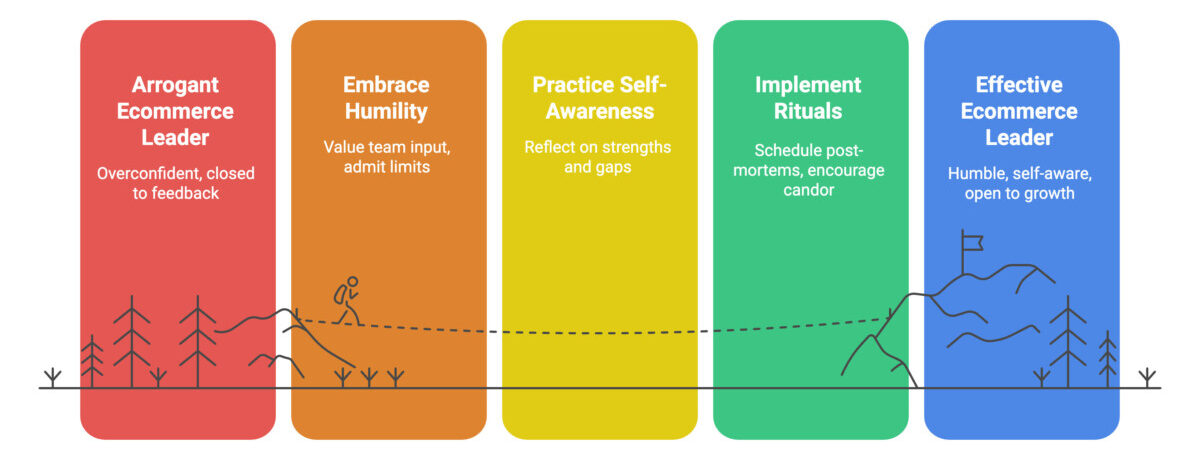
Ecommerce moves at a breakneck pace, but getting too high on your own headlines or tuning out feedback is a fast track to capped growth. Humility and self-awareness aren’t just nice-to-have character traits—they’re competitive assets and core values. Leaders who embrace intellectual humility and honest self-reflection build companies that outlast sudden platform shifts and keep bouncing back when the market throws curveballs.
Think about the brands that keep climbing: they’re led by people who don’t just celebrate wins—they question them. They use every quarter as a gut check, not an excuse to coast. Here’s why humility and self-awareness serve as a powerful growth multiplier and keep you from becoming your own biggest obstacle.
Humility in leadership isn’t about playing small or hiding your strengths. It’s about recognizing the limits of what you know right now, asking for help when you don’t, and showing your team that growth matters more than being “right.” Practicing intellectual humility does a few important things:
Consistent humility supports cultures where talent feels safe to question processes, challenge groupthink, and present bold fixes. For a real-world master class in this, study how Barbara Corcoran Shark Tank Story illustrates the power of staying open to feedback and course correction—even for brands that have “made it.”
Self-awareness is a leader’s secret weapon. Instead of getting trapped in assumptions or cognitive bias like the Dunning-Kruger effect, you regularly pause and ask: “What’s true here? What am I not seeing?” Successful founders and operators dedicate time to reflect on both strengths and gaps.
Building self-awareness in yourself (and your leadership team) leads to:
Not sure where to start? Try implementing a few of the Mindful E-commerce Strategies for 2024. Building regular reflection into your personal calendar, or making team debriefs a habit, grounds your decision-making—especially when things get noisy.
The most effective ecommerce leaders operate where ambition meets humility. They keep raising the bar, but not by pretending to have all the answers. Here’s how you can make these qualities a built-in advantage:
Want to see how top founders keep their edge? Look at the Traits of Highly Effective Leadership for perspectives on why self-awareness sits at the root of every high-output team.
Humility and self-awareness aren’t souvenirs you pick up once. They’re ongoing practices. In a marketplace where the Dunning-Kruger effect and other cognitive biases can derail even the hardest-working teams, building your long-term value means grounding every call in honest self-checks and an appetite for new input. Practice this, and your brand’s ceiling keeps rising quarter after quarter.
Understanding the Dunning-Kruger effect isn’t just a psychology lesson—for high-growth founders and marketers, it directly impacts better decisions and stronger business outcomes. Recognizing how overconfidence and self-doubt skew your perspective makes it easier to focus on what truly drives growth: consistent feedback, honest self-reflection, and effective collaboration.
Embrace humility as your advantage. Build support networks that highlight blind spots and treat growth as a team sport, not a solo effort. Make self-assessment a regular part of your routine—explore frameworks like Behavioral Assessment Tests Benefits to enhance your self-awareness through thoughtful assessment of strengths and gaps. The leaders who scale sustainably aren’t lone heroes—they are those who embed reflection and humility into their daily operations.
You already know that simple confidence isn’t enough. The long game belongs to operators who challenge assumptions, invite strong feedback, and commit to ongoing learning that upgrades their playbook. If operational excellence is your goal, this should be your foundational principle.
Here’s a challenge: What’s one area where your confidence might be outpacing your competence? Share your thoughts below or bring it up at your next team meeting. You might be surprised where genuine growth begins.
Thanks for striving to improve, not just expand. I look forward to sharing future content that dives deeper into frameworks designed to unlock hidden talent and transform self-reflection into measurable results.

The Dunning-Kruger effect is a bias where people with limited skills overestimate their abilities, while experts often underestimate theirs. In ecommerce, this can lead to poor decisions, missed feedback, and slower growth if not recognized and managed.
When team members overrate their skills, they may ignore valuable advice, skip customer research, or repeat mistakes, causing real harm to business growth. On the other hand, talented people who doubt themselves might stay silent, leading your team to miss great ideas and growth opportunities.
Watch for team members who avoid feedback, resist outside input, or seem overconfident about untested plans. If you notice projects often not meeting expectations or quiet team members holding back, these may be warning signs of the bias in action.
No, this is a common misconception. The Dunning-Kruger effect isn’t about overall intelligence; even experts can fall into the trap by underestimating their own strengths or assuming others know as much as they do.
Start by building regular, honest feedback sessions into your processes, such as peer reviews or post-project debriefs. Encourage both open discussion of mistakes and recognition of hidden strengths to make sure everyone continues to learn and grow.
Knowing the four stages of competence allows you to better identify where you and your team stand, making it easier to target training, assign the right projects, and coach effectively. This helps avoid both overconfidence and missed expertise.
Self-awareness helps leaders spot blind spots, accept input, and adjust strategies in real time. Brands led by self-aware operators adapt faster, avoid repeating mistakes, and build a stronger, more resilient company culture.
Yes, a feedback-driven organization spots issues early, accelerates learning, and creates trust within the team. This leads to faster innovation, better retention of skilled talent, and smarter long-term decisions, all of which are critical for ecommerce success.
Companies that talk openly about both successes and failures—and reward honest self-assessment—are better at overcoming blind spots. This culture of humility becomes a competitive edge, helping teams stay agile and attract top talent.
Explore tools and frameworks like behavioral assessment tests or regular skills audits to further sharpen your team’s self-understanding. Reading case studies and real founder stories from trusted sources will also deepen your approach to continuous learning and leadership.
Curated and synthesized by Steve Hutt | Updated September 2025
📋 Found these stats useful? Share this article or cite individual statistics: