

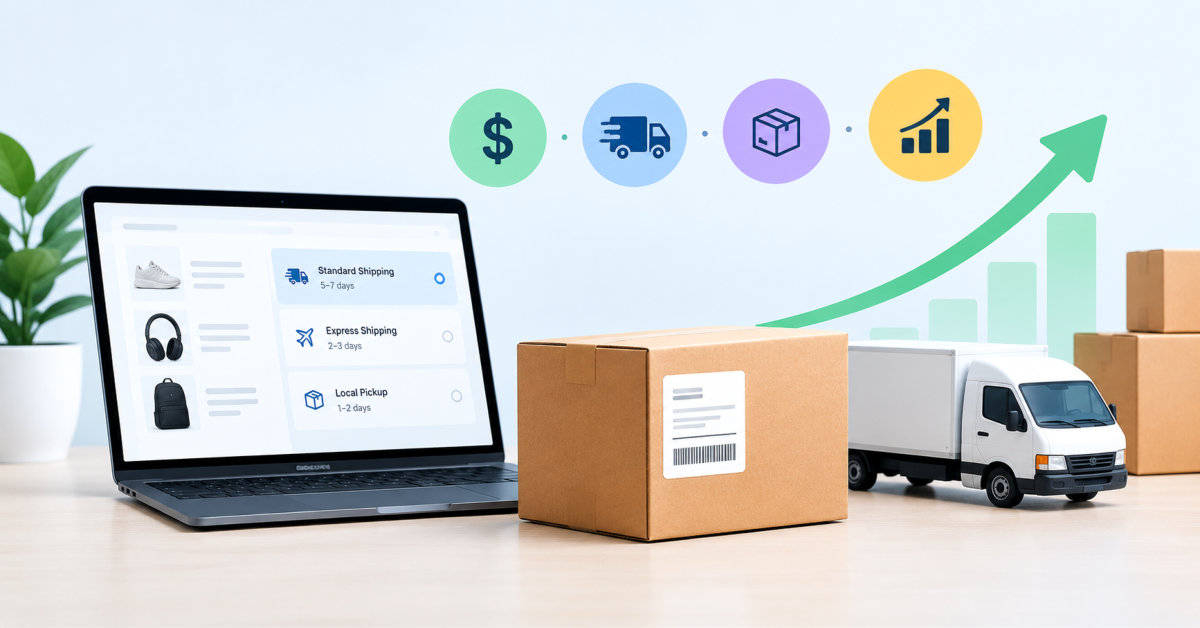
E-commerce merchants can protect profit margins without making delivery worse by auditing carrier invoices, reducing dimensional weight, matching service levels to customer needs, and measuring the full fulfillment cost of every order.
Shipping does not usually ruin a margin in one large, obvious expense. It erodes margin through small billing errors, oversized cartons, poorly matched service levels, and surcharges that recur on every order.
For e-commerce businesses, shipping is no longer just an operational expense. It can determine whether a sale produces a healthy profit or quietly eats into the margin. With parcel volumes growing and customers continuing to expect affordable, reliable delivery, merchants need to look beyond headline shipping rates and examine what they are actually paying per order.
The good news is that many shipping costs can be controlled without raising customer fees or sacrificing delivery quality. These six tactics can help e-commerce businesses protect their margins this year.
Shipping invoices contain far more information than the final amount due. Dimensional adjustments, incorrect service levels, duplicate charges, residential fees and other surcharges can gradually create significant leakage.
A regular parcel audit compares what was contracted and shipped with what the carrier actually billed. A Canada Post shipping audit, for example, can help a merchant identify discrepancies that are difficult to spot when hundreds or thousands of shipments are processed each month.
The key is consistency. An annual review may recover some money, but recurring audits can also reveal patterns that need to be fixed at the source.
A lightweight product does not necessarily mean a cheap parcel. Carriers may calculate shipping charges using dimensional weight when a package occupies more space than its actual weight would suggest.
This makes packaging design a financial decision. Measure products after they are packed, review box sizes across your product catalogue and eliminate excessive empty space where practical. A smaller carton can reduce both shipping charges and packaging-material costs.
Not every customer needs the fastest available delivery. Analyze orders by destination, product type and customer behavior to determine where standard, expedited and express services actually make sense. If customers regularly choose inexpensive delivery, there is little reason to absorb the cost of premium shipping simply to maintain an unnecessarily aggressive default. A tiered shipping strategy can preserve customer choice while protecting margins.
A carrier’s quoted rate tells only part of the story. The meaningful number is the total fulfillment cost attached to an order. Include packaging, labor, shipping, surcharges, returns and any customer-service costs associated with delivery problems. This can reveal that a product with an apparently strong gross margin is less profitable once fulfillment expenses are included.
Packaging should evolve alongside your product catalogue. If one item accounts for a large percentage of shipments, creating a box specifically suited to its dimensions can produce savings at scale. Consider package weight, cube, material costs and how efficiently cartons can be stacked. Even a small reduction per parcel becomes meaningful when multiplied across thousands of orders.
Do not bury shipping surcharges inside one broad transportation expense. Track fuel, residential, remote-area, additional-handling and dimensional charges separately.
This makes unusual increases much easier to identify. If one surcharge is repeatedly appearing on the same product or destination, the problem may be packaging, routing or service selection rather than the carrier’s basic rate.
E-commerce shipping profitability rarely comes from one dramatic change. It comes from controlling the small costs that repeat across every order. By auditing invoices, optimizing packaging, matching services to customer needs and measuring the true cost of fulfillment, merchants can turn shipping from a margin drain into a carefully managed competitive advantage.
An e-commerce business should audit shipping invoices every month, with weekly spot checks once parcel volume or carrier complexity makes small errors difficult to see. Monthly audits are frequent enough to identify duplicate charges, dimensional adjustments, service-level errors, and recurring surcharges before they become embedded in normal operating costs. Brands processing high volumes, using multiple carriers, or shipping across remote regions should automate exception reporting where possible. The point is not simply to request refunds. It is to identify the packaging, checkout, routing, or fulfillment rule creating the charge, then correct it before the same error is repeated across future orders.
Dimensional weight is a carrier billing method that charges for the space a package occupies when that space is greater than its actual weight would justify. It increases e-commerce shipping costs because a light product in an oversized carton can be billed as though it were much heavier. Merchants should measure packed products, compare actual weight with billed weight, and prioritize package redesigns for high-volume SKUs showing consistent dimensional adjustments. A smaller carton, fitted mailer, reduced void fill, or revised bundle configuration can lower billed weight while still protecting the product during transit.
Shopify stores should not offer free shipping on every order unless their contribution-margin model proves that the business can absorb the cost across its full order mix. Free shipping is most effective when it supports a clear objective, such as raising average order value, improving conversion on a high-margin product line, or staying competitive in a category where customers strongly expect it. Set thresholds using true fulfillment cost, not only the carrier label price. If low-value orders lose money after packaging, labor, returns, and surcharges, use a threshold, offer paid expedited delivery, or make smaller products add-ons to a more profitable basket.
The true shipping cost per e-commerce order equals the carrier charge plus surcharges, packaging, fulfillment labor, expected return costs, and delivery-related customer-support costs. This measure is more useful than a carrier rate because it shows the full contribution-margin effect of getting one order to a customer. Start by calculating a blended average for each product category or shipping method, then make the analysis more granular as volume grows. Reviewing this number by SKU, zone, order value, and promotion can reveal that certain products or free-shipping offers are less profitable than they appear in standard gross-margin reporting.
E-commerce merchants should track fuel, residential, remote-area, dimensional, additional-handling, address-correction, and delivery-area surcharges separately from the base transportation charge. Separating these fees makes recurring patterns visible and helps operators identify the operational cause behind higher shipping spend. Dimensional fees may point to poor packaging fit, address-correction fees may indicate checkout data-quality problems, and remote-area fees may require zone-specific shipping rules. Fuel surcharges may be unavoidable, but they should be monitored because they can make an old free-shipping threshold or flat-rate offer unprofitable as carrier pricing changes.




