

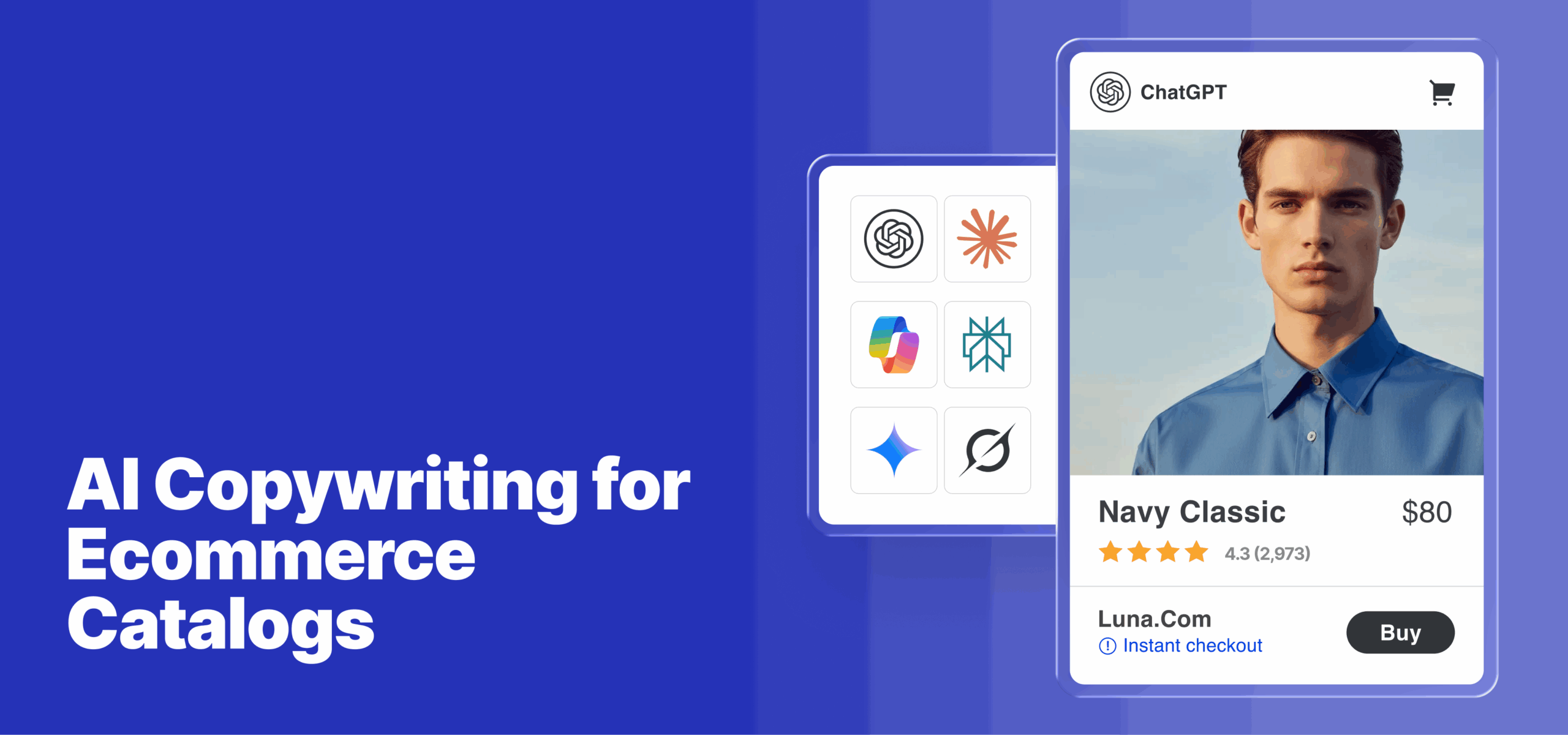
Managing a massive product catalog often feels like running on a treadmill that won’t stop. Every new season brings hundreds of SKUs requiring unique, accurate descriptions, which can turn content generation into an operational challenge.
Instead of relying solely on manual hours to solve the problem, many modern e-commerce managers are adopting a more streamlined approach. By leveraging AI writing assistants, teams can efficiently process complex supplier data into attribute-rich product copy at scale. This approach is not just about writing faster; it provides a framework to structure your catalog so modern AI engines can more easily understand, index, and recommend your products to shoppers.
Keeping massive product catalogs updated is a significant undertaking, and the methods for managing that data are evolving. Historically, teams spent countless hours manually rewriting supplier descriptions or HTML-formatting bullet points for search engines. Today, AI engines look beyond basic HTML; they tend to favor structured data and distinct problem-solution framing to deliver direct, confident answers to shoppers.
Despite the widespread availability of generative tools, there is often a gap in daily execution. Recent data shows that while 88% of organizations use AI in at least one business function, only 7% have achieved a fully scaled integration for their day-to-day operations. Many e-commerce teams are still figuring out how to transition AI from a brainstorming novelty into a reliable structural catalog management tool.
“The biggest hurdle brands face is moving past the pilot phase of AI and actually restructuring their workflows,” explains Eli Weiss, VP Retention Advocacy. “When you integrate these tools properly, your team can manage exponential catalog expansion without linearly scaling headcount.“
Updating hundreds of SKUs rapidly generally requires embracing a more systematic, machine-readable approach alongside traditional writing. Here are five actionable strategies to help streamline your catalog copywriting.
Modern LLMs prioritize factual density when parsing information. When a shopper asks an AI engine for “the best waterproof hiking boots for wide feet,” the engine scans the web for exact, structured attributes rather than parsing long paragraphs.
To adapt, consider breaking down your traditional descriptions into modular, “snippet-friendly” data blocks. Formatting specifications like material, fit, and care instructions cleanly and explicitly can be highly beneficial. With AI Overviews now appearing on 14% of all shopping-intent queries, creating descriptions with explicit, machine-readable answers can help your products surface more effectively.
Relying solely on generic feature lists may not always capture a buyer’s attention or satisfy an AI engine’s context requirements. Instead, e-commerce managers can guide their LLM tools to rewrite standard supplier descriptions into use-case-specific copy. Framing the product around the precise problem it solves for the customer adds valuable context.
For example, instead of merely listing “stainless steel construction,” you might prompt your AI to generate a copy that highlights how the product “keeps coffee hot during a 12-hour nursing shift.” When conversational assistants provide these highly specific, nuanced answers to user queries, it helps reduce friction and shorten the buying cycle by moving shoppers from discovery directly to purchase.
Manually exporting massive CSV files to make minor copy tweaks is becoming less common. Many major platforms now feature built-in conversational interfaces that allow merchants to execute bulk updates using natural language commands. You can instruct your platform assistant to “rewrite all winter jacket descriptions to highlight waterproofing” and review the changes immediately.
“Using conversational AI for backend catalog management completely changes the speed at which we operate,” notes Amit Bachbut, Director of Growth Marketing. “Natural language processing reduces technical debt and dramatically speeds up time-to-market for new collections.”
As discovery continues to incorporate conversational AI engines, it is helpful for your underlying catalog architecture to keep pace. Aligning copywriting and catalog metadata with emerging Universal Commerce Protocol (UCP) standards ensures that AI engines can smoothly read your descriptions and potentially facilitate transactions.
A helpful step is configuring your data feeds to be compliant with these protocols. By shifting some of your copywriting focus from purely descriptive titles to highly structured data attributes—like specific materials, sustainability metrics, and usage occasions—you empower AI agents to confidently recommend your products across conversational platforms.
The most effective AI-generated copy generally sounds like your best customers talking. To achieve this resonance at scale, you can use zero-party data to improve your AI outputs.
Consider feeding real customer questions, common support tickets, and review sentiment into your AI prompts. By doing so, the generated product descriptions will more naturally mirror the exact vocabulary and phrasing your buyers use. This strategy helps bridge the gap between high-volume operational efficiency and an authentic, relatable brand voice.
As consumer search behavior incorporates more conversational interfaces, optimizing product pages involves more than traditional search engine algorithms. The discipline is expanding from traditional Search Engine Optimization (SEO) to include Generative Engine Optimization (GEO).
Traditional SEO often prioritizes keyword density and backlink profiles. GEO, conversely, focuses heavily on factual density, attribute clarity, and source-worthiness. Because AI engines are designed to synthesize direct answers, it can be highly beneficial to structure your product descriptions as clear data repositories alongside your traditional sales pitches.
With the global artificial intelligence market having recently surpassed $244 billion, appearing as a verified, cited source within AI engine results is a notable advantage for growing brands. E-commerce managers should aim to format their catalogs in a way that large language models (LLMs) can parse with confidence.
“The goal is no longer just aiming for position one on a traditional search page,” explains Davis Belcher, Content Marketing Manager. “It is about becoming ‘source-worthy’ so that an AI engine trusts your catalog data enough to synthesize it directly into a shopper’s conversational summary.”
While AI writing assistants are incredibly efficient at structuring product specifications from supplier data, they lack personal experience. An AI engine cannot physically test your apparel, taste your beverage, or assemble your furniture.
This is where User-Generated Content (UGC) acts as both a standard marketing asset and a critical data source for your catalog. AI can draft the bulk of your product copy, but first-party human proof often helps close the sale. Shoppers who engage with reviews and user content convert 161% higher than those who do not interact with UGC.
Furthermore, LLMs continuously analyze customer reviews to understand the real-world application and current sentiment surrounding a product. If a shopper asks an AI assistant, “Do these running shoes run narrow?”, the engine frequently looks to aggregate review data rather than the manufacturer’s generated spec sheet. Integrating authentic customer voice helps ensure your catalog remains dynamic and relevant.
“There is a psychological barrier to ‘zero-click’ buying through automated assistants,” notes Mira Talisman, Growth CRO Team Lead. “Human validation remains the critical bridge. Your AI can rapidly build the most optimized, attribute-rich product description, but it is the authentic customer review sitting right beneath it that provides the trust necessary to finalize the purchase.“
Scaling high-volume copywriting through AI is effective, but execution can occasionally falter if an organization’s underlying infrastructure is not prepared for rapid data generation. Trying to rapidly adopt LLMs often highlights deep-rooted operational bottlenecks. In fact, research indicates that 70% of AI challenges stem from process issues, not technology, meaning the friction usually lies in how teams work rather than the software itself.
To close this implementation gap, e-commerce managers might reconsider how their teams operate. Instead of functioning solely as manual writers, brands can encourage their talent to act as “AI Editors” and prompt engineers. By establishing clear brand guidelines and deploying comprehensive system prompts, human editors can focus on quality assurance, strategic oversight, and voice consistency.
“Transitioning to AI-assisted catalog management requires managing the change securely and thoughtfully without alienating your core customer base,” says Amit Bachbut, Director of Growth Marketing. “When teams pivot to becoming ‘AI Editors,’ they ensure brand voice consistency while allowing the technology to handle the heavy lifting.“
Consider utilizing Yotpo Reviews to automatically feed your product pages with high-value, authentic customer sentiment. By leveraging AI-powered Smart Prompts, you are 4x more likely to capture specific, high-value topics from shoppers, helping to ensure your catalog is enriched with the fresh data that modern AI engines prioritize.
Furthermore, integrating Yotpo Loyalty allows you to reward customers for providing this essential content, helping to create a sustainable loop of fresh data and increased retention.
Managing a massive e-commerce catalog no longer requires relying entirely on manual copywriting. By selectively adopting AI writing tools, brands can help transform basic supplier data into the highly structured, attribute-rich content that modern discovery engines value.
The goal is to move beyond traditional optimization and incorporate factual completeness and verified relevance. Empowering your team to act as strategic editors, leveraging authentic customer feedback, and exploring Generative Engine Optimization can help ensure your products are continually discovered and trusted.
Instead of just counting keyword frequency, AI engines tend to look for factual density and explicit problem-solution framing. They pull structured data attributes to synthesize direct, conversational answers for the shopper.
GEO is the practice of structuring your product catalog and content so that it acts as a verified, highly factual source. The goal is to be cited directly in AI-driven conversational summaries rather than just ranking as a standard link on a search engine results page.
Yes, it is possible. By utilizing comprehensive system prompts, feeding the AI zero-party customer data, and training your team to act as “AI Editors” who review and refine the output, you can help maintain consistency at scale.
Structured data breaks down lengthy paragraphs into modular, easily digestible elements—such as material, fit, and use cases. This format makes it much easier for an LLM to accurately read, index, and recommend your products.
While AI writes the technical specifications, customer reviews provide authentic, real-world context. LLMs analyze these reviews to understand current buyer sentiment and use that data to answer highly specific shopper queries.
Using conversational backend assistants, merchants can execute bulk edits across hundreds of SKUs very rapidly. Natural language commands allow managers to alter entire collections in a fraction of the time it would take manually.
UCP provides a standardized framework that allows AI engines to smoothly interact with your catalog. By formatting copy and metadata to include specific attributes, you enable AI agents to securely understand and interact with your products.
You can guide your AI writing assistants by feeding them common customer support tickets, historical queries, and detailed supplier specifications. Incorporating the exact questions your customers ask helps ensure the generated copy is relevant.
Yes, if left unprompted, generative tools can produce repetitive copy. To avoid this, it is highly recommended to provide specific, use-case-driven prompts for different products to ensure each description maintains unique framing.
They allow e-commerce managers to bypass complex spreadsheets and manual technical interfaces. Users can type natural language commands to update product descriptions, add new specification tags, or rewrite content across an entire collection simultaneously.






