The brands that will scale through the next phase of ecommerce are not the ones with the biggest ad budgets. They are the ones that stopped renting audience and started building relationships.
The right time to build a B2B pipeline is before paid channels break, not after. Three measurable signals tell you the window is open: paid channels account for more than 60 to 70% of total revenue, CAC is rising faster than revenue growth quarter over quarter, and inventory turnover is slowing despite consistent ad spend. When all three appear together, not in isolation, a DTC to B2B sales pipeline is no longer a hedge. It is a structural necessity.
Average customer acquisition costs climbed 40 to 60% between 2023 and 2025, landing somewhere between $68 and $84 per customer depending on category. Every Meta algorithm shift, every iOS privacy update, every CPM spike hits the same nerve: a revenue model built on a single paid channel is structurally fragile. The brands surviving this environment are not just cutting ad spend. They are building a second engine that runs on relationships, data, and outreach instead of auction-based ad inventory.
The clearest indicators are specific and measurable. Vague feelings of “we should diversify” are not the signal. The signal is the combination of all three metrics moving in the wrong direction simultaneously. A brand with rising CAC but stable inventory turnover and diversified channels is in a different position than a brand where all three are deteriorating together. Know which situation you are in before you build anything.
One practical diagnostic: pull your channel revenue breakdown for the last four quarters. If paid social and paid search together exceed 60% of total revenue and the trend line is moving toward 70%, you are already past the point where diversification is optional. The question is not whether to build a B2B pipeline. The question is how fast you can build one that produces forecastable revenue before the next platform disruption hits.
B2B revenue is structurally superior to DTC revenue because between 70 and 90% of B2B customers place recurring orders on set cycles, which means once a wholesale account is live, it generates forecastable revenue that changes how you plan inventory, manage cash flow, and ultimately how your business is valued. DTC revenue fluctuates with algorithms. B2B revenue compounds with relationships.
According to the Grand View Research report on the global B2B e-commerce market, the market reached $22 trillion in 2024 and is projected to reach $57.5 trillion by 2030, growing at an 18.2% CAGR. DTC brands ignoring this channel are not just leaving revenue on the table. They are competing in a smaller pond by choice while a much larger market grows alongside them.
The valuation argument is worth making explicitly. A DTC business with 80% of revenue from paid channels trades at a discount to a business with diversified, recurring revenue streams. Wholesale accounts that reorder on predictable cycles are valued differently than one-time DTC transactions driven by ad spend. If you are building toward an exit, or simply toward a business that does not require constant reinvestment in ad spend to maintain revenue, B2B pipeline is not a nice-to-have. It is a structural component of the asset you are building.
For a deeper look at why the pendulum is swinging back toward wholesale and what the B2B infrastructure buildout actually requires, the why wholesale may be your highest-leverage growth move in 2026 episode breaks down exactly what operators are doing right now to capture this shift.
B2B sales does not require a dedicated sales team for most consumer goods and consumables categories, and the data on modern wholesale buyer behavior proves it. Today, 67% of B2B buyers prefer to research and purchase independently rather than engage a sales rep. In one documented consumer goods case, deploying a B2B self-service portal reduced the sales cycle by 67% and increased online lead generation by 145%.
The “rep-first” assumption is costing brands pipeline they could be building right now. The modern wholesale buyer behaves more like a DTC consumer than a traditional procurement officer. They want transparent pricing, instant quotes, and the ability to place orders without a phone call. If your brand still says “contact us for wholesale pricing,” you are creating friction where a competitor is offering instant conversion.
This does not mean sales relationships do not matter. It means the entry point into a wholesale relationship has changed. Buyers research independently, make a shortlist, and then engage. If you are not on the shortlist because your B2B ordering experience is broken or nonexistent, no amount of outbound sales effort will compensate. The infrastructure has to come before the outreach.
Enterprise categories and complex product lines may still require human-assisted selling at the close stage. But for the majority of Shopify brands in consumer goods, wellness, food and beverage, beauty, and home categories, a self-service portal plus structured outreach is sufficient to generate and convert wholesale leads without dedicated headcount.
The first-party data sitting in your Shopify backend is a wholesale demand map, and most brands are not reading it that way. Shipping addresses, geographic purchase concentrations, and repeat-buy frequency by product are not just retention tools. They are signals that tell you exactly where wholesale demand already exists in the market.
The workflow is straightforward. Export your DTC shipping data and identify your top-performing zip codes and metro areas. Identify business types operating in those zones that match your product category: wellness boutiques, specialty retailers, clinics, salons, food service operators. Build a targeted outreach list of buyers in those zones who are already surrounded by your end consumer. Lead with demand evidence in your outreach: “Your customers in [city] are already buying this. Here’s how we can make it easier for you to stock it.”
This approach requires no ad spend. It requires 30 minutes in your Shopify analytics backend and a structured cold outreach sequence. The signal already exists in your data. Most brands are simply not routing it through the right lens.
The geographic demand signal is particularly powerful for brands with strong regional concentrations. If 40% of your DTC orders ship to the Pacific Northwest and you have no wholesale accounts in that region, that is not a coincidence. That is a map telling you exactly where to start your wholesale outreach. The retailers in those markets are serving the same customer who is already buying from you direct.
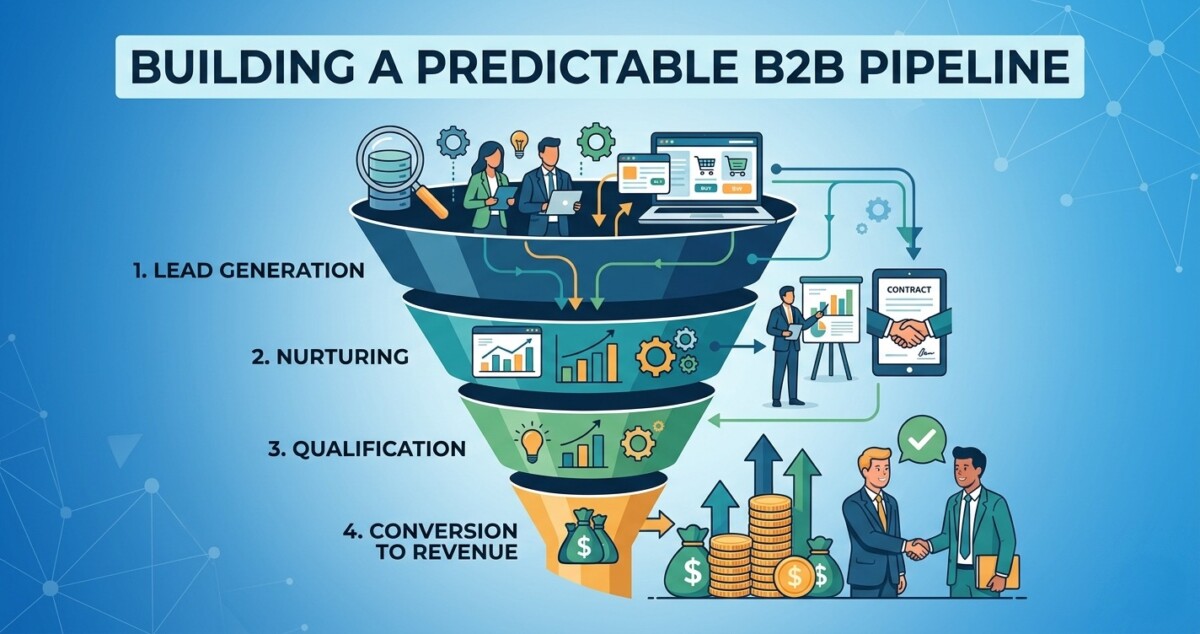
Building a predictable B2B sales pipeline as a DTC brand follows a six-step operational sequence. Each step builds on the previous one, and skipping steps creates the operational gaps that kill early wholesale relationships before they compound.
Step 1: Translate Your Consumer ICP Into a B2B Buyer Persona. Your DTC persona maps directly to a wholesale buyer persona. A “health-conscious woman, 28 to 40, urban” maps to “wellness boutique owner, 2 or more locations, metro area.” Make that translation explicit before outbound begins. Without it, your outreach will be generic and your targeting will be unfocused.
Step 2: Mine DTC Data for Regional Demand Signals. Use your shipping data to identify where demand already exists. These are your highest-probability wholesale markets and the foundation of any smart wholesale buyer outreach strategy.
Step 3: Build a Lightweight B2B Self-Service Portal. Before outreach goes out, make sure buyers can act when they land on your site. This means transparent wholesale pricing or tiered pricing behind a simple login, digital linesheets or catalogs, minimum order quantities clearly stated, and a mobile-optimized checkout for B2B orders. Shopify natively supports running how to run DTC and wholesale from a single Shopify store, which eliminates the need for a separate platform.
Step 4: Run Mission-Aligned Cold Outreach. Volume cold email does not work. Mission-aligned outbound does. Anchor line 1 to the buyer’s mission or customer base, not your product. Connect your product to their customer’s outcome in line 2. Make a frictionless ask in line 3: a brief conversation, not a commitment. Example structure: “You work with customers who care about [outcome]. We’ve built [product] specifically for that buyer. Happy to show you why [similar business type] in [city] have been stocking it, worth a quick call?”
Step 5: Use LinkedIn for Direct Wholesale Buyer Targeting. LinkedIn is the only channel where you can identify and reach wholesale buyers, procurement managers, and retail distributors by exact job title and company size without paying for ad inventory. Consistent thought leadership content paired with direct connection outreach opens conversations rather than pitching products. Passive content builds trust. Active outreach books retail buyer meetings.
Step 6: Protect Margin With Proper Pricing Architecture. Wholesale pricing tiers must be set so B2B accounts do not undercut your DTC margin or retail pricing. This is an operational prerequisite, not an afterthought. For a detailed breakdown of how to structure both sides of the business without creating channel conflict, see how to create a balanced strategy for both DTC and B2B customers.
Not every channel reaches wholesale buyers at the same speed or cost. The table below compares the five primary channels DTC brands use to build B2B pipeline, ranked from fastest time to first meeting to longest ramp.
The self-service portal is the only channel that generates inbound pipeline without active outreach effort once it is live. Cold email and LinkedIn outreach produce faster first conversations but require ongoing effort to maintain. Trade shows and dedicated sales reps produce the longest ramp and the highest cost, and are the least appropriate starting point for a brand building its first B2B pipeline.
Genuine consumer brand awareness reduces wholesale sales resistance before your first outreach email lands, and most B2B sales strategy guides for ecommerce brands miss this entirely. When retailers and distributors see that end consumers already recognize, search for, and repeat-purchase a brand, the risk calculation shifts in your favor.
In one documented case, a brand’s DTC momentum caused existing stockists to proactively raise their forecasts, and new retailers began making inbound inquiries without any active outbound sales effort from the brand. This is not luck. It is the compounding effect of organic brand building: community, reviews, and UGC working as a pipeline accelerant in the wholesale channel.
This is why the two channels are not in competition. Every piece of social proof you build with consumers reduces the persuasion work you need to do with wholesale buyers. A brand with 10,000 five-star reviews and strong organic search presence walks into a wholesale conversation with structural credibility that a brand launching directly into B2B without DTC history does not have. The DTC work you have already done is not separate from B2B pipeline strategy. It is the foundation of it.
For context on how channel strategy is shifting across the broader U.S. ecommerce market and what it means for brands running both DTC and wholesale simultaneously, how the U.S. ecommerce market is reshaping channel strategy in 2026 covers the macro picture in detail.
The affiliate-reseller model sits between DTC and traditional wholesale and creates a self-sustaining pipeline that requires no ongoing ad spend and no dedicated outbound sales team to maintain. It is one of the most underused structural pipeline models available to consumer brands, and it works particularly well in categories where end users engage professional intermediaries.
Consider a brand in the beauty or wellness space that pays professional resellers, skin therapists, fitness coaches, or nutritionists a commission when their clients purchase through the brand’s DTC site. The reseller earns without carrying inventory. The brand gains a B2B relationship and DTC revenue simultaneously. Neither party takes on the inventory risk that traditional wholesale requires.
The model requires product categories where the end user engages a professional intermediary as part of their purchasing decision. When the category fit is right, it creates a pipeline that compounds as the reseller network grows. Each new reseller brings their existing client base into contact with your brand without any incremental ad spend on your side. The B2B appointment setting and outbound pipeline services approach works alongside this model for brands that want to accelerate the reseller recruitment phase through structured outreach.
The operational requirement is a clean commission structure, clear terms on how reseller discounts interact with your DTC pricing, and a tracking mechanism that attributes sales accurately. Brands that skip the operational setup create the same channel conflict problems that poorly structured wholesale pricing creates. The model is powerful when it is set up correctly and fragile when it is not.
Building a predictable B2B sales pipeline as a DTC brand is not a pivot away from what is working. It is a structural stabilizer for everything you have already built. Your consumer data already tells you where wholesale demand lives. Your brand equity already reduces sales resistance with retail buyers. Your B2B sales strategy is already half-formed in the data you are sitting on. It just needs to be routed through the right outreach channels and backed by the right infrastructure.
The six-step framework in this article does not require a sales team, trade show budget, or a separate platform. It requires 30 minutes in your Shopify backend, a structured cold outreach sequence, a functional B2B ordering experience, and consistent LinkedIn presence. Those are operational investments, not capital investments. They compound over time in a way that paid ad spend does not.
A DTC to B2B sales pipeline is not a backup plan. It is the business model stabilizer that makes everything else sustainable. The brands that will scale through the next phase of ecommerce are not the ones with the biggest ad budgets. They are the ones that stopped renting audience and started building relationships.
Building a DTC to B2B sales pipeline takes 60 to 90 days of consistent effort across multiple channels before meaningful pipeline visibility appears. Mission-aligned cold outreach can generate first conversations within 2 to 4 weeks of launch. A B2B self-service portal begins compounding inbound inquiries over months once it is live and buyers can find it. LinkedIn outreach paired with consistent thought leadership content typically produces first wholesale meetings within 4 to 8 weeks. The full pipeline, with multiple channels running simultaneously and a growing roster of active wholesale accounts, takes 90 days to show clear patterns. Brands that expect results in two weeks from a single channel will be disappointed. Brands that run all channels in parallel from day one will have data within a month.
Wholesale pricing only hurts DTC margins if pricing architecture is set up incorrectly. Wholesale tiers must be structured to protect your DTC price floor and prevent channel conflict where wholesale buyers undercut your own store. When set up correctly, B2B accounts improve overall unit economics by reducing customer acquisition cost to near zero on recurring orders. A wholesale account that reorders every 60 days at 50% of retail with no ad spend attached generates better margin contribution per dollar of revenue than a DTC customer acquired through paid social at $70 to $80 CAC. The math works in favor of wholesale when the pricing architecture is right.
A dedicated B2B sales rep is not required for most consumer goods, wellness, food and beverage, beauty, and home categories. A self-service portal, structured cold outreach sequence, and LinkedIn-based pipeline building can generate and convert wholesale leads without dedicated sales headcount. The 67% of B2B buyers who prefer to research and purchase independently before engaging a rep means the infrastructure matters more than the rep at the entry stage. Enterprise categories, complex product lines, and accounts requiring negotiated contracts may still need human-assisted selling at the close stage. Start without a rep, build the infrastructure, and hire when the pipeline volume justifies it.
Finding wholesale buyers starts with your own DTC shipping data. Export your order history, identify your top-performing zip codes and metro areas, and then use LinkedIn to search for buyers by job title in those specific geographic markets. Search terms like “buyer,” “purchasing manager,” “retail buyer,” and “wholesale manager” combined with your product category and target city will surface the right contacts. Industry directories, trade publications, and platform-specific wholesale marketplaces like Faire are secondary sources once your primary outreach list is built. The geographic demand signal in your own data is always the highest-probability starting point because it tells you where your end consumer already exists.
The biggest mistake DTC brands make when building a B2B sales strategy is generating wholesale interest before the operational infrastructure is ready to support it. Running outreach before having bulk packaging, consistent inventory, a clear pricing structure, and a functional B2B ordering system in place produces pipeline you cannot fulfill. Failing to fulfill early wholesale inquiries damages the relationships you worked to build and creates a reputation problem in tight-knit retail buyer communities where word travels fast. Build the portal, set the pricing architecture, confirm inventory capacity, and prepare the operational documentation before the first outreach email goes out. The outreach is the easy part. The infrastructure is what determines whether early interest converts to long-term wholesale accounts.