





Quick Decision Framework
- Who This Is For: Shopify store owners and DTC operators doing $0 to $5M/year who are spending on paid ads but haven’t yet built a system to capture, nurture, and convert visitors through owned channels.
- Skip If: You already have a multi-step welcome flow running, email and SMS capture on every key page, and a referral program live. This guide covers the foundation, not advanced optimization.
- Key Benefit: A clear framework for reducing your customer acquisition cost by shifting budget from paid channels toward owned ones, with specific benchmarks and tools at every stage.
- What You’ll Need: Access to your Shopify admin, an email and SMS platform (Omnisend works for this entire guide), and your current CAC number or marketing spend data.
- Time to Complete: 12 minutes to read. 2 to 4 hours to implement the first two strategies.
The brands winning on customer acquisition in 2026 aren’t spending more on ads. They’re building systems that turn one ad click into a subscriber, and one subscriber into a buyer, without paying for the same person twice.
What You’ll Learn
- Why ecommerce customer acquisition costs have climbed 40% in two years and what that means for your channel strategy right now.
- How to calculate your CAC by channel, not just overall, so you know exactly where to invest and where to cut.
- Which seven acquisition strategies are producing the most consistent results for Shopify brands in 2026, from email capture to TikTok Shop to AI search.
- What a welcome email and SMS sequence should look like at each stage, including timing, messaging, and conversion benchmarks.
- How to use quizzes and referral programs to bring in buyers who cost less to acquire and spend more over time.
Ecommerce customer acquisition has gotten measurably harder. The average CAC for DTC brands now sits between $68 and $84, up roughly 40% from just two years ago. Google Shopping CPCs jumped 33.72% in 2025 alone. Overall ROAS across paid channels declined 10% in the same period. Every dollar you spend acquiring a customer today buys you less than it did in 2024, and the trajectory isn’t reversing.
The brands I’ve watched navigate this well aren’t the ones with the biggest ad budgets. They’re the ones who stopped treating paid ads as their primary acquisition channel and started building systems around it. Email and SMS capture. Welcome automation. Referral programs. Content that shows up in Google and in ChatGPT. These aren’t backup channels. In 2026, they’re the engine, and paid ads are the spark plug.
In this guide, you’ll find seven acquisition strategies that are working right now for Shopify brands at different stages, from just starting out to scaling past seven figures. Each one comes with specific tools, real benchmarks, and a clear sense of who it’s actually for.
Turn visitors into loyal customers with Omnisend‘s multichannel email and SMS workflows. Quick sign up. No credit card required.
What Is Ecommerce Customer Acquisition?
Ecommerce customer acquisition is the process of attracting and converting people who have never bought from your store into first-time buyers. The moment a customer completes that first purchase, acquisition ends. Everything that follows, repeat purchases, loyalty campaigns, subscription renewals, belongs to retention.
That distinction matters because the economics are completely different. Acquiring a new customer costs five to seven times more than retaining an existing one, which is why your LTV:CAC ratio is a more useful number than CAC alone. A healthy ratio sits at 3:1, meaning you earn $3 in lifetime value for every $1 you spend to acquire the customer. If your ratio is below 2:1, your acquisition spend is outpacing the value you’re getting back, and no amount of channel optimization will fix a fundamentally broken unit economics problem.
The most effective acquisition strategies in 2026 combine paid and owned channels. Paid channels like Meta and Google drive discovery. Owned channels like email and SMS convert that discovery into a first purchase at a fraction of the ongoing cost. Neither works as well alone as they do together.
Customer Acquisition Cost (CAC): What It Is and How to Track It
Your CAC tells you how much you’re paying to bring in each new customer. The formula is straightforward: divide your total marketing spend by the number of new customers acquired in the same period. If you spent $5,000 and gained 100 new customers, your CAC is $50. But the number that matters most isn’t your overall CAC. It’s your CAC by channel.
Here’s why that distinction is worth your attention. Referral programs typically produce the lowest CAC of any channel, often in the $40 to $65 range for DTC brands. Paid social sits dramatically higher, with Facebook averaging around $230 per new customer acquired. Organic search compounds over time and eventually produces some of the best CAC numbers you’ll see, but it requires 12 to 18 months of consistent investment before the returns become predictable. When you track CAC by channel, you can see exactly which channels are working, which ones are bleeding budget, and where to shift resources to improve your overall acquisition efficiency.
To put a number on whether your CAC is healthy, compare it against your LTV. A 3:1 LTV:CAC ratio is the standard benchmark. Food and beverage brands often achieve 4.5:1. Fashion and apparel typically runs closer to 2.5:1 because of higher return rates and lower repeat purchase frequency. Knowing your category benchmark helps you set realistic targets rather than chasing an arbitrary number.
Here are the tools you can use to track CAC across your acquisition channels:
One note on attribution: no single tool gives you a perfect picture. The most useful approach is to layer free native analytics with one paid attribution tool once you’re running more than two paid channels simultaneously. Below that threshold, GA4 plus your ad platform dashboards will tell you most of what you need to know.
7 Ecommerce Customer Acquisition Strategies That Work in 2026
These seven strategies are sequenced intentionally. Start with the first two before you invest heavily in any of the others. The email and SMS foundation they build will make every other channel more profitable.
- Turn site visitors into subscribers before they leave
- Convert subscribers into first-time buyers with a welcome automation
- Make paid social spend work harder with email capture
- Turn TikTok Shop into a first-purchase engine
- Get found in search and in AI answers
- Build a referral program that turns buyers into recruiters
- Use quizzes to segment and convert from the first interaction
1. Turn Site Visitors Into Subscribers Before They Leave
Most visitors won’t buy on their first visit. That’s not a problem if you capture their contact information before they leave. If they leave without sharing an email or phone number, you’ve paid to bring them to your store and received nothing in return. Email and SMS capture is the foundation of every other strategy in this guide because it’s the one that makes everything else cheaper.
The format of your popup matters more than most store owners realize. Omnisend’s popup performance data shows that multi-step welcome popups convert at 2.3%, compared to 2.0% for single-step forms. Gamified popups like Wheel of Fortune reach 3.5%. Exit-intent popups on product and cart pages convert at 1.8% when used strategically. Page-targeted popups, shown only on specific product or collection pages, convert at 2.4% versus 2.0% for sitewide displays.
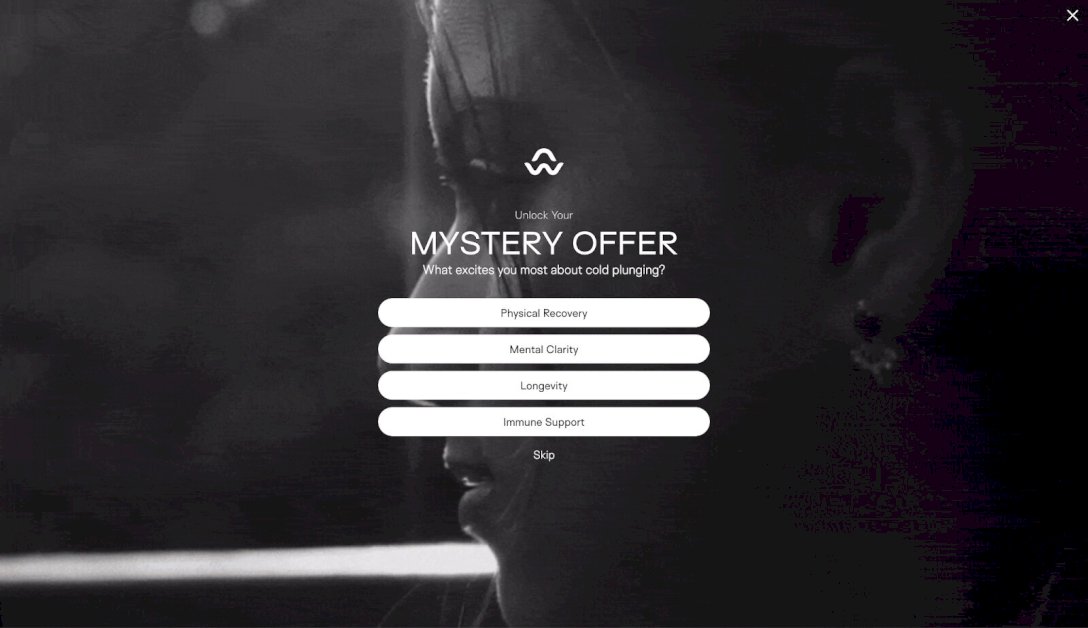
The multi-step popup works because it asks a preference question first rather than leading with the email request. “What are you shopping for?” or “What’s your skin type?” gives the visitor a reason to engage before you ask for anything. By the time the email field appears, they’ve already invested in the interaction. Nordic Wave uses this format effectively, asking a simple product preference question before revealing the signup incentive.
Exit-intent popups serve a different purpose. They’re your last chance to capture someone who has already decided to leave. Use them on product and cart pages specifically, not sitewide, and pair them with a concrete offer rather than a generic “stay in touch” message. The specificity of the offer is what drives the conversion.
One setup detail worth implementing early: enable revenue attribution in your email platform. Omnisend includes this natively. It lets you see exactly how much revenue each popup generates over time, which tells you which formats and offers are actually driving purchases rather than just growing your list with people who never buy.
2. Convert Subscribers Into First-Time Buyers With a Welcome Email Automation
Capturing the signup is the first step. Converting that subscriber into a paying customer is where the real acquisition work happens. Without a structured welcome sequence, your popup investment produces a list that doesn’t buy. With one, it becomes your highest-converting automated channel.
The numbers make the case clearly. According to Omnisend’s 2026 Ecommerce Marketing Report, automated welcome messages had a 37.49% open rate and a 2.91% conversion rate in 2025. Every automated email generated $2.87 per send, compared to $0.18 for standard broadcast campaigns. Automated SMS drove 18% of all orders despite being only 9% of total sends. These aren’t theoretical gains. They’re what happens when you deliver the right message at the right moment in the relationship.
A three-email welcome sequence with an optional SMS touchpoint covers the full conversion arc. Email 1 goes out immediately after signup. Deliver the promised incentive, introduce the brand, and set expectations for what’s coming. Keep this email focused on the subscriber, not on your product catalog. To’ak Chocolate does this well, opening with the story behind their chocolate rather than a product grid. Rachel Riley’s founder takes a similar approach, sending a personal thank-you that tells subscribers exactly what to expect next. Welcome emails sent immediately typically see 50 to 60% open rates, the highest of any email in your entire marketing stack.
Email 2 goes out on day two or three. This is where you build trust rather than push for the sale. Share your brand story, highlight your bestsellers, and back everything up with social proof. Customer reviews and user-generated content work particularly well here because they let existing customers do the persuading. To’ak Chocolate’s second email introduces the founders and their sourcing story in Ecuador, turning a product into a relationship.
Email 3 goes out on day five to seven. Create urgency by reminding subscribers that their welcome offer expires soon, and consider adding a secondary incentive to push hesitant buyers over the line. Something like “Your 15% discount expires tonight. Shop now and we’ll add a complimentary sample to your order” gives subscribers two reasons to act rather than one.
The SMS layer is optional but worth adding once your email sequence is running. A single SMS on day six, timed to catch subscribers who missed your emails, consistently adds incremental conversions without additional creative investment. Keep the message short and direct: “Your discount code expires tonight. Use it here: [link].” That’s it. The simplicity is the point.
3. Make Paid Social Spend Work Harder With Email Capture
Meta and Google function more as discovery channels than direct sales drivers in 2026. A prospect who clicks your ad is interested. They’re not necessarily ready to buy. If your entire paid strategy is optimized for immediate purchase conversion, you’re writing off the majority of your ad spend every single day.
The shift that changes this is pairing every paid campaign with an on-site email and SMS capture mechanism. When a visitor clicks your ad and lands on your store, your popup is their second touchpoint. If they subscribe before leaving, you haven’t lost the ad spend. You’ve converted a $3 click into a subscriber you can reach for months at near-zero marginal cost. Your welcome sequence then does the conversion work that the ad couldn’t.
Traffic-based popup targeting makes this even more precise. Omnisend lets you show different signup forms to visitors arriving from different traffic sources. Visitors coming from your paid campaigns see an offer specific to the ad they clicked. Organic visitors see your standard welcome incentive. This relevance improvement directly increases signup rates, and higher signup rates lower the effective CAC of every paid campaign you run.
The practical implication is this: stop measuring your paid campaigns purely on return on ad spend from direct purchases. Add email subscriber acquisition to your success metrics. A campaign that produces a 1.5x ROAS on direct sales but adds 400 email subscribers who convert at 3% over the following 30 days has a total return that looks completely different when you account for the downstream revenue.
4. Turn TikTok Shop Into a First-Purchase Engine
TikTok Shop removes friction from the purchase decision by letting users buy without leaving the app. For the right product categories, this dramatically shortens the path from discovery to conversion. Beauty, wellness, accessories, home goods, and food products perform well here because they’re demonstrable in under 15 seconds and carry enough impulse appeal to drive in-app purchases.
Before committing resources to TikTok Shop, assess product fit honestly. If your product requires detailed explanation, comparison shopping, or customization, use TikTok for brand awareness and direct traffic back to your Shopify store rather than trying to close the sale in-app. The channel works best when the product sells itself on camera in the first few seconds.
The loss-leader approach is worth understanding at any stage. List a hero product at break-even margin on TikTok Shop. Your paid CAC on Meta might be $45 for a similar customer. If you acquire that same customer through TikTok Shop at $0 in ad spend, the economics shift significantly even if the first sale doesn’t generate profit. Once the order syncs with Shopify via the TikTok Shop integration, the buyer is in your email list. Your post purchase email sequence then drives repeat purchases at full margin, and the first sale’s thin margin becomes irrelevant in the context of the full customer relationship.
The creator affiliate model is worth considering before you build an in-house content operation. TikTok’s affiliate marketplace lets you set a commission rate and let creators produce content promoting your product. You pay only when a sale completes. For stores without an influencer budget, this is performance-based UGC content that also generates assets you can repurpose in ads, emails, and product pages. The creative output compounds in value well beyond the initial sale.
5. Get Found in Search and in AI Answers
Organic search remains one of the most cost-efficient acquisition channels available to ecommerce brands because your costs stay relatively flat while your traffic compounds. A product page that ranks for “men’s merino wool sweaters” keeps generating traffic without requiring ongoing ad spend. That’s the structural advantage paid channels can never replicate.
In 2026, “organic search” means two distinct surfaces: traditional Google results and AI-generated answers from tools like ChatGPT, Perplexity, and Gemini. Both matter for product discovery, and they require different content approaches.
For traditional search, the priority is commercial intent pages. Optimize your product and collection pages for specific, high-intent queries. “Men’s merino wool sweaters” converts faster than “wool sweaters” because the shopper already knows what they want. Clean product titles, detailed descriptions, strong review content, and fast page load times are the fundamentals. Get these right before investing in blog content.
For AI search visibility, the content that gets cited is different from what ranks in Google. AI tools like ChatGPT pull answers from customer reviews, Reddit discussions, and trusted editorial content. If your brand has no presence in those sources, you’re invisible in AI-generated product recommendations. OpenAI’s Instant Checkout feature, introduced in late 2025, now lets users buy from Shopify stores directly inside ChatGPT. Brands with clean catalog data, strong review volume, and editorial coverage are the ones appearing in those results. Investing in review generation through tools like Judge.me and building informational content that earns editorial citations are the two highest-leverage moves for AI search visibility right now.
Informational content serves both surfaces. A guide like “how to choose a standing desk” captures research-phase buyers in Google and gets cited by AI tools answering the same question. Pair these guides with email capture popups and your content investment feeds directly into your welcome sequence, turning organic traffic into subscribers and subscribers into buyers.
6. Build a Referral Program That Turns Buyers Into Recruiters
Referral programs produce the lowest CAC of any acquisition channel in ecommerce, typically $40 to $65 per new customer for DTC brands. You’re not paying for clicks or impressions. You’re paying a reward only when a new customer actually converts. The economics are inherently efficient because the cost is tied directly to the outcome.
The quality of referred customers is also consistently higher than customers acquired through paid channels. Someone who comes to your store because a friend recommended it arrives with a level of trust that no ad can manufacture. That trust translates to higher conversion rates on the first visit, lower return rates, and measurably better lifetime value. Customers acquired through referrals typically show 20 to 40% lower CAC and higher LTV than paid channel equivalents.
Timing is the most underrated element of referral program success. The moment immediately after a positive purchase experience is when customers are most likely to share. Send your referral email right after the delivery confirmation or immediately following a positive review submission. Crocs does this well, sending a referral ask at the exact moment customer satisfaction peaks rather than burying it in a loyalty program tab that nobody visits.
The offer needs to be specific and time-bound to work. “Give $10, get $10” with a 14-day expiration outperforms “earn rewards” with no deadline every time. SEE Eyewear’s referral emails work because the offer is prominent, the CTA is singular, and there’s no ambiguity about what the customer is supposed to do next.
For the technical setup, Smile.io and ReferralCandy both handle link generation and reward tracking reliably. Connect whichever you choose to your Omnisend flows so the referral message goes out automatically after the Shopify delivery confirmation fires. Manual referral campaigns sent weeks after purchase perform a fraction as well as automated ones sent at the right moment.
7. Use Product Quizzes to Segment and Convert From the First Interaction
Quizzes change the acquisition dynamic by reversing the usual sequence. Instead of asking for an email address and then trying to figure out what the customer wants, you learn what they want first and then ask for their email to deliver a personalized result. The difference in purchase intent between these two approaches is significant.
A visitor who enters their email to get 10% off has low commitment to buying. A visitor who completes a five-question skincare quiz and submits their email to see their personalized routine has already invested in the interaction and is actively looking for a product recommendation. That’s a fundamentally different subscriber, and your welcome sequence can treat them differently from the first email.
The data advantage extends beyond the immediate conversion. Quiz responses give you zero-party data, information customers choose to share with you directly. Unlike behavioral data inferred from browsing, this data is accurate and remains useful as privacy regulations continue to tighten. A customer who tells you they’re shopping for a gift should receive a completely different welcome email than a customer shopping for themselves. You don’t need to wait for purchase history to build that segmentation. You have it from the first interaction.
Keep your quiz short. Three to five questions is the right range. More than that and completion rates drop sharply. Each question should collect information that directly informs your product recommendation, not generic demographic data. The email capture screen should make a specific promise: “Get your personalized skincare routine” rather than “Sign up for our newsletter.” The results page should show specific product recommendations, not a generic bestseller list.
Syos, a saxophone mouthpiece brand, places their quiz only on product pages, which means it appears exclusively when a shopper is already in buying mode. Visitors answer preference questions about their instrument and playing style, then submit their email to see their matched mouthpiece. The specificity of the quiz makes the email capture feel like a service rather than a marketing tactic, and the resulting subscribers convert at rates well above their standard popup.
With Omnisend, quiz responses sync automatically to contact profiles and can trigger different welcome sequences based on the answers given. The setup takes a few hours. The segmentation it creates runs automatically from that point forward, making every subsequent email more relevant without any additional manual effort.
Frequently Asked Questions
What are the most effective ecommerce customer acquisition strategies in 2026?
The most effective strategies combine owned and earned channels rather than relying on paid advertising alone. Email and SMS capture with a structured welcome sequence is the foundation because it converts existing traffic into subscribers and subscribers into buyers at a fraction of the cost of acquiring new paid traffic. Layered on top of that, referral programs, SEO, AI search visibility, TikTok Shop, and product quizzes each add acquisition volume at lower CAC than paid social or search. The brands seeing the best results aren’t using more channels. They’re using fewer channels more completely, with proper automation and attribution in place before expanding.
What is a good customer acquisition cost for an ecommerce brand?
The right CAC depends on your product category, average order value, and customer lifetime value. The standard benchmark is an LTV:CAC ratio of 3:1, meaning you earn $3 in lifetime value for every $1 spent acquiring a customer. For DTC brands, average CAC currently sits between $68 and $84, up roughly 40% from two years ago. Food and beverage brands typically achieve a 4.5:1 ratio. Fashion and apparel runs closer to 2.5:1. Track your CAC by channel rather than overall, because the gap between your best and worst performing channels is often 5x or more, and knowing that gap tells you exactly where to reallocate budget.
How do I lower my ecommerce customer acquisition cost without cutting ad spend?
The most reliable way to lower effective CAC without reducing ad spend is to increase what you extract from each visitor your ads bring to your site. This means capturing email and SMS subscribers from paid traffic before they leave, running a welcome sequence that converts those subscribers into buyers, and measuring the downstream revenue those subscribers generate alongside your direct ROAS. Brands that implement this approach often find their effective CAC drops 20 to 35% within 60 days without changing their ad budget at all. The ad spend stays the same. The conversion infrastructure around it gets better.
What is the cheapest way to acquire ecommerce customers?
Referral programs and organic search consistently produce the lowest CAC of any acquisition channel. Referral programs typically cost $40 to $65 per new customer acquired for DTC brands, and those customers arrive with higher trust and better lifetime value than paid channel equivalents. Organic search requires upfront content investment but compounds over time, eventually producing traffic at near-zero marginal cost. The practical answer for most stores is to build the referral program and email capture infrastructure first, which produces immediate results, and invest in SEO content in parallel for the compounding returns that show up 12 to 18 months later.
How does AI search affect ecommerce customer acquisition in 2026?
AI tools like ChatGPT, Perplexity, and Gemini are now active discovery surfaces for product research. Shoppers ask these tools which products to buy, which brands are worth considering, and how to choose between options. The brands that appear in those answers are the ones with strong review volume, editorial coverage, and clean product catalog data. OpenAI’s Instant Checkout feature, introduced in late 2025, takes this further by allowing purchases from Shopify stores directly inside ChatGPT. Brands optimizing for AI search visibility now, through review generation, informational content, and catalog data quality, are building an acquisition advantage that will compound as AI-assisted shopping continues to grow.
