

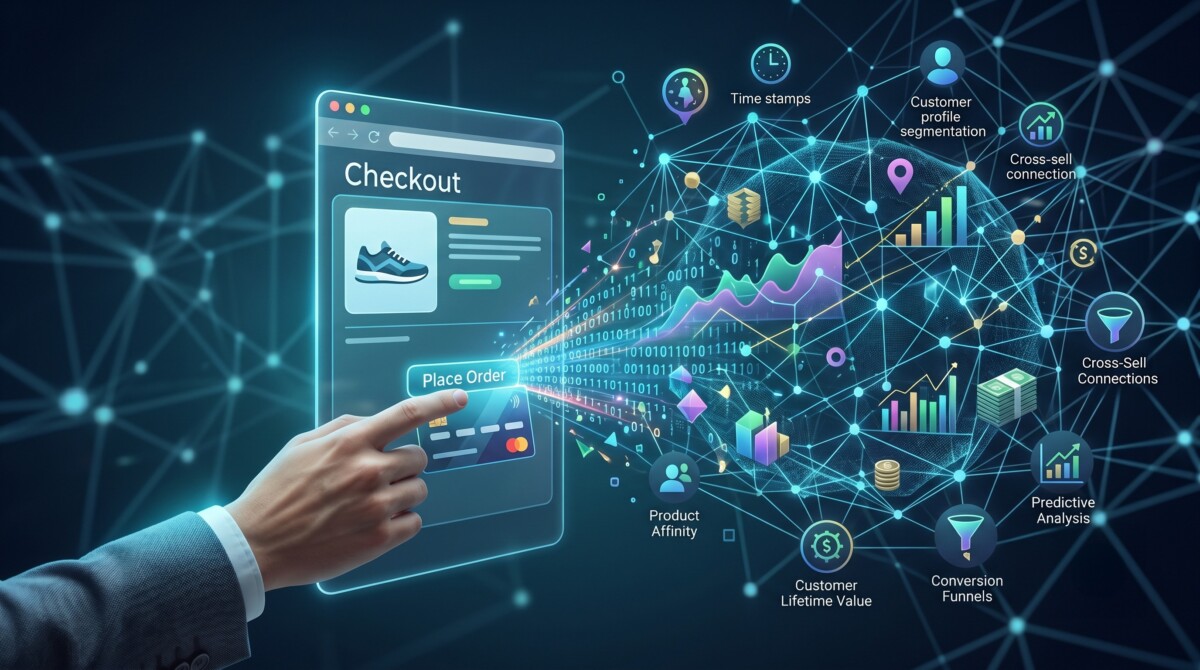
The best ecommerce brands treat every purchase as data because each order reveals customer patterns, informs smarter offers, and compounds retention and lifetime value. Brands that treat purchases as isolated transactions give that advantage away to competitors.
The ecommerce brands that win long term are the ones that let every order make the next one smarter, not just richer.
Two brands. Same product category. Similar traffic. Similar ad spend.
Twelve months later, one has compounding revenue, a growing base of repeat buyers, and a customer lifetime value that makes acquisition costs look like a bargain. The other is running harder just to stay in place — replacing churned customers, discounting to win back lapsed ones, watching margins go the wrong direction.
The difference usually isn’t the product. It isn’t the marketing. It’s what each brand does with a purchase after it happens.
One treats every order as a signal. The other treats it as a transaction. Over time, that gap compounds into something very hard to close.
Most ecommerce businesses are built around getting the sale. Product pages, checkout flows, abandoned cart sequences — all of it optimized for the moment someone enters their card number and clicks buy.
What happens after is usually an afterthought. A confirmation email. A shipping notification. Then silence, until the next campaign goes out.
But a completed order is one of the richest signals a brand can get. It tells you what the customer wanted, when they wanted it, how much they were willing to pay — and if you have their history, how this order fits into a longer pattern. Most brands collect that signal and do nothing with it.
The signals that matter aren’t complicated. They’re already sitting in your store.
What someone bought tells you the problem they were solving. When they bought tells you their rhythm — seasonal, impulsive, or on a predictable replenishment cycle. How often they come back tells you whether you’re a habit or an occasional option. What they browsed but didn’t buy tells you what they’re still thinking about.
Stack those signals and you stop guessing what a customer wants next — you can see it. McKinsey research has consistently put the revenue impact of real personalization — the kind that responds to behavior, not just populates a first name — at 10 to 15 percent. Not from running complex models. From using the data that was already there.
The standard playbook — 20% off, whole list, Tuesday send — still moves product well enough to feel like it’s working. But it’s also training your customers to wait for a discount before they buy.
Behavior-based promotions work differently. Instead of broadcasting the same offer, you’re responding to what each customer is actually doing.
Someone who bought for the first time three weeks ago gets a follow-up tied to that purchase — a tip, a complementary product, something that makes sense given what they just bought. A customer who’s been buying for two years gets an offer that acknowledges the relationship instead of pretending you’ve never met.
Open rates go up. Conversion goes up. And because you’re not conditioning your whole list to hold out for a sale, margin holds too. The mechanic is simple — the discipline is doing it consistently.
Product recommendations are one of the most common and least well-executed features in ecommerce.
“Customers also bought” is popularity with an alias. The person who just spent $280 on a leather wallet does not need to see the $12 keychain that gets tacked onto every order in that category. That’s not helpful — it’s noise.
The difference between a recommendation that feels useful and one that feels random is context. What has this customer bought before? What have they looked at? What price points do they buy at? What adjacent problem might they have that they haven’t solved yet?
With that context, recommendations stop being upsells and start being service. The customer who buys skincare on a 45-day cycle should see a replenishment prompt before they run out, not three weeks after. The customer who’s browsed a second category a dozen times without buying is signaling something. The question is whether anyone’s listening.
In most stores, someone who’s bought fifteen times over three years gets the same homepage, the same email, the same experience as someone who found the brand last week.
That’s a problem on two fronts. Your most loyal customers are also the most attractive acquisition targets for competitors — they’ve proven they spend in this category. And there’s revenue locked in those relationships that never gets unlocked because the brand never gave those customers a reason to go deeper.
Most loyalty programs don’t fix this. They just add a points wrapper to a discount program. Earn points, redeem for money off, repeat — which trains your best customers to expect lower prices and erodes the margin on the relationship you were trying to protect.
What actually works is making the relationship feel like one. Early access before a product goes wide. A message that references how long they’ve been around. A benefit — free shipping, priority support, something exclusive — that isn’t available to the whole list. The signal is simple: we know you’ve been here, and it means something.
The compounding effect is real. Research on customer lifetime value consistently shows that a five-point improvement in retention can lift profitability by 25 to 95 percent depending on category. The brands treating their best customers accordingly are the ones seeing those numbers.
None of this needs a full infrastructure rebuild before anything can move.
The most useful first question is whether the data you’re already collecting is connected to anything that changes what customers see. Most stores are sitting on far more behavioral data than they’re using. Browse history, purchase frequency, category affinity — it’s there. It’s just not wired to anything.
From there, find the biggest gap between what you know about a customer and what you’re showing them. That’s where the highest-leverage work almost always is.
For brands that have hit the ceiling of what their current stack does out of the box, the next step is usually building the connective layer — the part that makes behavioral data usable across the full experience. That’s the kind of work that sits under custom ecommerce development: getting your systems to actually share information instead of holding it in silos.
A brand that treats every purchase as data gets smarter with every order. Recommendations improve. Promotions get more relevant. Retention goes up. Acquisition costs drop because the customers it keeps are worth more and stay longer.
A brand that treats every purchase as a transaction starts over every time a customer comes back. The second visit looks like the first. The tenth looks like the second. No learning, no advantage, no gap closing.
That divergence doesn’t look dramatic in month one. In year two, it’s the whole story.
The best time to start was last year. The second best time is before your competitor does.
No. A few thousand orders is enough to start segmenting by purchase frequency, category, and recency. The sophistication scales with volume — but the value of starting with what you have is immediate.
First-name subject lines are table stakes — and customers know it. Real personalization means the content, timing, offer, and recommendations are shaped by what this specific customer has actually done. Not who they said they were when they signed up.
Sending discounts to customers who would have bought anyway is what hurts you. Behavior-based promotions let you target incentives at the people who actually need one, and reward loyal customers with things that aren’t just price reductions — access, exclusivity, recognition. The goal is to stop training your whole list to wait for a sale.
Check whether your email platform knows what a customer bought yesterday. If it doesn’t, that’s your starting point. Once the data is connected, the gaps in your current experience become obvious fast.
Behavioral email flows and post-purchase sequences can show measurable lift within 30 to 60 days. Repeat purchase rate and lifetime value take three to six months to move meaningfully — but that’s still this year.
Author Name: Anginé Pramzian
Bio: Founder, CEO & Creative Director, Concept Studio (est. 2012). Anginé founded Concept Studio in 2012 and has spent the years since working with brands that take their digital presence seriously. She oversees everything from brand strategy to ecommerce development — the kind of work that only makes sense when the creative and technical sides are in the same room.
Connect on LinkedIn: https://www.linkedin.com/in/pramzian/
You do not need a large customer base to make behavior driven personalization worth doing. A few thousand orders is enough to start segmenting by purchase frequency, category, and recency. The sophistication of what you build scales with volume, but the value of starting with what you have is immediate.
The difference between real personalization and just using someone’s first name is whether the experience responds to what a customer has actually done. First name subject lines are table stakes and customers know it. Real personalization means the content, timing, offers, and recommendations are shaped by their behavior, not just by the details they entered when they signed up.
Sending fewer blanket discounts will not hurt conversion if you target incentives at the customers who actually need them. Sending discounts to customers who would have bought anyway is what damages margin. Behavior based promotions let you focus incentives on people who need a nudge and reward loyal customers with things that are not just price reductions, such as access, exclusivity, or recognition.
You can tell whether your current tools can support this by checking whether your email platform knows what a customer bought yesterday. If it cannot see recent purchases at the customer level, that is your starting point. Once the data is connected, the gaps in your current experience become obvious quickly and you can see where behavior should be driving change.
Behavioral email flows and post purchase sequences can show measurable lift within 30 to 60 days. Repeat purchase rate and lifetime value usually take three to six months to move meaningfully, but that is still within this year. The earlier you start, the sooner the compounding effect begins.
Author Name: Anginé Pramzian
Bio: Founder, CEO and Creative Director, Concept Studio, established in 2012. Anginé founded Concept Studio in 2012 and has spent the years since working with brands that take their digital presence seriously. She oversees everything from brand strategy to ecommerce development, the kind of work that only makes sense when the creative and technical sides are in the same room.
Connect on LinkedIn: https://www.linkedin.com/in/pramzian/





